
A performance improvement plan, or PIP, gives an employee a clear opportunity to address specific performance problems before they become more serious.
A good PIP does more than document what is going wrong. It explains what needs to change, how improvement will be measured, what support the manager will provide, and when progress will be reviewed.
When used well, a performance improvement plan can turn an unclear performance problem into a structured path forward. When used poorly, it can create confusion, mistrust, and unnecessary risk.
Here is how to build and use one fairly and effectively.
Key Takeaways
- A performance improvement plan should focus on specific, observable performance gaps, not personality traits.
- Every PIP should include measurable expectations, deadlines, support, check-ins, and clear success criteria.
- Managers should investigate the reason behind poor performance before deciding that a PIP is the right solution.
- A PIP should provide a genuine opportunity to improve rather than simply document a decision that has already been made.
- Consistent follow-up matters just as much as the written plan itself.
What Is a Performance Improvement Plan (PIP)?
A performance improvement plan (PIP) is a structured, time-bound plan used to help an employee address specific performance gaps. It outlines the problem, expected standard, measurable goals, support available, review schedule, and criteria the employee must meet to demonstrate improvement.
In simple terms, a PIP answers four questions:
- What is not meeting expectations?
- What does acceptable performance look like?
- What needs to change?
- How and when will improvement be measured?
The purpose is not simply to create documentation.
A well-designed PIP gives both the employee and manager a shared understanding of what must happen next.
For example, telling someone to “communicate better” leaves plenty of room for interpretation. Telling them to “send a written project update to stakeholders by 3 p.m. every Friday for the next eight weeks” gives everyone something concrete to work with.
That difference matters.
When Should You Use a Performance Improvement Plan?
A performance improvement plan usually makes sense when there is a clear and ongoing gap between expected and actual job performance that has not been resolved through normal feedback or coaching.
For example, a PIP may be appropriate when an employee:
- repeatedly misses important deadlines;
- consistently falls below defined productivity or quality standards;
- makes recurring work errors despite previous coaching;
- fails to complete core responsibilities;
- repeatedly misses reasonable performance targets;
- struggles to meet documented customer-service expectations; or
- does not show sustained improvement after receiving clear feedback.
The key word is performance.
A manager should be able to explain exactly which part of the employee’s work is falling short and what acceptable performance would look like.
Before starting a formal plan, review what the employee was originally told about the role. Were the expectations clear? Were they realistic? Did the employee receive the tools, training, access, and support needed to meet them?
If those questions do not have clear answers, the problem may not be ready for a PIP.
When Should You Not Use a PIP?
Not every workplace problem is a performance improvement plan problem.
Sometimes an employee appears to be underperforming because expectations were never explained properly. In other cases, the real issue may be workload, poor processes, inadequate training, conflicting priorities, or a lack of manager support.
Before moving to a formal PIP, HR and the manager should ask what is actually causing the gap.
| Situation | Better First Step |
|---|---|
| Employee is unclear about expectations | Clarify responsibilities and goals |
| Employee lacks a required skill | Training or coaching |
| Priorities constantly change | Manager and workload review |
| Employee lacks necessary tools or access | Remove operational barriers |
| New employee is still learning the role | Onboarding and development support |
| Interpersonal conflict is affecting work | Conflict resolution or manager intervention |
| Serious misconduct is involved | Follow the appropriate disciplinary process |
| Medical, disability, leave, or accommodation issues may be involved | Consult HR and follow applicable policies and laws |
This distinction prevents managers from using a PIP to solve the wrong problem.
It also makes the eventual plan stronger. If a PIP is necessary, the manager can show that reasonable underlying causes were considered first.
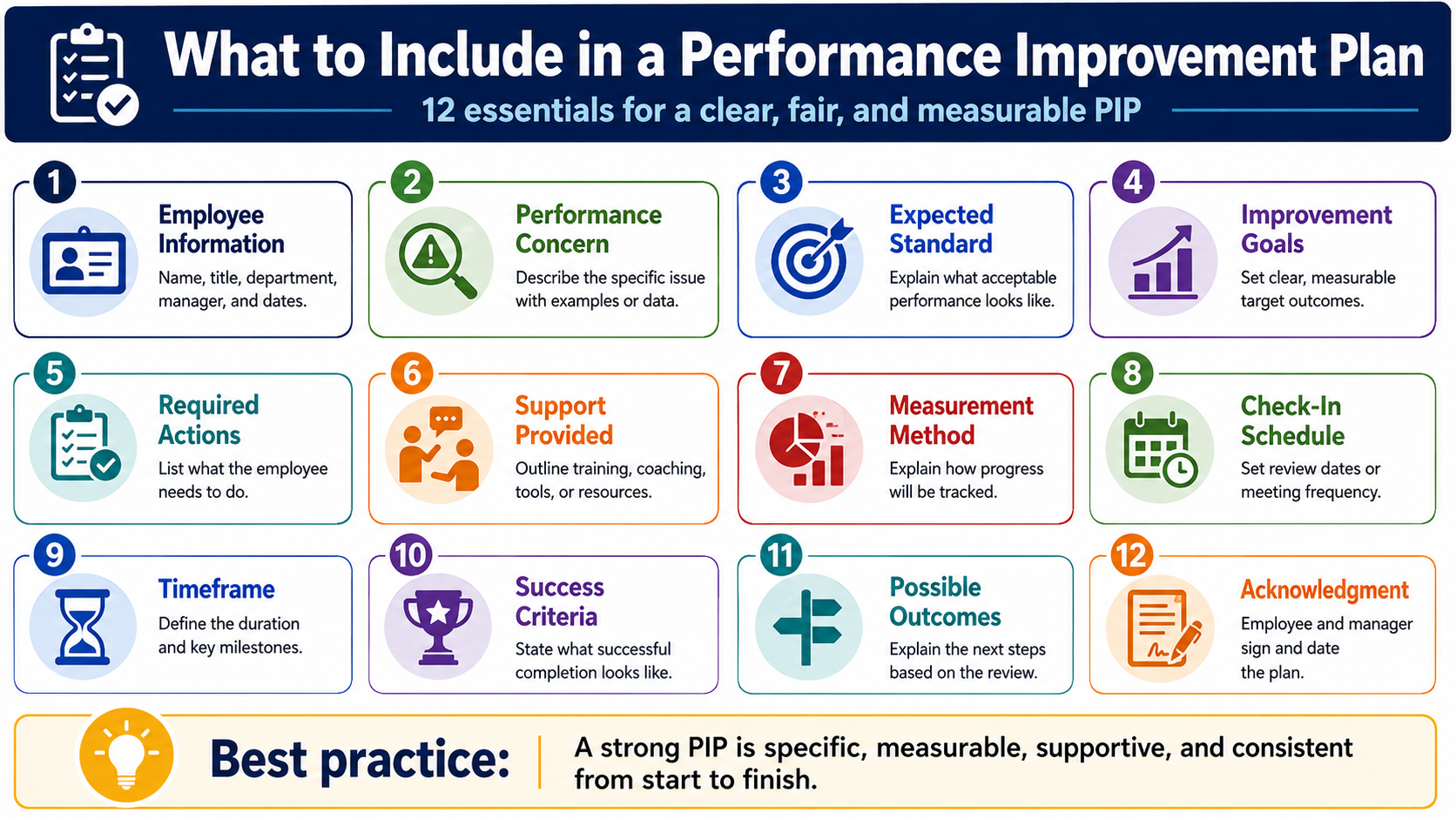
What Should a Performance Improvement Plan Include?
A useful PIP needs more than a list of complaints.
It should give the employee enough information to understand the problem, take action, and know whether progress is on track.
At minimum, include the following.
| PIP Element | What to Include | Example |
|---|---|---|
| Employee information | Name, title, department, manager | Customer Success Specialist |
| Performance concern | Specific gap in performance | Client follow-ups are frequently late |
| Expected standard | What acceptable performance looks like | Follow-ups sent within one business day |
| Evidence | Relevant examples or data | 9 of 20 follow-ups were late last month |
| Improvement goal | Measurable desired outcome | At least 95% sent on time |
| Required actions | What the employee needs to do | Review open accounts each morning |
| Manager support | Training, coaching, tools, resources | Weekly coaching and CRM refresher |
| Measurement | How progress will be assessed | CRM activity reports |
| Check-ins | Dates or frequency | Every Friday |
| Timeframe | Start and review dates | September 1–October 30 |
| Success criteria | What completing the plan means | 95%+ compliance for six consecutive weeks |
| Possible outcomes | What happens after review | Completion, further review, or other action under policy |
Make performance gaps specific
Avoid statements such as:
“Your work needs to improve.”
That does not tell the employee enough.
Instead, describe what is happening:
“Four of the six monthly reports submitted during the last quarter were delivered after the agreed deadline.”
Now there is a specific issue to discuss.
Turn vague goals into measurable expectations
One of the most common PIP mistakes is using goals that sound reasonable but cannot actually be measured.
Vague goal:
Improve communication with customers.
Measurable goal:
Respond to assigned customer support requests within one business day in at least 95% of cases during the improvement period.
Another example:
Vague goal:
Be more reliable with deadlines.
Measurable goal:
Submit weekly project reports by 3 p.m. every Friday for eight consecutive weeks.
The employee should not reach the end of a PIP wondering whether they succeeded.
Clear goals make progress easier for both sides to evaluate. For more on building measurable expectations, see HubEngage’s guide to employee goal setting.
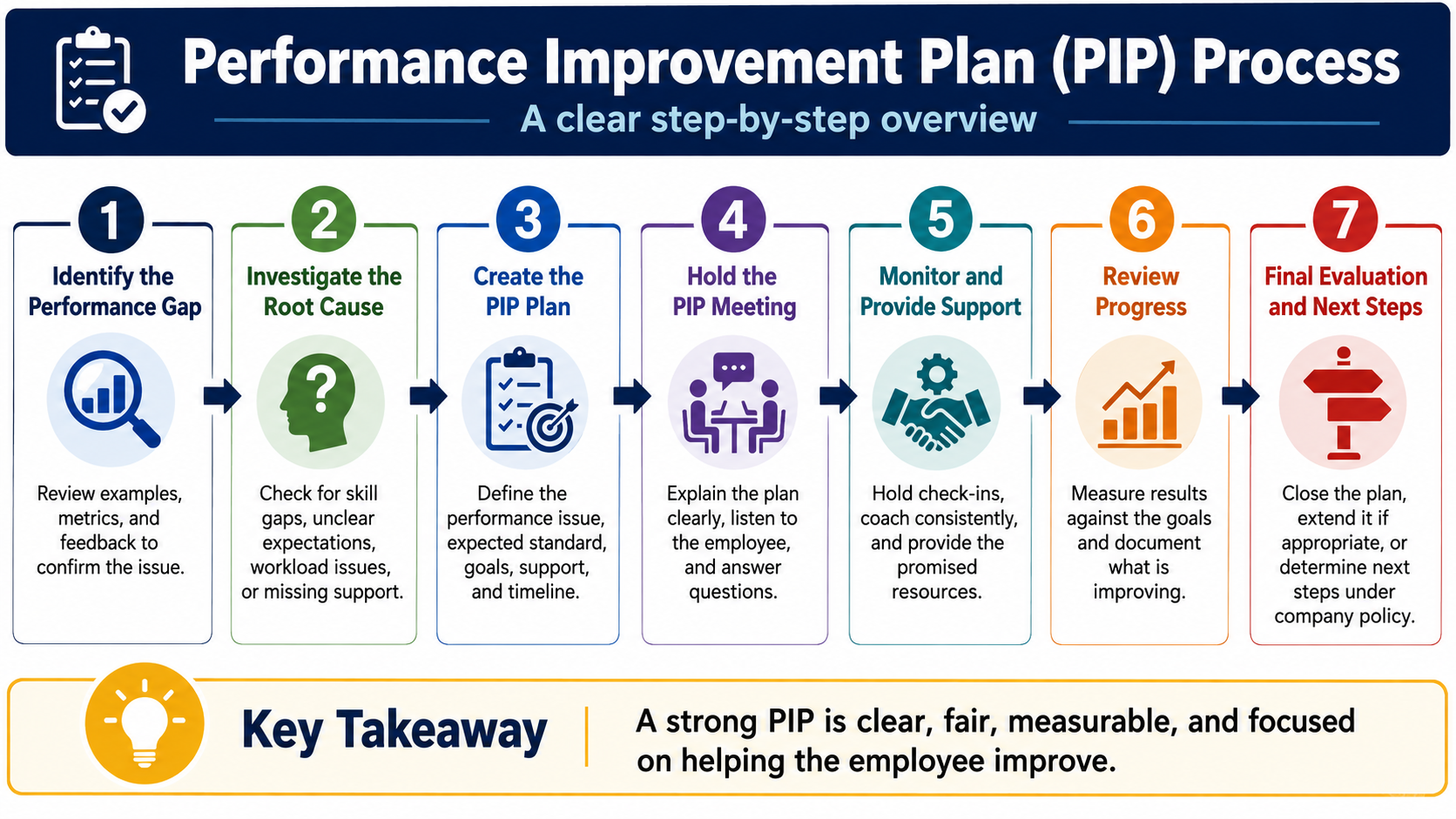
How to Create and Use a Performance Improvement Plan
Writing the document is only one part of the process.
The manager also needs to understand why the problem exists, communicate expectations clearly, provide support, and follow through consistently.
1. Verify the performance gap
Start with evidence rather than impressions.
Look at the employee’s actual responsibilities and compare the expected standard with recent performance.
Useful evidence might include:
- missed deadlines;
- quality results;
- completed work;
- customer complaints;
- error rates;
- attendance records where applicable;
- project outcomes; or
- previously documented feedback.
Avoid basing a PIP on statements such as “doesn’t seem committed” or “has a bad attitude” unless there are specific job-related behaviors behind those observations.
The U.S. Equal Employment Opportunity Commission recommends communicating performance standards, applying them consistently, and using relevant factual details when evaluating employees. EEOC guidance on performance evaluations provides useful context for managers.
2. Review earlier expectations and feedback
Ask whether the employee knew there was a problem.
A formal PIP should rarely be the first time someone hears that their performance is below expectations.
Review previous:
- one-on-one discussions;
- performance reviews;
- coaching conversations;
- written feedback;
- goals; and
- role expectations.
This also helps the manager distinguish a recurring performance problem from a temporary setback.
3. Look for the root cause
Poor performance does not always mean a lack of effort.
An employee might be struggling because of:
- unclear priorities;
- missing knowledge;
- insufficient training;
- inefficient processes;
- unrealistic workload;
- unclear ownership;
- changing expectations; or
- limited access to necessary systems.
Understanding the reason matters because the solution should address the actual problem.
If someone lacks product knowledge, for example, telling them to “improve performance” will not solve much. Product training might.
4. Define what good performance looks like
Write down the standard the employee is expected to meet.
Be as concrete as possible.
Instead of:
“Handle customers professionally.”
Try:
“Maintain an average customer satisfaction score of at least 4.2 out of 5 while following the team’s documented escalation procedure.”
The target should relate directly to the employee’s role.
5. Set measurable improvement goals
Translate the performance gap into a small number of achievable goals.
Good goals are:
- specific;
- job-related;
- measurable;
- realistic;
- time-bound; and
- within the employee’s reasonable control.
Do not overload the PIP with every weakness the manager has ever noticed.
Focus on the performance issues that genuinely need to change.
6. Define the employee’s actions
The employee should know what they are expected to do differently.
That could include actions such as:
- completing training;
- using a new workflow;
- reviewing work before submission;
- attending weekly coaching;
- providing regular project updates; or
- following a documented quality checklist.
Keep these actions connected to the improvement goals.
7. Explain the support the organization will provide
A PIP should not simply say, “Fix this.”
Managers should explain how they will support improvement.
Support might include:
- additional training;
- job shadowing;
- clearer documentation;
- coaching;
- more frequent manager feedback;
- system access;
- examples of acceptable work;
- mentoring; or
- temporary milestone reviews.
Meaningful support makes the process more credible and gives the employee a genuine opportunity to improve.
8. Decide how progress will be measured
Choose the evidence you will use before the plan starts.
For example:
- completion rates;
- error percentages;
- customer satisfaction;
- sales results;
- response times;
- deadlines met;
- audit results; or
- documented manager observations.
Do not change the scoring system halfway through the plan unless there is a legitimate reason that is clearly communicated.
9. Set a reasonable timeframe
The amount of time should fit the performance issue.
Some changes can be demonstrated quickly. Others require enough time for the employee to learn, apply feedback, and show consistent improvement.
That is why an arbitrary deadline is not always helpful.
More on PIP length appears below.
10. Hold the PIP meeting
Do not simply email the document without context.
Meet with the employee and explain:
- why the plan is being introduced;
- which performance issues it addresses;
- what improvement looks like;
- what support will be provided;
- how progress will be measured;
- when check-ins will happen; and
- what possible outcomes may follow.
Give the employee an opportunity to ask questions and respond.
The goal is clarity, not intimidation.
11. Hold regular check-ins
Once a PIP starts, the manager’s role becomes even more important.
Discuss progress regularly rather than waiting until the final review.
A useful check-in can cover:
- What has improved?
- What remains below expectations?
- What evidence supports that assessment?
- Is the employee encountering new barriers?
- Is promised support being provided?
- What needs to happen before the next meeting?
Document meaningful feedback and agreed next steps.
12. Assess the final outcome against the original criteria
At the end of the plan, return to the success measures written at the beginning.
Do not suddenly introduce a new reason the employee has failed.
The outcome should be based on the expectations, evidence, and criteria the employee was given.
How Long Should a Performance Improvement Plan Last?
There is no single PIP duration that works for every employee, role, employer, or jurisdiction.
You will often hear about 30-, 60-, or 90-day PIPs. These can be useful planning ranges, but they should not be treated as a universal rule.
A reasonable timeframe depends on:
- the nature of the performance problem;
- how quickly improvement can realistically be demonstrated;
- the employee’s role;
- the complexity of the work;
- company policy;
- applicable contracts or collective bargaining requirements; and
- applicable employment laws.
For example, an employee may be able to demonstrate timely report submission within a few weeks. Proving sustained improvement in a longer sales cycle may take considerably longer.
The U.S. Office of Personnel Management provides detailed guidance on PIPs for federal employees, including specific federal procedures and examples. However, those rules should not be assumed to apply to private employers. You can review the OPM Performance Improvement Plan Quick Guide for federal-specific context.
Performance Improvement Plan Example
Consider a customer success specialist who repeatedly fails to follow up with clients on time.
Performance concern
Over the previous six weeks, 14 of 35 assigned client follow-ups were completed more than one business day after the required response period.
Expected performance
Customer follow-ups should be completed within one business day unless the account is documented as requiring additional investigation.
Improvement goal
Complete at least 95% of required client follow-ups within one business day during the final six weeks of the improvement period.
Required employee actions
The employee will:
- review all open client tasks at the beginning and end of each workday;
- use CRM reminders for every follow-up;
- flag cases that cannot be resolved within one day; and
- complete the assigned customer workflow refresher training.
Manager support
The manager will:
- review CRM workflow practices with the employee;
- provide refresher training;
- hold a 20-minute check-in every Friday; and
- provide specific feedback when a missed follow-up is identified.
Measurement
CRM records will be reviewed weekly to calculate the percentage of follow-ups completed within the required period.
Success criteria
The employee successfully completes the PIP by maintaining at least 95% timely follow-ups during the final six consecutive weeks while following the team’s escalation process.
Notice how each part connects.
The performance problem is specific. The expectation is clear. The employee has actions to take. The manager has responsibilities too. Finally, the success criteria can be measured.
Performance Improvement Plan Template
Use the following structure as a starting point. Adjust it to your organization, policies, role requirements, and jurisdiction.
Employee Information
Employee name:
Job title:
Department:
Manager:
Date issued:
Plan start date:
Review date:
Performance Concern
Describe the specific area of performance that is below expectations.
Include relevant examples, dates, metrics, or other objective information where appropriate.
Expected Performance Standard
Explain what acceptable performance looks like for the employee’s role.
Improvement Goals
1) Goal 1:
Expected outcome:
Measurement method:
Deadline:
2) Goal 2:
Expected outcome:
Measurement method:
Deadline:
3) Goal 3:
Expected outcome:
Measurement method:
Deadline:
Required Employee Actions
List the actions the employee should take to meet the improvement goals.
Manager and Company Support
List the coaching, training, tools, resources, or other support that will be provided.
Progress Measurement
Explain exactly how performance will be evaluated during the plan.
Check-In Schedule
List the dates or frequency of review meetings.
Success Criteria
State the results the employee must demonstrate to successfully complete the plan.
Possible Outcomes
Explain the possible next steps according to company policy and applicable requirements.
Notes
Include relevant comments, agreed actions, or other information.
Acknowledgment
Employee: __________________
Manager: __________________
Date: __________________
An acknowledgment should be handled according to your organization’s policies and applicable requirements.
For another perspective on structuring PIPs, AIHR provides a detailed performance improvement plan template and guide that covers goals, action plans, resources, and progress tracking.
How to Conduct a PIP Meeting
A PIP conversation can be uncomfortable. Being direct usually makes it easier.
Start by explaining why the meeting is taking place.
Then walk through the performance concerns one by one. Use examples and evidence instead of general impressions.
For instance:
Instead of saying, “You’ve been unreliable lately,” explain which deadlines were missed and what the agreed deadlines were.
After discussing the issue, explain the expected standard and how progress will be measured.
Then discuss support.
Ask whether anything is preventing the employee from meeting the expectations. Listen to the answer rather than treating the meeting as a one-way announcement.
Before finishing, confirm:
- what needs to improve;
- what the employee will do;
- what the manager will provide;
- when the next check-in will happen;
- how success will be measured; and
- what the employee should do if they need clarification.
Employees may disagree with the assessment. That does not mean the conversation has failed.
The manager’s job is to remain factual, respectful, and consistent.
How to Manage an Employee During a PIP
The biggest mistake after creating a strong PIP is forgetting about it until the deadline.
A performance improvement plan needs active management.
Keep check-ins consistent
If the plan says meetings will happen every Friday, hold them every Friday when reasonably possible.
Consistency signals that the process matters.
Give feedback while the employee can still use it
Do not save six weeks of problems for the final meeting.
If performance slips during week two, explain what needs to change during week two.
That gives the employee a chance to respond.
Recognize real progress
A PIP should not become a search for evidence of failure.
If the employee is improving, say so.
For example:
“Your follow-up rate reached 94% this week, compared with 79% when the plan started. The target remains 95%, but the trend is moving in the right direction.”
That is much more useful than silence.
Deliver the support you promised
If the plan says the employee will receive training, coaching, or access to resources, make sure that happens.
Manager commitments should be treated seriously too.
Keep documentation factual
Document dates, outcomes, metrics, feedback, and agreed next steps.
Avoid emotional interpretations.
“Three reports were submitted late this month” is useful documentation.
“Employee does not care enough about the job” is an assumption unless there is objective evidence behind it.
What Happens at the End of a PIP?
A PIP usually ends in one of three broad situations.
1. The employee meets expectations
If the agreed performance criteria have been met, acknowledge the improvement and formally close the PIP according to your process.
Explain how performance will be managed going forward.
The employee should not remain indefinitely in an unclear “almost still on a PIP” status.
2. The employee shows partial improvement
Sometimes progress is real but incomplete.
Review:
- what improved;
- what remains below the standard;
- whether the original goals were reasonable;
- whether promised support was delivered;
- whether unexpected barriers arose; and
- what your policies allow.
HR should help determine the appropriate next step rather than automatically extending every PIP.
3. The employee does not meet expectations
If performance remains below the clearly communicated standard, the organization may need to consider further action under its policies and applicable law.
Review the documentation carefully before making a consequential employment decision.
Depending on the circumstances, HR or legal advice may be appropriate.
Common Performance Improvement Plan Mistakes
Even a detailed PIP can fail if the process around it is weak.
Using vague expectations
“Show more leadership” is difficult to evaluate.
Define the behavior or result you expect.
Making success impossible
A PIP should be challenging where improvement is needed, but the targets still need to be realistic.
If an employee cannot reasonably meet the goals even with strong performance, the plan is not serving its purpose.
Treating the outcome as predetermined
If the decision to terminate someone has already been made, describing the process as a genuine improvement opportunity creates obvious trust problems.
A PIP should mean what it says.
Ignoring the root cause
More pressure will not fix missing training, broken processes, contradictory instructions, or unrealistic workloads.
Investigate first.
Providing no support
An effective PIP identifies what the employee needs to change and what the organization will do to help them get there.
Changing expectations halfway through
Do not move the finish line without a legitimate reason.
Employees should know how success will be judged from the beginning.
Skipping check-ins
Regular conversations give employees a chance to course-correct.
A final meeting full of previously undisclosed concerns defeats that purpose.
Judging personality instead of performance
Statements such as “not enthusiastic enough” or “not a culture fit” are often too vague to guide improvement.
Focus on job-related behavior and outcomes.
Applying different standards without a clear reason
Consistency matters.
Managers should be able to explain why employees in comparable situations are being held to particular standards.
Legal and HR Considerations for Performance Improvement Plans
Performance management should be handled consistently and based on job-related expectations.
A PIP may also intersect with issues involving disability accommodations, protected leave, discrimination, retaliation, employment contracts, collective bargaining agreements, or other workplace protections.
That means managers should avoid treating every performance situation as identical.
For example, if an employee raises a possible accommodation issue during the process, HR may need to address that question separately rather than simply continuing the PIP without review.
Similarly, performance expectations should not be applied more harshly to someone because they raised a discrimination concern or participated in a protected process.
HR should review higher-risk cases and make sure managers are following organizational policy and applicable law.
This article provides general HR information and is not legal advice. Employment requirements vary by jurisdiction and workplace.
Performance Improvement Plan Checklist for Managers
Before issuing a PIP, ask:
- Is there a specific performance problem?
- Can I support it with facts or examples?
- Was the employee told what good performance looks like?
- Has the employee received relevant feedback?
- Have I considered the root cause?
- Is a PIP actually the appropriate response?
- Are the goals measurable?
- Are the targets realistic?
- Does the employee know what actions to take?
- Have we identified appropriate support?
- Do we know how progress will be measured?
- Are check-ins scheduled?
- Are success criteria clear?
- Are possible outcomes explained?
- Has HR reviewed the plan where appropriate?
- Would I be comfortable applying the same standard in a comparable situation?
If several answers are “no,” the plan probably needs more work.
FAQs About Performance Improvement Plans
What does PIP mean at work?
PIP stands for Performance Improvement Plan. It is a structured process that identifies specific performance problems, explains the standard an employee needs to meet, sets measurable improvement goals, and establishes a period for reviewing progress.
What should a performance improvement plan include?
A PIP should include the performance concern, expected standard, supporting examples, measurable goals, required employee actions, manager support, measurement methods, check-in dates, timeframe, success criteria, and possible outcomes.
The exact format can vary by organization.
How long should a PIP last?
There is no universal duration for every PIP. Organizations often use periods such as 30, 60, or 90 days, but the right timeframe depends on the performance issue, role, company policy, contractual requirements, jurisdiction, and how long an employee reasonably needs to demonstrate improvement.
Is a performance improvement plan disciplinary action?
It depends on the organization’s policies and the circumstances.
Some employers treat a PIP as part of a formal disciplinary or performance-management process. Others distinguish development-focused PIPs from disciplinary action.
Organizations should define their own process clearly and apply it consistently.
Can an employee successfully complete a PIP?
Yes.
If an employee meets the success criteria defined in the plan, the organization can formally close the PIP and return to normal performance management.
Managers should make successful completion as clear as unsuccessful completion.
What happens when an employee meets their PIP goals?
The manager should document the successful outcome, communicate that the plan has been completed, and explain expectations going forward.
Regular feedback should continue even after the formal PIP ends.
What happens if an employee does not meet PIP goals?
The employer should review the evidence, support provided, employee progress, company policy, and applicable requirements before deciding what happens next.
Possible actions vary by organization and circumstances, so HR involvement is often appropriate.
How often should managers meet with employees during a PIP?
There is no universal schedule, but meetings should happen frequently enough to give the employee meaningful feedback while there is still time to adjust.
Weekly or biweekly meetings may work in many situations, depending on the length of the plan and how quickly performance can be measured.
Final Takeaway
A performance improvement plan works best when there are no surprises.
The employee should understand what is wrong, what good performance looks like, what needs to change, what support is available, and exactly how progress will be measured.
For managers, the goal is not to create the longest possible document. It is to create a fair and usable process.
Start with facts. Set measurable expectations. Provide meaningful support. Meet regularly. Document what happens. Then evaluate the outcome against the same criteria you established at the beginning.
When those pieces are in place, a PIP becomes more than paperwork. It becomes a clear framework for addressing performance problems while giving employees a meaningful opportunity to improve.