
Exempt vs nonexempt employees differ mainly in whether federal minimum-wage and overtime protections apply. Under the Fair Labor Standards Act (FLSA), covered nonexempt employees are generally entitled to overtime when they work more than 40 hours in a workweek, while employees who properly meet an exemption may be excluded from those requirements.
However, being salaried does not automatically make an employee exempt. HR still needs to evaluate how the employee is paid, what the employee actually does, which exemption applies, and whether state or local law sets a stricter standard.
That distinction matters because an incorrect classification can create overtime, payroll, recordkeeping, and employee-relations problems.
This guide explains how HR should classify exempt vs nonexempt employees under current 2026 federal rules, including salary requirements, duties tests, state-law differences, examples, and a practical classification framework.
Key Takeaways:
- Salary alone does not make an employee exempt; HR must verify compensation requirements, actual duties, and the specific FLSA exemption.
- The current federal salary threshold for most executive, administrative, and professional exemptions is $684 per week, but state rules can be much stricter.
- A salaried employee can still be nonexempt, and an hourly employee can sometimes qualify as exempt under limited FLSA exceptions.
- HR should recheck classifications whenever duties, pay, work location, reporting structure, or applicable law materially changes.
- Strong documentation and accurate timekeeping can reduce overtime, payroll, and misclassification risk when exemption decisions are challenged.
What does exempt vs. nonexempt mean?
A nonexempt employee is generally covered by the FLSA’s minimum-wage and overtime protections. An exempt employee meets the requirements of a specific exemption from those protections.
For the common executive, administrative, and professional exemptions, HR generally needs to evaluate three things: how the employee is paid, whether the employee meets the required salary level, and whether the employee’s actual duties satisfy the exemption.
The U.S. Department of Labor’s FLSA white-collar exemption guidance makes another point HR should remember: job titles alone do not determine exempt status.
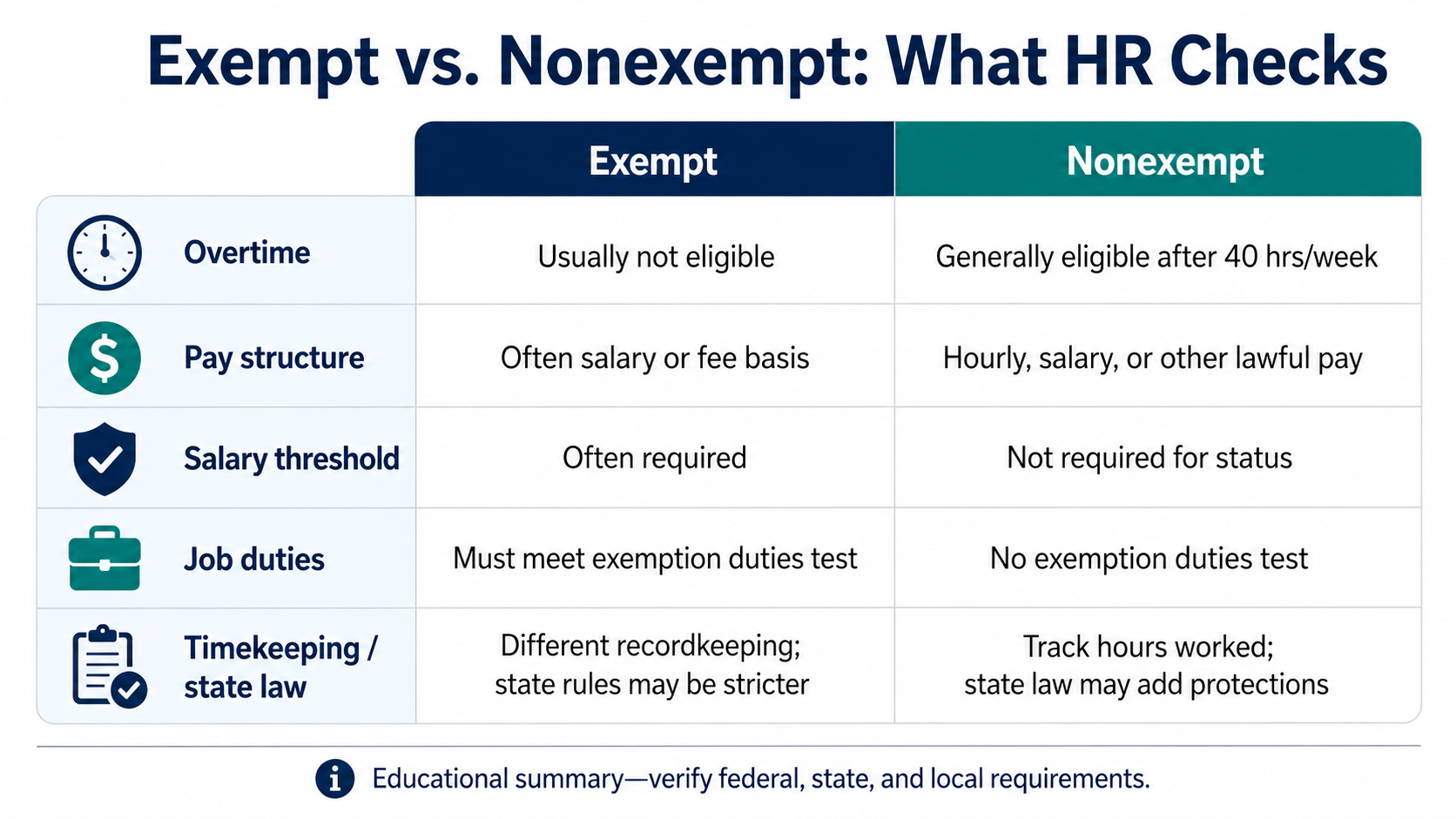
Exempt vs nonexempt employees: quick comparison
| Factor | Exempt employee | Nonexempt employee |
|---|---|---|
| Federal overtime | Usually not entitled under the applicable exemption | Generally entitled to overtime after 40 hours |
| Pay method | Often salary or fee basis | Can be hourly, salaried, commissioned, or another lawful method |
| Salary threshold | Applies to many white-collar exemptions | No exempt salary threshold |
| Job duties | Must satisfy a specific exemption when required | No exemption duties test required |
| Timekeeping | Different recordkeeping requirements may apply | Accurate hours worked must be captured |
| State law | May impose stricter exemption requirements | May provide additional wage protections |
Salary and exempt status are therefore not interchangeable terms. Likewise, hourly and nonexempt are not always interchangeable.
What is the federal exempt salary threshold in 2026?
As of August 2026, the federal salary level for most executive, administrative, and professional exemptions is $684 per week, or $35,568 per year.
For the highly compensated employee exemption, the current federal total annual compensation threshold is $107,432, including at least $684 per week paid on a salary or fee basis.
This deserves particular attention because the rule changed and then changed back.
In 2024, the Department of Labor issued a rule that increased the salary threshold and scheduled another increase for 2025. However, a federal court vacated that rule in November 2024.
Then, on May 14, 2026, DOL issued a technical amendment restoring the operative 2019 regulatory text. As a result, employers are again applying the $684-per-week federal standard for most executive, administrative, and professional exemptions.
HR teams can verify the current position through the Department of Labor’s May 2026 exemption-rule update.
Importantly, meeting $35,568 does not automatically make someone exempt. It is only one part of the analysis.
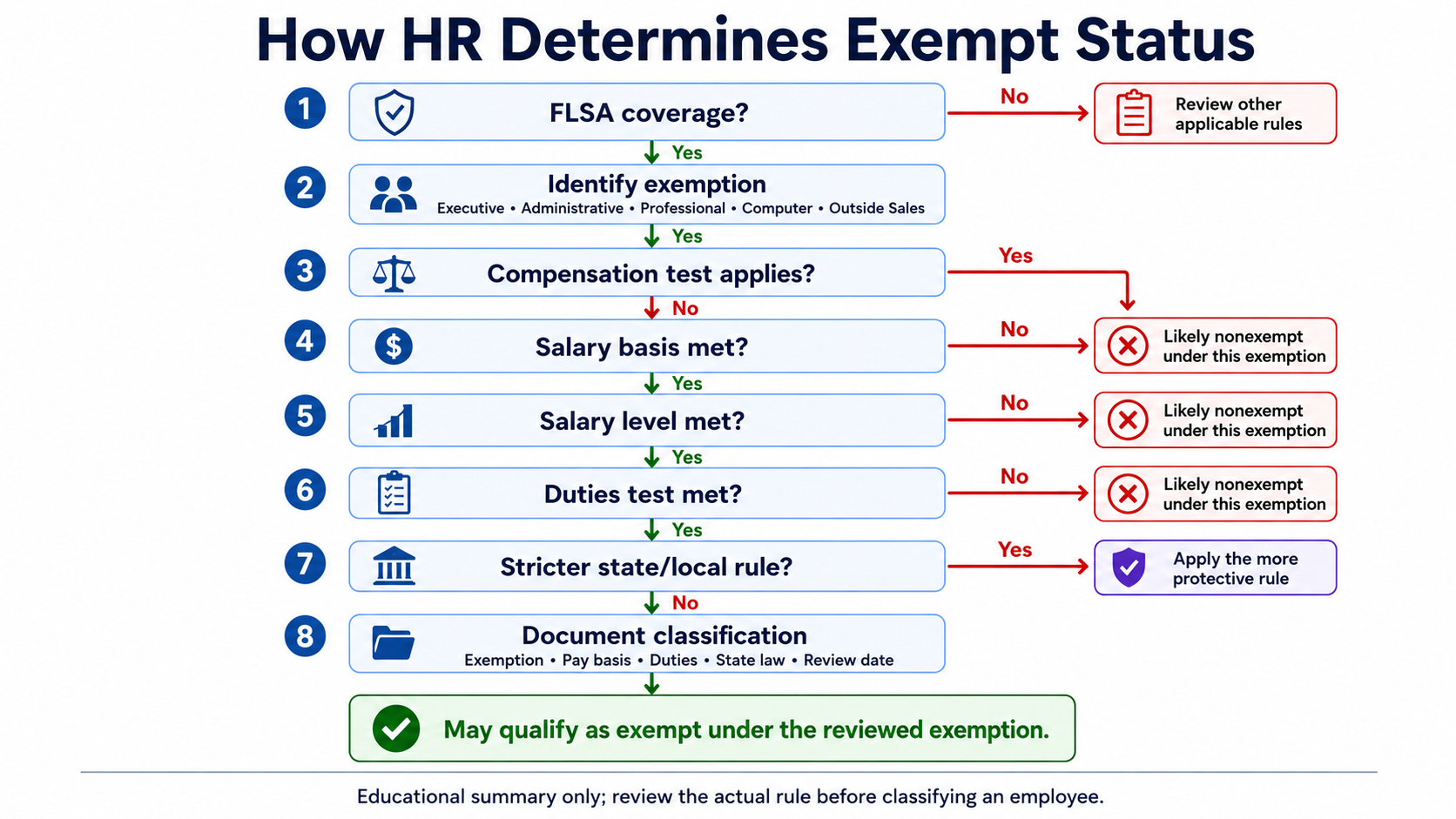
HR’s 6-step check for exempt status
A defensible classification process is easier when HR works through the requirements in a consistent order.
1. Identify the exemption being considered
Do not simply label a job “exempt.”
Instead, document the exemption HR believes applies. Common FLSA categories include:
- executive
- administrative
- learned professional
- creative professional
- computer employee
- outside sales
- highly compensated employee
Each exemption has its own requirements. Therefore, HR should identify the specific legal basis before reviewing the job.
2. Check whether a salary or compensation requirement applies
Most executive, administrative, and professional employees must satisfy federal compensation requirements.
However, there are exceptions. For example, qualifying outside sales employees are not subject to the standard salary requirement, while certain computer employees can qualify when paid at least $27.63 per hour if the other requirements are satisfied.
So, HR should not use one compensation checklist for every exemption.
3. Apply the salary basis test
For most standard white-collar exemptions, an employee must receive a predetermined amount of compensation that is generally not reduced because of variations in the quality or quantity of work performed.
In practice, this is where payroll practices matter.
If deductions from salary are handled incorrectly, an otherwise defensible exemption can become more complicated. Therefore, HR and payroll should review salary deductions together instead of treating exemption status as an HR-only issue.
4. Apply the salary level test
For most federal executive, administrative, and professional exemptions, the employee must currently receive at least:
$684 per week
or
$35,568 per year
Again, passing that threshold only gets HR to the next question.
5. Review what the employee actually does
Actual duties matter more than the title printed on the business card.
For example, the executive exemption generally involves management as the employee’s primary duty, directing the work of at least two full-time employees or their equivalent, and having meaningful authority or input concerning employment decisions.
By contrast, the administrative exemption focuses on qualifying office or nonmanual work related to management or general business operations and the exercise of discretion and independent judgment on significant matters.
Meanwhile, the learned professional exemption generally involves work requiring advanced knowledge in a field of science or learning customarily acquired through prolonged specialized instruction.
Therefore, two employees with the title “manager” may have different FLSA classifications if their real responsibilities are materially different.
6. Check state and local requirements
Federal law is the baseline, not necessarily the final answer.
Before HR approves an exemption, check the requirements where the employee actually works. This is especially important for remote and distributed employees who move across state lines.
Finally, document:
- the exemption reviewed;
- salary or compensation information;
- key duties supporting the classification;
- applicable state-law analysis;
- who completed the review; and
- the date of the review.
Can a salaried employee be nonexempt?
Yes. A salaried employee can be nonexempt.
This is one of the most common classification misconceptions.
“Salary” describes a method of payment. “Exempt” describes an employee’s status under a particular wage-and-hour exemption.
For example, suppose an employee earns a $50,000 salary but performs routine processing work with little discretion or independent judgment. The employee’s salary is above the federal threshold, but salary alone does not establish the administrative exemption.
If no exemption applies, the employee can remain salaried and nonexempt. The employer must then comply with applicable overtime and timekeeping requirements.
Therefore, HR should avoid using payroll labels such as “salary = exempt” as a substitute for a classification review.
Can an hourly employee be exempt?
Yes, in limited circumstances.
The federal computer employee exemption provides the clearest example. Certain qualifying computer systems analysts, programmers, software engineers, and similarly skilled employees may meet the compensation requirement if they are paid at least $27.63 per hour and satisfy the applicable duties requirements.
Outside sales employees are another category with different salary requirements.
Still, most ordinary hourly workers are nonexempt. HR should therefore treat an hourly exempt classification as something to verify carefully rather than assume it is impossible.
Does an exempt employee have to manage people?
No.
Managing employees is central to the executive exemption, but it is not a universal requirement for every exempt employee.
An administrative employee, learned professional, qualifying computer employee, or outside sales employee can potentially qualify under a different exemption without supervising two employees.
This is why starting with the exemption category matters. Otherwise, HR can end up applying the executive test to a job that should be reviewed under a completely different provision.
State law can change the classification answer
An employee who satisfies the federal exemption test may still be nonexempt under state law.
California is a useful example.
The state’s minimum wage increased to $16.90 per hour on January 1, 2026. Because California ties the salary requirement for many white-collar exemptions to twice the state minimum wage for full-time employment, the 2026 minimum salary requirement is $70,304 per year.
The California Department of Industrial Relations publishes the 2026 minimum-wage and exempt-salary requirement.
Consider an employee earning $60,000 annually. That salary is comfortably above the current federal $35,568 threshold. However, it is below California’s 2026 salary requirement for the applicable exemptions.
Therefore, a national HR team should not maintain one federal salary threshold and assume it answers the classification question everywhere.
State law may also differ on duties tests, overtime, meal and rest requirements, wage statements, and related protections. If an employee moves, works remotely from another jurisdiction, or divides time between locations, HR should determine which rules apply before relying on the existing classification.
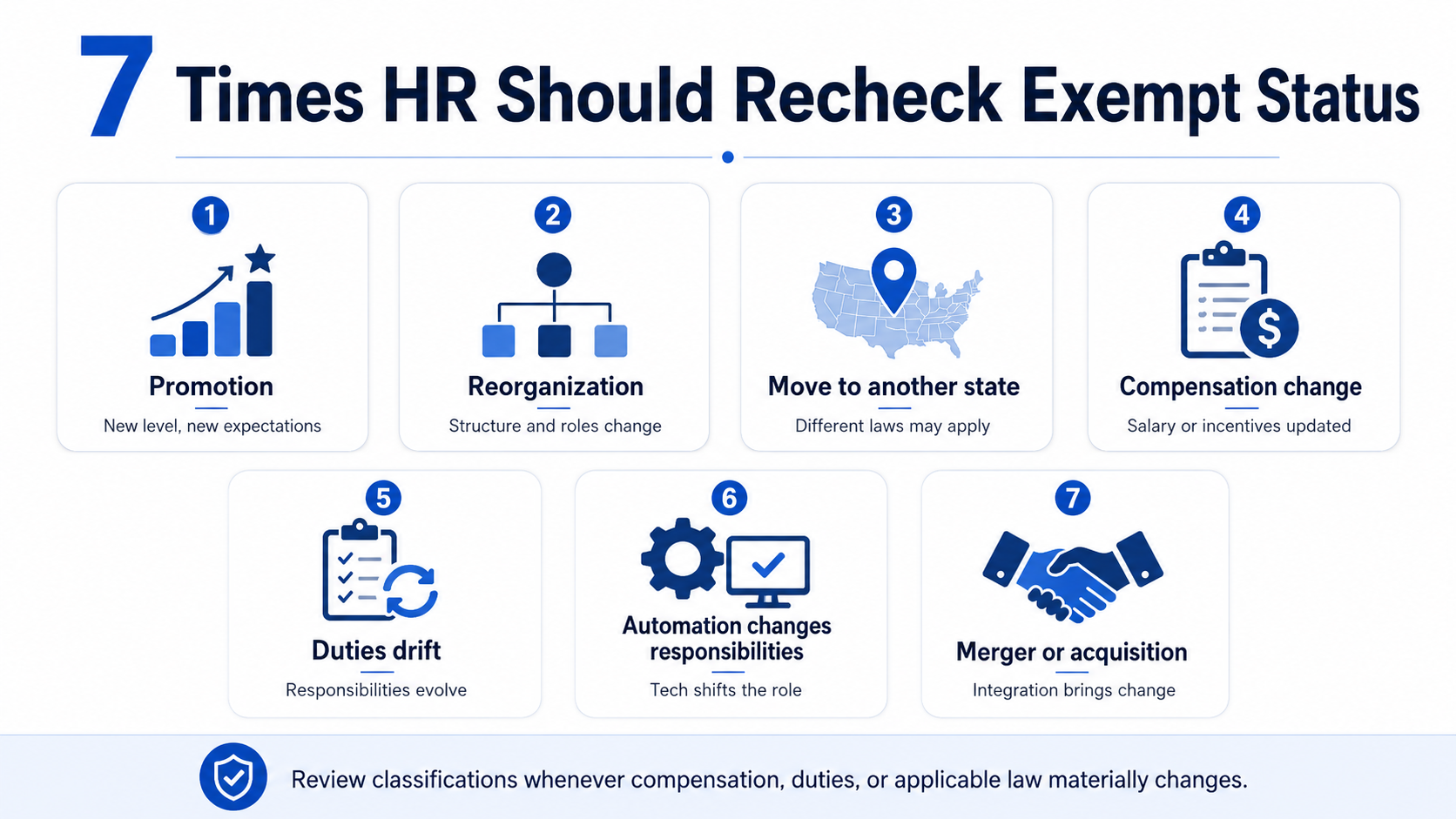
When should HR re-audit an exempt classification?
Exempt status should not be treated as a decision HR makes once at hiring and never revisits.
Consider reopening the classification review when:
- an employee receives a promotion or demotion;
- a reorganization materially changes responsibilities;
- a manager loses or gains direct reports;
- an employee relocates to another state;
- compensation materially changes;
- the job description no longer matches actual work;
- automation removes higher-level responsibilities;
- layoffs push managers toward more routine production work; or
- a merger or acquisition exposes inconsistent classifications.
For example, a supervisor may have qualified for the executive exemption when managing a full team. After a restructuring, that person may spend most of the week performing frontline work and supervise fewer employees.
The title may not change. The legal analysis might.
What should HR do after reclassifying an employee as nonexempt?
Changing the payroll code is not enough.
HR also needs to change how the employee and manager handle working time.
Explain:
- when the new classification becomes effective;
- how working time must be recorded;
- when overtime applies;
- how overtime approval works;
- whether meal periods or other timekeeping rules change;
- how remote work or after-hours messages should be handled; and
- who employees should contact with payroll questions.
Managers need the same briefing.
For example, telling a newly nonexempt employee not to work unauthorized overtime does not mean the employer can ignore overtime that was actually worked. Therefore, managers need practical instructions for controlling workload without encouraging off-the-clock work.
Communication matters even more for shift-based and deskless teams because employees may not regularly check corporate email. HubEngage’s frontline employee communication resources provide practical guidance for reaching employees across locations and work patterns.
What exempt-versus-nonexempt mistakes should HR avoid?
Several errors appear repeatedly in real classification reviews.
Treating salary as the deciding factor
A salary above $35,568 does not create an exemption. The applicable duties and other requirements still matter.
Classifying by job title
“Manager,” “administrator,” “coordinator,” “director,” and similar titles are not exemption tests.
Instead, ask what the employee actually spends time doing and what level of authority the employee exercises.
Checking salary but not duties
This can be especially risky with administrative roles. An employee may perform office work and earn a substantial salary but still lack the discretion or responsibilities required for an exemption.
Copying another employee’s classification
Two people with similar titles may perform substantially different jobs.
Likewise, a role that is exempt in one state may fail a state salary or duties requirement elsewhere.
Letting job descriptions become stale
Job descriptions help, but they are evidence—not the final answer.
If the written description says the employee manages a department while the employee actually spends nearly all of the workweek doing routine production work, HR needs to investigate the discrepancy.
Forgetting the operational side of reclassification
Moving someone to nonexempt status creates timekeeping and manager-training implications.
Therefore, HR, payroll, and the employee’s manager should coordinate the change.
A practical documentation record for HR
For each exempt position, maintain a short classification record containing:
| Review item | What to document |
| Exemption | Specific exemption being relied upon |
| Compensation | Salary basis, salary level, or alternative compensation test |
| Duties | Facts supporting each required duties element |
| Work location | State/local rules checked |
| Supporting records | Current job description and organizational information |
| Review | Reviewer, approval date, and next review trigger |
This does not need to become a 20-page legal memo for every employee.
Instead, HR needs enough documentation to show why the decision was made and to make the next review easier.
FAQs on Exempt vs. Nonexempt Employees:
Do exempt employees get overtime?
Generally, employees who properly satisfy an applicable FLSA overtime exemption are not entitled to federal overtime under that exemption.
However, HR must confirm every requirement. Paying a salary or giving someone a managerial title does not remove overtime rights by itself. State law may also provide broader employee protections.
Can a salaried employee receive overtime?
Yes. Salaried employees can be nonexempt and eligible for overtime.
A salary is only a method of compensation. If the employee does not qualify for an overtime exemption, applicable overtime requirements still apply. HR also needs a compliant method for calculating and recording working time.
Does an exempt employee have to earn at least $35,568?
For most federal executive, administrative, and professional exemptions, the current standard is $684 per week, equivalent to $35,568 annually.
However, different rules apply to certain occupations and exemptions, and state law may require a much higher salary.
Can an employer make an exempt employee nonexempt?
Generally, yes.
An employer can choose to treat an employee as nonexempt and provide applicable minimum-wage and overtime protections. However, the employer must then properly track working time, calculate overtime, and comply with other applicable wage-and-hour requirements.
Do exempt employees need to clock in and out?
The FLSA does not impose the same hours-worked recordkeeping requirements on properly exempt white-collar employees that apply to nonexempt workers.
However, employers may still track exempt employees’ time for attendance, leave, project costing, billing, security, or operational purposes. HR should also check state requirements.
Can a part-time employee be exempt?
Potentially, yes.
Part-time status by itself does not determine exemption. The employee must still meet the requirements of the particular exemption being used. HR should not assume that working fewer than 40 hours automatically means the worker is exempt or that exemption rules cease to matter.
Can bonuses count toward the exempt salary requirement?
Certain nondiscretionary bonuses and incentive payments can count toward a limited portion of the federal standard salary level for applicable exemptions.
However, specific conditions apply, and the rules differ for some categories. Therefore, HR should verify the current compensation rule before relying on bonuses to meet an exemption threshold.
What should HR do if the job description and actual duties are different?
Review the classification using the employee’s actual duties.
Then determine why the description is outdated and update it. If the real job no longer satisfies the exemption, HR should assess the appropriate reclassification and payroll response rather than relying on documentation that no longer reflects the work.
The practical takeaway for HR
Classify the job based on the applicable exemption, compensation rules, actual duties, and work location—not salary or title alone.
For exempt vs nonexempt employees, a repeatable HR process is more useful than relying on assumptions: identify the exemption, check compensation, test the duties, verify state law, document the decision, and reopen the analysis when the role changes.
The current federal threshold also illustrates why periodic review matters. After the 2024 overtime rule was vacated, DOL formally restored the operative 2019 regulations in May 2026, leaving the standard federal EAP salary level at $684 per week.
For HR, the simplest rule is this: classify the work you actually have today, under the law that applies today.
Legal disclaimer: This article provides general HR information for US employers and is not legal advice. Federal, state, and local requirements may differ, so employers should verify current rules and consult qualified counsel when appropriate.