
To calculate employee turnover rate, divide the number of employees who left during a defined period by the average headcount for that same period, then multiply by 100.
For most HR reporting, the turnover rate formula uses average headcount rather than only beginning or ending headcount because the workforce usually changes during the measurement period. However, rapidly growing, shrinking, or seasonal employers may need a more detailed monthly average instead of a simple two-point average.
HR teams that are also investigating why people leave can use broader employee turnover guide alongside the calculation itself.
This guide covers the formula, examples, denominator choices, turnover types, benchmarking, reporting mistakes, and practical HR decisions that follow from the result.
“Employee turnover rate matters because it can reveal problems that headcount alone will not show. Rising turnover may point to issues with managers, pay, workload, scheduling, hiring, onboarding, or career opportunities before those problems become harder and more expensive to fix.”
Key Takeaways
- Employee turnover rate shows how much of your workforce is leaving during a defined period, giving HR a clearer view of workforce stability than headcount alone.
- A rising turnover rate can be an early warning sign of problems with managers, pay, workload, scheduling, onboarding, or career growth.
- The company-wide number is only the starting point. HR should break turnover down by department, manager, location, role, tenure, and exit type to find the real pattern.
- Consistency matters. Using the same definition of a separation, employee population, and calculation method makes turnover trends more reliable over time.
- Turnover should lead to action, not just reporting. The goal is to identify preventable exits, understand what is driving them, and focus retention efforts where they can have the greatest impact.
What is employee turnover rate?
Employee turnover rate is the percentage of a workforce that leaves an organization during a defined period. HR normally calculates it by dividing employee separations by average headcount and multiplying by 100. Total turnover can include voluntary and involuntary departures, although HR should also report those categories separately.
How to calculate turnover rate
The standard calculation is:
Turnover rate (%) = Employee separations ÷ Average headcount × 100
Then calculate average headcount:
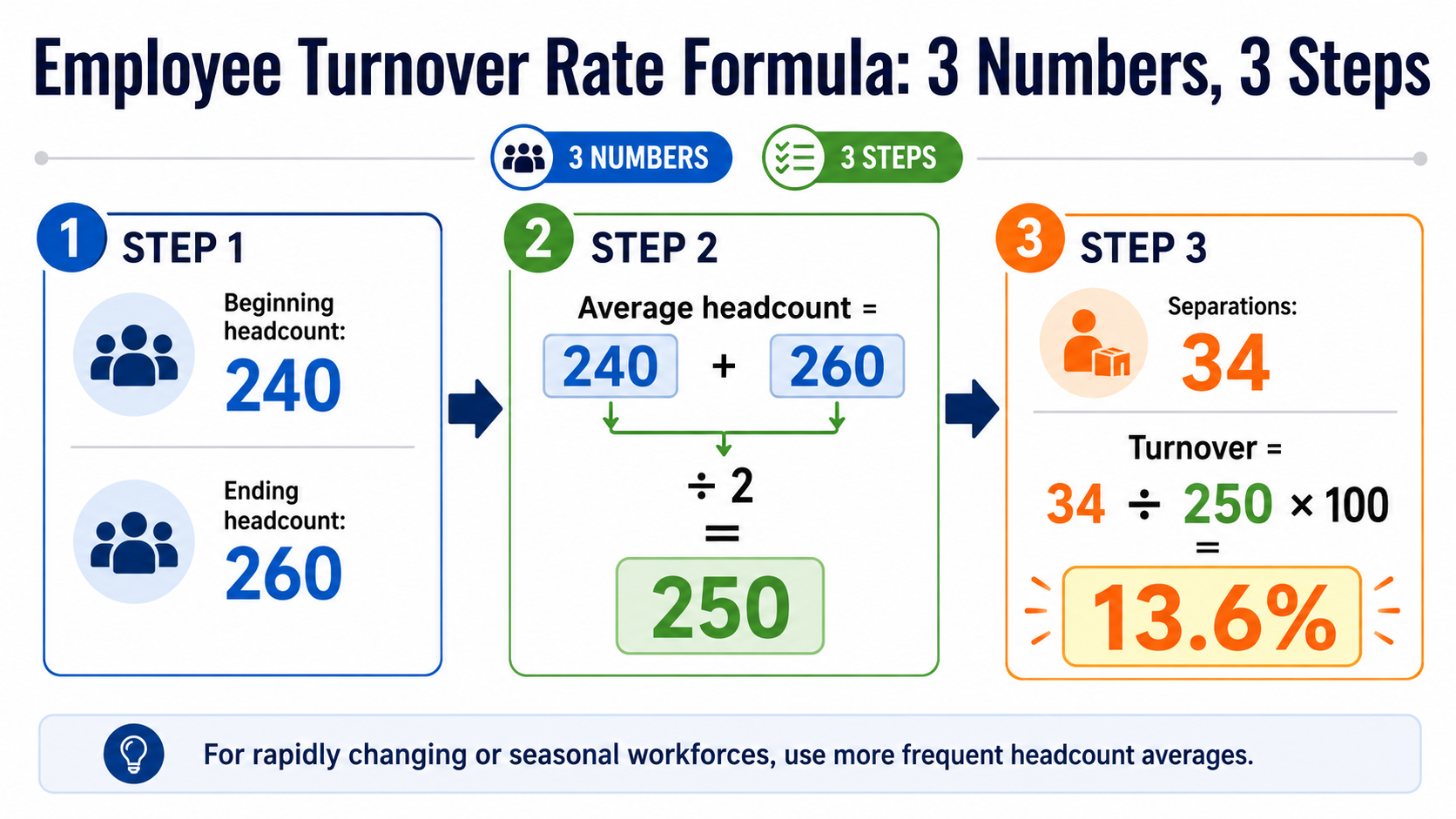
Average headcount = (Beginning headcount + Ending headcount) ÷ 2
This average-headcount approach is also reflected in common US HR guidance, including SHRM’s turnover-rate methodology.
Employee turnover calculation example
Suppose a company has:
- 240 employees on January 1
- 260 employees on December 31
- 34 employee separations during the year
First, calculate average headcount:
(240 + 260) ÷ 2 = 250
Then calculate turnover:
34 ÷ 250 × 100 = 13.6%
The company’s annual turnover rate is 13.6%.
That does not automatically mean turnover is good or bad. HR still needs to determine who left, where departures occurred, whether the exits were voluntary, and how the result compares with previous periods and relevant labor-market data.
| Factor | What HR needs to know |
|---|---|
| Numerator | Count employees who actually separated during the period |
| Denominator | Use the same workforce population when calculating average headcount |
| Voluntary exits | Report separately from employer-initiated exits |
| Internal moves | Usually exclude from company turnover |
| Reporting period | Clearly label monthly, quarterly, annual, or rolling 12-month |
| Benchmark | Compare with a similar period, population, and methodology |
What should count as an employee separation?
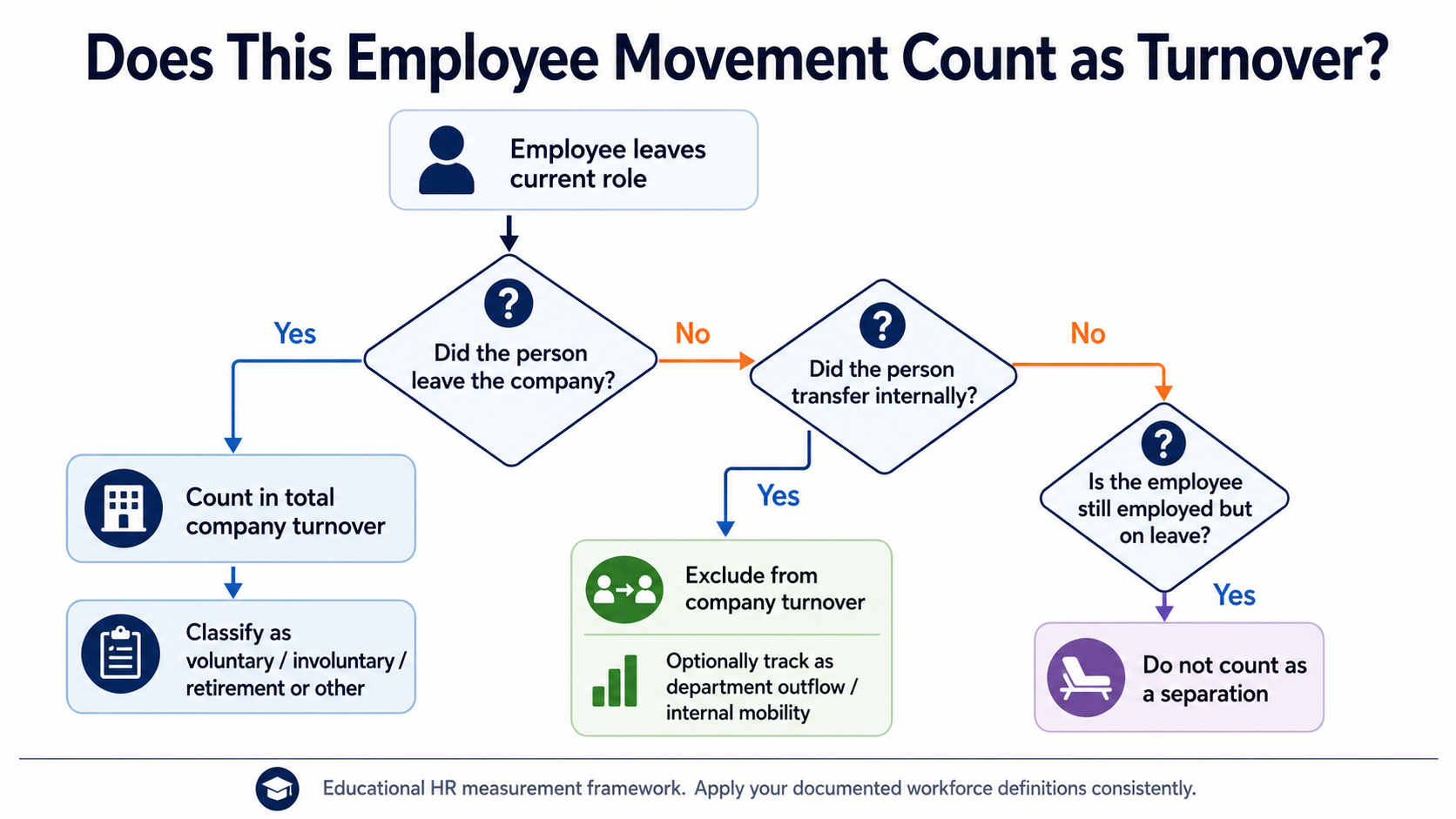
For total company turnover, count genuine exits from the employer’s workforce and apply the same rule every reporting period.
Typical categories include:
- resignations
- terminations for performance or conduct
- layoffs and reductions in force
- retirements
- other permanent separations
However, HR should not lump every category together and stop there. A 15% rate caused primarily by resignations creates a different workforce question from a 15% rate caused by a planned restructuring.
BLS follows a similar distinction in JOLTS: quits are generally employee-initiated, layoffs and discharges are employer-initiated, and retirements and certain other exits are tracked separately.
Do internal transfers count?
Usually not for organization-wide turnover.
If an employee moves from Finance to Operations but remains employed by the company, the organization has not lost an employee.
However, if HR is analyzing department outflow, that transfer matters. The Finance leader still lost capacity even though the company did not lose the worker.
Therefore, distinguish:
- Company turnover: external separations only
- Department turnover: external exits
- Department outflow: external exits plus internal transfers out
Do not call all three metrics “turnover” on the same dashboard.
What about contractors and temporary workers?
Keep the numerator and denominator consistent.
If contractors are not employees in your headcount, their departures should not appear in employee turnover. Likewise, temporary-help workers employed by an agency normally belong in the agency’s employment population rather than the host company’s employee denominator. BLS takes the same employer-of-record approach in its JOLTS definitions.
Which average headcount should HR use?
Use beginning-plus-ending headcount for a relatively stable workforce; use more frequent headcount snapshots when the workforce changes substantially during the period.
The simple method is:
Average headcount = (Beginning + Ending) ÷ 2
That works well when headcount changes gradually.
However, imagine a seasonal employer that begins with 200 people, expands to 500 for several months, then ends the year with 200. The midpoint formula gives an average headcount of 200 even though the company employed far more people for much of the year.
In that situation, calculate:
Average annual headcount = Sum of monthly headcounts ÷ 12
A payroll-period or daily average can be even more precise when reliable data are available, but more precision is not automatically more useful. HR needs a method that is accurate enough, reproducible, and understandable to leadership.
Most importantly, use headcount, not FTE, when the numerator counts individual people. Dividing 20 individual departures by an FTE denominator mixes two different units.
Should HR calculate monthly, annual, or rolling turnover?
The same basic formula works across periods, but the interpretation changes.
Monthly turnover
Suppose March begins with 200 employees, ends with 196, and six employees leave.
Average headcount:
(200 + 196) ÷ 2 = 198
Monthly turnover:
6 ÷ 198 × 100 = 3.03%
Monthly reporting is useful for spotting sudden changes. However, one month can be noisy, especially for smaller teams.
Annual turnover
Annual turnover is usually more useful for year-over-year reporting, workforce planning, and leadership scorecards because it covers an entire business cycle.
Rolling 12-month turnover
For ongoing dashboards, a rolling 12-month rate is often more useful than multiplying one month’s result by 12.
Use:
Separations during the latest 12 months ÷ Average headcount during those 12 months × 100
This smooths short-term volatility while still updating every month.
Should HR annualize monthly turnover?
You can multiply a monthly rate by 12 for a rough annualized projection, but label it as annualized or projected turnover.
Do not present it as actual annual turnover. Seasonal hiring, layoffs, acquisitions, hiring freezes, and unusual resignation periods can make the projection misleading.
HR’s 6-Step Turnover Rate Check
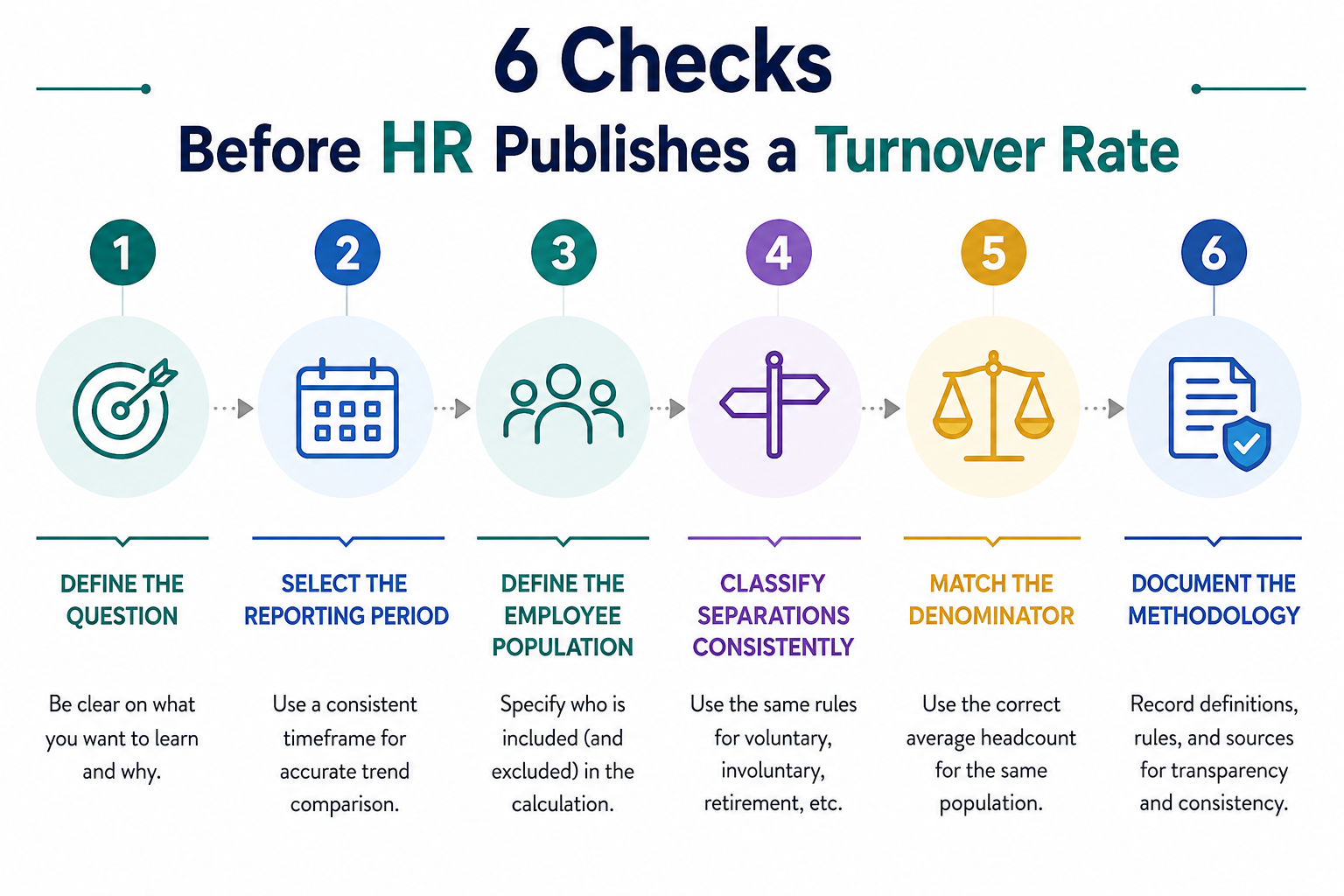
Before publishing the number, run this check:
- Define the purpose. Decide whether you are measuring total turnover, voluntary turnover, new-hire turnover, or another workforce question.
- Choose the period. Monthly, quarterly, annual, or rolling 12-month.
- Define the population. Decide which employees, locations, departments, or employment categories are included.
- Count separations consistently. Keep voluntary, involuntary, retirement, and other exit codes available for segmentation.
- Use a matching denominator. The headcount population must match the employees represented in the numerator.
- Document the method. Put the definition behind the dashboard so another HR analyst can reproduce the calculation.
That last step matters more than it sounds. Two analysts can produce two mathematically correct turnover numbers if they are answering different workforce questions.
Calculate voluntary and involuntary turnover separately
Total turnover tells HR how much workforce movement occurred; voluntary and involuntary turnover help explain why.
Using the earlier example, assume the company’s 34 exits consist of:
- 22 voluntary departures
- 12 involuntary departures
- average headcount of 250
Voluntary turnover:
22 ÷ 250 × 100 = 8.8%
Involuntary turnover:
12 ÷ 250 × 100 = 4.8%
Total:
8.8% + 4.8% = 13.6%
That segmentation makes the metric more actionable. Rising voluntary departures may justify examining manager practices, compensation, scheduling, career opportunities, or employee experience. Meanwhile, rising involuntary departures may point HR toward hiring quality, performance management, restructuring, or workforce-planning issues.
How should HR calculate new-hire turnover?
Use a hire cohort, not the average number of employees with less than one year of tenure.
For example, suppose HR wants a 90-day new-hire turnover metric. Sixty people joined during Q1, and nine left within their first 90 days.
After all 60 hires have had a full 90-day observation window:
90-day new-hire turnover = 9 ÷ 60 × 100 = 15%
Using a completed cohort avoids a common analytics problem: dividing departures by a shrinking “employees currently under 90 days” denominator can create extreme or meaningless percentages.
The same approach works for 30-day, six-month, or first-year turnover. Define the cohort, give each employee the same observation window, and calculate the share who left.
What is a good turnover rate?
There is no universal good turnover percentage.
Compare your result in three ways:
- Your own trend: Is turnover rising or falling using the same methodology?
- Internal segments: Which jobs, managers, locations, shifts, or tenure bands differ materially?
- Relevant external data: How does comparable workforce movement look in your labor market or industry?
For current US context, the BLS June 2026 JOLTS release reported a 3.4% monthly total separations rate, including a 2.0% quits rate and 1.1% layoffs-and-discharges rate for total nonfarm employment.
However, do not compare 3.4% directly with your company’s 13.6% annual turnover and conclude your organization is performing better or worse.
BLS JOLTS produces monthly labor-flow rates, and its separations rate is calculated using monthly employment. Your annual internal turnover calculation may use average annual headcount. The period and denominator therefore differ.
Use BLS data for labor-market context, not as an automatic annual target.
Turnover rate and retention rate are not always opposites
Do not automatically calculate retention as 100% minus turnover.
A true retention calculation normally follows a starting cohort:
Retention rate = Employees from the starting population still employed at the end ÷ Employees at the start × 100
Turnover, by contrast, normally divides all qualifying separations during the period by average headcount.
Therefore, new employees can enter the turnover calculation even though they were never part of the original retention cohort.
For example, a company can retain most of the employees it had on January 1 while simultaneously experiencing heavy turnover among people hired later in the year. Both metrics can be correct.
Does federal or state law dictate the turnover formula?
For ordinary internal HR reporting, the common turnover formula is a measurement convention rather than a universal federal employment-law calculation.
BLS and HR organizations publish methodologies, but employers still need to define their internal population, separation categories, and reporting period consistently.
State and local law generally do not change the arithmetic of an ordinary internal turnover dashboard. However, the separations underneath that metric can involve separate federal, state, or local obligations concerning layoffs, final pay, discrimination, protected leave, notice requirements, or other employment matters.
Therefore, do not treat an HR turnover metric as a substitute for a legal analysis required for a specific termination, reduction in force, benefit plan, government filing, or employment decision.
Common turnover calculation mistakes HR should avoid
The most common problems are definition problems rather than math problems.
Using ending headcount instead of average headcount. If the workforce grew or shrank, a single snapshot can materially change the result.
Mixing employees and FTEs. If departures count people, use people in the denominator.
Comparing monthly and annual percentages. Always label the measurement period.
Counting internal transfers as company exits. Track internal mobility separately.
Combining layoffs and resignations without segmentation. Total turnover may be correct but analytically unhelpful.
Changing definitions midyear. A new calculation methodology can make a trend look better or worse without any real workforce change.
Averaging turnover percentages across departments. Recalculate using combined separations and combined headcount instead. A simple average gives small and large departments equal weight.
Treating annualized turnover as actual turnover. A projection based on one or two months is not a completed-year result.
Ignoring early-tenure exits. Company-wide turnover can hide a serious hiring or onboarding problem.
FAQs on Employee Turnover Rate
What is the formula for employee turnover?
Divide employee separations during the measurement period by average headcount for the same period, then multiply by 100.
For a stable workforce, average headcount can usually be calculated as (beginning headcount + ending headcount) ÷ 2. If headcount changes substantially during the period, averaging monthly or payroll-period headcount snapshots generally provides a more representative denominator.
Do fired employees count toward turnover?
Yes, if HR is reporting total turnover.
Employer-initiated terminations are separations, so they belong in a total-turnover numerator. However, HR should also calculate involuntary turnover separately. Otherwise, a company with frequent layoffs or performance terminations may appear to have the same retention problem as a company experiencing frequent voluntary resignations.
Do layoffs count as employee turnover?
Yes, layoffs normally count in total turnover because employees have separated from the organization.
However, report layoffs separately from voluntary exits. A restructuring can create a temporary spike that says little about employee willingness to stay. If leadership wants a retention-focused measure, voluntary turnover or regrettable turnover may be more informative than total turnover alone.
Can turnover be higher than 100%?
Yes. Turnover can exceed 100% in a high-churn workforce.
For example, a 10-person team with an average headcount of 10 could experience 15 separations during a year if replacement employees also leave. The calculation would be 15 ÷ 10 × 100 = 150%. A result above 100% does not automatically mean the calculation is wrong.
Should internal transfers count toward department turnover?
It depends on what the metric is intended to measure.
An internal transfer should not normally count as company-wide turnover because the worker remains employed. However, a department may want a separate outflow metric that includes transfers because they still create vacancies and workload changes. Name the measure clearly so leaders do not confuse internal movement with employees leaving the company.
Is attrition the same as turnover?
The terms are often used interchangeably, but organizations do not always define them the same way.
Some HR teams use “attrition” for employee loss through resignation or natural workforce reduction, while “turnover” covers a broader set of exits. Because terminology varies, define the metric in your reporting documentation rather than assuming everyone uses the same definition.
How often should HR calculate turnover?
Monthly monitoring plus a rolling 12-month view works well for many employers.
Monthly data helps HR detect sudden changes, while the rolling 12-month rate reduces short-term noise. Annual reporting remains useful for board reports, budgeting, and year-over-year comparisons. Smaller employers may need quarterly or rolling results because one or two exits can cause large monthly percentage swings.
Is employee retention rate 100% minus turnover?
Not necessarily.
Retention normally tracks how many people from a starting employee cohort remain at the end of a period. Turnover generally measures all qualifying separations against average headcount. Because employees hired during the period may appear in turnover but not in the original retention cohort, the two percentages do not always add to 100%.
Conclusion
Use one documented calculation method consistently, then segment the result before deciding whether turnover actually requires action.
A useful employee turnover rate is more than departures divided by headcount. HR should use a denominator that reflects the workforce, distinguish voluntary from involuntary exits, examine early-tenure and department-level patterns, and compare only genuinely comparable periods and benchmarks.
That measurement discipline remains relevant in 2026. SHRM’s 2026 Talent Trends research, based on 2,094 US HR professionals surveyed February 9–20, 2026, found that 42% had experienced difficulty retaining full-time employees during the prior 12 months.
Next, document the calculation in your HR reporting standards and investigate the teams, tenure groups, roles, and exit types driving the result.