A survey platform can be excellent on a laptop and still fail in a warehouse.
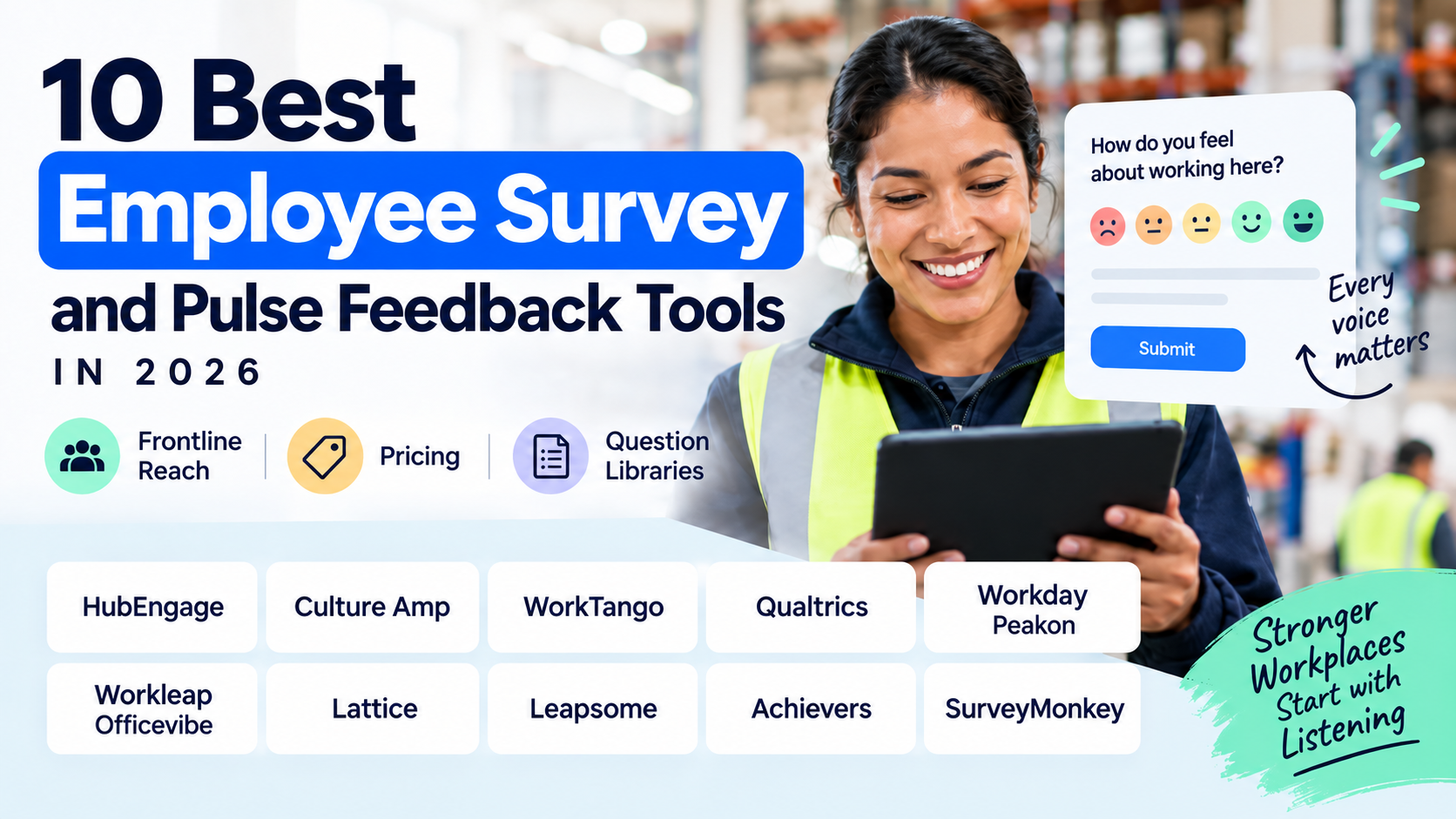
The best employee survey tools in 2026 are HubEngage, Culture Amp, WorkTango, Qualtrics, Workday Peakon Employee Voice, Workleap Officevibe, Lattice, Leapsome, Achievers, and SurveyMonkey. But they solve different problems.
For frontline-heavy organizations, HubEngage and WorkTango stand out because reaching employees without relying on corporate email is built into the product model. Culture Amp has become much stronger for deskless listening with SMS and kiosk access. Qualtrics and Workday Peakon suit larger, more complex listening programs. Officevibe works well when you want a lightweight pulse rhythm. SurveyMonkey remains difficult to beat for flexible survey building and public pricing.
The tool matters. The listening design matters more.
A company can buy a sophisticated employee feedback platform, send a 47-question survey by email to a workforce where half the people rarely check email, celebrate a respectable response rate, and still have a distorted picture of what employees think.
That is the problem this comparison is designed around.
Product capabilities and pricing were checked against current vendor documentation in September 2026. This is a desk-research comparison, not a claim of hands-on product testing.
The 10 Best Employee Survey Tools at a Glance
| Employee survey tool | Best fit | Frontline reach | Question library | Pricing approach |
| 1. HubEngage | Frontline and distributed employee listening | Very strong: mobile app, web, SMS, email, push, QR and digital-display access | Prebuilt templates plus flexible question formats | Custom, primarily based on employee count |
| 2. Culture Amp | Research-led engagement programs and benchmarking | Very strong: email, SMS, kiosk, Slack, Teams and direct links depending on survey type | 40+ ready-to-use survey templates | Annual quote based on employees, products and service tier |
| 3. WorkTango | Frontline surveys and structured action planning | Very strong: mobile, email and kiosk access, including employees without email | Research-backed templates designed with I-O psychologists | Custom pricing, 12-month minimum |
| 4. Qualtrics EmployeeXM | Complex enterprise employee experience programs | Strong: email, SMS, Teams and other enterprise distribution options | 300+ certified pulse questions | Quote-based |
| 5. Workday Peakon Employee Voice | Continuous listening in Workday-heavy organizations | Very strong: SMS, kiosk, mobile app, email, Slack and Teams | 90-question, 23-category model for newer 2026 environments | Quote-based |
| 6. Workleap Officevibe | Simple recurring pulse surveys for small and midsize teams | Good: email, SMS, Slack and Teams, with options for non-desk workers | 122 expert-built questions across 10 engagement drivers | Workleap Standard starts at $4,999 annually |
| 7. Lattice | Engagement surveys connected to performance management | Good: shareable links, QR access and mobile-friendly participation | Research-backed templates, pulse, lifecycle and benchmarking | Engagement starts at $4 per seat/month, $4,000 annual minimum |
| 8. Leapsome | Surveys connected to performance and people processes | Moderate to good: mobile survey response without login after invitation | Expert-verified templates and best-practice question catalog | Quote/calculator based; 14-day trial |
| 9. Achievers | Listening tied closely to employee recognition | Good, especially for organizations already using Achievers | 100+ customizable Voice of Employee templates | Custom pricing |
| 10. SurveyMonkey | Flexible DIY surveys and transparent pricing | Moderate: links, email, Slack, Teams and mobile browser | 90+ HR templates and 1,800+ prewritten questions | Team Advantage $30/user/month; Team Premier $92/user/month, billed annually |
The frontline-reach assessment is editorial. I gave the strongest marks to products that document ways to reach employees without corporate email, including SMS, kiosk access, shared devices, QR codes, employee IDs, or dedicated mobile delivery.
That distinction matters. “Mobile friendly” and “designed for a workforce without company email” are not the same thing.
1. HubEngage: Best Overall for Frontline and Distributed Employee Surveys
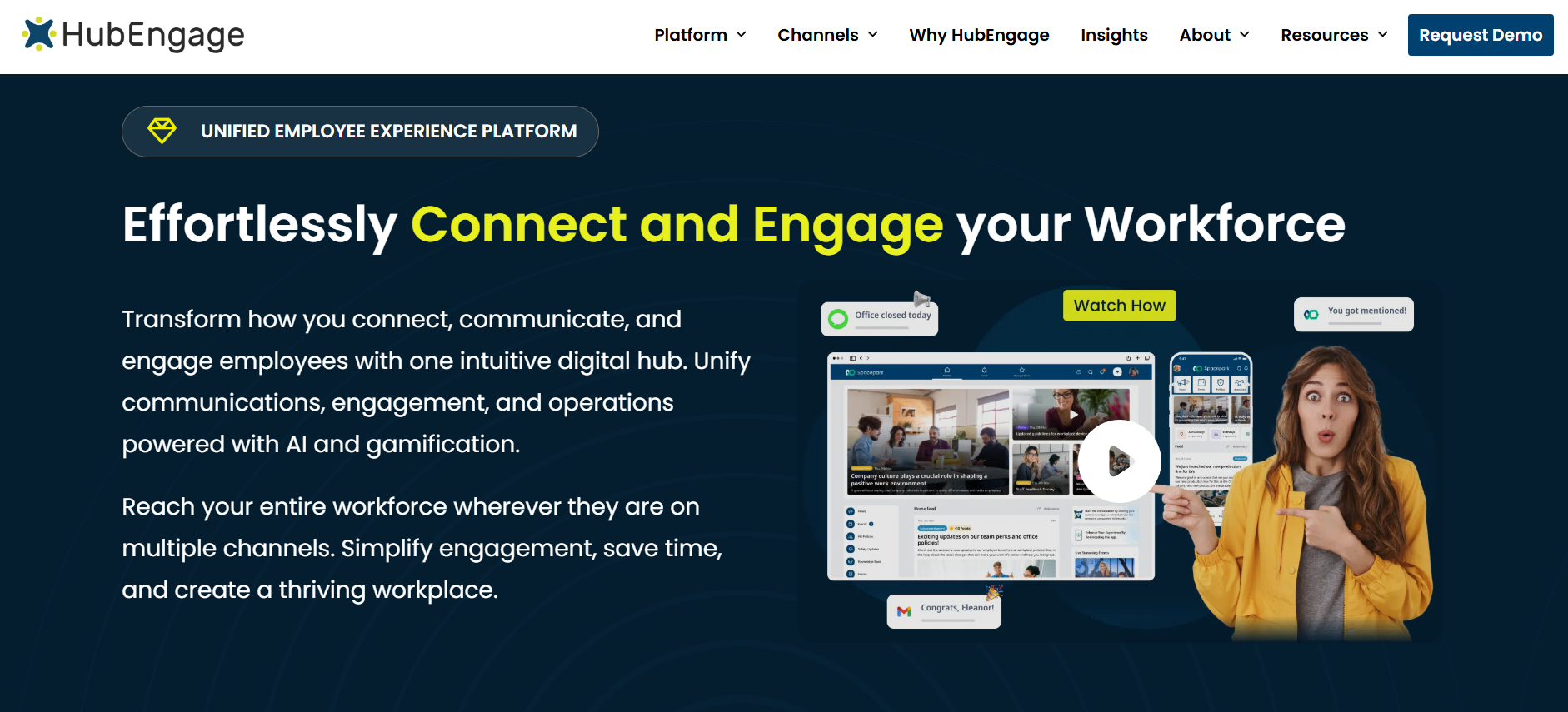
HubEngage takes the first spot because this comparison gives substantial weight to something employee-survey comparisons often treat as an afterthought: whether the survey can reliably get in front of a warehouse associate, nurse, store employee, driver, technician, or restaurant worker.
Its survey platform supports distribution through mobile, web, email, SMS, push notifications, QR codes, and digital displays. That gives HR more routes into a workforce where email may reach managers very well and everybody else inconsistently.
The survey side itself covers engagement surveys, pulse surveys, recurring surveys, anonymous feedback, employee sentiment, multilingual delivery, open-ended responses, ratings, rankings, media-supported questions, and automated reminders. Survey participation can also connect with points and rewards where an organization wants to use incentives.
What I find more useful than the raw feature count is how the surveys sit alongside employee communication.
A retail organization could announce a benefits change in the employee app, send a short follow-up pulse to affected employees, remind nonrespondents through another channel, and then compare results by location or another employee attribute. That is a different operating model from exporting an HRIS list into an isolated survey product four times a year.
The platform can also synchronize workforce data through HRIS and payroll connections, which matters when you want surveys targeted or analyzed by location, department, workforce group, or similar attributes.
The trade-off is equally clear. If you employ 300 office workers who all live in Microsoft Teams and need one annual engagement survey, HubEngage may give you more breadth than you need. Its value becomes more convincing when surveys sit beside employee communications, frontline access, recognition, social participation, or other engagement programs.
Pricing is not published as a fixed per-user figure. HubEngage says proposals depend primarily on employee count, with monthly, annual, and multiyear options. That means buyers need to compare the exact modules and channels in the quote rather than assuming every capability is included.
For organizations where reach is the hard part, the HubEngage employee survey platform deserves an early place on the shortlist.
Best fit: Multi-location, frontline, deskless, or mixed workforces that want employee surveys connected to a broader employee communication and engagement platform.
2. Culture Amp: Best for Research-Led Engagement Surveys and Benchmarking
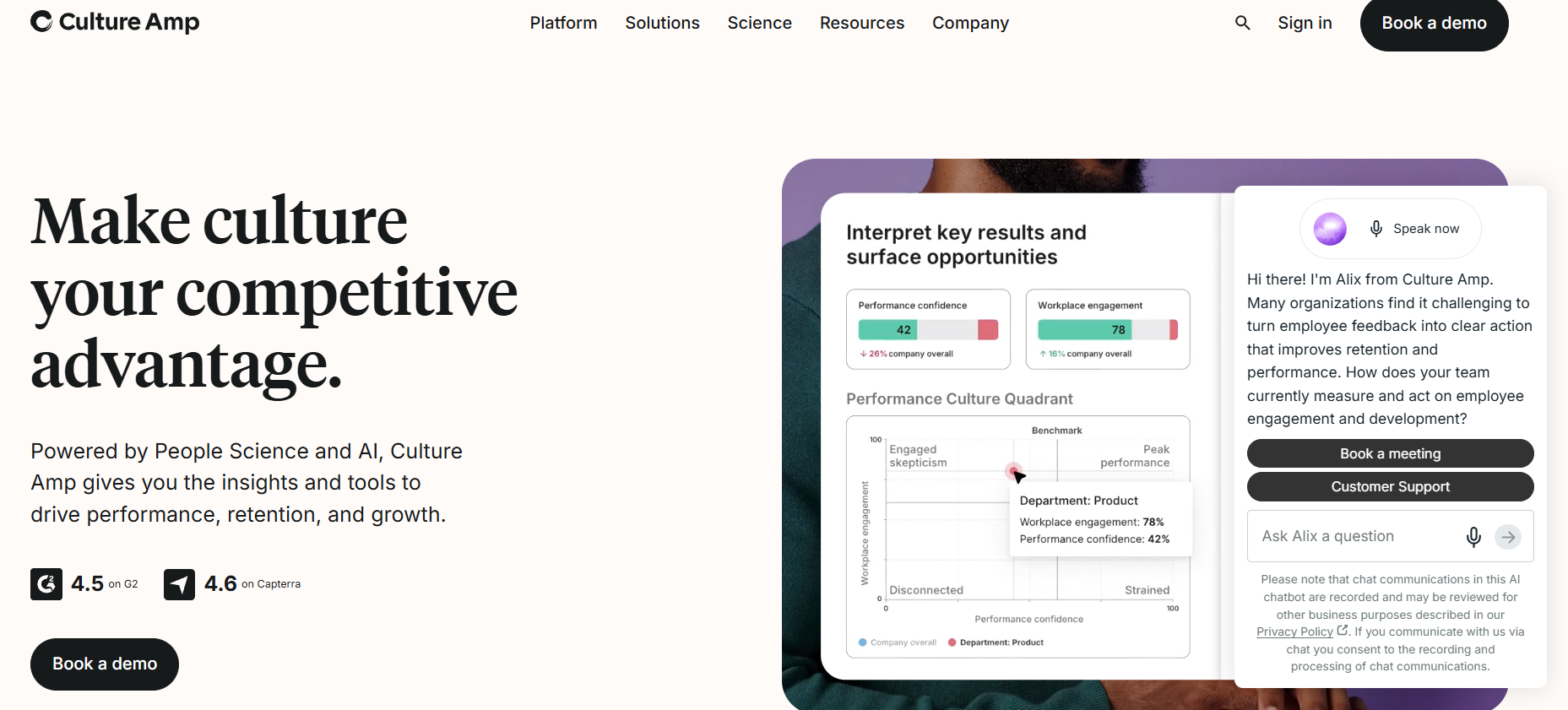
Culture Amp has long had a strong position in employee engagement measurement. What makes it more interesting in 2026 is that its frontline story has improved materially.
It now supports SMS invitations for eligible engagement surveys and kiosk mode for employees without designated email addresses or computers. Kiosk users can access surveys through unique identifiers such as employee or payroll IDs. Survey invitations can also reach employees through email, Slack, Microsoft Teams, or direct links depending on the survey type.
That closes a gap that used to make people-science platforms easier to recommend for corporate populations than for manufacturing, retail, hospitality, or other deskless settings.
Culture Amp’s bigger strength is still survey methodology.
Its Engage product offers more than 40 ready-to-use survey templates developed with data scientists and organizational psychologists. Its standard engagement survey currently contains 57 questions, with a shorter 20-question option for organizations that want a lighter baseline. The platform also provides benchmarking, pulse surveys, onboarding and offboarding surveys, comment summaries, retention analysis, and action planning.
Culture Amp is a good choice when the questions behind the score matter as much as the mechanics of distributing the survey. HR teams that want established constructs, comparison data, and a structured way for managers to respond to results will find more depth here than in a general-purpose survey builder.
The limitation is that this is a substantial employee-experience platform. If your actual requirement is “send six questions to 500 employees every month,” buying Culture Amp solely for pulse surveys may be difficult to justify.
Pricing is annual and quote-based. Culture Amp says cost depends on employee count, the products selected, and service tier.
Best fit: Organizations that care heavily about survey science, benchmarking, manager follow-through, and increasingly, deskless participation.
3. WorkTango: Best Dedicated Survey Platform for Hard-to-Reach Frontline Teams
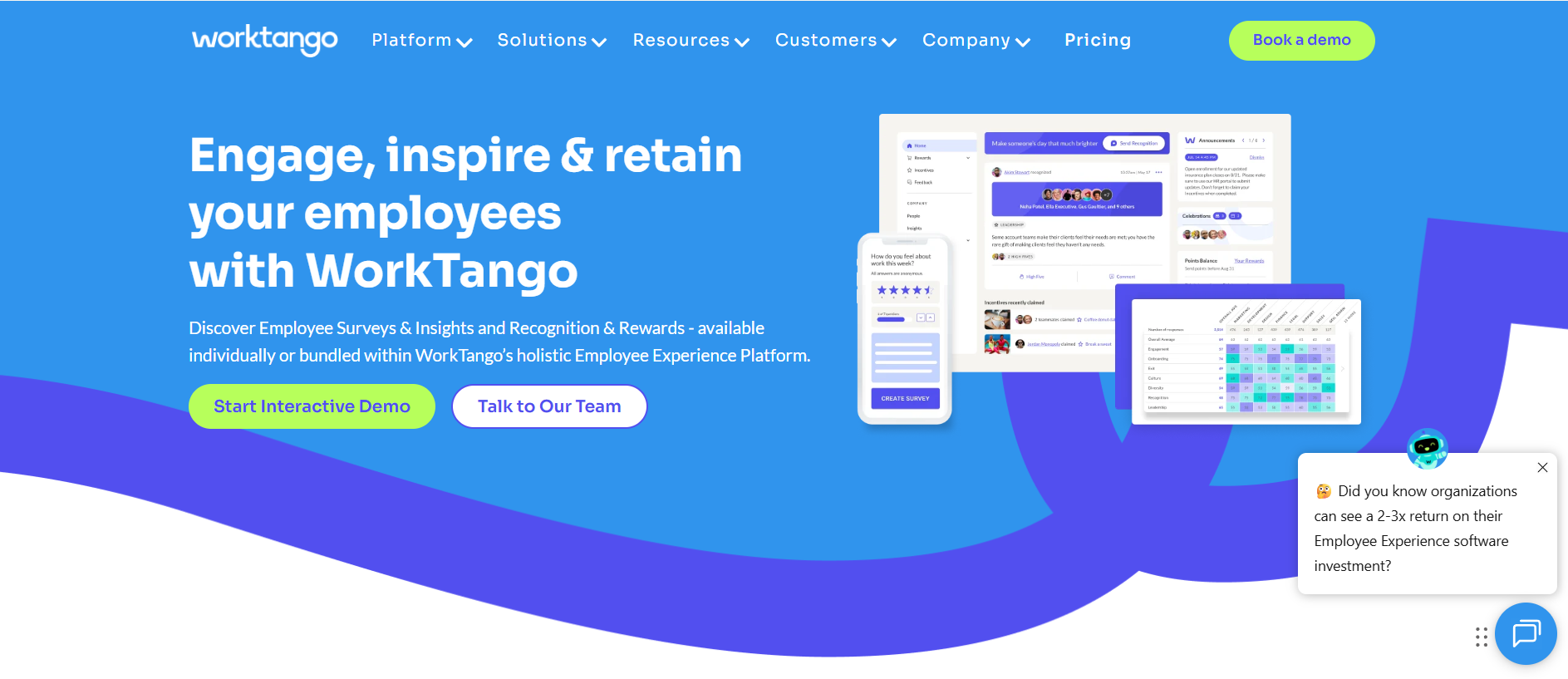
WorkTango gets one thing right that is easy to overlook in a software demo: an employee should not need another account or app merely to answer a survey.
Its employee surveys can be delivered through email or kiosk access, including employees who do not have email addresses. WorkTango also emphasizes mobile participation and has built its survey product around workforce segmentation, confidentiality, and employee feedback rather than adapting a generic forms product for HR.
Its survey methodology includes preconfigured templates designed with I-O psychologists. Organizations can run engagement and pulse programs, eNPS, lifecycle surveys, confidential surveys, and custom questionnaires. Results can flow into role-specific dashboards and action planning rather than stopping at a report.
That last part deserves attention.
Many organizations do not have a survey problem. They have a post-survey problem.
The questionnaire goes out. HR analyzes the results. Executives see a presentation. Managers are told to focus on “communication” and “career development.” Six months later, employees receive another survey asking about the same issues.
WorkTango puts more emphasis than many products on translating results into recommended actions and manager-level follow-through.
Pricing is custom. WorkTango lets organizations buy its employee survey product separately rather than requiring its recognition product as well, and the vendor lists a 12-month minimum contract.
If your priority is a focused listening platform rather than an all-purpose employee app, WorkTango belongs near the top of the list.
Best fit: Distributed organizations that need strong survey access for employees without email and want a structured route from feedback to manager action.
4. Qualtrics EmployeeXM: Best for Complex Enterprise Employee Experience Programs
Qualtrics is what I would look at when the listening program itself is complex.
Maybe you have 40,000 employees. Different business units run different listening programs. Executives want one view while regional HR teams need their own segmentation. Engagement, onboarding, retention, well-being, manager effectiveness, and organizational change are being measured separately. You also need strict controls over who sees which results.
That is where Qualtrics starts to justify its weight.
Its pulse survey product draws from more than 300 certified questions and the EX25 methodology. Surveys can run weekly, biweekly, or monthly, with rotating or randomized question sets. The platform includes configurable anonymity thresholds, role-based dashboards, automated analysis of written comments, manager recommendations, action planning, and external benchmarking.
For distribution, Qualtrics employee-experience programs can use channels including email, SMS, and Microsoft Teams depending on the configuration. That gives it a credible route into mixed workforces rather than limiting the platform to inbox-based surveys.
Qualtrics also allows unlimited engagement and pulse surveys within its People Engage annual subscription terms, although the commercial model itself is quote-based.
The warning is complexity.
A six-question monthly pulse does not become six times better because the software behind it can support a multinational experience-management program.
Smaller HR teams should be realistic about how much of Qualtrics they will actually use. More analytical depth can create more administrative work if nobody owns the listening program after launch.
Best fit: Large organizations with sophisticated employee-experience programs, complex segmentation, multiple survey programs, and mature HR analytics teams.
5. Workday Peakon Employee Voice: Best for Continuous Listening in a Workday Environment
Workday Peakon Employee Voice is one of the strongest products in this comparison for reaching employees who are not sitting in front of an inbox.
Its documented survey channels include email, SMS, kiosk access, the Peakon mobile app, Slack, Microsoft Teams, and Workday experiences. Kiosk mode is specifically designed for employees without business email and can use a unique code or login on a communal or personal device.
That makes Peakon a serious frontline survey option, particularly for organizations already using Workday.
There is also an important 2026 product change buyers should understand.
For Peakon environments created from March 31, 2026 onward, Workday introduced a more flexible question model with 90 questions across 23 categories. It added 26 new questions and three new driver groupings while retiring others. Older environments are transitioning during later Workday release cycles, so two organizations evaluating “Peakon” in 2026 may not yet be working with exactly the same question model.
Peakon’s strength is continuous structured listening. It is less suitable when HR wants a highly flexible forms tool.
Workday’s own documentation notes constraints in the survey methodology, including limitations around one-off surveys and question formats in some configurations. That is a reminder that a purpose-built engagement system and a general survey builder solve different jobs.
Pricing is not publicly listed as a simple number.
Best fit: Larger organizations already invested in Workday that want continuous listening, strong employee segmentation, and credible survey access for workers without company email.
6. Workleap Officevibe: Best for a Lightweight Recurring Pulse Rhythm
Officevibe has a more opinionated approach than many employee survey tools.
Instead of handing HR a giant blank questionnaire and saying “good luck,” it revolves around a recurring pulse model. Its survey library contains 122 expert-built questions covering 10 engagement drivers, including relationships with managers and peers, recognition, personal growth, wellness, alignment, satisfaction, and happiness.
Questions are personalized based on employees’ previous participation and areas where the system needs more data. Officevibe also prevents the same question from being sent to an employee more than once within three months.
That can be useful for an HR team that wants a listening cadence without designing every pulse from scratch.
It can also feel restrictive if you want complete control.
The frontline picture is better than the old “Officevibe equals office employees” assumption suggests. Surveys can be delivered by email, SMS, Slack, or Teams, and Workleap documents ways to include non-desk employees using personal email addresses, shared devices, kiosks, or text-based communication. Employees do have to accept their Workleap invitation before they can receive and answer Officevibe surveys.
Pricing is more visible than most of this market. Workleap currently lists Standard from $4,999 per year and Pro from $11,999, with custom Enterprise pricing for organizations above 250 employees. Those prices cover the broader Workleap product package, so buyers should compare what they need beyond the survey component.
Best fit: Small and midsize organizations that want a structured, recurring employee pulse with less survey-design work.
7. Lattice: Best When Engagement Surveys Need to Sit Beside Performance Management
Lattice makes the most sense when employee listening is part of a broader talent-management system.
Its Engagement product includes pulse surveys, onboarding and exit surveys, eNPS, custom surveys, action planning, benchmarking using Lattice and Mercer data, and automated analysis of survey results.
That creates useful context for HR teams already running performance reviews, goals, one-on-ones, and employee development in Lattice.
The argument is less compelling if you need an isolated pulse-survey tool.
Frontline access has also improved. Lattice introduced shareable survey links that can be distributed through channels such as Slack, email, or QR codes, specifically positioning the change as helpful for deskless employees who may take surveys on their phones.
There is still a difference between “deskless friendly” and a platform built from the beginning around no-email employee access. If frontline participation is central to your purchase, I would make Lattice demonstrate the exact login and survey path your employees will use rather than awarding points because QR sharing exists.
Lattice is unusually transparent on price for this category. As of September 2026, Engagement is listed at $4 per seat per month, billed annually. Lattice also states a minimum annual agreement of $4,000.
That can make budgeting easier than products that require a discovery call before buyers get any commercial reference point.
Best fit: Organizations already interested in Lattice for performance, goals, or talent processes and that want engagement data in the same environment.
8. Leapsome: Best for Surveys Connected to a Broader People Platform
Leapsome sits in a similar buying conversation to Lattice, although its survey model has its own strengths.
Organizations can use research-backed templates for engagement, pulse, onboarding, project, and other surveys, create custom questionnaires, automate recurring rounds, adjust anonymity settings, rotate questions, track eNPS, and use automated analysis of written feedback. Its September 2026 documentation also confirms that teams can start from predefined surveys or a catalog of established survey questions.
Survey participants can respond from a phone, and an employee who receives a valid invitation link does not need to log into Leapsome before answering.
That removes useful friction.
It does not make Leapsome as naturally frontline-oriented as HubEngage, WorkTango, Culture Amp, or Peakon because its documented participation flow still starts heavily around invitations and employee identity rather than multiple dedicated deskless channels.
Leapsome itself recommends keeping a monthly engagement survey to around 10 questions, rotating larger question catalogs when necessary, including an open-ended item, and using anonymity thresholds. That is sensible guidance because pulse software becomes counterproductive when “continuous listening” turns into continuous questioning.
Pricing varies according to headcount, selected modules, and contract term. Leapsome offers a 14-day trial and uses a one-year minimum contract. Customer-success services have additional commercial thresholds for smaller contracts.
Best fit: Growing organizations that want surveys connected to performance, feedback, development, and other people-management processes.
9. Achievers: Best When Employee Listening and Recognition Belong Together
Achievers approaches employee feedback from a different direction.
Its core reputation is in recognition and rewards, so its Voice of Employee and Pulse products make the most sense when an organization wants to connect listening with recognition, communication, and the broader employee experience.
Voice of Employee includes surveys, polls, quizzes, forms, lifecycle feedback, HRIS synchronization, reporting, and more than 100 customizable templates. Its separate Pulse capability uses research-backed survey designs, company benchmarks, heatmaps, and leader action guidance.
That can work well if an organization already uses Achievers and does not want survey findings trapped in another system.
For example, suppose employee feedback shows that recognition is uneven across several operating locations. A platform that already contains recognition behavior and employee listening gives HR more context than a standalone questionnaire.
I would be more cautious about choosing Achievers solely because you need a survey tool for a hard-to-reach frontline population. Its broader platform supports mobile communication and frontline use cases, but the public survey documentation is less explicit about no-email survey distribution than products such as WorkTango, Peakon, or Culture Amp.
That does not mean it cannot serve the workforce. It means the vendor should prove the exact workflow during evaluation.
Pricing is custom rather than publicly posted.
Best fit: Organizations that already see recognition and employee listening as connected programs rather than separate HR activities.
10. SurveyMonkey: Best Flexible Survey Builder With Clear Public Pricing
SurveyMonkey is the odd product in this list, and that is exactly why it belongs here.
It is not primarily an employee-experience platform. It is a broad survey platform that HR teams can use very effectively.
That difference can save money and complexity when you do not need an elaborate engagement operating system.
SurveyMonkey currently offers more than 90 HR survey templates and a library of more than 1,800 prewritten questions on applicable paid plans. Its employee use cases include engagement, pulse surveys, onboarding, benefits, manager feedback, exit surveys, and other workforce topics. Surveys can be anonymous, segmented using uploaded employee data, and shared through channels including email, Slack and Microsoft Teams.
Its public pricing is also refreshingly specific.
Team Advantage currently costs $30 per user per month with a three-user minimum, billed annually, and includes up to 50,000 responses per year. Team Premier is $92 per user per month with the same minimum and up to 100,000 responses. Enterprise pricing is custom. SurveyMonkey lists potential response overage charges of up to $0.15 per response on paid plans.
Where does it lose ground?
Employee identity, manager workflows, workforce hierarchy, HRIS-driven segmentation, action plans, and continuous engagement measurement can be much deeper in dedicated employee-listening platforms.
A 200-person business that wants quarterly surveys may never miss those capabilities.
A 30,000-person company trying to give 1,500 managers controlled access to team-level engagement results probably will.
Best fit: Organizations that value survey flexibility, a huge general question library, straightforward pricing, and lower platform complexity.
Frontline Reach Is More Than Making the Survey Mobile-Friendly
This deserves its own section because software comparisons routinely get it wrong.
Almost every modern survey can open on a phone.
That tells you very little about whether the product can reach frontline employees.
Picture an employee starting a 6 a.m. shift at a distribution center.
She does not have a corporate inbox. She has never logged into your HR portal from her personal phone. The company does not expect her to install five workplace apps. Her supervisor controls when the team can step away from the floor.
Can she still answer your employee survey?
That question leads to a much better product evaluation.
A credible frontline survey setup might use SMS, a kiosk code, a QR poster in a break room, a dedicated employee app, a shared tablet, or another authentication method that does not assume everybody has Microsoft 365 credentials.
Then another question appears: can the system still connect her response to the correct location or workforce segment while protecting the confidentiality promised to employees?
That is harder.
It is one reason HubEngage, WorkTango, Culture Amp, and Workday Peakon rank strongly in this comparison. Each documents mechanisms designed for populations beyond the normal corporate inbox.
If a substantial percentage of your employees work in stores, hospitals, plants, hotels, distribution centers, restaurants, vehicles, construction sites, or the field, I would make vendors demonstrate this journey live.
Do not ask, “Do you support frontline employees?”
Give them an employee profile with no corporate email and ask them to get that person into a confidential survey.
Question Libraries: Bigger Is Not Automatically Better
Employee survey software marketing has turned question libraries into a numbers contest.
Qualtrics offers more than 300 certified questions for its pulse program. Officevibe uses 122 expert-built questions. Achievers offers more than 100 customizable templates. Culture Amp has more than 40 ready-to-use survey templates. SurveyMonkey gives buyers access to more than 1,800 prewritten questions across its wider survey library.
Those numbers cannot be compared directly.
A template is not a question. A general survey question bank is not the same as a validated employee-engagement model. A larger library can create more choice while also making it easier for an inexperienced administrator to build a messy survey.
The more useful question is: does the library help you measure something consistently enough to make a decision?
Consider manager support.
A strong listening program does not need 27 different questions about managers because the software happens to provide them. It needs a stable set of questions tied to a clear construct, enough continuity to track movement, and room for targeted follow-ups when something changes.
For teams building or reviewing their own question framework, the federal government’s NIOSH Worker Well-Being Questionnaire is also worth reading. The revised 2026 WellBQ covers five broad domains spanning work experience, workplace policy and culture, physical environment and safety, health, and life outside work. It is a useful reminder that employee experience extends beyond “Would you recommend this company?”
For recurring pulse surveys, shorter usually wins.
A pulse should answer a current question, not quietly become the annual engagement survey sent twelve times.
If you are planning the cadence as well as selecting software, the TurnOnWork guide to employee engagement pulse surveys covers question design, frequency, and follow-through in more detail.
A Survey Tool Should Make Anonymity Understandable, Not Mysterious
“Anonymous survey” is easy to put on an invitation.
The details are harder.
HR still wants to know whether one location has a manager problem. Leaders want scores by department, tenure, role, shift, or geography. Employees want confidence that a manager cannot work backward from those same filters and identify who wrote a critical comment.
Those goals can conflict.
Good survey software therefore needs more than an anonymous toggle. It needs sensible reporting thresholds, permissions, clear treatment of written comments, and rules around small employee groups.
This becomes especially important for frontline teams.
Imagine a location with seven employees on the night shift. If six people give positive ratings and one employee writes a detailed complaint about the supervisor, a dashboard can technically be “anonymous” while still making the author fairly obvious.
Your vendor should be able to explain exactly what managers see in that situation.
I would also ask whether administrators can identify who has completed a confidential survey without seeing how that person answered. That distinction can support reminders while protecting responses, but employees should understand how the process works.
Trust is part of survey design. Software settings cannot repair a listening program employees do not believe.
The Best Pulse Software Helps You Stop Asking Questions Too
Survey fatigue is often blamed on cadence.
The real cause is frequently lack of purpose.
Employees can tolerate a short monthly pulse when they see a connection between the question and something happening at work. They become skeptical when HR keeps asking how communication could improve and communication never changes.
A good platform should therefore help you manage question rotation, survey frequency, reminder volume, participation, and trend continuity.
But software cannot decide whether you have earned the right to ask again.
Before each survey, somebody should be able to answer three questions:
What decision could this feedback change?
Who will own the response?
When will employees hear what happened?
If those answers are vague, delaying the survey may produce better long-term data than sending another pulse.
Pricing Employee Survey Software: Compare the Listening Program, Not the License
Pricing in this category is frustratingly inconsistent.
SurveyMonkey publishes exact plan prices. Lattice gives buyers a per-seat price for Engagement. Workleap publishes starting annual package prices.
Most of the larger employee-experience platforms ask you to request a quote.
That makes a direct price table look more precise than the market really is.
There are also costs hiding around the survey itself.
SMS delivery may be packaged differently from email. Advanced benchmarks may depend on plan. AI analysis, consulting, implementation, manager access, integrations, premium support, additional modules, or minimum contract values can change the economics.
Your headcount model can matter too.
Suppose you have 8,000 employees but only three HR administrators. A product priced by survey author may behave very differently from one priced against the entire workforce.
That is why I would give every shortlisted vendor the same purchasing scenario.
Price a three-year program for your real headcount, expected workforce growth, survey frequency, required languages, SMS volume, integrations, manager dashboards, implementation, and support.
Then ask what happens when headcount rises 15%.
The cheapest survey is rarely the one with the lowest line item if your HR team has to spend days manually cleaning employee lists, chasing locations, rebuilding reports, and distributing results after every cycle.
Which Survey Tool Is Best for a Frontline Workforce?
For a predominantly frontline workforce, I would start with HubEngage, WorkTango, Culture Amp, and Workday Peakon before widening the field.
They arrive there for different reasons.
HubEngage makes sense when surveys are part of a broader communication and employee-engagement problem and you need several routes to reach workers.
WorkTango makes sense when the survey program itself is the priority and no-email or kiosk access needs to be straightforward.
Culture Amp is particularly interesting for organizations that want established survey methodology and benchmarking without giving up SMS and kiosk access.
Workday Peakon becomes much more attractive when Workday is already your employee-data foundation and continuous listening is part of the HR operating model.
Qualtrics can absolutely support large frontline programs too, particularly in complex enterprises. I would place it higher when analytical depth and enterprise program management outweigh simplicity.
For more on the measurement problem beyond survey software, the TurnOnWork guide to measuring employee engagement looks at participation, segmentation, operational signals, and what to do when one workforce group is missing from the data.
Which Tool Is Best for a Smaller Company?
For a smaller office-based organization, this ranking changes.
SurveyMonkey may be enough.
Officevibe can be a stronger choice if you want a recurring employee pulse that runs with relatively little design work.
Lattice or Leapsome make more sense when the survey will sit beside performance reviews, goals, feedback, and development.
Buying Qualtrics for a 150-person company that wants a quarterly five-question pulse can create a lot of software around a relatively simple problem.
The right product is not the one that can do the most.
It is the one your team can run well.
Which Employee Survey Tool Has the Best Question Library?
There is no useful single winner because the libraries serve different purposes.
Qualtrics has one of the deepest dedicated enterprise EX question sets in this comparison, with more than 300 certified pulse questions.
Officevibe is more opinionated, using 122 questions across 10 engagement drivers inside its recurring pulse model.
Culture Amp stands out for research-led survey templates and benchmarking rather than competing solely on raw question count.
Workday Peakon now has a streamlined 90-question model across 23 categories for newer 2026 environments.
SurveyMonkey offers the widest general-purpose choice, with more than 1,800 prewritten questions, but that library extends well beyond employee engagement.
If you have a mature organizational psychology or people-analytics function, flexibility may matter more.
If one HR manager is setting up the program between payroll deadlines, a smaller, well-structured library can be a better product.
The Frontline Test I Would Run Before Signing a Contract
Skip the perfect demo employee.
Give the vendor a harder one.
Tell them you have a Spanish-speaking employee on the night shift at a food-processing plant. The employee has no company email address, uses a personal Android phone, and shares a supervisor with 22 other workers.
Then ask the vendor to show the whole journey.
How does that employee receive the survey?
How do they authenticate?
Can they respond in the correct language?
What does HR know about their completion status?
What does the supervisor see?
When does a small group become too small to report separately?
How does the employee know the survey is confidential?
What happens if they do not respond?
Can the next reminder reach them somewhere other than email?
You will learn more from those ten minutes than from half an hour of dashboard slides.
Then repeat the exercise for the manager.
Give the manager a poor score on workload, strong results on recognition, and 18 written comments. Ask what happens next.
Can the manager understand the problem without an HR analyst sitting beside them?
Can HR assign an action?
Can the organization check whether that action improved the next survey?
That is employee-listening software.
The questionnaire is only the beginning.
How to Choose Among These 10 Employee Survey Tools
Start with reach.
If the people whose opinions you most need are the least likely to receive the survey, every downstream feature becomes less valuable.
Then look at the question model. Decide whether you need a research-led engagement framework, a flexible questionnaire builder, or both.
After that, inspect anonymity and segmentation together. You need enough employee context to locate problems without creating reporting groups so narrow that confidentiality becomes questionable.
Next comes action.
Ask how results reach managers, how managers know what to do next, and how HR sees whether anything happened.
Finally, price the complete listening program.
That sequence tends to produce a better shortlist than comparing AI summaries, colorful dashboards, and library size first.
Final Verdict
If I were building a shortlist in 2026, I would not send all 10 vendors an RFP.
For a frontline or distributed workforce, I would start with HubEngage, WorkTango, Culture Amp, and Workday Peakon, then add Qualtrics if enterprise complexity calls for it.
For a corporate workforce that wants rigorous engagement measurement and benchmarking, Culture Amp and Qualtrics move higher.
For an organization already structuring its people processes around performance software, Lattice or Leapsome can keep surveys closer to the rest of the manager experience.
If you want recognition and employee listening in the same platform, Achievers deserves consideration.
For a smaller organization that primarily needs good surveys rather than an employee-experience platform, SurveyMonkey or Officevibe may be the more sensible buy.
And if your workforce is difficult to reach, do not let a beautiful analytics screen distract you from the first question:
Can your employees actually get into the survey?
Everything else depends on that.
Frequently Asked Questions
What is the best employee survey tool in 2026?
HubEngage is the strongest overall choice in this comparison for organizations with frontline and distributed employees because of its multi-channel survey delivery and broader employee-engagement capabilities. Culture Amp is particularly strong for research-led engagement programs, WorkTango for dedicated frontline listening, and Qualtrics for complex enterprise programs.
What is the best pulse survey software for frontline employees?
HubEngage, WorkTango, Culture Amp, and Workday Peakon are strong options when frontline access is a priority. Their documented delivery options go beyond conventional corporate email, using combinations of SMS, kiosk access, mobile apps, QR codes, shared devices, and other channels.
Which employee survey tool has the largest question library?
SurveyMonkey offers more than 1,800 prewritten questions across its broader survey platform. Among dedicated employee-experience products, Qualtrics advertises more than 300 certified pulse questions. A larger library is not automatically better, however. Survey methodology, benchmarking, question consistency, and action planning can be more important than raw question count.
How much does employee survey software cost?
Pricing varies widely. SurveyMonkey Team Advantage is currently $30 per user per month when billed annually, with a three-user minimum. Lattice Engagement is listed at $4 per seat per month with a $4,000 annual agreement minimum. Workleap Standard starts at $4,999 annually. HubEngage, Culture Amp, WorkTango, Qualtrics, Workday Peakon, Achievers, and several other platforms use custom or quote-based pricing.
How many questions should an employee pulse survey include?
A practical pulse usually contains roughly three to 10 focused questions. The appropriate number depends on the purpose and workforce. A five-question monthly check-in can make sense for a frontline team, while an annual baseline engagement survey may reasonably be much longer. The key is to avoid turning every pulse into a full engagement survey.
Can employees complete surveys without a company email address?
Yes, on some platforms. HubEngage supports channels including SMS, mobile, web, QR, and other communication routes. WorkTango supports kiosk participation for employees without email. Culture Amp offers kiosk access and SMS for eligible engagement surveys. Workday Peakon supports kiosk and SMS access for workers without business email. Always test the exact authentication process before purchasing because the experience differs considerably between vendors.
Are employee pulse surveys anonymous?
They can be, but “anonymous” means different things depending on the product and configuration. Check reporting thresholds, segmentation rules, written-comment handling, administrator permissions, and whether managers can see small employee groups. Employees should also be told clearly what information is collected and who can access the results.
Is SurveyMonkey good enough for employee engagement surveys?
For many smaller and midsize organizations, yes. SurveyMonkey offers extensive templates, anonymous surveys, employee-data segmentation, multiple distribution options, and public pricing. Dedicated employee-experience platforms become more valuable when you need HRIS-driven employee hierarchies, complex benchmarking, controlled manager dashboards, frontline authentication, and structured action planning at scale.