Key Takeaways
-
Fix the causes, not just the attendance numbers. Illness, unpredictable schedules, burnout, transportation difficulties, caregiving responsibilities, and poor working conditions can all contribute to employee absenteeism.
-
Make scheduling more predictable. Publish rosters earlier, reduce unnecessary last-minute changes, provide adequate recovery time, and allow reasonable employee input into shift assignments.
-
Equip frontline managers to prevent avoidable absences. Supportive conversations, consistent call-out procedures, early intervention, and practical problem-solving work together better than attendance warnings alone.
-
Measure attendance accurately and fairly. Track unplanned absence hours, frequency, staffing disruptions, and associated costs while distinguishing protected leave from attendance violations.
-
Treat absenteeism reduction as an operational improvement program. Connect scheduling, employee experience, communication, workforce planning, and manager accountability rather than assigning the entire problem to HR.
What Is Employee Absenteeism, and Why Does It Matter for Frontline Teams?
Employee absenteeism is time missed from scheduled work. For workforce operations, the most useful distinction is between planned absences, unexpected absences, protected leave, and attendance-policy violations.
An employee who takes approved vacation, a nurse who uses protected medical leave, and a warehouse worker who misses a shift without notifying anyone create different staffing situations. They should not be treated as the same attendance problem.
| Attendance category | What it means | Appropriate management response |
|---|---|---|
| Planned absence | Approved vacation, scheduled time off, or other authorized leave | Include it in workforce planning |
| Unplanned absence | An unexpected inability to work a scheduled shift | Arrange coverage and determine the appropriate leave classification |
| Legally protected absence | Time off covered by applicable leave or accommodation protections | Respect legal rights and arrange coverage without prohibited penalties |
| Unexcused absence | An absence that violates an applicable, lawful attendance policy after relevant exceptions are considered | Investigate fairly and apply consistent procedures |
| Tardiness | Arriving after the scheduled start time | Assess frequency, circumstances, and operational impact |
| No-call, no-show | Missing a shift without notifying the employer through an expected channel | Attempt contact, check for emergencies or protected circumstances, then follow policy |
These distinctions matter because excessive absenteeism at work is not always evidence of poor commitment.
An employee may want to work but be unable to because the roster changes unexpectedly, reliable transportation is unavailable, or a medical condition requires leave.
Another employee may have repeated unexplained absences despite reasonable scheduling arrangements and adequate support.
Effective employee attendance management requires employers to distinguish these situations before deciding how to respond.
The operational cost of missed shifts
Frontline employee absenteeism is especially disruptive because much of the work must happen at a specific place and time.
A production line needs qualified operators. A healthcare unit requires appropriate staffing. A retail store cannot postpone customer service until an absent employee returns.
Unexpected absences can lead to:
-
Overtime expenses, temporary staffing costs, and last-minute coverage arrangements.
-
Higher workloads and fatigue among employees who remain on duty.
-
Production delays, longer customer wait times, and reduced service capacity.
-
Training and quality problems when replacements lack role-specific experience.
-
Increased manager time spent arranging coverage instead of supervising operations.
The effects can compound. An understaffed team relies on overtime, workers become fatigued, and further absences make the schedule even harder to stabilize.
This does not mean every absence should be prevented. Sick employees may need time to recover, and certain absences are legally protected. The objective is to reduce avoidable disruption while maintaining employee health, safety, and legal rights.
Employee absenteeism vs. employee turnover
Absenteeism and turnover are related workforce challenges, but they measure different outcomes.
Absenteeism concerns missed scheduled work while someone remains employed. Turnover occurs when an employee leaves and the organization must replace them.
Both can share underlying contributors, including burnout, weak supervision, inadequate staffing, and unpredictable working hours. However, reduced absenteeism does not automatically mean turnover will decline.
HR teams should monitor attendance, turnover, employee feedback, and staffing levels together instead of assuming that improving one metric will fix the others.
What Are the Most Common Causes of Absenteeism Among Frontline Workers?
The common causes of absenteeism in the workplace include illness, injury, work-related fatigue, schedule conflicts, caregiving responsibilities, transportation difficulties, burnout, and poor working conditions. For shift-based organizations, the way work is scheduled and managed can make these challenges more difficult.
1. Unpredictable schedules and frequent shift changes
A retail associate may arrange child care for a Saturday morning shift, only to discover that the schedule has moved to Saturday evening.
A hospitality employee might be asked to cover several late shifts after an earlier roster indicated daytime work.
These changes create conflicts with responsibilities outside work. Employees may have limited ability to rearrange transportation, child care, second jobs, or medical appointments.
Predictable scheduling gives employees more time to plan and reduces unnecessary conflicts.
There is useful evidence for treating scheduling as an operational improvement opportunity. The Stable Scheduling Study, conducted with Gap stores, found that a scheduling intervention increased median sales by 7% and labor productivity by 5% in participating treatment stores.
The study did not establish that absenteeism fell by those percentages. Its relevance here is that more stable scheduling can improve business performance rather than simply increase labor costs.
2. Shift fatigue, long hours, and insufficient recovery
Shift worker absenteeism can become a recurring problem when employees receive inadequate recovery time between demanding shifts.
Night work, rotating schedules, repeated overtime, and extended hours can interfere with sleep and responsibilities outside work.
The CDC’s National Institute for Occupational Safety and Health (NIOSH) emphasizes that work-related fatigue can impair attention, judgment, reaction time, and safety. Its guidance, updated July 14, 2026, identifies nonstandard work schedules, extended hours, stress, and physically demanding work as potential contributors.
The practical implication is that managers should not treat repeated fatigue complaints as an individual motivation problem without reviewing the roster.
For example, regularly asking employees to close a restaurant late at night and return for an early opening shift may create an avoidable recovery problem.
Reducing unnecessary quick turnarounds, reviewing overtime concentration, and protecting rest periods should be part of workplace attendance improvement.
3. Employee burnout and unsustainable workloads
Burnout can contribute to absenteeism when employees experience ongoing exhaustion, pressure, and insufficient support.
This is particularly relevant in understaffed healthcare facilities, production environments, busy retail locations, and hospitality operations where employees must maintain performance during unpredictable demand.
Gallup’s workplace burnout research associates frequent burnout with increased sick-day use and reduced performance confidence. The relationship deserves attention, although it should not be interpreted as proof that every absence is caused by burnout.
A common operational mistake is to respond to absenteeism by permanently increasing the workload of employees who consistently attend.
That approach may maintain short-term coverage but increase fatigue and dissatisfaction across the team.
Supervisors should examine workload distribution, staffing adequacy, break practices, overtime, and recovery before assuming employees are simply unwilling to work.
4. Transportation and caregiving barriers
For hourly workers, reliable attendance can depend on circumstances employers do not directly control.
Common challenges include unreliable public transportation, child care arrangements that do not match shift times, eldercare responsibilities, and unexpected family emergencies.
Consider a warehouse employee whose shift starts at 5 a.m. If public transportation does not operate early enough and the employee’s vehicle is unavailable, punctual attendance becomes difficult.
An employer cannot eliminate every transportation problem. However, it may be able to offer a compatible shift, adjusted start time, established carpool arrangements, or a predictable scheduling pattern.
These interventions should be considered where operationally feasible, rather than treating every logistical difficulty as a disciplinary matter.
5. Safety problems, illness, and physical working conditions
Unsafe or physically demanding work can contribute to injuries, illness, fatigue, and medically necessary absences.
In manufacturing, repetitive physical tasks and inadequate ergonomics deserve attention. In healthcare, infectious disease exposure and demanding clinical work can affect attendance. Hospitality employees may face extended periods of standing, lifting, and working in hot environments.
Organizations should investigate relevant health and safety risks, improve equipment and working practices, and support appropriate recovery.
Reducing recorded sick leave by pressuring sick employees to attend is not the same as improving workforce health. It can create presenteeism, where employees are physically present but unable to work effectively or safely.
6. Poor manager relationships and communication failures
Employees may become less willing to raise scheduling problems when managers respond inconsistently, dismiss concerns, or criticize legitimate requests for time off.
Poor communication can also create administrative attendance problems.
A worker might not know that a shift changed, may be unable to access the scheduling system, or may report an absence to someone who fails to inform the supervisor responsible for coverage.
These problems are particularly common risks in deskless environments where employees do not routinely check corporate email.
Employers should therefore examine both the employee experience and the reliability of their communication procedures.
TurnOnWork’s guide to frontline employee communication strategies explains how organizations can design communication around different shifts, locations, and levels of digital access.
How to Reduce Absenteeism in the Workplace Step by Step
The most effective approach is to identify where missed shifts occur, understand why they happen, remove preventable barriers, and improve the consistency of manager responses. These absenteeism reduction strategies are designed for frontline and shift-based operations, where attendance affects staffing coverage immediately.
Step 1: Establish an accurate attendance baseline
Start by examining attendance records from the previous 8–12 weeks, or a longer period if seasonal patterns are important.
Analyze employee attendance by location, department, shift, day of the week, job role, and tenure where the data is sufficient to protect employee privacy.
Look for operational patterns.
For example, one store may experience frequent Monday morning call-outs. A manufacturing facility might have more unplanned absences after consecutive overtime shifts. Another location may have a sharp increase in early-tenure attendance problems.
These patterns help identify where investigation should begin. They do not prove misconduct or establish the underlying cause.
Track protected leave separately from attendance-policy violations. HR should define appropriate categories before managers use attendance dashboards for coaching or disciplinary decisions.
Also check data quality. Payroll records, scheduling software, and manager-maintained attendance logs may classify the same event differently.
A clean baseline is essential before evaluating employee absenteeism solutions.
Step 2: Make work schedules more predictable
One of the most practical ways to reduce absenteeism in shift-based workplaces is to give employees more advance notice and reduce unnecessary schedule disruption.
Organizations can improve scheduling by:
-
Publishing rosters as far in advance as operationally practical.
-
Keeping employee start times and assigned days reasonably consistent.
-
Collecting availability and scheduling preferences before finalizing rosters.
-
Limiting unnecessary last-minute changes.
-
Establishing a transparent process for shift exchanges.
-
Reviewing consecutive working days, overtime, and recovery periods.
Where practical, recurring shifts can help employees arrange transportation and caregiving responsibilities.
Predictability does not require eliminating flexibility. A strong scheduling process provides stable core assignments while allowing controlled changes when genuine operational needs arise.
Managers should also distinguish employee-requested swaps from employer-driven schedule changes.
2026 consideration: Some U.S. jurisdictions impose specific scheduling requirements. For example, Seattle’s Secure Scheduling Ordinance requires covered retail and food-service employers to provide schedules at least 14 days in advance, with additional obligations concerning certain changes and rest periods.
These obligations are jurisdiction- and employer-specific rather than nationwide requirements. Employers should review the Seattle Office of Labor Standards guidance and applicable local rules before changing their policies.
Step 3: Reduce avoidable fatigue and understaffing
Attendance programs can fail when managers focus on call-outs but ignore the workload that remaining employees must absorb.
If the same employees repeatedly cover staffing gaps through overtime, the organization may be creating additional fatigue risks.
Review scheduling alongside workload and staffing requirements.
For example, a distribution center experiencing repeated overnight absences should examine staffing coverage, overtime distribution, workload peaks, and recovery periods before introducing stronger attendance penalties.
An effective approach may involve cross-training additional employees, maintaining qualified relief coverage, or changing how work is distributed.
Where staffing shortages are persistent, the underlying solution may be changes to authorized headcount or labor planning rather than more intensive attendance monitoring.
The objective is to avoid a cycle in which one absence creates conditions that make further absences more likely.
Step 4: Create a simple and reliable call-out process
Employees should know exactly how to report an unexpected absence and what happens next.
A complicated reporting process can turn an ordinary absence into an operational crisis.
For example, a hospital employee may inform a coworker that they are sick, but the staffing coordinator may not receive that information until the next shift is about to begin.
Establish a standard procedure that identifies the reporting channel, the responsible recipient, and the backup contact when the primary manager is unavailable.
Where appropriate, employees can report an absence through a designated phone number, approved messaging channel, or workforce management system.
The process should produce a confirmation and notify the person responsible for staffing coverage.
It also needs reasonable exceptions for emergencies, protected leave, and circumstances where employees cannot follow the standard procedure.
Avoid requiring unnecessary medical details in group messages. Sensitive information belongs in restricted HR or leave-management systems.
Step 5: Build a practical shift coverage system
Reducing unplanned absences is only one part of absenteeism management. Organizations also need to reduce the disruption when legitimate absences occur.
A coverage system should identify employees who are trained, available, and eligible to perform the required work.
Possible approaches include voluntary open-shift opportunities, approved shift exchanges, cross-trained relief workers, and properly managed float pools.
An effective workflow looks like this:
-
The employee reports an absence through the designated channel.
-
The manager or staffing coordinator confirms receipt.
-
HR or the authorized leave team handles any required leave classification.
-
The scheduling owner identifies qualified coverage options.
-
An available replacement accepts the assignment.
-
The updated roster and essential shift information are communicated to the affected team.
For safety-sensitive roles, managers must confirm competency, required credentials, working-time restrictions, and appropriate supervision before assigning coverage.
The process should also prevent accidental double-booking and unauthorized overtime.
When replacements join a shift unexpectedly, they need the operational context to work effectively. TurnOnWork’s shift handover communication guide provides practical formats for transferring unfinished work, safety concerns, and responsibility between teams.
Step 6: Train managers to address attendance problems early
Frontline managers play a central role in preventing frequent call-outs because they interact directly with employees and control many day-to-day working conditions.
However, they need guidance on how to handle absences without making assumptions or crossing legal boundaries.
When an employee develops a concerning attendance pattern, the manager should first verify the records and consult HR where appropriate.
A private conversation can then focus on the attendance requirement, the practical difficulty, and whether support or an accommodation process may be needed.
For example, rather than immediately accusing an employee of poor commitment, a supervisor might explain that the team has experienced several unexpected coverage gaps and ask whether a schedule-related problem needs attention.
If the employee identifies a child care conflict, transportation problem, or inconsistent start time, the manager can consider available operational adjustments.
If the employee raises a medical issue, disability-related limitation, pregnancy-related need, or potentially protected leave, the matter should move through the appropriate HR process.
Managers should not pressure employees to disclose diagnoses or assume that a recurring absence pattern is misconduct.
When attendance violations remain after a fair review, organizations can apply their lawful disciplinary procedures consistently.
The manager’s job is not to diagnose employees or excuse every attendance problem. It is to establish expectations, identify solvable barriers, and involve HR when the situation requires specialized review.
Step 7: Use employee feedback to identify problems managers cannot see
Some absenteeism problems remain hidden because employers only analyze timekeeping records.
A scheduling dashboard can reveal that a team experiences frequent absences after weekend shifts. It cannot necessarily explain whether employees are experiencing fatigue, caregiving conflicts, transportation problems, or management issues.
Short, confidential employee surveys and structured team conversations can add context.
Ask practical questions such as:
-
How much notice do you normally receive before your schedule changes?
-
Are your assigned shifts compatible with your regular transportation arrangements?
-
Do you receive enough recovery time between demanding shifts?
-
Is the absence-reporting process clear and accessible?
-
What changes would make it easier to attend your scheduled shifts consistently?
Employees should have access to suitable feedback channels, including options for people without corporate email or regular computer access.
Feedback should be analyzed at an appropriate aggregate level. Managers should not use small-team survey results to identify or challenge individuals.
The next step is essential: communicate what leadership learned, explain which improvements are possible, and identify who is responsible for implementing them.
For more detail, see TurnOnWork’s guide on measuring employee engagement for frontline and deskless teams.
Step 8: Monitor results and adjust the intervention
Attendance improvement should be reviewed regularly rather than evaluated after one successful week.
Compare similar periods, locations, and shifts. Look at missed hours, absence frequency, overtime coverage, fatigue complaints, and manager follow-through.
If unplanned absence hours decline but employee overtime rises sharply, the organization may have shifted the burden rather than solved the problem.
Similarly, a lower reported absence rate is not necessarily positive if employees feel pressured to work while sick.
Review both attendance outcomes and the conditions that affect them.
Managers should be able to explain what changed operationally, whether employees experienced the intended improvement, and which problems remain unresolved.
The TurnOnWork Attendance Friction Map: A Practical Framework for Finding the Right Fix
TurnOnWork’s Attendance Friction Map is an editorial framework for identifying the operational barriers associated with employee absenteeism. It groups potential problems into four categories: scheduling, capacity, working conditions, and communication.
The model is intended to guide investigation and prioritization. It is not a validated diagnostic instrument or a substitute for individual leave and accommodation review.
| Friction category | Warning signs | Questions to investigate | Potential improvements |
|---|---|---|---|
| Schedule friction | Absences cluster around changing shifts, weekends, or short-notice assignments | Are schedules changing too frequently? Do employees have enough advance notice? | Stable rosters, employee availability input, controlled shift exchanges |
| Capacity friction | Frequent overtime, high workload, understaffing, and fatigue complaints | Are staffing levels adequate? Are the same employees repeatedly covering absences? | Relief staffing, cross-training, workload redistribution, recovery time |
| Working-condition friction | Illness-related absences, injuries, persistent stress, or complaints about physical demands | Are safety risks, workload, supervision, or workplace conditions contributing? | Hazard controls, ergonomic improvements, manager support, appropriate accommodation |
| Communication friction | Missed roster updates, unclear reporting requirements, delayed coverage | Can employees access their schedules and report absences reliably? | Clear call-out procedures, accessible updates, confirmation, manager escalation |
How to apply the framework
Imagine a retail operation with several locations and an increase in unplanned Monday morning absences.
The initial response might be to introduce stricter attendance warnings.
The Attendance Friction Map encourages the operations team to investigate first.
The scheduling review shows that employees frequently receive last-minute weekend changes. Employee feedback also identifies transportation difficulties for an early morning start time.
In this hypothetical situation, the first intervention could be to stabilize the roster and review start-time flexibility rather than introduce additional penalties.
The team would then compare attendance over an appropriate period, check employee feedback, and examine whether coverage and workload improved.
The framework helps organizations avoid applying the same employee absenteeism reduction strategy to fundamentally different problems.
A useful prioritization rule: Start with barriers that affect multiple employees, can be changed operationally, and are supported by both attendance patterns and employee feedback. Handle individual medical or protected-leave situations through the appropriate confidential process.
What Should an Effective Workplace Attendance Policy Include?
An effective workplace attendance policy should establish clear expectations, reasonable notification procedures, consistent handling of attendance violations, and safeguards for protected leave and accommodations. It should help employees understand their responsibilities without discouraging legitimate time off.
Define expectations and notification procedures
The policy should explain scheduled start times, attendance recording, how to report lateness or absence, and whom employees should contact.
For frontline teams, notification procedures should work outside normal office hours.
An employee working an overnight shift should not be required to contact an HR office that only operates during the day without access to an alternative reporting channel.
Provide the policy during onboarding, explain it in relevant languages and formats, and make it accessible afterward.
Avoid procedures so complicated that employees cannot reasonably follow them during an emergency.
Distinguish attendance violations from protected leave
This is one of the most important safeguards in employee absenteeism management.
Under the federal Family and Medical Leave Act (FMLA), eligible employees of covered employers may take job-protected leave for qualifying family and medical reasons. The FMLA can also permit intermittent or reduced-schedule leave in qualifying circumstances.
The U.S. Department of Labor specifically identifies assessing negative attendance points for protected FMLA leave as a potential violation.
The Americans with Disabilities Act (ADA) may require covered employers to modify attendance rules or provide leave as a reasonable accommodation, unless doing so would create an undue hardship.
The Equal Employment Opportunity Commission’s guidance on employer-provided leave explains these obligations and why automatic maximum-leave rules can create legal problems.
Employers should also account for protections under the Pregnant Workers Fairness Act (PWFA), applicable state and local paid sick or safe leave laws, and relevant collective bargaining agreements.
As of 2026, U.S. leave requirements continue to differ significantly across jurisdictions. The KFF overview of paid family and sick leave provides current context for the state and local policy landscape.
For multi-state employers, one generic attendance-point system may be insufficient without jurisdiction-specific rules and HR review.
Use consistent and proportionate attendance interventions
When an absence is not protected and a policy violation has been established, the response should consider the circumstances and the organization’s established procedures.
A reasonable process generally includes verifying the attendance record, giving employees an opportunity to explain relevant circumstances, determining whether further HR review is necessary, and documenting the decision.
Progressive discipline may be appropriate for repeated, substantiated attendance violations. But automated penalties based solely on a numerical threshold create risks when protected leave, disability-related needs, or emergencies are involved.
The same principle applies to attendance bonuses. Employers should review the legal treatment of protected leave and comparable nonprotected absences before designing perfect-attendance incentives.
A policy that pressures employees to work while contagious or physically unfit can create health, safety, and operational problems.
Build support into return-to-work conversations
A return-to-work conversation can help identify unresolved scheduling and workplace problems.
For a short, ordinary absence, this may involve confirming that the employee has the information needed to resume work and checking whether any operational follow-up is required.
When an employee returns after extended medical leave, restrictions or accommodation needs should be handled through the appropriate HR process.
Managers should not conduct unnecessary medical questioning or require employees to disclose confidential health information to coworkers.
The aim is a safe, productive return to work rather than treating every absence as evidence of wrongdoing.
How Do You Calculate and Benchmark the Employee Absenteeism Rate?
Calculate an internal absenteeism rate by dividing absent scheduled work hours by total scheduled work hours and multiplying by 100. Define which absence categories belong in the calculation before comparing results.
Absenteeism rate formula
For operational reporting, organizations may use an unplanned absence rate:
The numerator and denominator must follow a consistent documented definition.
For example, exclude approved vacation from the planned-hours denominator where those hours were removed before the roster was finalized. Track protected unexpected absences separately for operational coverage and avoid treating them as disciplinary violations.
What is a good absenteeism rate?
There is no single ideal absenteeism rate for every workplace.
The U.S. Bureau of Labor Statistics reported a 3.2% absence rate among full-time wage and salary workers in 2025, alongside a 1.7% lost worktime rate.
Industry-level absence rates in the same data included:
| Industry | 2025 BLS absence rate |
|---|---|
| Manufacturing | 2.9% |
| Retail trade | 3.4% |
| Healthcare and social assistance | 3.8% |
| Accommodation and food services | 3.4% |
BLS, Absences From Work by Occupation and Industry, 2025.
These figures require careful interpretation. The BLS absence rate measures the percentage of full-time wage and salary workers who were absent during a reference week under its specific definition. It is not the same measure as an employer’s percentage of missed scheduled hours.
The BLS definition includes certain medical, caregiving, and family-related absences, but excludes vacation and some other categories. It also excludes part-time workers from this table.
Additionally, the 2025 annual estimates cover 11 months because October data were not collected during the federal government shutdown. BLS notes that the 2025 figures are not strictly comparable with annual estimates from other years.
Therefore, a company calculating a 4% internal missed-hours rate cannot automatically conclude that its attendance performance is worse than the national 3.2% absence rate.
A better benchmarking approach is to compare the organization’s historical results, similar sites, similar shifts, and consistently defined operational measures.
Which attendance metrics should employers track?
A useful dashboard extends beyond a single percentage.
| Metric | What it measures | Why it matters |
|---|---|---|
| Unplanned absence rate | Unplanned absent hours divided by scheduled hours | Shows the overall coverage burden |
| Absence frequency | Number of absence episodes per employee or workforce group | Helps distinguish repeated short absences from longer events |
| Short-notice coverage rate | Vacant shifts filled successfully divided by short-notice coverage needs | Shows staffing resilience |
| Overtime hours | Additional hours worked to maintain coverage | Reveals costs and potential fatigue |
| Schedule-change frequency | Employer-driven changes after roster publication | Helps identify scheduling instability |
| Employee turnover | Employees leaving over a defined period | Adds context about broader workforce conditions |
| Employee feedback | Aggregated concerns about schedules, workload, fatigue, and support | Helps interpret attendance patterns |
Protected leave can be included in appropriately restricted operational forecasting, but it must be distinguished from policy violations and handled in accordance with legal requirements.
Avoid publishing employee-level medical or leave information in general management dashboards. Small-group reporting should also protect employees from being identified indirectly.
How Can Retail, Healthcare, Manufacturing, and Hospitality Teams Reduce Absenteeism?
The most useful employee absenteeism solutions vary by industry because operational requirements, staffing flexibility, health risks, and employee schedules differ. Organizations should select interventions based on the work being performed rather than apply one attendance program everywhere.
| Industry | Common attendance challenges | Practical interventions |
|---|---|---|
| Retail | Variable store hours, weekend coverage, short-notice schedule changes, transportation and caregiving conflicts | Publish rosters earlier, support approved shift exchanges, improve weekend staffing coverage, collect availability preferences |
| Manufacturing | Physically demanding work, fatigue, overtime, limited availability of qualified relief operators | Improve recovery periods, cross-train replacements, review ergonomic risks, maintain qualified coverage |
| Healthcare | Night shifts, long hours, illness exposure, burnout, staffing and credential requirements | Review fatigue and workload, maintain qualified float coverage, improve shift coordination, support protected medical leave |
| Hospitality | Seasonal demand, late-night work, variable start times, intense peak-period workloads | Plan around demand peaks, avoid unnecessary quick turnarounds, improve advance scheduling, cross-train employees |
| Warehousing and logistics | Early starts, transportation barriers, workload fluctuations, time-sensitive dispatch operations | Review start-time feasibility, improve forecasting, create trained relief coverage, standardize absence escalation |
These are recommended interventions, not claims that a specific employer achieved a particular absenteeism reduction.
Retail: Stabilize employee availability and weekend coverage
Retail operations often need flexibility because customer demand changes by day and time.
However, frequently changing schedules can create conflicts that would be easier to manage with greater predictability.
A practical retail attendance improvement program can start by reviewing when employees are generally available and comparing those preferences with actual staffing requirements.
Managers can then create more consistent core shifts and identify where additional staffing flexibility is genuinely needed.
For example, if weekend call-outs are concentrated among employees repeatedly assigned outside their stated availability, the first response should be to review the scheduling process.
Attendance bonuses or disciplinary rules should not substitute for reasonable staffing planning.
Manufacturing: Reduce fatigue and protect operational continuity
Manufacturing attendance problems can have consequences beyond the number of missing employees.
An absent machine operator may stop a production line if no other employee is qualified to perform the role.
Managers should identify positions where one absence creates a disproportionate operational disruption.
Cross-training and maintaining a qualified relief roster can improve continuity. However, organizations must ensure replacement employees have completed required training and can perform tasks safely.
When absences repeatedly follow overtime-heavy periods, supervisors should review working hours and recovery arrangements.
The goal is to reduce both attendance-related disruption and the conditions that may contribute to illness, injury, or fatigue.
Healthcare: Balance staffing reliability with employee health
Healthcare employers need reliable attendance while respecting clinical staffing requirements and legitimate medical leave.
A nurse or other healthcare worker who is unwell may need to stay home, particularly when health or infection-control considerations make working inappropriate.
Absence management should therefore focus on safe staffing, appropriate relief coverage, workload management, and supportive communication.
Healthcare organizations can also examine recurring schedule patterns, including night work, long shifts, and the distribution of overtime.
A reduction in sick leave is not a successful outcome if it comes at the expense of patient safety or employee health.
Hospitality: Plan for demand without exhausting employees
Hotels, restaurants, and other hospitality operations must often manage variable customer demand with limited staffing flexibility.
Repeatedly covering busy periods through last-minute calls and extended shifts can create attendance problems of its own.
A better approach is to improve demand forecasting, maintain cross-trained backup coverage, and give employees greater notice of expected working hours.
Managers should also look for patterns associated with late closing shifts, early opening shifts, and seasonal workload peaks.
Changes should preserve necessary service coverage while making schedules more manageable for employees.
Can Employee Communication Technology and AI Help Reduce Absenteeism?
Technology can support absenteeism reduction by making scheduling information accessible, improving notification and coverage workflows, and identifying operational patterns. However, software cannot independently resolve unsafe working conditions, inadequate staffing, or poor management practices.
Use the right tools for the right problem
Workforce scheduling and timekeeping systems can help employers publish rosters, record attendance, and manage shift exchanges.
Employee communication platforms can help supervisors distribute approved roster changes, explain attendance procedures, and collect feedback.
For example, HubEngage offers an employee mobile app with communication, messaging, surveys, recognition, and employee information access.
Those capabilities may be useful for distributing attendance-policy updates, reaching deskless employees, and gathering feedback about scheduling barriers.
They should not be confused with dedicated timekeeping, leave administration, or workforce scheduling functionality.
Before selecting a system, organizations should assess whether it integrates with existing HR and scheduling tools and whether employees can realistically access it during their working day.
A technology deployment should also provide suitable alternatives for employees who do not use personal smartphones or cannot access an app. Employers should account for applicable wage-and-hour requirements when employees are expected to perform work-related digital activities.
Use AI for operational insight, not automated punishment
AI-assisted systems can help HR and operations teams analyze attendance trends, forecast staffing needs, and summarize aggregated employee feedback.
For example, an analytics tool may identify that unplanned absences coincide with periods of heavy overtime or frequent roster changes.
That finding can prompt a management review. It should not automatically trigger disciplinary action.
Attendance records may involve sensitive medical and protected-leave information. Organizations should restrict access, review data quality, monitor for discriminatory effects, and ensure that consequential employment decisions receive appropriate human review.
AI can help identify a pattern. It cannot reliably determine an employee’s motivation or whether an absence violates the law simply from timekeeping data.
The more useful technology question is not whether software can predict who might be absent. It is whether the organization can use operational information to improve scheduling, coverage, working conditions, and manager decisions.
What Does a 90-Day Employee Absenteeism Reduction Plan Look Like?
A 90-day plan should move from measurement and diagnosis to targeted operational changes and outcome evaluation. It should assign clear ownership while avoiding arbitrary attendance targets before the organization understands its baseline.
Employee absenteeism reduction plan template
| Timeline | Main objective | Actions | Responsible teams | Evidence of progress |
|---|---|---|---|---|
| Days 1–30 | Establish the baseline and identify causes | Audit attendance categories, analyze shifts and sites, review scheduling practices, gather employee feedback, check policy compliance | HR, operations, workforce planning | Reliable baseline, documented attendance patterns, prioritized root causes |
| Days 31–60 | Implement targeted improvements | Adjust scheduling practices, train managers, improve notification workflows, establish qualified coverage arrangements | Operations managers, HR, scheduling teams | Changes implemented, managers trained, improved schedule reliability |
| Days 61–90 | Evaluate and refine | Compare attendance and coverage metrics, assess overtime and workload, review employee feedback, adjust interventions | HR analytics, operations leadership | Measurable outcomes, identified limitations, decisions on continuing or expanding changes |
Days 1–30: Diagnose before changing policy
HR should work with site managers to reconcile attendance and scheduling information.
The team should identify the locations and shifts experiencing the greatest staffing difficulties while checking whether recorded absences are classified appropriately.
Employee feedback can then help explain the operational patterns.
At the end of the first month, management should have a prioritized list of problems and a small set of interventions to test.
For example, one location may need schedule stabilization, while another needs better qualified relief coverage.
Days 31–60: Introduce focused interventions
Choose improvements that match the causes identified during the initial review.
A retail location might introduce an earlier roster publication process and a clearer shift-exchange policy. A manufacturing facility might improve relief staffing and review overtime concentration.
During this period, managers should receive consistent guidance on absence reporting, supportive attendance conversations, and escalation to HR.
The organization should document when changes were introduced so their effects can be evaluated against the baseline.
Avoid changing every policy and workflow at once. Otherwise, it becomes difficult to identify which changes helped.
Days 61–90: Evaluate operational and employee outcomes
Compare results with the original baseline while accounting for differences in staffing, seasonality, scheduled hours, and demand.
Review whether unplanned absence hours declined, coverage improved, and overtime became more manageable.
Employee feedback should establish whether scheduling changes reduced actual workplace friction.
If attendance improves but employees report greater fatigue or pressure to work while sick, leadership should investigate rather than declare the program successful.
A 90-day evaluation can show early progress, but it may not capture longer-term seasonal patterns. Continue reviewing results beyond the initial implementation period.
How Do You Measure the ROI of Absenteeism Reduction Strategies?
Measure the return on investment by estimating the incremental operational costs avoided through improved attendance, subtracting the cost of the intervention, and comparing the net benefit with the investment.
Do not assume that every hour of reduced absence generates savings equal to an employee’s full hourly wage.
Employees may receive paid leave, their regular pay may remain unchanged, and replacement labor may already be part of the budget.
The financial benefit should reflect costs that the organization actually avoids.
Absenteeism reduction ROI formula
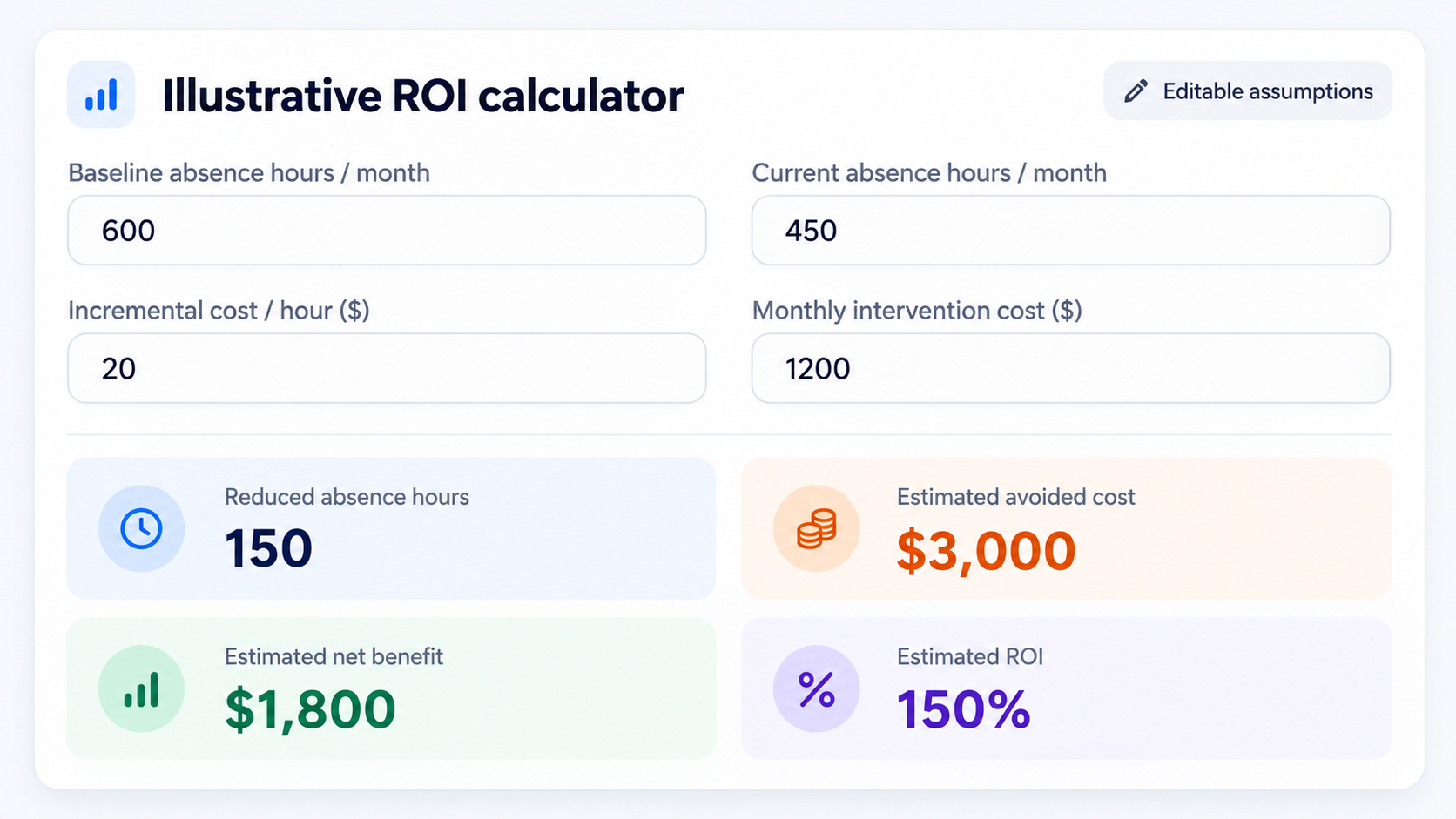
Copy calculation. Hypothetical figures for planning purposes. Results exclude unverified productivity, safety, or retention benefits and assume the reduction is attributable to the intervention.
With the default assumptions, the employer reduces unplanned absence hours by 150 per month. At $20 in genuinely avoidable incremental cost per hour, that produces $3,000 in estimated monthly savings.
After subtracting $1,200 in intervention costs, the estimated monthly net benefit is $1,800, representing an illustrative 150% ROI.
Actual savings require evidence that the attendance improvement caused a reduction in overtime premiums, temporary staffing expenses, or other measurable costs. Employers should also consider whether demand, staffing levels, or seasonal illness changed during the measurement period.
Include nonfinancial outcomes in the evaluation
Financial ROI provides only one part of the picture.
A strong evaluation should also consider changes in schedule reliability, employee fatigue, service continuity, safety outcomes, staff retention, and manager workload.
Some of these outcomes may have financial consequences, but organizations should not assign arbitrary dollar values to them.
The most defensible business case separates verified savings from potential longer-term benefits.
What Mistakes Should Employers Avoid When Trying to Reduce Employee Absenteeism?
The most common mistakes are responding to every absence with discipline, using unreliable attendance data, overlooking operational causes, and measuring success without considering workforce health.
Treating all absences as avoidable
Legitimate illness, disability-related needs, caregiving responsibilities, and protected leave cannot be treated as equivalent to unexplained attendance violations.
Trying to eliminate all absence may encourage unsafe presenteeism and unlawful practices.
A better objective is to reduce avoidable operational barriers, improve coverage, and address genuine policy violations fairly.
Introducing stricter penalties before investigating causes
Stricter rules may appear to offer a quick solution, but they cannot repair unstable schedules, inadequate staffing, or inaccessible reporting systems.
Employers should understand why attendance problems occur before deciding whether policy changes are necessary.
Rewarding attendance without considering health and fairness
Perfect-attendance incentives can have unintended effects if employees feel they must work while ill.
They can also create fairness and legal concerns if protected leave is treated improperly.
Recognition programs should emphasize reliable teamwork and positive contributions without pressuring employees to sacrifice health or protected leave.
Ignoring manager behavior
Two departments with similar workloads may experience very different attendance environments because employees receive different levels of support and scheduling flexibility.
Organizations should examine manager practices, policy consistency, and employee trust alongside staffing and absence data.
Using technology as a substitute for operational changes
A new attendance dashboard cannot solve a transportation conflict or eliminate excessive overtime.
Digital tools should support a better process, not simply make existing problems easier to count.
Focusing exclusively on short-term attendance improvements
A temporary reduction in reported absences may not indicate lasting progress.
If the improvement depends on employees working longer hours, delaying medical care, or feeling unable to report problems, the underlying workforce risks remain.
Sustainable attendance improvement requires reviewing employee well-being and operational performance together.
Final Thoughts: Reducing Absenteeism Starts With Better Workplace Operations
Learning how to reduce absenteeism in the workplace requires more than tracking attendance percentages or introducing stricter rules.
For frontline and shift-based organizations, effective employee attendance improvement begins with understanding how schedules, workload, health, transportation, communication, and management practices affect employees’ ability to work reliably.
Employers should make schedules more predictable, maintain qualified backup coverage, simplify call-out procedures, support managers, and protect legitimate leave.
The strongest absenteeism reduction plans also evaluate results fairly. Lower unplanned absence rates matter, but so do reduced fatigue, better staffing resilience, safer working conditions, and improved employee experience.
The goal is not to make every employee attend every shift regardless of circumstances. It is to build a workplace where employees can attend reliably, legitimate absences are handled fairly, and operations remain dependable when unexpected absences occur.