Language barriers in the workplace are usually treated as a translation problem. That’s too small. In practice, they’re an operational risk, because the true failure point is whether workers understood the instruction, the hazard, or the policy in time to act safely and correctly. For multilingual frontline teams, the question isn’t just what got translated. It’s whether communication reached the worker in a usable form and was verified.
Key takeaways
- Language barriers at work include literacy gaps, jargon, accents, dialects, and digital channels that assume one dominant language.
- Multilingual workforce issues show up most sharply in onboarding, safety briefings, shift handoffs, and incident reporting.
- Translated documents are not proof of comprehension. Check understanding with teach-back, demonstrations, and supervisor sign-off.
- AI translation helps with low-risk written content, but safety, legal, medical, disciplinary, and emergency communication still need humans.
- Measure outcomes, not document volume. Track comprehension, near-miss reporting, and task completion by language group.
What Language Barriers in the Workplace Actually Are
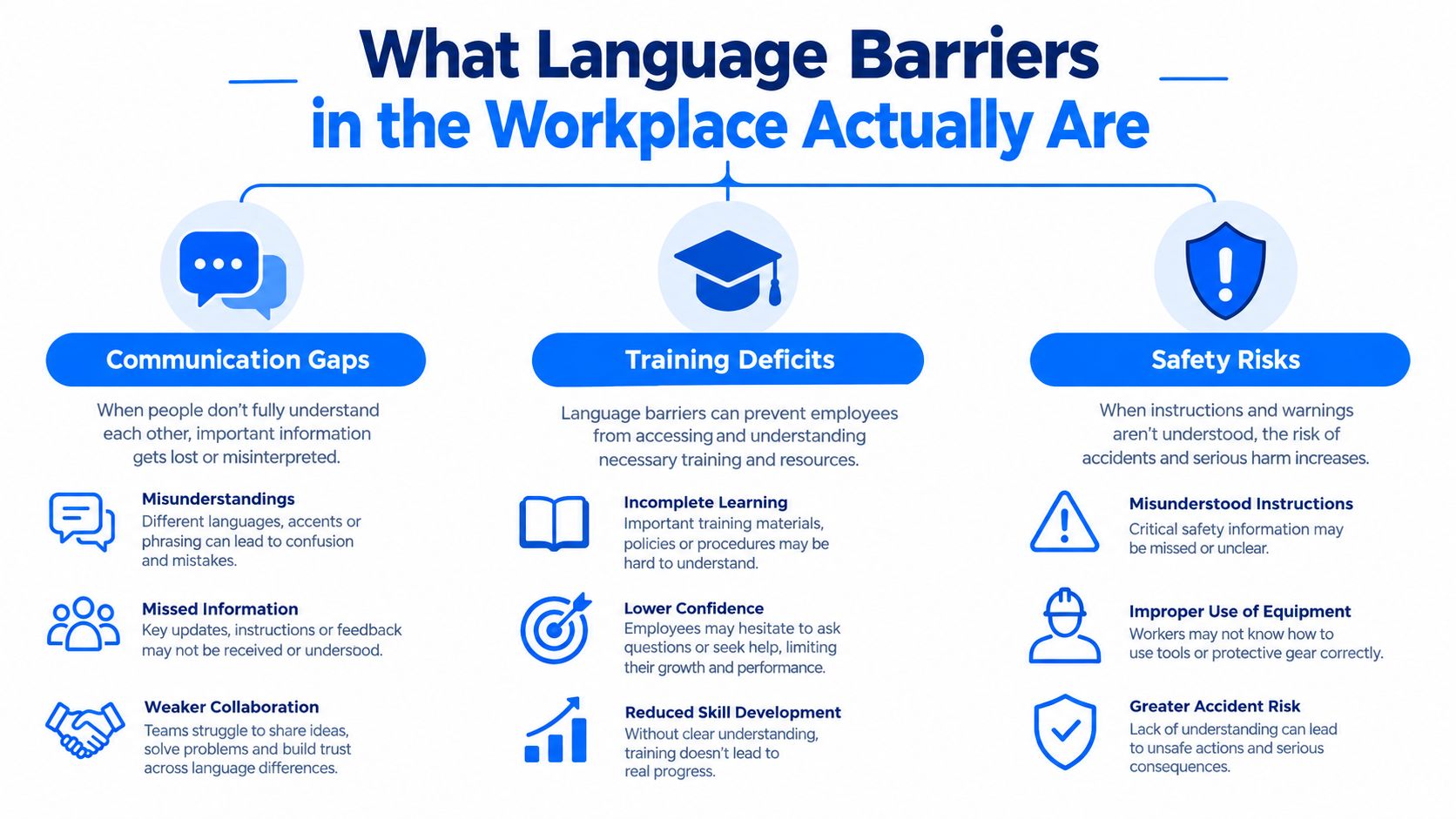
Language barriers in the workplace are any communication gaps that stop employees from understanding, acting on, or contributing to work. That includes spoken fluency, reading level, dialect variation, jargon-heavy systems, hearing access, and tools that assume everyone reads the same language at the same pace. In frontline environments, the damage usually shows up first in safety, training, and task execution, not in polite conversation.
The OECD’s skills analysis makes the point clearly. Immigrants scored about 24 points lower than native-born adults in literacy, which the OECD says is roughly equal to 3.5 years of schooling (OECD skills and labour-market outcomes report). The same source links weaker outcomes to host-country fluency, literacy, numeracy, and where education was acquired. It also shows that migrants lacking proficiency had a 14-point lower employment rate and a 17-point higher overqualification rate.
What it looks like on the floor
A worker may understand a coworker in a casual conversation and still miss the details in a safety bulletin, a lockout step, or a disciplinary notice. That’s why language accessibility in the workplace is broader than translation alone. It includes whether the message is readable, audible, visible, and confirmable.
Practical rule: If the only evidence you have is that a document was sent, you don’t know whether the message was understood.
| Friction point | Where it appears | Operational risk |
|---|---|---|
| Jargon and abbreviations | Policies, SOPs, shift notes | Wrong action or missed steps |
| Reading load | Handbooks, compliance docs, safety forms | Low comprehension and poor recall |
| Spoken speed and accent | Huddles, coaching, handoffs | Missed details and hesitation |
| Digital-only instructions | Apps, portals, QR workflows | Workers can’t access the task at the point of need |
| Dialect and hearing differences | Noisy production areas, wards, loading bays | Instructions are heard but not understood |
A useful test is simple. If a message is safety-critical, time-sensitive, or tied to a job decision, it belongs in your multilingual workplace communication system, not in a one-off translation queue. For a broader frontline lens, Turn On Work’s deskless workforce coverage is a useful companion when you’re mapping where those gaps appear.
Why a Multilingual Frontline Workforce Changes the Stakes
A multilingual frontline workforce changes the stakes because language readiness usually lags hiring. People are often still learning the job, the site, and the local safety rules at the same time. That is where communication gaps turn into missed steps, slower handoffs, and avoidable risk.
The OECD’s settlement data shows why. Across the EU, 62% of immigrants reported at least advanced proficiency in the host-country language, compared with 72% in non-European settlement countries and 50% in Korea (OECD settling-in report). It also shows that among recent arrivals in the EU, only 40% reported advanced proficiency, compared with 70% among settled immigrants. In the United States, the comparable increase was from 63% to 74%.
Where the exposure concentrates
The same OECD settling-in report cited above shows that 18% of immigrant workers across the OECD were in elementary occupations, compared with 11% of native-born workers. That matters because elementary jobs carry more written instructions, safety rules, and shift coordination. Language barriers at work are concentrated where the work is most time-sensitive and least forgiving.
| Region | Recent arrivals advanced proficiency | Settled immigrants advanced proficiency |
|---|---|---|
| European Union | 40% | 70% |
| United States | 63% | 74% |
Operational takeaway: If your onboarding assumes language skills are already settled, your process is too optimistic.
The practical implication is straightforward. Recruitment, onboarding, safety training, and frontline execution all need frontline employee communication that works before fluency catches up. That is a workforce-operations issue, not just an HR or inclusion issue. If your current stack is fragmented, Turn On Work’s frontline super app coverage is a useful reference point for deciding where language-specific content should live.
The TurnOnWork Language Access Loop
The TurnOnWork Language Access Loop is a five-step operating model for turning language access into a managed workflow. It treats communication, engagement, technology, AI, and operations as one system. That’s the point. Language access fails when those five pieces sit in separate silos and nobody owns comprehension end to end.
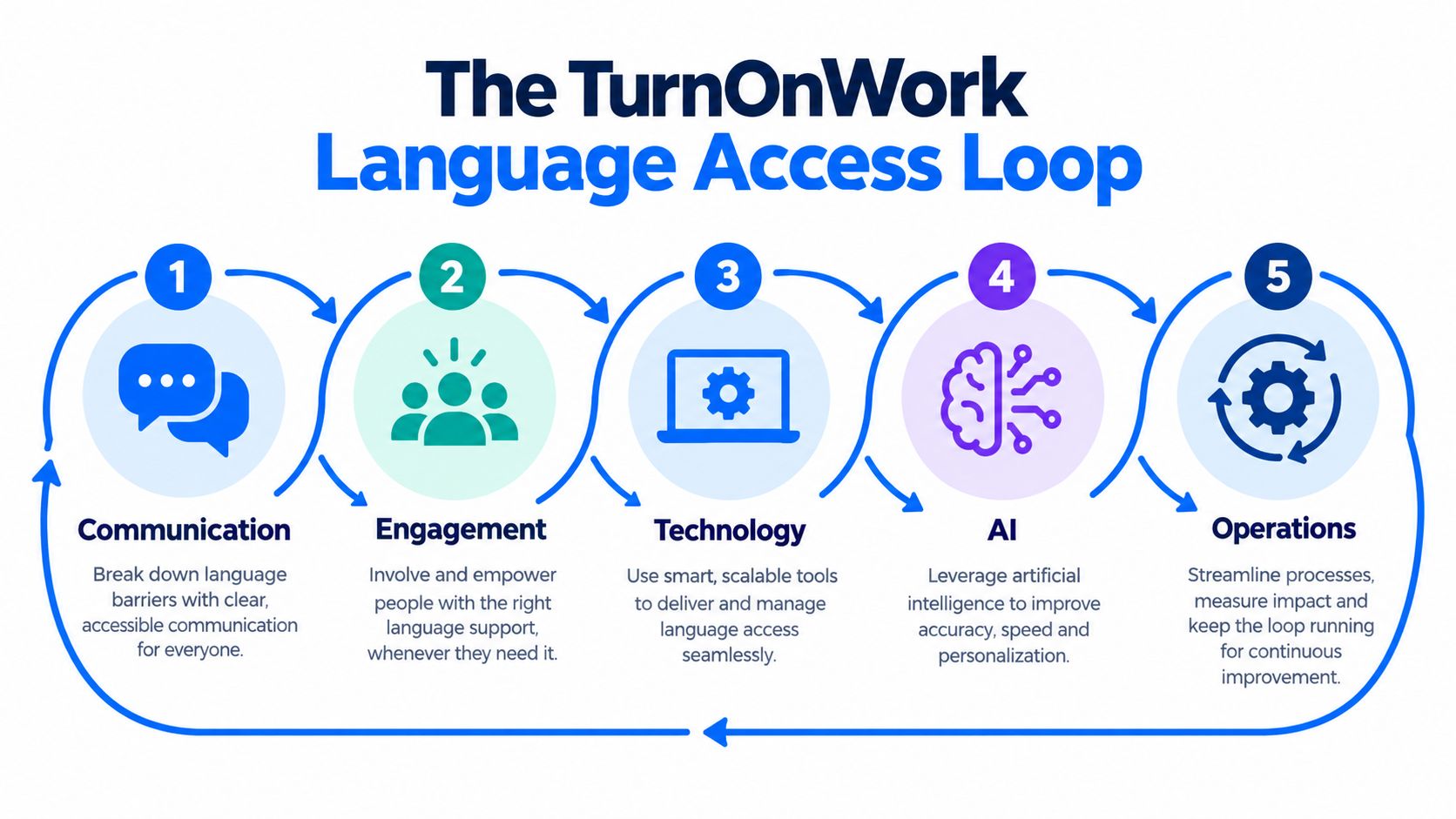
How the loop works
- Map the languages. HR and operations identify the languages, literacy levels, and channels used by actual worker groups.
- Deliver in the right format. Internal communications and line managers choose the format, such as translated text, captions, audio, visual guides, or live interpretation.
- Confirm comprehension. HR and supervisors use teach-back, short checks, or demonstration rather than assuming delivery equals understanding.
- Act on feedback. Operations fixes the work process when repeated confusion shows up, instead of sending another memo.
- Measure outcomes. Comprehension, task accuracy, and reporting quality become the scorecard.
| Stage | Owner | Output | Failure mode it prevents |
|---|---|---|---|
| Map the languages | HR and operations | Language profile by site, shift, and role | Guessing who needs support |
| Deliver in the right format | Internal communications | Content matched to audience and channel | Sending the right message in the wrong form |
| Confirm comprehension | Managers and HR | Teach-back or check for understanding | Mistaking delivery for understanding |
| Act on feedback | Operations | Process fixes and escalation paths | Repeating the same confusion |
| Measure outcomes | HR analytics and ops | Comprehension and incident data | Reporting on output instead of impact |
The loop matters because it ties employee communication strategies to real work. It also keeps AI in the right lane. AI can help with drafting, versioning, and scale, but it can’t own the safety conversation, the disciplinary process, or the emergency response. In this model, language access is a workforce system, not a translation project.
Safety and Productivity Consequences You Can Measure
The clearest cost of workplace language barriers is unsafe work. When workers don’t fully understand hazard briefings, equipment instructions, or emergency steps, the risk shows up in injuries, near misses, and delayed response. That’s why this is a safety-control issue, not just a communication issue.
The OECD-backed workplace evidence is blunt. Foreign-born Hispanic workers represented 14% of workplace fatalities while making up 8.2% of the workforce, and their fatal-injury risk was 35% higher than that of non-Hispanic workers (workplace fatality comparison). Construction research in the same evidence base points to language proficiency as a recurring factor in migrant-worker risk. The message for managers is simple. A translated handbook isn’t enough if nobody checks comprehension under real site conditions.
The first week is the danger zone
A study presented in the 2019 ARCOM proceedings found that among 16 migrant or foreign workers who suffered fatal construction injuries in 2016, four died on their first day and half died within their first 10 days on site (ARCOM proceedings). That makes onboarding timing part of the control plan. The highest-risk moments are pre-start orientation, the first week on site, crew transfers, equipment changes, and emergency drills.
| High-risk moment | Why comprehension matters | Verification method |
|---|---|---|
| Pre-start orientation | Sets the baseline for rules and hazards | Teach-back and short demo |
| First shift on site | New tasks and new environment | Supervisor sign-off |
| Crew transfer | Work context changes fast | Repeat instructions in the worker’s language |
| Equipment change | Instructions become more technical | Visual check plus return demonstration |
| Emergency drill | Seconds matter | Drill observation and question check |
A translated document is evidence of distribution. It is not evidence of understanding.
The same logic applies beyond construction. Healthcare, logistics, hospitality, cleaning, manufacturing, and agriculture all rely on quick, unambiguous instructions. If you want a practical internal benchmark, look at near-miss reporting, corrective-action closure, and task accuracy by language group, not just at whether the handbook was translated. For a metrics lens that pairs well with this, see Turn On Work’s internal communications KPIs and metrics coverage.
Role-Specific Tactics for Managers, Comms and HR
The fastest gains come when each function owns a different part of the language-access chain. Managers handle comprehension at the point of work. Internal communications handles clarity and reach. HR handles records, onboarding, and employee support. Operations fixes the workflow when the message keeps breaking down.

What managers should do this week
Start with bilingual supervisors or designated bilingual leads on shifts where language mix is predictable. After safety briefings, use a short teach-back, ask the worker to show the step, or have them point to the tool or control they’ll use. When a worker raises a problem, capture it in their preferred language if possible, then route it to the right owner.
What internal communications should change
Write in plain language first. Then translate the content that matters, especially executive updates, policy changes, and frontline alerts. A multilingual employee communication platform can help organizations distribute translated updates across mobile apps, email, SMS, and digital displays. Use captions on videos and asynchronous Q&A to make communication more accessible for employees who may not feel comfortable speaking up in meetings.
What HR and operations need to coordinate
HR should record language needs in employee records and build multilingual onboarding into the hire process. Operations should place pictograms on equipment, publish multilingual huddles for shift teams, and keep mobile-first task instructions close to the work. For employee relations, use qualified interpreters for sensitive conversations instead of ad hoc translation by a coworker.
Practical rule: Don’t ask a supervisor to “just translate” a grievance, a medical concern, or a disciplinary warning.
If you need a platform example in the workflow, Turn On Work provides guidance on multilingual frontline communication, including translated workplace messages and clarification channels when a worker still doesn’t understand the original message. That’s useful because the underlying goal is not translation output. It’s a more reliable employee communication strategy.
Where AI Translation Helps and Where Humans Must Stay
AI translation helps most when the content is written, low risk, and easy to review. It helps least when tone, urgency, legal meaning, or immediate safety judgment matter. That distinction matters because a translation tool can widen access, but it can also create a false sense of clarity if no one checks the result.
A 2025 business-language survey reported that more than half of C-level leaders spend over an hour daily dealing with ineffective communication, 72% planned to adopt AI, and 25% specifically targeted translation tasks (EF business-language survey). The takeaway isn’t that every workplace should automate translation. It’s that leaders are already trying to reduce friction, and they need guardrails that keep multilingual employee communication safe.
A simple decision matrix
| Communication type | Recommended channel | Governance check |
|---|---|---|
| Draft policy update | AI-assisted draft, human edit | Review for plain language and accuracy |
| Meeting notes or searchable records | AI transcription or translation | Preserve the original and label the version |
| Safety briefing | Qualified human translation or live interpreter | Teach-back and supervisor confirmation |
| Legal, medical, disciplinary, grievance | Human review and interpreter support | Escalation path and audit trail |
| Emergency instruction | Real-time human communication first | Confirm the worker understood the action |
The risk with AI is not just error. It’s uneven access. Fluent English speakers can move faster through tools and updates, while others get the lower-quality version of the same content. That can deepen a two-tier workplace unless leaders audit error rates, language coverage, adoption, and confidence by worker group. A useful comparison point for this discussion is Turn On Work’s AI in HR use cases overview, especially when you’re deciding what to automate and what to keep human-led.
How to Roll Out and Measure Multilingual Communication
The rollout should move in four phases, audit, pilot, expand, govern. That keeps workplace translation solutions tied to measurable outcomes instead of a pile of new files. The point is not to create more content. It’s to reduce confusion where work happens.
Start with an audit
List the languages, channels, sites, and roles where confusion shows up. Pull complaints, incident notes, onboarding feedback, and manager observations into one view. You’re looking for the places where language differences affect safety, task speed, or employee participation.
Pilot where the work is most exposed
Choose one frontline site, one shift, or one workflow. Use translated task instructions, bilingual supervisors, and a comprehension check on safety content. Keep the pilot narrow enough that managers can run it well.
Expand only what proved useful
If teach-back improved understanding on a line or ward, codify the script and the escalation path. If captions increased participation in updates, make them standard. If a translation channel is never used, the channel design is probably wrong.
Govern like an operating system
Assign named owners, review the metrics quarterly, and fold the workflow into HR tech and internal comms processes. The ownership model should be clear enough that no one can say, “We thought someone else had it.”
| KPI | Owner | Source | What good looks like |
|---|---|---|---|
| Comprehension-test score | HR and operations | Onboarding and safety checks | Workers can explain the task back |
| Near-miss reporting by language group | Operations | Incident system | Reporting is visible and usable |
| Time to action on frontline tasks | Site manager | Shift workflow | Instructions move from message to action quickly |
| Engagement by preferred language | Internal communications | Employee listening tools | Participation isn’t limited to one language group |
| Incident-report closure rate | Operations and HR | Case management system | Reports are closed with documented follow-up |
A good multilingual program changes behavior, not just content volume. If the dashboard only shows how many translations were produced, the program is too shallow. Use a tool like the multichannel internal communications audit checklist to pressure-test whether your channels, owners, and workflows support multilingual frontline communication.
FAQs on Language Barriers in the Workplace
What is the difference between translation and interpretation? Translation is for written content. Interpretation is for spoken communication in real time. In safety, legal, medical, and disciplinary moments, interpretation usually matters more because workers need to understand and respond immediately.
Are language barriers an HR problem or an operations problem? They’re an operations problem with HR support. HR can capture language needs, improve onboarding, and keep records. Operations owns the work conditions, the safety controls, and the proof that instructions were understood.
What’s the fastest first move without a new vendor? Pick one high-risk team and add a teach-back step after safety briefings. That costs little, surfaces confusion fast, and tells you whether your current language-access approach is working.
How do we handle confidential or legally sensitive communication? Use a qualified interpreter or a human-reviewed process. Don’t rely on informal coworker translation for grievances, discipline, medical issues, or anything with legal exposure.
If you’re trying to fix language barriers in the workplace this quarter, start with one frontline team, one safety workflow, and one comprehension check. Build the loop, assign owners, and measure understanding instead of document counts. That’s where the work changes.