Artificial intelligence in Human Resources has moved far beyond theory and into daily practice. For a modern organization, the effective use of AI in HR is no longer a futuristic concept – it’s the connective tissue that links together employee engagement, internal communications, and workforce operations into a cohesive, intelligent workforce experience.
Those plain-language policy answers still have to reach the same people who get operational updates, which is why AI-in-HR programs often sit next to an employee communications hub.
When AI works in concert with the right technology and a clear operational strategy, it transforms how employees are hired, supported, and engaged. It moves organizations from reactive problem-solving to proactive, data-driven execution.
Key Takeaways
- Integrated Experience: The true power of AI in HR is realized when it connects disparate systems. Instead of siloed tools for communications, operations, and engagement, AI creates a unified, intelligent experience for every employee, from the frontline to the corporate office.
- Practical Application Over Hype: While many companies begin with AI for recruiting, the most significant impact is seen across the entire employee lifecycle. Practical, everyday applications like personalized onboarding, intelligent shift scheduling, and continuous employee listening are where AI proves its long-term value.
- Proactive Engagement: AI enables a shift from lagging indicators, like the annual engagement survey, to real-time insights. By analyzing sentiment and behavioral data, AI helps leaders identify burnout risks, skill gaps, and development opportunities before they escalate, improving retention.
- Trust as a Prerequisite: Successful AI adoption is impossible without employee trust. A responsible rollout requires a transparent governance plan from day one, addressing data privacy, algorithmic bias, and accuracy. Starting with focused pilot projects is the best way to demonstrate value and build organizational confidence.
The Reality of AI in HR Today
Forget the sci-fi fantasies of robots running HR. In the real world, the most effective use of artificial intelligence in HR isn’t about replacing people – it’s about giving them superpowers. What we’re really talking about is a set of intelligent tools like machine learning, natural language processing, and predictive analytics that work in the background to make our work lives better.

You can think of AI as the central nervous system connecting your entire workforce experience. It’s the invisible thread weaving together your employee engagement initiatives, internal communications, and day-to-day operations into a single, intelligent system that supports both employees and business objectives.
Moving from Theory to Practical Outcomes
The true value of AI in HR shines when it’s used to fix concrete, everyday headaches. For frontline employees drowning in a sea of information, AI can cut through the noise by personalizing communications and delivering knowledge exactly when it’s needed. For hiring managers stuck in painfully slow recruiting cycles, it can automate tedious screening and scheduling tasks, freeing them up to focus on what matters: connecting with great candidates.
Rather than a single, monolithic technology, AI in HR is best understood as a dynamic capability that learns from workforce data. It’s the difference between a static workflow and a system that adapts to employee needs, operational demands, and communication patterns.
This evolution from rigid processes to responsive systems is a game-changer. For example, predictive AI can analyze turnover patterns to help you get ahead of future staffing gaps. Meanwhile, conversational AI can instantly answer common HR questions 24/7, dramatically cutting down the administrative load on your team. We’re also seeing generative AI become an invaluable partner for drafting clear, consistent, and inclusive messages, a cornerstone of today’s internal communications trends.
A smart AI strategy improves how work gets done. It enables organizations to shift from simply reacting to issues like disengagement to proactively building an environment where every employee feels supported, informed, and connected. That’s the foundation for a truly exceptional workforce experience.
Practical AI Use Cases Across the Employee Lifecycle
The conversation around AI in HR often gets lofty, but its real value comes from solving tangible, everyday problems for your people. It’s not about finding one magical “AI button” to press. Instead, think of it as a toolkit of practical applications that can improve communication, simplify how work gets done, and genuinely make the day-to-day better for every employee.
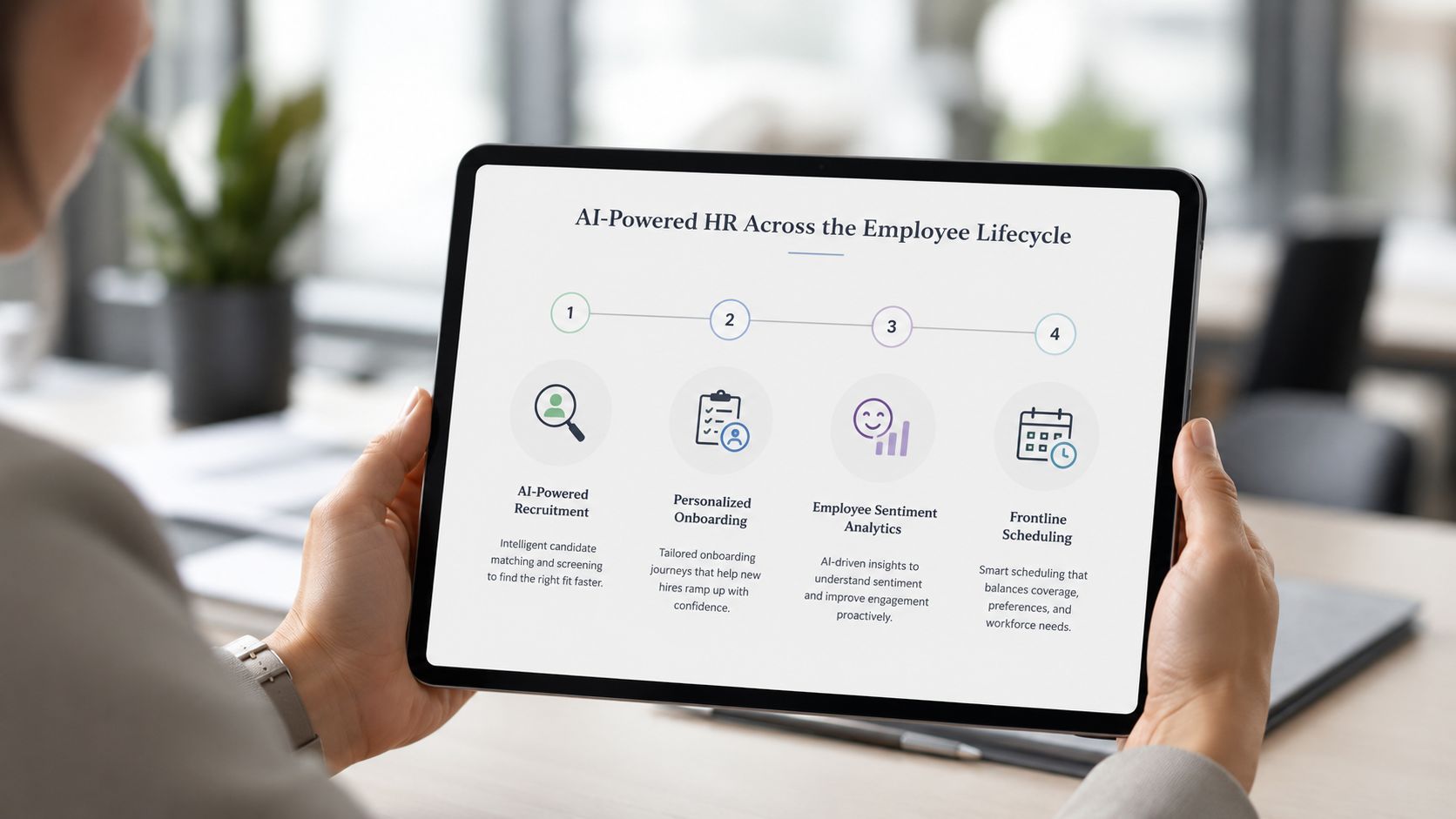
Let’s walk through some of the most powerful ways HR leaders are using AI right now, from the first hello in recruiting to the daily grind on the front line.
To give you a clearer picture, here’s a breakdown of how these AI tools map directly to HR functions and the tangible benefits they deliver to your workforce.
Table: AI Applications Across HR Functions
| HR Function | AI Use Case | Workforce Experience Benefit |
|---|---|---|
| Talent Acquisition | AI-powered job description analysis | Attracts a more diverse and qualified applicant pool with inclusive, targeted language. |
| Onboarding | Personalized onboarding checklists & content | New hires feel supported and become productive faster with role-specific guidance. |
| Internal Comms | Natural language search for company info | Employees get instant, accurate answers to policy and procedure questions, reducing frustration. |
| Knowledge Management | AI-powered content summarization | Key takeaways from long documents are available at a glance, saving time for everyone. |
| Operations | Intelligent, automated scheduling | Provides fairer, more predictable schedules that respect employee preferences and prevent burnout. |
| Performance | Proactive task & safety alerts | Keeps frontline workers safe and focused on the right priorities with real-time guidance. |
As the table shows, each application is designed to remove friction from a specific part of an employee’s job. Let’s dig a little deeper into how this works in practice.
Accelerating Talent Acquisition and Onboarding
Hiring is often the first place companies start with AI. Recent data shows that generative AI has become a common tool for recruiters, with applications that fundamentally reshape the hiring experience.
These tools are helping teams slash recruitment timelines and improve candidate quality. For instance, many organizations now use AI to draft more effective and inclusive job descriptions, while others rely on it to screen resumes with more speed and consistency.
But it goes well beyond just sifting through resumes. AI is changing the entire experience for candidates and new hires.
- Intelligent Job Descriptions: Generative AI can draft job posts that are not only optimized for search engines but also analyzed for biased language, helping you attract a broader and more diverse talent pool.
- Automated Candidate Engagement: AI chatbots can field common questions 24/7, help schedule interviews, and provide automated updates, creating a far more professional and respectful process for every applicant.
- Personalized Onboarding Journeys: Gone are the days of a one-size-fits-all firehose of new-hire information. AI can build a custom onboarding path for each person based on their role, department, or even pre-hire skill assessments, delivering the right information and training at the right time.
Improving Internal Comms and Knowledge Management
In any large or distributed company, just finding the right information can feel like a full-time job. This is where AI completely changes the game for internal communications and knowledge sharing.
An AI-powered search tool, built right into your company’s app or intranet, can essentially act like a “Google for your company.” Employees can just ask plain-English questions, like “What’s our parental leave policy?” or “Who’s the IT contact for the Chicago warehouse?”, and get an immediate, accurate answer pulled directly from official company documents.
This simple change has a massive impact on the employee experience.
- It cuts through the noise. Employees get just the information they need without digging through shared drives or old emails.
- It empowers people to self-serve. This frees up your HR and ops teams from answering the same questions over and over, letting them focus on more strategic work.
- It helps create better content. Generative AI can assist your internal comms team by drafting targeted announcements, summarizing long reports into crisp bullet points, or adapting a single message for different teams (like frontline staff versus corporate).
Optimizing Frontline Workforce Operations
For deskless and frontline teams in retail, healthcare, and logistics, operational efficiency isn’t a buzzword, it’s essential for success. AI is proving to be an indispensable tool for managing the complexities of frontline work.
Think of AI as a smart assistant for your operations managers. It crunches countless variables to find the sweet spot between business needs, labor costs, and employee well-being, directly tackling the burnout that comes from unpredictable or unfair scheduling.
Here are some of the most critical operational uses:
- Smart Scheduling: AI algorithms can generate optimal schedules that factor in employee availability, shift preferences, skills, labor laws, union rules, and even predicted customer traffic. The result is fairer schedules, happier employees, and a dramatic reduction in understaffing or overstaffing.
- Task Management and Prioritization: For a busy worker on the move, AI can push a prioritized task list straight to their mobile device. This ensures the most important duties get done first and can even include step-by-step guidance for complex jobs.
- Demand Forecasting: By analyzing historical sales data, local events, holidays, and even weather patterns, predictive AI can forecast staffing needs with surprising accuracy. This helps managers plan ahead and avoid last-minute scrambles to find coverage.
By weaving these applications together, you start to build a more intelligent and responsive organization where technology truly serves your employees. When these AI-driven functions are integrated within a unified workforce experience platform, you create a seamless and supportive journey for every person on your team.
How AI Reshapes Employee Engagement and Retention
For years, the annual engagement survey was the best tool we had. But it always felt like looking in the rearview mirror. By the time you got the results, the problems were already entrenched. AI is changing that dynamic entirely, moving us from a yearly check-in to a continuous, real-time conversation with our workforce.
Think of it as an early warning system. Instead of waiting for a valued employee to hand in their notice, AI-powered employee listening tools can analyze sentiment from everyday communications and anonymous feedback channels, flagging burnout risks before they become critical. It picks up on the subtle shifts in language that signal disengagement, giving managers a chance to step in, offer support, and solve the problem.
From Listening to Action
This shift from passive listening to proactive intervention is where AI really proves its worth. An AI-driven employee listening strategy doesn’t just collect data; it identifies themes, pinpoints friction, and suggests actionable interventions. This could mean alerting a manager to team-wide frustration over a new process or flagging an individual who seems increasingly isolated.
But listening is just the start. The real game-changer for retention is using AI to foster internal growth and career mobility, which are consistently two of the biggest reasons people choose to stay with a company.
By connecting an employee’s skills, performance data, and stated career goals, AI can create personalized development roadmaps. This transforms career pathing from a vague aspiration into a tangible, actionable plan that shows employees you are invested in their future.
Building Agency and Belonging
When an employee can see a clear, achievable path forward within the company, complete with recommended training, mentorship opportunities, and potential next roles, their sense of belonging and commitment skyrockets. This is a huge factor in retention.
This is a world away from those generic, one-size-fits-all learning portals. A smart AI curates and suggests opportunities that align both with the employee’s personal ambitions and the company’s strategic needs. It might recommend a specific project to build a new skill, connect them with a mentor in another department, or flag an upcoming internal job opening they are uniquely qualified for.
Ultimately, by giving employees AI-powered tools for their own development, you hand them the reins to their own careers. They’re no longer just passengers in HR programs; they become active drivers. This proactive approach is a cornerstone of the modern workforce experience and a key part of the employee engagement trends we’re seeing shape the future of work.
Your Roadmap for Responsible AI Implementation
Rolling out AI in your HR department isn’t about snapping up the latest shiny tech. It’s about earning and keeping your employees’ trust. A successful launch must be deliberate and human-first, focusing on clear rules, quality control, and open communication from the very beginning. Without a foundation of trust, even the most impressive AI tools will fail to gain adoption.
Think of this less as a technical manual and more as a strategic guide for HR leaders. The goal is to create a framework that puts people first, ensuring AI improves their work experience, not just automates it.
Start with a Strong Governance Framework
Before you even evaluate a vendor, you need to establish the rules of the road. An AI governance framework is non-negotiable. This isn’t just an HR task; pull together a cross-functional team with representatives from HR, IT, legal, and, most importantly, your employees to ensure all perspectives are considered.
This framework must tackle the key risks head-on:
- Data Privacy: Be crystal clear about what employee data is being used, how it’s being secured, and who has access to it. Employees must feel confident that their information is handled responsibly.
- Algorithmic Bias: You must actively audit for biases in any AI model that could lead to unfair decisions in hiring, promotions, or performance reviews. The goal is to make processes more fair, not to codify existing inequities.
- Accuracy and Accountability: Have a clear process for verifying the output of generative AI and other models. Who is accountable for ensuring an AI-drafted communication is accurate and on-brand? Define that line of responsibility from day one.
Prioritize Transparency and Employee Control
The fastest way to kill an AI project is to make employees feel like it’s being done to them instead of for them. Transparency is your most valuable asset. Be upfront about where and why AI is being used, what the technology is doing, and, crucially, how it helps make their job better.
The heart of responsible AI is empowerment. Give people tools that genuinely help, be transparent about how those tools work, and provide a clear way for them to provide feedback, flag errors, or get human help when needed.
This visual shows how a responsible approach creates a positive cycle for employee engagement.
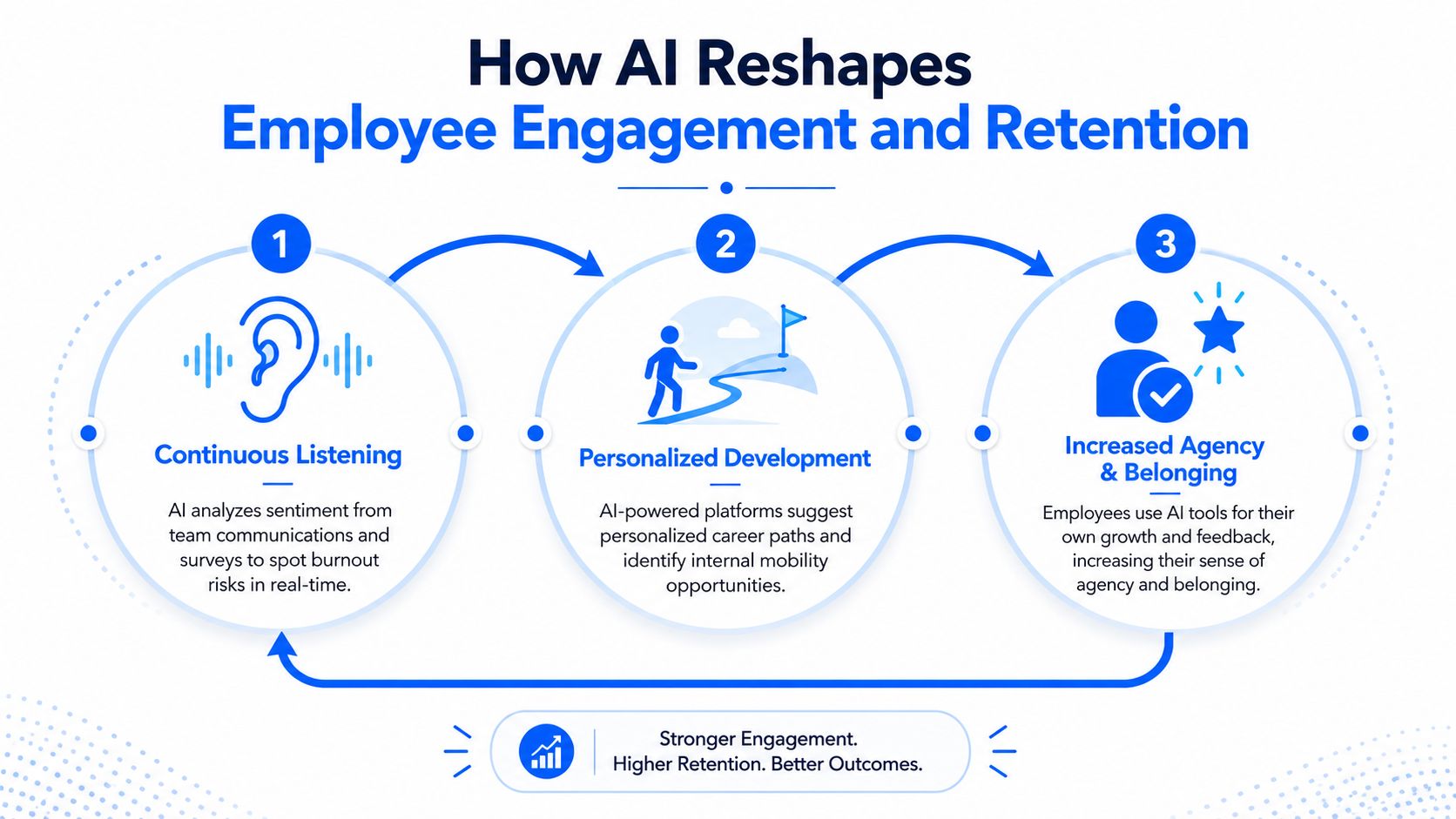
When you look closely, you can see the loop: continuous listening informs personalized development, which gives employees a real sense of agency and belonging.
Launch a Pilot Project to Prove Value
Forget the big-bang, company-wide launch. It’s too disruptive and risky. Instead, start small with a focused pilot project. Pick a single, high-impact problem and test if AI can solve it. For instance, you could pilot an AI scheduling tool in one department to measure its impact on reducing manual work and creating more equitable shifts.
A well-run pilot project will do a few critical things for you:
- Demonstrates Tangible ROI: It provides hard data to build the business case.
- Identifies Unforeseen Challenges: It lets you discover technical and cultural hurdles in a low-stakes environment.
- Builds Internal Champions: It creates a group of early adopters who can share their positive experiences with colleagues and build grassroots support.
By starting small and proving the benefits, you build the momentum and trust you need for a wider rollout. This methodical approach ensures your AI in HR initiatives provide real, lasting value.
Making the Business Case for Investing in AI for HR
Getting the green light for new HR tech isn’t about listing features; it’s about speaking the language of the business. To get executives on board with AI, you must connect your proposal to company-wide strategic objectives like operational efficiency, cost reduction, and talent retention.
Draw a straight line from AI tools to the results that matter most to leadership: cutting costs, improving productivity, and building a more stable, resilient workforce.
Connecting AI to Business-Wide Goals
Think about the most common, time-consuming tasks your team handles. Things like manual scheduling or fielding repetitive employee questions. AI-powered automation tackles these head-on, which doesn’t just free up your team for more strategic work, it adds up to significant labor cost savings.
It goes deeper than that. A more engaged workforce, actively supported by AI-driven tools for feedback and development, isn’t a fluffy metric. It leads directly to lower employee turnover, which has a clear and impressive return on investment by reducing recruitment and training costs.
The most powerful arguments are those that tie AI directly to the company’s biggest goals. For instance, using AI to optimize frontline schedules does more than just boost morale. It ensures you have the right people in the right place during your busiest hours, which directly improves customer service and drives sales. Similarly, using AI to screen and onboard talent faster means you can fill critical roles, innovate, and seize new market opportunities before your competitors.
Recent market projections underscore this urgency. The global market for AI in HR was valued at nearly $7.9 billion in 2025 and is projected to expand significantly. With widespread adoption becoming the norm, the cost of not investing in AI is becoming the bigger risk. As of 2026, leading organizations are no longer asking if they should adopt AI, but how they can integrate it to gain a competitive advantage.
When you frame AI as the engine for a better workforce experience, you’re not just talking about HR anymore. You’re positioning it as a core driver of business performance, the connective tissue between happy, productive people and a healthy, growing company.
Ultimately, your business case needs to show how smarter workforce operations give you a serious competitive edge. When your communication is seamless, your teams are engaged, and your execution is flawless, the entire business reaps the rewards.
FAQs on Using AI in HR
How is AI different from standard HR automation?
Think of standard HR automation as a rule-follower. It executes predefined, “if-then” tasks, like sending a confirmation email when an application is received. It’s efficient for simple, repetitive workflows but lacks the ability to learn or adapt.
AI, on the other hand, is a data-driven decision-support tool. It learns from data to identify patterns, make predictions, and generate insights. For example, instead of just processing applications, an AI system can analyze a candidate’s skills and experience to suggest other open roles where they might be a great fit. Automation follows instructions; AI provides intelligence.
Will AI replace human HR professionals?
No, the goal of AI in HR is not replacement but augmentation. It aims to automate the high-volume, administrative tasks that consume a significant portion of an HR professional’s time, such as initial resume screening, scheduling interviews, and answering repetitive policy questions.
This frees up HR teams to focus on high-value, uniquely human work: strategic talent planning, developing leaders, managing complex employee relations, and shaping company culture. AI handles the transactional tasks so that people can focus on the people.
What are the biggest risks of using AI in HR?
The primary risks center on trust, privacy, and fairness.
- Algorithmic Bias: If an AI model is trained on historical data that contains past biases (e.g., in hiring or promotions), the AI will learn and perpetuate those biases at scale, leading to unfair outcomes.
- Data Privacy: Employees must have confidence that their personal and performance data is secure and used ethically. Lack of transparency about how data is collected and analyzed can quickly erode trust.
- Accuracy and Over-reliance: Generative AI can produce inaccurate information (“hallucinate”), and relying on AI for final decisions without human oversight can lead to serious errors in judgment.
How can we ensure our use of AI is ethical?
Ethical AI implementation is an ongoing process, not a one-time checklist. It requires a proactive governance strategy.
- Establish a Governance Team: Create a cross-functional committee including HR, IT, legal, and employee representatives to set clear policies and oversee AI usage.
- Audit for Bias: Regularly test AI models to ensure they are producing fair and equitable outcomes across different demographic groups.
- Maintain Transparency: Be open with employees about how AI is being used, why it’s being used, and what its limitations are. Provide channels for feedback and appeals.
- Keep a Human in the Loop: This is the golden rule. AI should be used as a tool to support human decision-making, not to replace it. A person must always be responsible for the final call on critical decisions like hiring, firing, and promotions.