The most popular advice on employee listening is also the least useful. “Run a survey, share the results, make an action plan” sounds tidy, but it breaks the moment you operate across shifts, sites, managers, and mixed work environments.
Always-on listening is easier to keep honest when pulse questions and forms live in an employee surveys hub that managers can act on, not a slide deck after the fact.
A real employee listening strategy isn’t a survey calendar. It’s an operating system for workforce experience. It detects signals, interprets sentiment, routes issues to the right owners, and turns feedback into visible decisions. That only works when employee engagement, internal communications, HR technology, AI, frontline enablement, and workforce operations are designed together.
If your listening program produces dashboards but not better manager conversations, sharper communication, faster problem resolution, or clearer priorities, it isn’t working.
Employee Listening Is Not a Survey Program
Annual engagement surveys still have a role. They are not the strategy.
An effective employee listening strategy treats listening as a business capability, not an HR ritual. It combines structured feedback, manager observations, lifecycle touchpoints, operational signals, and always-on channels into one system. The point is to understand what employees are experiencing now, what’s changing, and what leaders need to do next.
That matters because most workforce problems don’t appear neatly inside a single annual survey window. Communication gaps show up after policy changes. Friction appears during onboarding. Trust breaks when a supervisor ignores a recurring issue. Frontline teams often experience all of this first, but many programs still over-index on desk-based channels.
The better model is to build listening into the everyday mechanics of work. That means connecting surveys to internal comms plans, manager routines, scheduling realities, and the tools employees regularly use. It also means treating workforce experience as a connected discipline, which is why the broader workforce experience model matters so much in practice.
What listening actually includes
A mature program usually pulls together several forms of input:
- Structured surveys: annual, pulse, lifecycle, and event-triggered feedback
- Manager channels: one-to-ones, team huddles, skip-level conversations
- Qualitative inputs: focus groups, open comments, employee councils
- Always-on routes: suggestion boxes, mobile forms, hotline-style reporting
- Behavioral and operational signals: participation patterns, communication reach, recurring friction reported by teams
Listening should produce decisions, not just data.
What changes when you treat it as a system
Once listening becomes operational, different questions come into view. Which issues belong to HR, which belong to operations, and which belong to managers? Which employee groups are underheard? Which feedback themes require communication, not policy change? Which patterns are local, and which are systemic?
That’s the shift. Stop asking, “How do we get more responses?” Start asking, “How do we turn workforce signals into action people can see?”
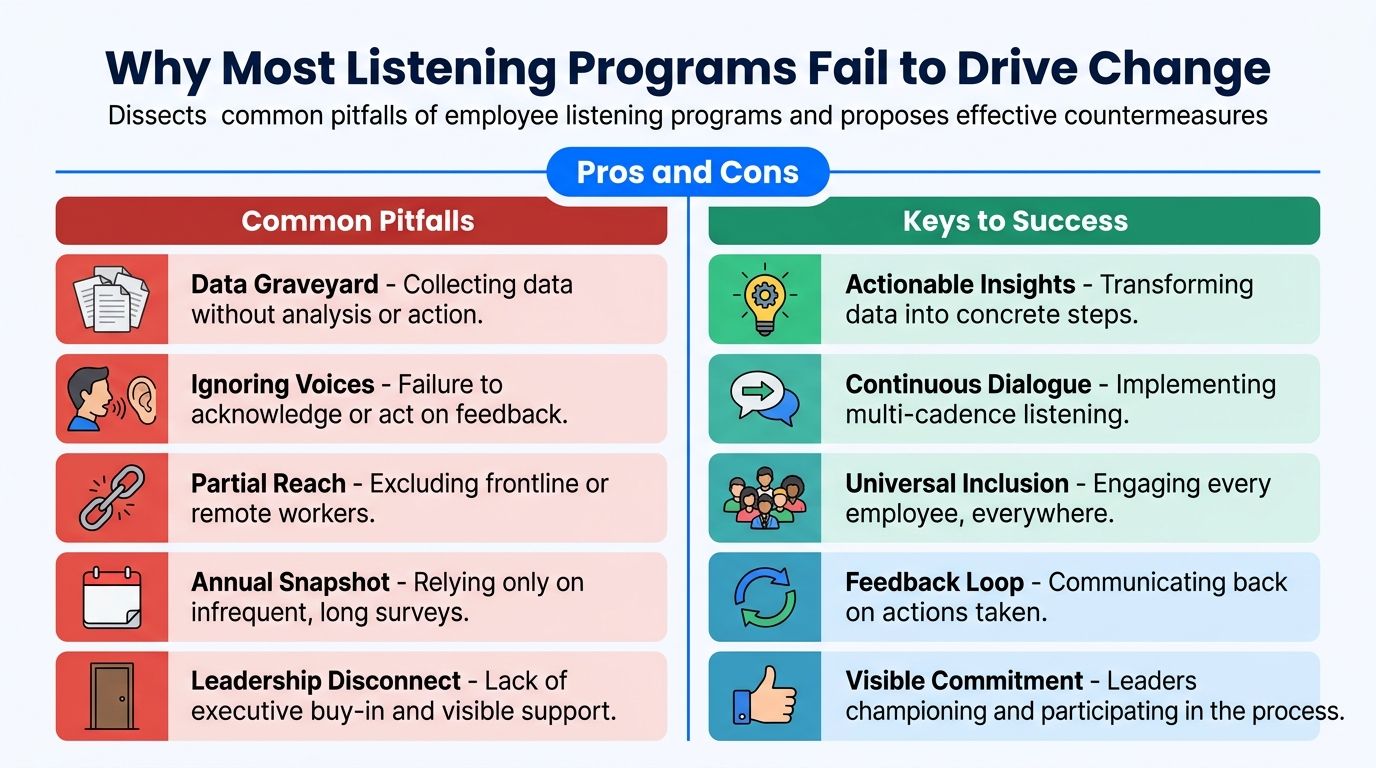
Why Most Listening Programs Fail to Drive Change
Listening programs usually break at the point where feedback is supposed to become a decision.
The pattern is familiar. Employees are asked for input. Leaders review dashboards. Managers get a slide or two. Then the day-to-day experience of work stays the same, especially for frontline teams who were already harder to reach in the first place.
That is data collection theater. It damages trust fast.
The early warning signs are operational, not cosmetic. You see them in slow ownership decisions, unclear escalation paths, and managers who receive charts without any guidance on what to do next. You also see them when a program depends on email, intranet access, or desktop workflows that exclude large parts of the workforce. In those cases, the company is not listening to employees broadly. It is listening to the employees who are easiest to reach.
The failure modes show up early
Weak programs tend to fail in predictable ways:
- Too many channels, no operating model: Teams add pulses, suggestion forms, town halls, and manager check-ins without defining which questions belong in each channel or what decision each one should inform.
- Action with no owner: An issue is visible in the data, but no one has named whether HR, operations, communications, or line leadership is responsible for the response.
- Frontline exclusion: Feedback routes rely on tools many workers do not use during the workday, so the loudest signals come from corporate teams while field reality stays underrepresented.
- Reporting without translation: Leaders receive dashboards, but managers do not get practical prompts, decision rights, or support for local follow-through.
- Weak closure: Employees hear that feedback was collected, but they do not hear what changed, what was deferred, or what the business chose not to do.
Response rate still matters. It just does not tell you whether the program works.
A high participation number can coexist with low credibility if employees never see visible follow-through. I have seen organizations celebrate a strong survey return, then lose trust because they asked broad questions with no plan to respond at team, function, or enterprise level. That is why the operating model matters more than the instrument. A well-designed workforce experience platform helps, but software does not fix unclear ownership or weak execution discipline.
Practical rule: If you can’t explain who will act on a piece of feedback before you collect it, you probably shouldn’t ask for it yet.
What fails
The common thread is inaction. Vague action causes nearly as much damage.
Employees do not expect every suggestion to be approved. They expect leaders to show that feedback was reviewed, priorities were set, trade-offs were made, and someone is accountable for the next step. Once people conclude that feedback disappears into a black hole, survey fatigue stops being a measurement problem. It becomes a trust and execution problem.
A Modern Framework for Continuous Employee Listening
The right framework is multi-rhythm. Different moments need different listening methods, and each one should answer a distinct operational question.
Research from O.C. Tanner’s 2020 Global Culture Report found that organizations using five or more listening modalities continuously throughout the year experience significantly higher trust, retention, and performance. That “five” threshold matters because a single channel always creates blind spots.
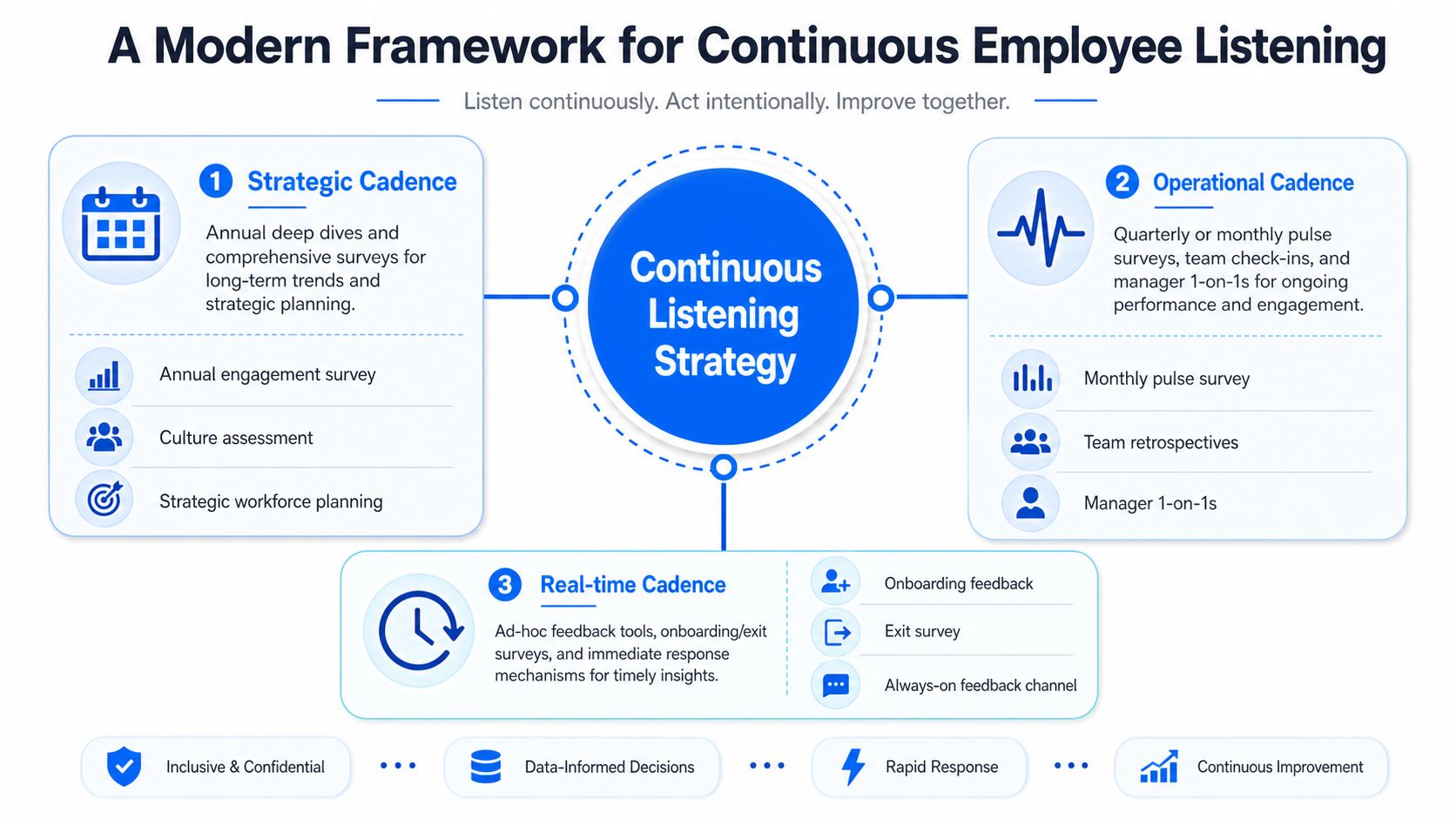
A lot of teams buy software before they design this rhythm. That’s backwards. Define the operating model first, then choose technology that supports it. A strong workforce experience platform approach should help you unify feedback, communication, and follow-through rather than create another silo.
Build the framework by cadence
Here’s a practical structure that works across office, hybrid, and frontline environments.
| Cadence | Channel | Primary use |
|---|---|---|
| Onboarding | Early lifecycle survey plus manager check-in | Catch friction during ramp-up |
| Pulse | Short recurring surveys | Track movement on a defined issue |
| Lifecycle | Promotion, transfer, leave, return, project end | Understand moments that reshape experience |
| Manager feedback | One-to-ones, huddles, skip-level input | Surface local issues early |
| Exit | Exit survey and exit conversation | Identify recurring causes of attrition |
| Always-on | Suggestion box, mobile form, hotline, QR route | Capture in-the-flow signals |
Keep each listening method narrow and useful
A mature program doesn’t ask every audience every question.
According to Happeo’s guidance on employee listening mechanics, pulse surveys should be kept to 10 to 15 validated questions, while annual surveys should stay in the 40 to 60 question range to reduce fatigue. The same guidance recommends piloting for 90 days in 1 to 2 business units before broad rollout, and targeting listening by role, location, tenure, or recent experience.
That targeting matters more than is often understood. A new hire in a distribution center, a nurse manager, and a remote product designer are not living the same employee experience. Their listening pathways shouldn’t look identical.
How the cadence works in practice
The annual survey gives you a strategic baseline. Pulse surveys tell you whether a known issue is improving. Lifecycle surveys capture moments that matter. Manager listening catches context that surveys miss. Always-on channels pick up the weak signals that don’t wait for a survey launch.
If every issue waits for the next survey cycle, your listening program is too slow for the way work actually happens.
The best systems also connect these inputs. If onboarding feedback flags confusion around scheduling, internal communications can clarify the process, operations can fix the workflow, and managers can reinforce the change. That’s what makes listening useful.
Engaging Your Frontline and Distributed Workforce
Most employee listening programs are still designed for people with inboxes, desktop access, and predictable calendar time. That excludes a large part of the workforce.
Qualtrics notes in its employee listening guidance that existing approaches overwhelmingly prioritize office-based workers, leaving a major gap for frontline employees who often lack consistent device access. This is one of the biggest design failures in employee experience work.

If you want an inclusive strategy, start with where work happens. In manufacturing, healthcare, retail, hospitality, transport, and field operations, “send an email survey” is often the wrong default. Better listening design usually sits much closer to the shift, the site, and the supervisor.
Teams working on frontline employee engagement already know this. Reach depends on channel fit, manager behavior, and operational timing.
What works better for frontline teams
Several practical tactics outperform office-centric habits:
- QR-based access: Put posters in break rooms, near time clocks, or in locker areas that route employees to a mobile-friendly form.
- Kiosk and shared-device options: In site-based environments, a dedicated station often works better than expecting personal device use.
- SMS pulses: Short mobile prompts can reach distributed teams who don’t use email consistently.
- Structured huddle prompts: Give supervisors a simple set of questions for shift-start or weekly team discussions.
- Voice and language flexibility: Provide multiple language options and allow spoken feedback where literacy or time constraints matter.
Psychological safety matters more in operational environments
Frontline employees often have less margin for speaking up, especially where local hierarchy is strong or staffing pressure is high. That’s why qualitative listening needs tighter design.
Nectar’s guidance on listening methods recommends keeping focus groups under 10 employees to create more meaningful conversation and better psychological safety. In practice, that small-group format works especially well when groups share context, such as same shift pattern, role family, or site conditions.
A frontline listening channel only counts if employees can access it during the reality of their workday.
The test is simple. If feedback requires extra time, a private laptop, or confidence that many workers don’t have, your program is hearing from the easiest people to reach, not the people you most need to hear.
Turning Insight into Action and Closing the Loop
The actual breaking point for most programs is not in data collection, but in prioritization.
When teams receive too much feedback at once, they either do nothing or launch too many initiatives. Both are mistakes. A better approach is to narrow the field quickly and assign visible ownership.
People Managing People outlines a useful 3-2-1 model for moving from insight to execution: identify three key results, discuss two opportunities, and commit to one action. That discipline keeps teams from mistaking discussion for progress.
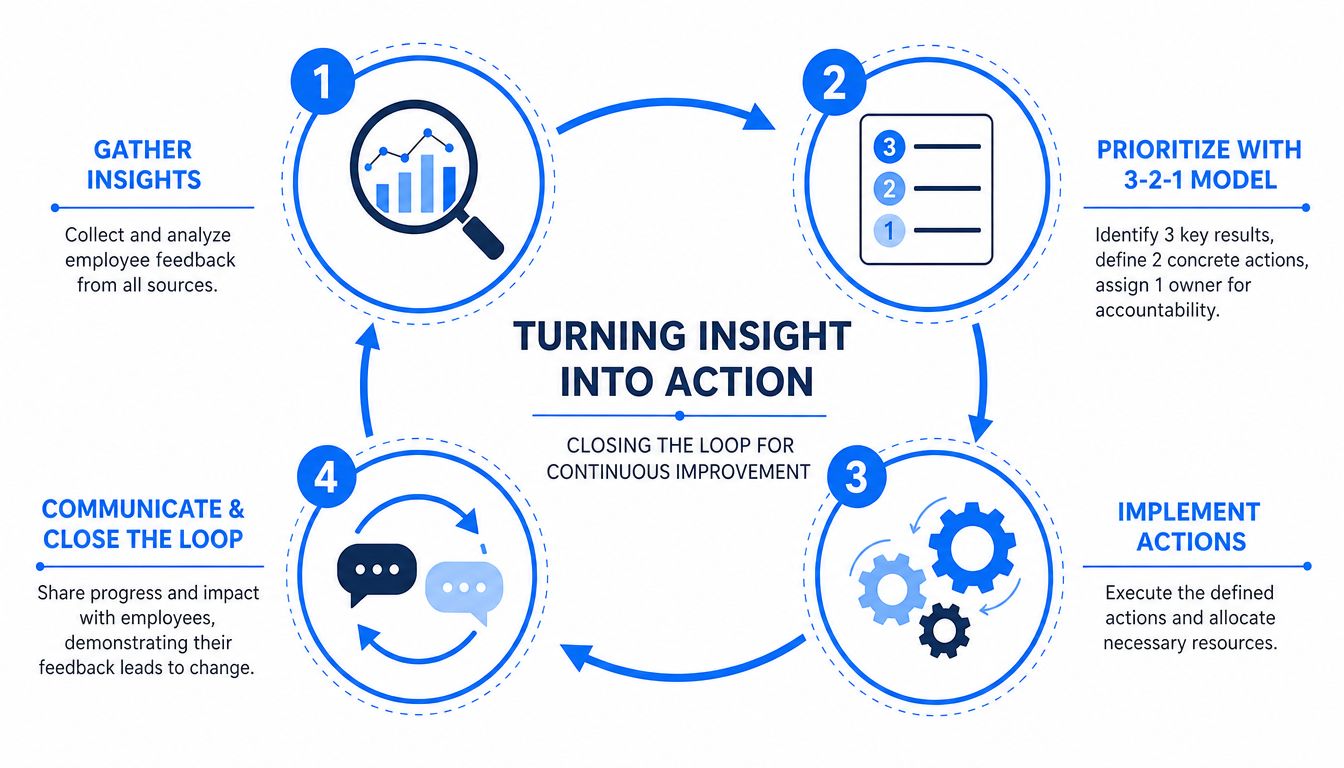
Use the 3-2-1 model at team level
Here’s what that looks like operationally:
-
Pull three findings that matter most
Choose a mix of signal types. For example, one score movement, one recurring open-text theme, and one issue managers are hearing directly. -
Discuss two opportunities
Don’t ask teams to fix everything. Focus on two changes that are specific enough to influence daily work. -
Commit to one action
Pick one move with a clear owner, timeline, and communication plan. Small wins build credibility faster than sprawling action plans.
Closing the loop means saying yes, no, or not now
Most guidance stops at “share the results.” That’s not enough. Employees need role-relevant clarity about what will change, what won’t, and why.
That’s where internal communications becomes operational, not cosmetic. A solid internal communications strategy should help leaders translate feedback into transparent updates at company, function, site, and team level.
A practical close-the-loop message usually includes:
- What we heard: the recurring themes, stated plainly
- What we’re changing now: named actions and owners
- What we’re not changing yet: the requests that won’t move forward immediately
- Why: operational, financial, legal, or safety constraints
- When we’ll update again: the next check-in point
Teamflect highlights this trust issue clearly. When feedback can’t be actioned, employees still need an honest explanation of why. Without that transparency, they start questioning the value of participating at all.
Closing the loop isn’t a thank-you note. It’s evidence that the organization can make and explain decisions.
The Evolving Role of AI and Human Judgment
AI has made employee listening faster. It has not made it automatic.
The best use of AI in an employee listening strategy is pattern detection at scale. AI tools can process open-text survey comments, suggestion box submissions, help desk themes, and message sentiment much faster than a people team reviewing spreadsheets by hand. That’s especially useful when feedback is coming from multiple channels and business units at once.
Where AI helps
AI is useful for a few specific jobs:
- Theme detection: clustering repeated issues across comments
- Sentiment sorting: flagging where language shifts from neutral to frustrated, confused, or positive
- Signal summarization: helping leaders scan large volumes of feedback quickly
- Manager support: generating draft talking points or action prompts based on team-level themes
That’s why the broader discussion around AI in HR matters here. The value isn’t replacing listening. It’s reducing the lag between feedback and interpretation.
Where people still have to lead
AI can tell you that comments about scheduling are rising. It cannot reliably tell you whether the issue is poor policy design, inconsistent local enforcement, a broken workforce management process, or weak manager communication.
Human judgment is still required to:
- interpret context by site, role, and manager
- decide what deserves action now
- handle sensitive issues with care
- facilitate the conversations that create trust
- explain trade-offs in a way employees will accept as credible
I’ve seen AI summaries help teams move faster. I’ve also seen leaders over-trust them and miss the operational story underneath. Use AI as a diagnostic layer, not as your decision-maker. Listening still depends on managers asking better questions, leaders making choices, and organizations following through.
A listening strategy gets stronger when employees can see the path from feedback to decision to action. That matters most for frontline and distributed workers, who are often asked for input far less often and informed far later. If the process is easy for headquarters and hard for everyone else, the strategy is poorly designed.
Employee Listening Strategy FAQs
What is an employee listening strategy?
It is the set of channels, review routines, decision rules, and follow-up actions an organization uses to gather feedback and turn it into change. A good strategy connects employee input to management habits, HR systems, communications, and operational decisions.
How many listening channels should a company use?
Use enough channels to match how people work. Office teams may respond through email, collaboration tools, and manager check-ins. Frontline teams may need SMS, QR codes, kiosks, shift huddles, and supervisor conversations. More channels only help if each one serves a clear purpose.
How often should we run pulse surveys?
Run pulse surveys when you need a quick read on a specific issue, team, or change. Keep them short, targeted, and time-bound. If pulses become constant, response quality drops and teams stop believing the questions matter.
Is the annual engagement survey still useful?
Yes. It works best as a baseline for trends, enterprise priorities, and year-over-year comparison. It does not replace ongoing listening, especially in fast-changing environments or dispersed operations.
What response rate should we aim for?
Aim for a response rate that gives you credible coverage across locations, functions, and worker groups, especially the frontline. High participation helps, but it is not proof of a healthy program. A lower response rate with visible follow-through will build more trust than a high response rate followed by silence.
How do we avoid survey fatigue?
Ask fewer questions, target them better, and only collect feedback you can act on. Fatigue usually comes from repetition, poor timing, and the absence of visible change after employees respond.
How should we listen to frontline employees?
Start with the realities of the job. If people do not sit at a desk, do not build the program around email links and long forms. Use mobile-friendly channels, on-shift touchpoints, multilingual options, and manager routines that fit the pace of the work.
How large should focus groups be?
Keep them small enough for people to speak candidly. Once the group gets too large, a few voices dominate and sensitive issues stay buried.
What’s the best way to turn feedback into action?
Use a simple operating rhythm. Pick one or two issues a team can influence, assign an owner, set a deadline, and tell employees what will change, what will not, and why. The discipline matters more than the template.
Can AI replace manager judgment in listening programs?
No. AI can sort comments, spot patterns, and speed up analysis. Leaders and managers still have to interpret local context, weigh trade-offs, and make decisions employees will see as fair and credible.