You’ve probably felt this already. The company grew fast, teams spread across time zones, managers started relaying updates in their own words, frontline employees missed messages that office staff saw instantly, and suddenly “internal comms” became the catch-all fix for confusion that started in operations, tooling, and leadership alignment.
Distributed teams usually need a dedicated employee communications hub so announcements, policies, and frontline updates do not live only in email.
That’s why an internal communications strategy for a distributed workforce can’t be a publishing calendar with nicer templates. It has to function as execution infrastructure. If people don’t know what changed, what matters now, where to find the latest guidance, and what action they’re expected to take, the business slows down.
A good strategy sits at the intersection of communication, workforce operations, employee experience, frontline enablement, HR technology, and increasingly AI. It tells employees what they need to know, in the right channel, at the right moment, with enough context to act. It also gives leaders a way to measure whether communication reduced friction or added noise.
Key takeaways
- Segment by work reality, not just org chart
- Assign a job to every channel
- Govern message creation before volume gets out of control
- Build a leadership cadence employees can predict
- Design feedback loops into every major communication
A useful platform can help operationalize these basics across content, delivery, and analytics, especially in a fragmented stack. That’s where a workforce experience platform becomes more than a software category. It becomes a control point for consistency.
From Announcements to Execution: The New Internal Comms Mandate
Internal comms used to be treated like an editorial service. Draft the email. Post the intranet update. Support the town hall. That model breaks down in distributed companies because the core challenge isn’t publishing. It’s operational clarity.

The business case is no longer subtle. Ineffective communication costs a single employee earning between $50,000 and $100,000 approximately 35+ working days per year due to lost time, and 86% of employees and executives cite a lack of collaboration or ineffective communication as the root cause of workplace failures, according to Axios HQ’s internal communications statistics roundup. If you lead comms in a distributed environment, those losses show up as rework, repeated questions, inconsistent customer handling, delayed rollouts, and frustrated managers.
What the function owns now
A modern internal communications strategy supports business execution in a few direct ways:
- Priority clarity: Employees know what matters this week, not just what was announced this quarter.
- Decision consistency: Managers translate fewer messages on the fly because the original communication is clearer.
- Channel discipline: Teams know whether to check email, Slack, Teams, the intranet, the mobile app, or the shift platform.
- Change readiness: New tools, policy changes, and process updates land with less confusion.
- Trust under pressure: During uncertainty, people hear from leaders early and in plain language.
In practice, this puts internal comms much closer to workforce operations than many organizations admit. If schedules, safety procedures, staffing changes, onboarding, and service standards depend on people receiving and understanding information, comms isn’t downstream support. It is part of the operating model.
Internal comms earns influence when it stops measuring output alone and starts reducing friction for the business.
What stops working in a distributed company
Three habits fail quickly at scale:
| Old habit | Why it fails | Better replacement |
|---|---|---|
| All-company blasts | Relevance drops and attention follows | Segment by work context and need |
| Channel sprawl | Employees don’t know where the source of truth lives | Define channel jobs clearly |
| Leader-by-leader messaging | Teams hear different versions of the same decision | Create message governance and manager toolkits |
If you’re still treating internal communications as announcements, you’ll stay busy and still miss the underlying problem. The mandate now is simpler and tougher. Help the workforce act with clarity.
The 5 Pillars of a Modern Internal Communications Strategy
The strongest internal communications strategy I’ve seen has five parts working together. Fragments of this are often in place. The difference is whether those pieces operate as a system.
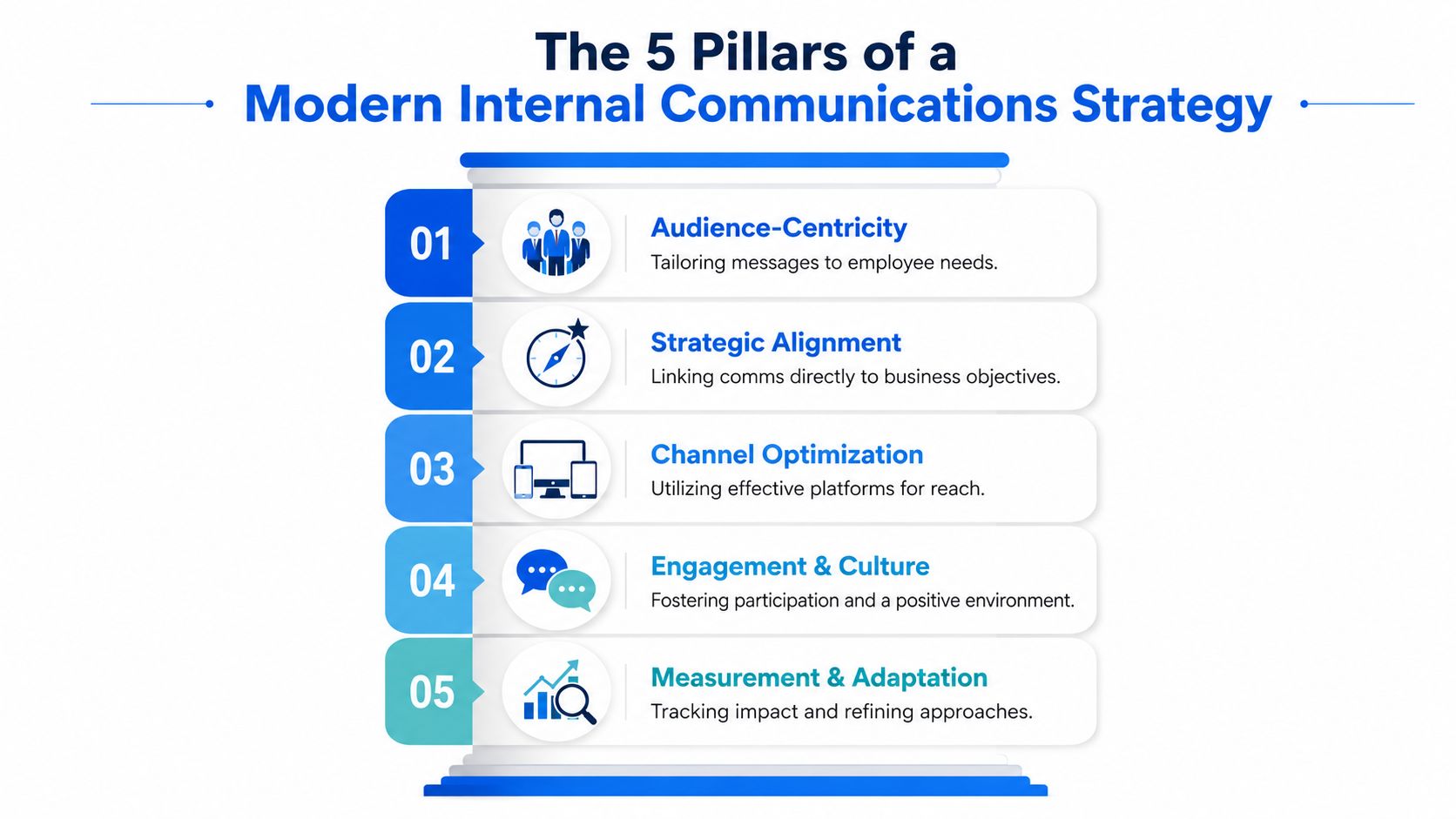
Pillar 1 Audience segmentation
Most underperforming campaigns can be traced to the same issue. The wrong people got a message that wasn’t built for them. ContactMonkey’s guidance is blunt about the four recurring failures. Inadequate audience segmentation, weak subject lines, poor formatting, and vague calls to action drive weak results, and segmenting by role, location, or employment type improves relevance and engagement, as outlined in ContactMonkey’s communications measurement guide.
That’s the baseline. For distributed companies, go further:
- Segment by work environment: remote, hybrid, office, field, plant, store, clinical, warehouse.
- Segment by action required: need to know, need to do, need to lead, need to cascade.
- Segment by access pattern: always-on desktop, shared terminal, personal mobile, company device, no digital access during shift.
A benefits update for salaried office staff and a scheduling change for shift-based employees should not share the same format, timing, or CTA.
Pillar 2 Channel architecture
Every channel needs a purpose. If email, Slack, Teams, SMS, the intranet, and the employee app all carry the same updates, employees stop trusting all of them.
Use a simple model:
- Email: formal announcements, policy updates, summaries, leadership notes
- Slack or Teams: rapid updates, reminders, team coordination
- Intranet or knowledge hub: evergreen source of truth
- Mobile app or SMS: urgent updates, frontline delivery, action prompts
- Manager huddles: context, discussion, escalation of questions
Practical rule: If employees can’t tell where to look for definitive information, the channel design is broken.
Pillar 3 Message governance
Fast growth creates content chaos. HR sends one message, operations sends another, IT launches a change notice, and regional leaders add local edits. Governance is what keeps relevance from turning into contradiction.
A workable governance model includes:
- A message intake process so comms can assess urgency, audience, and overlap.
- Editorial standards for plain language, scannable formatting, and one clear CTA.
- Approval rules that distinguish routine updates from sensitive or enterprise-wide changes.
- AI guardrails for drafting, summarizing, and translation.
AI can help with first drafts, localization, FAQ extraction, and repackaging content for different formats. It shouldn’t replace leader judgment on layoffs, safety incidents, conduct issues, or other high-trust moments. In those cases, employees need a leader’s accountable voice, not polished automation.
Pillar 4 Leadership cadence
Employees don’t trust leaders because a quarterly town hall happened. They trust leaders when the communication pattern is consistent enough to be believable.
A practical cadence often includes:
- Executive rhythm: regular business updates in plain language
- Manager cascade: talking points and FAQs before broad release
- Functional updates: predictable weekly or biweekly notes
- Local context: region or site leaders adapt, but don’t rewrite core facts
Leadership communication works best when it’s candid, slightly less polished than corporate copy, and tied to decisions employees can see in daily work.
Pillar 5 Feedback loops
A strategy without listening turns into broadcast management. Build response paths into the communication itself.
Try a mix of:
- Pulse questions: Was this clear? What’s still confusing?
- Live Q&A: all-hands, manager sessions, AMA formats
- Channel analytics: where drop-off happens, which segments engage, which don’t
- Manager signals: recurring questions from the field
Closing the loop matters as much as collecting input. If employees keep answering surveys and never hear what changed, trust drops fast.
Closing the Gap Reaching Your Frontline and Deskless Teams
Many internal communications strategies often falter. They claim to be multichannel, but they still assume employees have a laptop, inbox access, and time to read.
That assumption collapses in retail, healthcare, manufacturing, logistics, hospitality, and field service. Deskless workers can make up 50% to 70% of the workforce in industries like manufacturing and healthcare, often live in an “information blackout” because they lack consistent access to email or intranets, and can spend 20% of their workweek searching for the information needed to do their jobs, as described in Poppulo’s internal communications strategy analysis.
For many teams, the issue isn’t message quality. It’s message reach.
Mobile-first beats desktop-default
If your frontline audience receives core updates through email newsletters built for desktop reading, you’ve already lost. Mobile-first means more than responsive formatting.
It means:
- Short-form messages that answer what changed, what to do, and by when
- Task-linked delivery inside scheduling, shift, or workflow tools
- QR access points in break rooms, back-of-house areas, time-clock zones, and shared spaces
- Manager-ready scripts for shift huddles and team start meetings
The most effective approach is often task-integrated communication. Put the update where the work already happens. If employees check shifts in one app, complete inspections in another, and review tasks in a third, critical information should appear in those flows, not only in a corporate channel they rarely open.
Managers become the last mile
Frontline communication often succeeds or fails with supervisors. Not because they write better messages, but because employees ask them what the message means in practice.
That’s why strong frontline comms includes:
| Need | What to provide managers |
|---|---|
| Quick explanation | 3 talking points in plain language |
| Common concerns | FAQ sheet |
| Local adaptation | What can be tailored and what can’t |
| Escalation path | Who handles unresolved questions |
A good message to frontline teams is usually brief. A good manager toolkit is slightly deeper.
If the frontline manager has to interpret the announcement from scratch, the organization has outsourced clarity to chance.
For more operating patterns suited for non-desk workers, Turn On Work’s coverage of frontline employees is the right lens. The core question isn’t “what should we send?” It’s “how does this workforce receive and act on information during a shift?”
Measuring What Matters: From Clicks to Business Impact
Open rates and clicks still matter. They tell you whether people noticed a message. They do not tell you whether the communication improved execution.
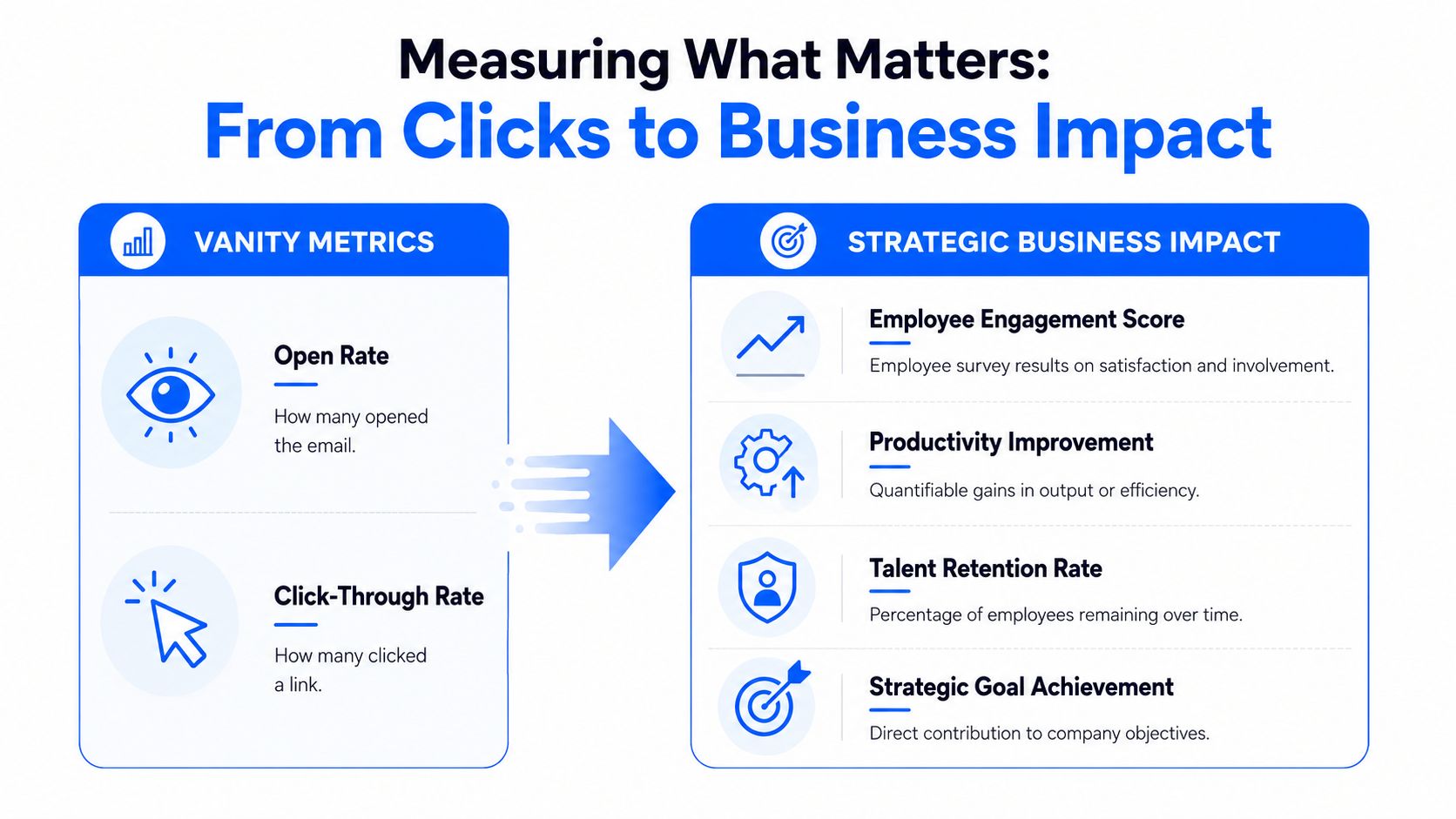
The field is already moving. Top-tier internal communicators are shifting beyond engagement metrics to measure impact on operational outcomes and retention. That shift matters because leadership rarely funds comms based on a prettier dashboard. They fund what helps the business run better.
A better measurement model
Use a three-layer view.
| Layer | What to track | Why it matters |
|---|---|---|
| Reach | opens, clicks, views, attendance | Confirms the message got seen |
| Understanding | pulse responses, manager feedback, repeated questions | Shows whether people grasped it |
| Business effect | task completion, adoption, error reduction, onboarding readiness, retention signals | Shows whether communication changed execution |
The core work is in the third layer. If a policy update reduced confusion, you should see fewer repeated support questions. If a manager communication cadence improved trust, you should hear fewer rumors and more consistent local messaging. If onboarding communication improved, new hires should reach proficiency with less friction.
Build a simple dashboard, not a reporting museum
Keep the operating dashboard tight:
- One view for channel performance
- One view for audience segments
- One view for business-linked outcomes
- One recurring review rhythm with HR, operations, and people analytics
For a broader workforce experience lens, this is the important distinction. Communication metrics on their own describe activity. Workforce experience metrics show whether people could do their jobs with less friction.
Report trends and decisions, not just metrics. “Store managers needed a shorter action summary” is more useful than “click-through dropped.”
What good before-and-after analysis looks like
You don’t need a complex research design. Start with a baseline, change the communication method, run it for a reasonable period, and compare results. If segmented messages with one CTA and clearer structure outperform the old all-staff blast, that’s enough to inform the next cycle.
Leadership usually wants a credible pattern, not academic proof.
Your Internal Comms Strategy Action Plan and Checklist
A strong internal communications strategy is easier to build when you treat it like an operating system, not a campaign calendar.
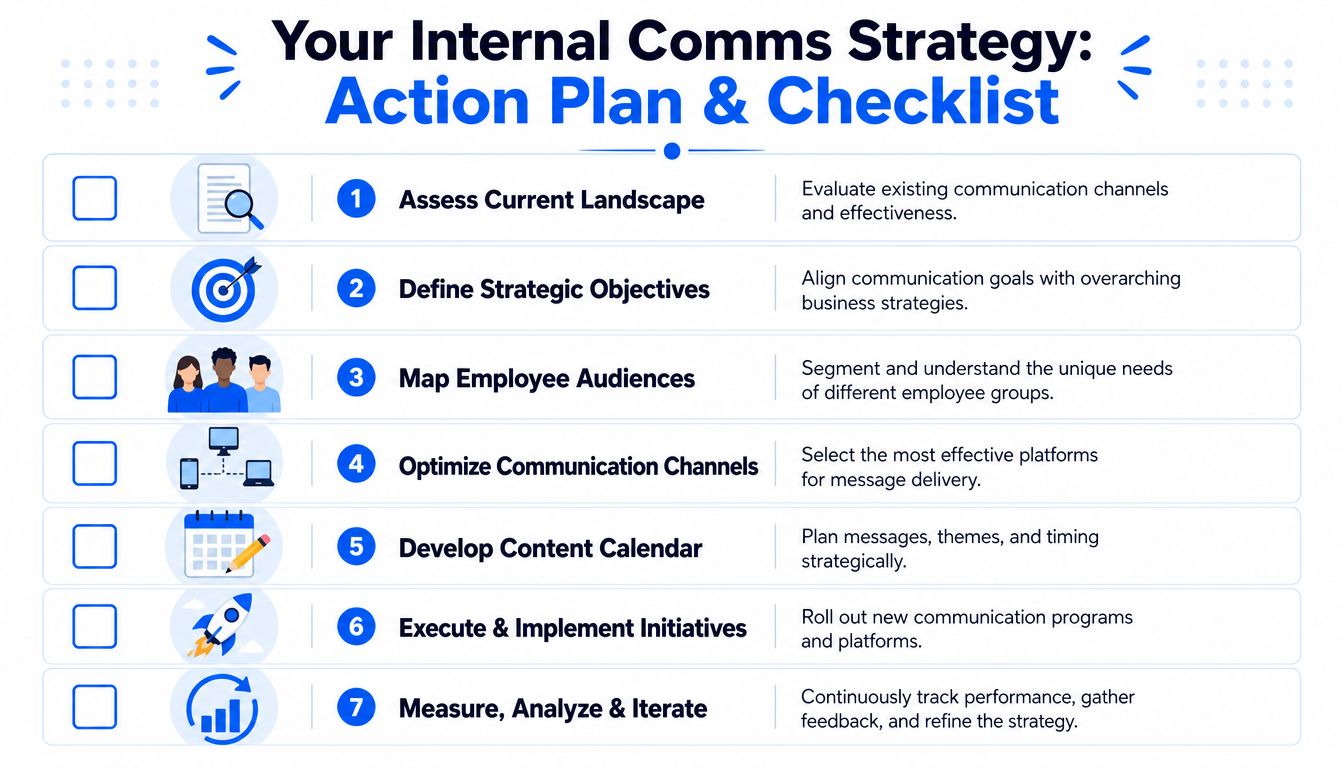
Use this checklist to get moving:
A practical checklist
- Audit your current channels: List every active channel, owner, audience, and message type. Remove duplication first.
- Define the business outcomes: Tie comms to execution goals such as change adoption, onboarding clarity, manager consistency, or frontline task completion.
- Map your workforce segments: Include deskless, hybrid, remote, site-based, and manager audiences. Don’t rely on department alone.
- Set channel rules: Decide what belongs in email, chat, intranet, mobile, meetings, and manager cascades.
- Create governance: Standardize intake, approvals, templates, AI usage, and escalation for sensitive messages.
- Establish leadership cadence: Lock in executive updates, manager toolkits, and local follow-through.
- Measure and adjust: Review the dashboard regularly and refine based on behavior, not opinion.
A content calendar still matters, but only after these decisions are made. Otherwise you’re just scheduling noise.
If you want more execution-focused ideas in this area, browse Turn On Work’s archive on internal communications.
Conclusion
A critical first move is to audit all channels and establish baseline metrics for opens, click-throughs, and engagement, then feed that data into a simple dashboard reviewed quarterly and connected to retention data or eNPS. If your team is reworking its internal communications strategy, keep the standard high and the system simple. Better communication is rarely about sending more. It’s about reducing ambiguity so people can act. That’s where employee experience, technology, AI, and operations start to reinforce each other instead of competing for attention.
FAQs on Internal Communications Strategy
What’s the first step in building an internal communications strategy?
Start with an audit. Identify every channel in use, who owns it, which audiences it serves, and what metrics you already have. Most teams discover overlap, inconsistent ownership, and missing frontline coverage before they discover a content problem.
How often should leadership communicate in a distributed company?
On a predictable cadence. Employees don’t need constant broadcasts. They need a rhythm they can trust. The exact frequency depends on the business, but the pattern should be stable enough that silence doesn’t create rumors.
Where does AI help most in internal comms?
AI is most useful for first drafts, summarizing long updates, repackaging content by audience, translation support, and theme analysis from employee feedback. It’s less appropriate for sensitive messages where accountability, nuance, and leader voice matter more than speed.
What’s the best channel for frontline employees?
There usually isn’t one single best channel. The best setup combines mobile-first delivery, manager huddles, and access inside the tools frontline teams already use for schedules, tasks, or daily work.
How should crisis communication work for a distributed workforce?
Predefine owners, approval paths, fallback channels, and audience tiers before a crisis happens. In the moment, send the shortest possible message with clear action, timing, and where updates will continue. Consistency matters more than polish.
For more practical guidance on internal communications, workforce operations, and distributed employee experience, explore more analysis and tools at Turn On Work.