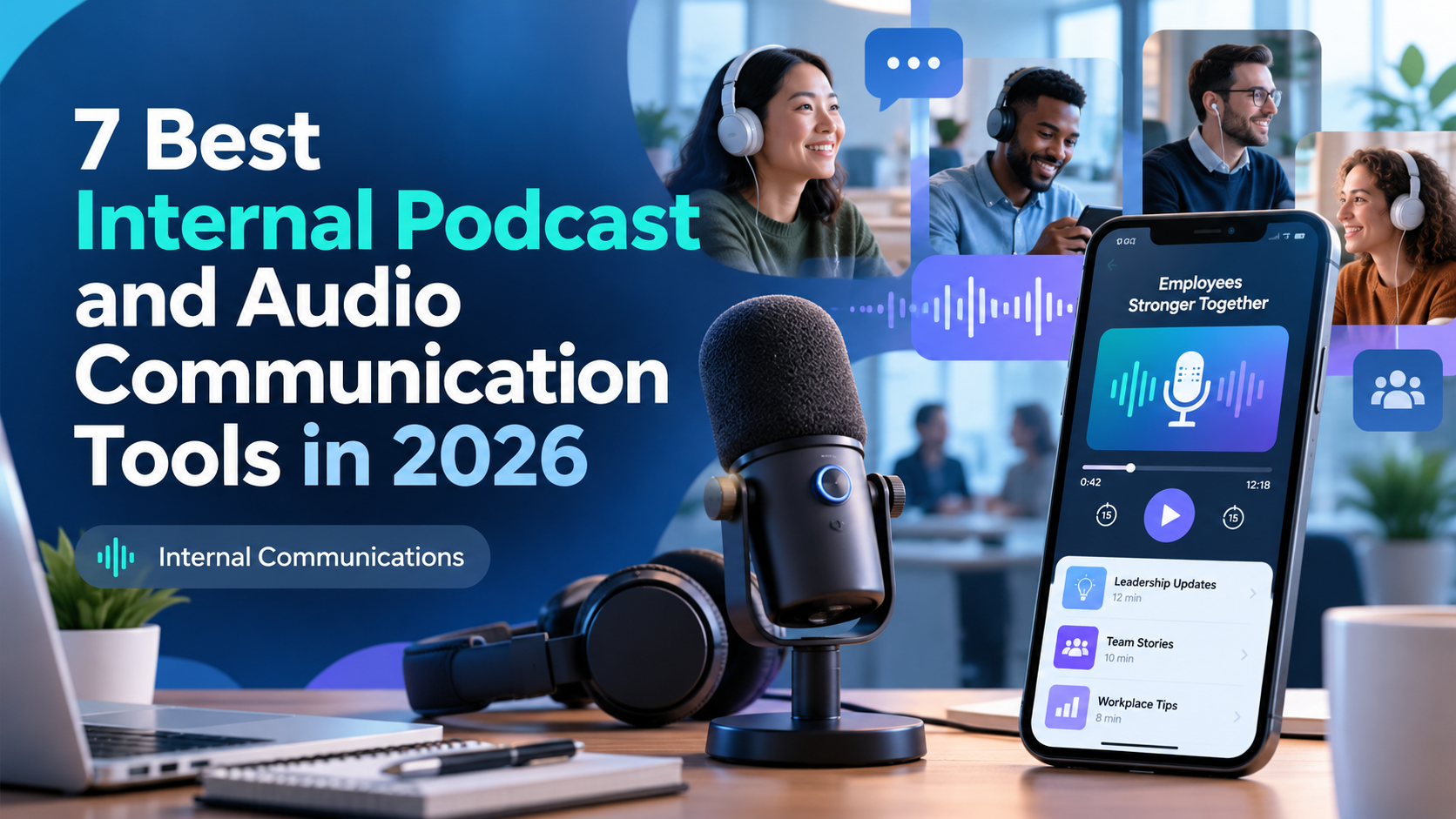
The best internal podcast tools in 2026 include HubEngage, Podbean Pro, uStudio, Supporting Cast, Hypecast, Springcast, and Castos. HubEngage is suited to multichannel employee communication, while the other six offer dedicated private podcast capabilities. Podbean Pro and uStudio emphasize enterprise security, Supporting Cast simplifies listening in familiar podcast apps, Hypecast combines production and distribution, Springcast supports private employee listening, and Castos offers affordable hosting.
Key Takeaways
- Choose based on your communication goals. A dedicated private podcast platform is different from an employee communication app that distributes announcements and links to audio content.
- Security matters as much as production quality. Employee podcasts containing confidential information need controlled access, reliable offboarding, and appropriate authentication.
- Mobile listening is essential for distributed teams. Frontline, field, and shift-based employees may need mobile-friendly playback and access without a desktop computer.
- Compare meaningful engagement metrics. Downloads and plays are useful, but audience reach, listening completion, employee feedback, and follow-up actions provide a clearer picture.
- Check the total cost before buying. Published prices vary substantially, and enterprise features such as SSO, advanced analytics, branded apps, and additional listeners may cost extra.
What Are Internal Podcasts, and Why Are Companies Using Them?
Internal podcasts are audio programs produced for employees rather than the general public. Companies use them to communicate leadership decisions, explain organizational changes, share operational knowledge, support onboarding, and provide training that employees can listen to on their own schedules.
Unlike public podcasts, internal company podcasts are typically distributed through authenticated employee applications, restricted-access websites, or private podcast feeds. They may contain business-sensitive information that should not appear in public directories.
An internal podcast is also different from a one-time voice announcement. A podcast generally has a repeatable publishing structure, organized episodes, an identifiable audience, and a way for employees to find previous content.
Common applications include:
- Leadership communication: Weekly executive updates, business priorities, and explanations of major decisions.
- Employee onboarding: Introductions to teams, workplace expectations, company processes, and employee experiences.
- Training and knowledge sharing: Product explanations, sales enablement, operational lessons, and subject-matter interviews.
- Employee engagement podcasts: Team stories, recognition, workplace culture discussions, and employee-led conversations.
- Change communication: Explanations of reorganizations, technology implementations, and revised procedures.
Audio works especially well when employees need context rather than another short notification. Hearing a leader explain why a decision was made can complement the formal written announcement.
However, podcasts should not replace searchable policy documents, emergency notifications, required training records, or direct conversations when employees need immediate clarification.
This distinction becomes clearer when organizations examine their broader employee communication tools and buying criteria.
What Has Changed for Internal Podcast Software in 2026?
Corporate podcast software increasingly supports more than file hosting.
Several platforms now provide AI-assisted transcription, audio editing, summaries, multilingual content preparation, and distribution into enterprise communication environments. Hypecast, for example, documents AI production workflows and Microsoft Teams integrations. Podbean offers automated transcription and production assistance, while Springcast has introduced additional private employee listening capabilities.
These developments can reduce production work, but they introduce new governance questions. Organizations should review automatically generated transcripts for accuracy, verify translations, obtain consent for recorded contributions, and determine how confidential recordings are processed.
The broader employee experience also matters. Gallup’s July 2026 research reported that 31% of US employees were engaged during the first half of 2026. Adding an audio channel will not independently solve disengagement. Its value depends on whether employees receive relevant information and whether managers help turn that information into meaningful conversations and actions.
Which Are the 7 Best Internal Podcast Tools in 2026?
The strongest options serve different organizational needs. Some specialize in secure enterprise podcasts, others emphasize production or familiar listening apps, and one supports audio communication as part of a broader employee communication strategy.
The following comparison is based on publicly documented vendor capabilities and pricing reviewed on October 20, 2026, rather than claimed hands-on testing.
Internal Podcast Software Comparison
| Platform | Best For | Main Strength | Published Starting Price |
|---|---|---|---|
| HubEngage | Multichannel employee communication | Mobile app, intranet, targeted messaging, and employee engagement | Custom quote |
| Podbean Pro | Secure enterprise podcast hosting | Private channels, SSO, mobile listening, and detailed analytics | $99/month, annually billed Business plan |
| uStudio | Large organizations with confidential audio | Dedicated secure apps, offline playback, and enterprise controls | Custom quote |
| Supporting Cast | Listening through familiar podcast apps | Private distribution to existing apps and listener-level analytics | $99/month |
| Hypecast | End-to-end corporate podcast production | Recording, AI editing, hosting, and workplace integrations | $139/month |
| Springcast | Internal audio and governed employee access | Private employee app, SSO options, and engagement analytics | Custom enterprise quote |
| Castos | Small businesses and growing teams | Affordable private hosting and flexible subscriber plans | $19/month |
Prices are vendor-published US dollar monthly rates where available. Annual billing requirements, private listener limits, and add-ons differ by platform.
1. HubEngage — Best for Multichannel Employee Audio Communication
Best for: Organizations that want audio to complement existing internal communications, employee engagement, and frontline communication workflows.
HubEngage is an employee communication platform that helps businesses distribute information through branded mobile apps, web and intranet experiences, email, SMS, and digital signage.
For a company introducing internal podcasts, its principal value is the wider distribution environment. Communications teams can use established employee channels to announce episodes, share supporting information, reach specific audiences, and direct employees toward approved listening destinations.
The platform also supports employee surveys, recognition, and messaging, making it relevant when podcast conversations need to connect with a broader employee experience program.
Key strengths: Multichannel communication, mobile employee access, audience targeting, integrated engagement features, and reporting across communication channels.
Limitations: HubEngage should not be treated as a dedicated private podcast hosting service. Native private RSS feeds, podcast-specific completion analytics, and specialized episode management are not established by its published communications documentation. Buyers should verify any proposed audio-hosting or integration workflow.
Pricing: Custom quotes based on employee population, selected capabilities, and contract terms.
Verdict: A sensible option when the priority is employee communication across channels, rather than purchasing a standalone corporate podcast platform.
2. Podbean Pro — Best for Secure Enterprise Podcast Hosting
Best for: Companies that need a dedicated employee podcast platform for internal communication, training, and department-specific audio programs.
Podbean Pro provides business podcast hosting with private channels, listener permissions, organizational groups, and secure distribution.
Its Pro Podcast app allows authorized employees to access company content on mobile devices. Podbean also documents offline listening, notification capabilities, SSO, and playback analytics that help administrators understand episode engagement.
This makes it useful for organizations producing recurring executive updates, internal training series, sales briefings, and multiple departmental podcasts.
Key strengths: Private audio and video channels, SSO, access segmentation, dedicated mobile playback, offline listening, administrative roles, and detailed podcast analytics.
Limitations: Private listener allowances depend on the subscription. The Business plan includes 100 private members before additional capacity is purchased. Organizations should also evaluate the experience of employees without corporate identities.
Pricing: The Business plan starts at $99/month with annual billing or $129/month paid monthly. Enterprise pricing is customized.
Verdict: One of the more direct choices for businesses requiring a secure, podcast-specific system with structured administration and listening analytics.
3. uStudio — Best for Enterprise Audio Security and Mobile Listening
Best for: Large enterprises distributing confidential podcasts, training, and leadership communications across dispersed workforces.
uStudio offers a private corporate podcast platform designed around authenticated enterprise distribution.
Organizations can deliver on-demand audio and video through dedicated web and mobile applications. The platform also supports live streaming, offline playback, organizational branding, and employee listening analytics.
Its enterprise authentication capabilities include SAML-based SSO and support for SCIM user provisioning. This is valuable when podcast access must follow employees’ existing organizational accounts and membership rules.
Key strengths: Secure mobile and desktop apps, SSO, user provisioning, offline playback, branded interfaces, live and recorded media, and named-user reporting.
Limitations: The security-focused listening experience primarily uses uStudio’s own applications rather than unrestricted consumer podcast apps. Its private RSS option is positioned for lower-security sharing, so buyers should carefully distinguish the available distribution models.
Pricing: Custom per-user SaaS pricing based on organizational size and requirements.
Verdict: A strong enterprise option when confidential content, internal identity management, and controlled mobile access are more important than consumer-app convenience.
4. Supporting Cast — Best for Listening in Familiar Podcast Apps
Best for: Organizations that want employees to access secure internal podcasts without learning a completely new listening application.
Supporting Cast focuses on private podcast distribution through applications employees may already use, including Apple Podcasts and Spotify.
Its internal podcast offering provides employee onboarding, listener authorization, private distribution, and episode-level analytics.
The service also documents SSO integration for enterprise customers, audience segmentation, and controls intended to limit unauthorized sharing.
The major advantage is a relatively familiar listening experience. Employees can add an approved internal podcast to their existing listening routine rather than repeatedly visiting a separate company portal.
Key strengths: Existing podcast-app compatibility, streamlined subscriptions, private access management, employee-level listening insights, and enterprise authentication options.
Limitations: Security teams should examine how private content is cached, downloaded, and accessed through third-party listening applications. Advanced enterprise controls are not all included in the entry-level package.
Pricing: The Starter plan is advertised at $99/month for up to 500 listeners. Enterprise pricing is available on request.
Verdict: Particularly attractive for organizations prioritizing listening convenience and reduced application friction while retaining managed access to internal podcasts.
5. Hypecast — Best for Corporate Podcast Production and Distribution
Best for: Internal communication teams that need recording, editing, publishing, and workplace distribution in one business podcast platform.
Hypecast combines a browser-based recording studio, podcast hosting, audio editing, AI-assisted production, distribution, and analytics.
Its production tools support transcription, summaries, chapters, and other content preparation tasks. The company also documents connections with Microsoft Teams, SharePoint, employee communication platforms, and learning systems.
For teams without dedicated audio producers, having these functions together may reduce the need to coordinate separate recording, editing, and hosting products.
Key strengths: Remote recording, AI editing, automatic transcripts, workplace integrations, analytics, and enterprise podcast management.
Limitations: Its published plans have limits on podcasts, employee audiences, and creator seats. SSO is listed under Enterprise, while private Spotify and Apple distribution is an add-on in smaller plans. Buyers should confirm any security requirements before choosing a tier.
Pricing: Small starts at $139/month for up to 1,000 employees; Medium is $499/month; Large is $899/month; Enterprise is custom-priced.
Verdict: An appealing corporate podcast solution for teams that want to manage the complete content workflow without maintaining several separate production tools.
6. Springcast — Best for Private Employee Podcasts and Access Governance
Best for: Companies seeking employee-only podcasts with centrally managed access, dedicated mobile listening, and enterprise oversight.
Springcast provides podcast hosting alongside a private listening application for organizations.
Its Springcast Mobile offering allows employees to access selected audio and video programs according to assigned groups. The Company and Enterprise plans include the mobile service, while Enterprise includes SSO and Company offers SSO as a paid option.
The platform documents listening analytics, employee responses, and SCIM provisioning when SSO is configured. It also emphasizes European data hosting, which may be relevant to multinational organizations with regional requirements.
Key strengths: Private mobile distribution, group-based permissions, SSO options, user provisioning, episode engagement reporting, and enterprise governance.
Limitations: Private shows within Springcast Mobile are not distributed through ordinary private RSS subscriptions in Apple Podcasts or Spotify. Organizations must also confirm login arrangements for employees without company email or identity accounts.
Pricing: Company and Enterprise packages are custom-priced. Published plan terms do not charge separately per mobile listener.
Verdict: A useful alternative for organizations that want dedicated employee podcast distribution and centrally controlled access rather than relying on consumer podcast applications.
7. Castos — Best for Affordable Private Podcast Hosting
Best for: Small businesses, HR teams, and growing organizations introducing internal podcasts without committing immediately to a large enterprise contract.
Castos provides podcast hosting with private subscriber management, analytics, and multiple podcast channels.
Businesses can distribute restricted content through private podcast feeds and invite individual subscribers. Its Growth plan includes access to a dedicated mobile app for private podcasting, while higher tiers increase audience limits and available production tools.
The platform is useful for practical programs such as new-hire introductions, department updates, and recurring training discussions.
Key strengths: Accessible entry pricing, private subscribers, multiple shows, analytics, a mobile listening option on Growth, and higher-tier enterprise services.
Limitations: Lower-priced plans have relatively small private listener allowances. Features such as SSO require the Premium offering, and growing organizations should calculate the cost of additional subscribers before expanding their programs.
Pricing: Essentials starts at $19/month for 100 private subscribers; Growth costs $49/month; Pro costs $99/month; Premium starts at $499/month.
Verdict: A practical starting point for businesses seeking affordable private podcast hosting with a path toward more advanced organizational requirements.
Which Internal Podcast Platform Is Best for Your Organization?
The best choice depends on whether your biggest problem is creating audio, securely hosting it, or getting employees to listen.
| Organizational Requirement | Platforms to Shortlist | Why |
|---|---|---|
| A wider employee communications system | HubEngage | Helps connect audio announcements with existing communication and engagement channels |
| Private podcasts with enterprise analytics | Podbean Pro, uStudio | Both provide dedicated internal podcast hosting and access controls |
| Podcasts inside familiar listening apps | Supporting Cast, Hypecast | Both offer private distribution options involving Apple Podcasts and Spotify |
| Built-in recording and AI production | Hypecast | Combines content creation, editing, hosting, and distribution |
| Controlled internal mobile listening | uStudio, Springcast | Focus on dedicated authenticated listening environments |
| Lower-cost podcast launch | Castos | Published entry pricing and private subscriber allowances |
| Department-specific training podcasts | Podbean Pro, uStudio, Springcast | Support organized content access and employee listening workflows |
Podbean Pro vs. uStudio vs. Supporting Cast vs. Hypecast
These four are especially relevant when a buyer needs dedicated corporate podcast software rather than a broader communications platform.
Podbean Pro is worth prioritizing when secure podcast hosting, structured channels, mobile playback, and detailed episode analytics are central requirements.
uStudio is better aligned with organizations that need tightly managed enterprise applications, secure offline listening, identity integration, and controlled distribution of confidential media.
Supporting Cast stands out when the employee experience depends on listening through familiar podcast applications. Its strength is making private podcasts convenient to access without requiring another dedicated app.
Hypecast becomes attractive when the production process itself is a major challenge. It combines content recording, AI-assisted editing, private distribution, and integrations with existing enterprise platforms.
The final decision should come from a realistic employee pilot, not simply the longest feature list.
How Should Frontline and Deskless Organizations Use Internal Podcasts?
Frontline employers should treat internal podcasts as a complementary communication channel, not a replacement for operational instructions, safety systems, or manager briefings.
Retail, manufacturing, logistics, healthcare, hospitality, and field service organizations face different communication conditions than office-based teams.
Employees may lack corporate email accounts, share devices, work changing shifts, or have limited connectivity. These constraints affect whether an internal podcast is accessible at all.
Consider three examples.
Retail: Weekly Store Leadership Updates
A retail organization could produce a short weekly podcast covering sales priorities, customer experience lessons, and upcoming initiatives.
The audio can explain the reasoning behind decisions, while the employee communication app provides a concise written recap and relevant links.
Store managers can reinforce the key points during pre-shift meetings. That keeps podcasts connected to daily work rather than turning them into another optional content destination.
Manufacturing: Capturing Operational Knowledge
A manufacturing company could record experienced supervisors explaining equipment changes, maintenance lessons, or recurring quality problems.
The resulting audio may help employees understand how experienced colleagues approach situations that are difficult to capture in a standard announcement.
However, approved operating procedures, safety instructions, and training assessments must remain accessible through the appropriate systems.
Audio storytelling is an additional way to transfer knowledge, not permission to substitute informal advice for controlled procedures.
Field Services: Asynchronous Team Communication
A field service company could produce short updates from regional managers about customer concerns, product changes, and recurring service challenges.
Technicians might listen during authorized breaks or other appropriate periods away from active work.
Offline availability could be helpful where connectivity is unreliable, provided the content is approved for offline storage and downloads comply with the employer’s security requirements.
For a broader approach to channel selection and workforce adoption, see TurnOnWork’s guide on improving frontline employee communication in 2026.
Two Frontline Risks Employers Should Not Ignore
Listening safety: Employees should not be encouraged to listen while operating equipment, driving when distracted, or performing tasks that require full situational awareness. The CDC’s National Institute for Occupational Safety and Health explains the workplace safety consequences associated with noise exposure and reduced situational awareness. Employers should apply their own task-specific safety rules to audio playback and headphone use.
Compensable training time: If nonexempt employees are required to complete job-related podcast training, employers must evaluate that time under applicable wage-and-hour requirements. The US Department of Labor’s FLSA guidance explains when attendance at training programs counts as hours worked. A mobile podcast should not become a way to shift mandatory training onto unpaid personal time.
What Features Matter Most When Choosing Internal Podcast Software?
A reliable internal podcast platform needs more than good sound quality. It must satisfy the organization’s security requirements, reach intended employees, and produce information that communication teams can actually use.
1. Private Hosting and Employee Authentication
Secure internal podcasts should be available only to authorized people.
Depending on the platform, protections may involve individual accounts, restricted feeds, SSO, group permissions, and automated provisioning.
Ask vendors how access changes when an employee transfers, leaves the organization, or loses authorization.
For sensitive material, also test whether revoked users can continue opening previously downloaded episodes. Removing account access does not necessarily remove audio files already saved on personal devices.
The NIST Digital Identity Guidelines provide a useful reference for evaluating authentication and identity-management approaches.
2. Mobile Listening and Offline Access
A corporate podcast platform should work on the devices employees actually use.
Evaluate iOS and Android support, mobile browser playback, login requirements, application installation, playback controls, and offline behavior.
For frontline teams, involve employees who use shared devices or do not have corporate email credentials. An excellent desktop experience does little for someone who cannot sign in from the workplace.
3. Transcripts and Accessible Alternatives
Internal podcasts should be accompanied by accurate written alternatives.
The W3C’s Web Accessibility Initiative explains the accessibility requirements and benefits of transcripts, including the WCAG Level A requirement for equivalent alternatives to prerecorded audio-only content.
A transcript makes content available to employees who cannot hear or conveniently play audio. It also allows readers to search for details instead of replaying an entire episode.
AI transcription can reduce manual production effort, but a responsible editor should still check names, technical terms, confidential information, and instructions before publishing.
4. Engagement Analytics and Employee Privacy
Business podcast platforms may measure downloads, plays, unique listeners, completion rates, listening duration, and episode-level behavior.
However, these metrics are not interchangeable.
A downloaded file does not establish that an employee listened. A completed episode does not prove the employee understood or applied its information.
Organizations should also define who can access named-user listening reports and explain how that information will be used.
Detailed tracking may be justified for specific training requirements. It is much harder to justify treating voluntary culture listening as an individual performance measure.
5. Integrations and Editorial Control
Consider how the platform connects with existing communication, HR, learning, and identity systems.
Relevant questions include whether it can:
- Authenticate employees using an existing identity provider.
- Maintain audience lists as employees join or leave.
- Embed or promote episodes in the intranet or employee app.
- Route learning content into an approved LMS.
- Provide separate publishing permissions for HR, Communications, and departmental contributors.
- Export reporting data for approved organizational analysis.
The objective is to prevent podcasting from becoming another isolated application with its own outdated employee lists and manual administration.
How Can You Score Internal Podcast Tools Before Buying?
The TurnOnWork Employee Audio Fit Framework is an editorial decision model for evaluating employee podcast technology against actual workforce conditions.
Rather than scoring vendors on feature count alone, it weights access, employee reach, listening quality, measurement, integration, and cost.
| Evaluation Category | Weight | Main Question |
|---|---|---|
| Security and access control | 25% | Can authorized employees access content while unauthorized users are excluded? |
| Workforce reach | 25% | Can target employees listen using their real devices, identities, and connectivity? |
| Listening experience and accessibility | 15% | Is content easy to discover, play, understand, and revisit? |
| Analytics and feedback | 15% | Can teams evaluate reach, engagement, and useful outcomes? |
| Integration and administration | 10% | Will the platform fit existing communication and HR workflows? |
| Total cost and scalability | 10% | Does the price remain acceptable as the audience grows? |
| Total | 100% |
How to Apply the Framework
Score each platform from 0 to 5 in every category. Multiply each score by its category weight, then divide by five to produce a weighted score out of 100.
For example, a platform that scores 4 out of 5 on workforce reach earns 20 of the 25 available points in that category.
Do not automatically select the highest total. Make nonnegotiable requirements pass-or-fail conditions before assigning scores.
A company handling confidential business information may require SSO and specific contractual security controls. A frontline employer may require successful login without corporate email. A regulated training program may need auditable completion records.
A vendor that fails one of those requirements should not win because it offers better audio editing or a lower subscription price.
Run a Pilot Before Expanding
Choose one department or workforce group and produce a small series of genuinely useful episodes.
Test the complete experience: invitation, login, playback, transcript access, notifications, reporting, and removal of access.
Include HR, IT, internal communications, employee representatives, and relevant managers in the review. Their concerns will differ, which makes the combined evaluation more useful.
How Much Does Internal Podcast Software Cost in 2026?
Internal podcast software ranges from relatively inexpensive private hosting to customized enterprise subscriptions.
Published entry prices in this comparison start at $19/month for Castos and $99/month for Podbean Pro’s annually billed Business plan and Supporting Cast’s Starter plan. Hypecast starts at $139/month. HubEngage, uStudio, and Springcast provide custom quotes for the relevant business offerings.
The subscription price is only one part of the budget.
An organization should also consider recording equipment, editing time, transcription review, accessibility, content approvals, administration, integrations, internal support, and employee onboarding.
Five cost questions deserve particular attention:
- Is pricing based on employees, invited listeners, active listeners, or the entire organization?
- Do private audiences, additional podcast channels, and extra administrators increase the cost?
- Are SSO, automated offboarding, transcripts, and detailed analytics included in the quoted tier?
- Will recording, editing, translations, and production assistance require additional subscriptions or staff time?
- What happens to archived recordings, private feeds, and subscriber access if the company cancels?
For a small organization testing one employee podcast, an affordable private hosting plan may be sufficient.
For a national workforce, the greater expenses may involve authentication, mobile rollout, ongoing content production, and operational administration.
Compare total program cost, not only the hosting invoice.
How Do You Launch a Successful Internal Company Podcast?
The most effective launch begins with a defined employee need and a repeatable publishing process.
A sophisticated platform will not compensate for episodes that are too long, irrelevant, difficult to access, or disconnected from employees’ responsibilities.
Step 1: Choose One Specific Communication Problem
Start with something employees already struggle to understand or access.
Examples include inconsistent leadership updates, scattered onboarding knowledge, or limited communication between regional teams and headquarters.
Avoid launching a broad corporate podcast simply because other organizations have one.
Step 2: Define the Audience and Listening Conditions
Determine who the episodes are intended for, which devices they can use, whether they have corporate accounts, and when listening is appropriate.
A field sales team may need a very different listening workflow from warehouse employees or remote software teams.
Step 3: Design a Repeatable Episode Format
Choose a format that matches the information.
A leadership update might feature an executive answering three employee questions. A training podcast could involve a subject-matter expert explaining one procedure. An onboarding series might feature short conversations with colleagues from different departments.
For many routine internal updates, a few focused minutes will be more practical than a lengthy interview. More complex topics may deserve longer episodes, but length should follow employee needs rather than an arbitrary target.
Step 4: Establish Editorial and Security Responsibilities
Assign clear responsibility for production, factual review, approvals, publishing, and employee access.
HR may own onboarding content, Operations may validate procedural accuracy, Communications may edit for clarity, and IT may control authentication.
Decide which subjects are not suitable for podcast distribution, including sensitive employee data, unapproved legal announcements, and confidential information that cannot be adequately protected.
Step 5: Publish with Written Supporting Material
Every episode should have a descriptive title, clear summary, accurate transcript, and a link to any official document employees may need.
For training content, identify the required action and where completion should be recorded.
For leadership content, explain where employees can ask questions or respond.
Podcasting becomes more useful when employees can move easily from hearing information to finding the source and taking the next step.
Step 6: Ask Managers to Reinforce the Message
Managers should not be expected to simply forward an episode.
Provide them with a concise summary of its main points and questions employees may raise.
If the content concerns a new procedure, managers should explain its practical implications and direct employees to the current approved instructions.
This approach complements the manager-led communication techniques described in TurnOnWork’s 25 internal communication examples for frontline employees.
Step 7: Review the First Episodes Before Scaling
Look at access problems, employee feedback, completion patterns, and actions taken after listening.
Ask employees whether they would prefer shorter episodes, written summaries, different topics, or another listening channel.
Continue only if the program solves a communication problem employees recognize.
What Should You Measure to Know Whether Internal Podcasts Work?
A useful measurement approach separates technical access, listening behavior, understanding, and organizational outcomes.
Publishing more episodes is not evidence that employee communication has improved.
| Metric | What It Tells You | Main Limitation |
|---|---|---|
| Activation rate | Percentage of invited employees who successfully access the platform | Does not show ongoing listening |
| Unique listener reach | Share of the intended audience that plays an episode | Does not prove understanding |
| Completion rate | Share of measurable listening sessions or listeners reaching a defined threshold | May vary with downloads and playback methods |
| Repeat listening | Whether employees revisit content | Replays can have several explanations |
| Employee feedback | Whether people find episodes useful and accessible | May not represent nonlisteners |
| Requested-action completion | Whether employees take an intended follow-up action | Other communication channels can influence outcomes |
| Manager follow-through | Whether supervisors reinforce relevant messages | Requires separate observation or reporting |
Measure against the audience intended to receive each episode. A podcast for warehouse supervisors should not be judged against the company’s entire headcount.
Connect Listening to Practical Outcomes
Suppose an organization publishes an onboarding series introducing new employees to workplace procedures and support resources.
Useful questions might include whether new hires can access the episodes, locate important information, identify the correct person for help, and demonstrate understanding in their normal onboarding assessments.
The audio program may contribute to better results, but its effect should not be assumed without a credible comparison.
This is consistent with the approach in TurnOnWork’s frontline onboarding software comparison, which emphasizes accessibility, employee workflows, and operational fit rather than treating software adoption as the final outcome.
What Are the Most Common Internal Podcasting Mistakes?
Internal podcasts usually underperform when companies focus on producing content without accounting for employee access, relevance, or the work environment.
Treating podcasts as mandatory substitutes for written communication. Audio is useful for explanation and storytelling, but employees still need written instructions, transcripts, and accessible reference documents.
Publishing long executive monologues without employee relevance. A message may be important to leadership without answering questions employees actually have. Organize episodes around topics, decisions, and practical implications.
Overlooking employees who cannot easily access the platform. Lack of corporate email, shared devices, connectivity, and accessibility needs should be considered before purchasing.
Assuming private means completely secure. A hidden podcast feed is not equivalent to controlled authentication, individual revocation, and secure handling of downloaded media.
Confusing listening data with employee engagement. High completion rates do not automatically translate into trust, satisfaction, retention, or improved workplace performance.
Using audio where operational records are required. A shift handover podcast, for example, cannot reliably replace current status records, assigned responsibilities, or documented safety procedures. The distinction is explored in TurnOnWork’s shift handover communication guide.
Expecting employees to listen outside paid working time. Mandatory work-related learning needs appropriate scheduling and wage-and-hour review for covered employees.
The strongest internal podcast programs avoid these problems by treating audio as one carefully governed part of the employee communication system.
Frequently Asked Questions
What is the difference between internal podcast software and public podcast hosting?
Internal podcast software restricts content to an authorized audience, often through employee accounts, private feeds, or SSO. Public hosting is designed to distribute episodes widely through podcast directories. Some hosting services offer both models, but buyers must confirm how their private-access features work.
Can employees listen to secure internal podcasts on Spotify or Apple Podcasts?
Yes, some providers support that approach. Supporting Cast and Hypecast offer private distribution involving familiar podcast apps. Other providers emphasize dedicated authenticated applications. Compatibility, subscriber controls, and security protections vary by platform and plan.
Can small businesses create internal podcasts without enterprise software?
Yes. Small businesses can use private podcast hosting with a restricted subscriber list. Castos, for example, provides an entry-level private hosting option. The appropriate plan depends on employee count, authentication requirements, and the confidentiality of the content.
Are internal podcasts effective for employee training?
They can be useful for reinforcement, explanations, interviews, and knowledge sharing. However, podcasts alone are generally insufficient when training requires demonstrations, supervised practice, assessments, or formal completion records. Employers should combine audio with the learning activities the job actually requires.
Should companies use AI to create internal podcasts?
AI can assist with editing, transcription, translation, summaries, and other production tasks. Human reviewers should verify accuracy, tone, technical terminology, confidentiality, and employee consent. Organizations should also review vendor data-handling terms before uploading sensitive recordings into AI-enabled production systems.
Final Verdict: Which Internal Podcast Tool Should You Choose?
The best internal podcast tool is the one that reaches the intended employees securely and makes useful information easier to understand.
HubEngage deserves consideration when audio forms part of a broader employee communication strategy across mobile, intranet, messaging, and engagement channels. For organizations needing dedicated secure podcast hosting, Podbean Pro and uStudio are stronger direct comparisons.
Supporting Cast is especially relevant when employees should listen through familiar podcast apps. Hypecast suits teams that want production, AI assistance, hosting, and distribution together. Springcast provides a dedicated private employee listening environment, while Castos offers a lower-cost way to introduce restricted podcasts.
No platform should be selected solely because it offers the most features or claims the strongest employee engagement.
Start with the audience, verify security and access, test the employee experience, and connect every podcast series to a real communication or learning objective.
When employees can access relevant information, understand what it means, and act on it, internal podcasts can become a valuable part of a more effective workplace communication system.