Internal communications software adoption is rising, but the bigger shift is operational. Communication now has to reach people in different conditions, across remote teams, hybrid offices, plants, clinics, stores, and field environments, with the right level of relevance and timing.
Teams that treat comms as a product (channels, cadence, measurement) usually consolidate on an employee communications hub instead of adding another newsletter tool.
That changes the standard for the function. Internal communications teams are choosing channels, setting audience rules, shaping manager follow-through, and checking whether a message produced a business result. AI raises the ceiling here, but only when it supports execution. Personalized drafts, translated variants, and role-based summaries help only if teams also measure trust, reduce noise, and fit communication into daily workflows.
The strongest programs treat internal communications as part of the workforce operating system. They connect publishing with manager routines, frontline access, HR systems, and task execution. That same shift is showing up across broader employee engagement trends, where relevance and credibility matter as much as reach.
For 2026, the trends that matter most are the ones that help teams personalize at scale, measure trust in practical ways, and execute consistently across every work setting.
Key Takeaways
- AI works best on narrow use cases first like policy updates, safety briefings, and audience-specific message variants.
- Trust has to be measured behaviorally through clarity, credibility, and manager communication, not just sentiment.
- Attention is now a governance problem because too many channels reduce message effectiveness.
- Managers remain the highest-value communication layer when they get usable toolkits and clear timing.
- Internal communications performs best when connected to operations including scheduling, task systems, HR tech, and frontline workflows.
1. AI-Assisted Content Creation and Personalization at Scale
Personalization is no longer a nice extra in internal communications. It is how teams keep one message useful across remote employees, hybrid teams, and frontline workers who do not share the same schedule, device access, or context.
Generative AI helps communication teams produce those variations faster, but speed is only part of the value. The bigger gain is operational. One approved message can be turned into versions by role, location, shift, reading level, and channel without asking a small team to rebuild the content from scratch every time.
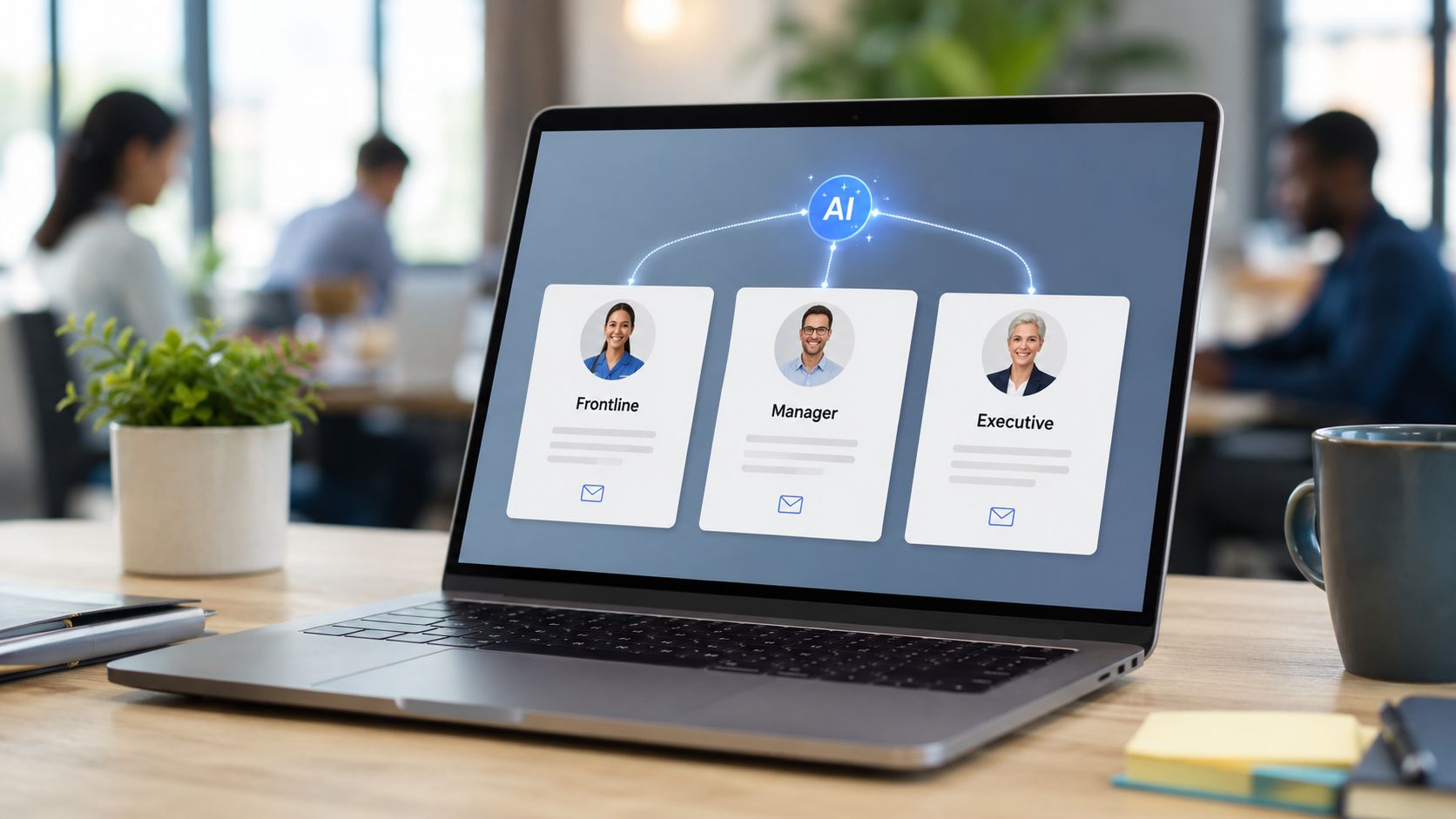
The strongest teams use AI inside a controlled workflow. They start with a source message that has clear intent, approved facts, and known risk points. Then they use AI to create practical variants such as a supervisor talk track, a mobile-first frontline summary, a field sales version, and an executive brief. Human review still decides what ships.
That distinction matters.
A hospital system might issue one infection-control update, then create separate versions for day shift, night shift, float staff, and nurse managers. A retailer might adapt a policy change for store associates, district managers, and distribution centers, with examples that reflect each environment. A manufacturer can turn a standard onboarding notice into versions for line operators, maintenance technicians, and office staff, each with different terminology and action steps.
Used poorly, AI creates more noise. It can overproduce content, flatten nuance, or introduce phrasing that sounds efficient but does not match how employees talk. Used well, it improves relevance while protecting consistency.
Practical rule: Use AI to adapt approved content for specific audiences and channels. Keep strategy, judgment, legal review, and final approval with people.
Start with narrow, repeatable use cases. Policy updates, benefits reminders, recurring safety communications, and manager toolkits are usually the best first candidates because teams can compare outputs, check accuracy quickly, and build review standards before expanding.
The best programs also connect personalization to measurement. Track whether employees received the version built for their role, whether managers used the briefing materials, and whether frontline teams acted on the message in the expected system or workflow. If AI speeds production but does not improve clarity, reach, or execution, it is just cheaper volume.
A strong operating model treats AI as part of the internal comms stack, not a writing shortcut. It supports segmentation, translation, accessibility, and channel formatting. Teams that want broader workforce impact should pair that approach with a clearer view of employee engagement trends so personalization improves the employee experience instead of just increasing output.
2. Trust and Transparency as Measurable Business Drivers
A lot of companies still treat trust like a soft outcome. It isn’t. In most organizations, trust shows up in whether employees believe leaders, whether they understand why decisions were made, and whether they hear the same story from executives and managers.
That matters most during hard moments. Layoffs, staffing shortages, restructuring, technology changes, and policy shifts all test credibility. Employees don’t need polished optimism. They need consistency, context, and proof that leaders will say what’s true even when the news is difficult.
How to measure trust without making it vague
The best trust measures are behavioral. Ask employees whether their manager explains the reasons behind decisions. Ask whether leadership communication matches reality. Ask whether they know what’s changing, what isn’t, and what they can influence.
A healthcare organization dealing with staffing strain can build trust by naming the constraint, explaining trade-offs, and sharing what support is being added for unit leaders. A manufacturing company can audit which supervisors employees rely on when policy changes hit the floor. A global hybrid employer can compare trust signals across headquarters, field, and remote teams to see where credibility breaks down.
Use trust metrics in executive reviews, not just in annual engagement decks. If leaders say transparency matters, trust data needs to shape accountability.
Bad news rarely destroys trust by itself. Evasion usually does.
3. Attention Management and Information Triage
Most internal communications teams don’t have a content problem. They have an attention allocation problem. Every new channel promises reach, but too often it creates duplication, noise, and missed priorities.
That trade-off is visible in the data. 65% of employees report ignoring updates because there are too many channels. If your organization keeps adding Slack posts, Teams messages, emails, intranet updates, SMS alerts, and digital signage without reducing anything else, message quality won’t save you.
Reduce channel load before adding more content
A hospital may need a critical-only protocol during peak clinical periods. A retailer might limit store communications to the scheduling app, shift huddles, and urgent text alerts. A manufacturer could set blackout windows around shift handoffs so workers can focus on safety and production continuity.
A simple audit usually reveals the issue fast:
- Count message volume: Track how many emails, notifications, and posts a frontline employee or manager gets in a normal day.
- Define urgency tiers: Separate life-safety, operational, manager-led, and informational communications.
- Batch low-priority content: Move non-urgent updates into a digest instead of firing them one by one.
- Retire duplicate channels: If nobody needs the same update in four places, stop posting it four times.
Attention is finite. Strong internal communications trends in 2026 reflect that reality by treating silence as a tool, not a failure.
4. Manager-Led Communication as Primary Engagement Channel
Internal communicators keep rediscovering the same truth. Employees usually trust their direct manager more than a corporate channel.
Workshop’s 2025 research puts that in operational terms. Manager communication enablement is the top internal communications trend with 68% adoption, compared with 58% for digital events and 52% for video content. That’s a strong signal that the manager layer isn’t optional. It’s the delivery system.

What manager enablement actually looks like
In a plant, that may mean a shift leader gets a one-page briefing, a short Q&A, and a huddle script for the start of the week. In healthcare, department leaders might receive language for discussing staffing changes before those changes affect schedules. In retail, store managers can use talking points to explain pricing, promotions, or policy changes during team meetings.
Most manager comms programs fail for one of two reasons. The materials are too long, or they’re delivered too late.
Use short kits built for live conversation:
- Talking points: One page, plain language, ordered by priority.
- Context cues: Explain the why, not just the what.
- Likely questions: Give managers credible answers for predictable concerns.
- Feedback path: Capture what employees asked so comms can adjust.
Managers don’t need more content. They need usable communication tools embedded in the operating rhythm.
5. Frontline-Specific Communication Strategy and Accessibility
Frontline communication is where generic internal communications advice breaks down. A nurse between patient rounds, a warehouse picker on a handheld device, and a cashier checking tomorrow’s shift don’t interact with communication the way office workers do.
That gap is one reason many AI and personalization programs disappoint. While 78% of comms leaders cite AI as a top personalization trend, only 12% report successful implementation with frontline staff who lack consistent email access. The issue isn’t just technology maturity. It’s channel fit, device reality, literacy differences, and operational context.
Build for the conditions people actually work in
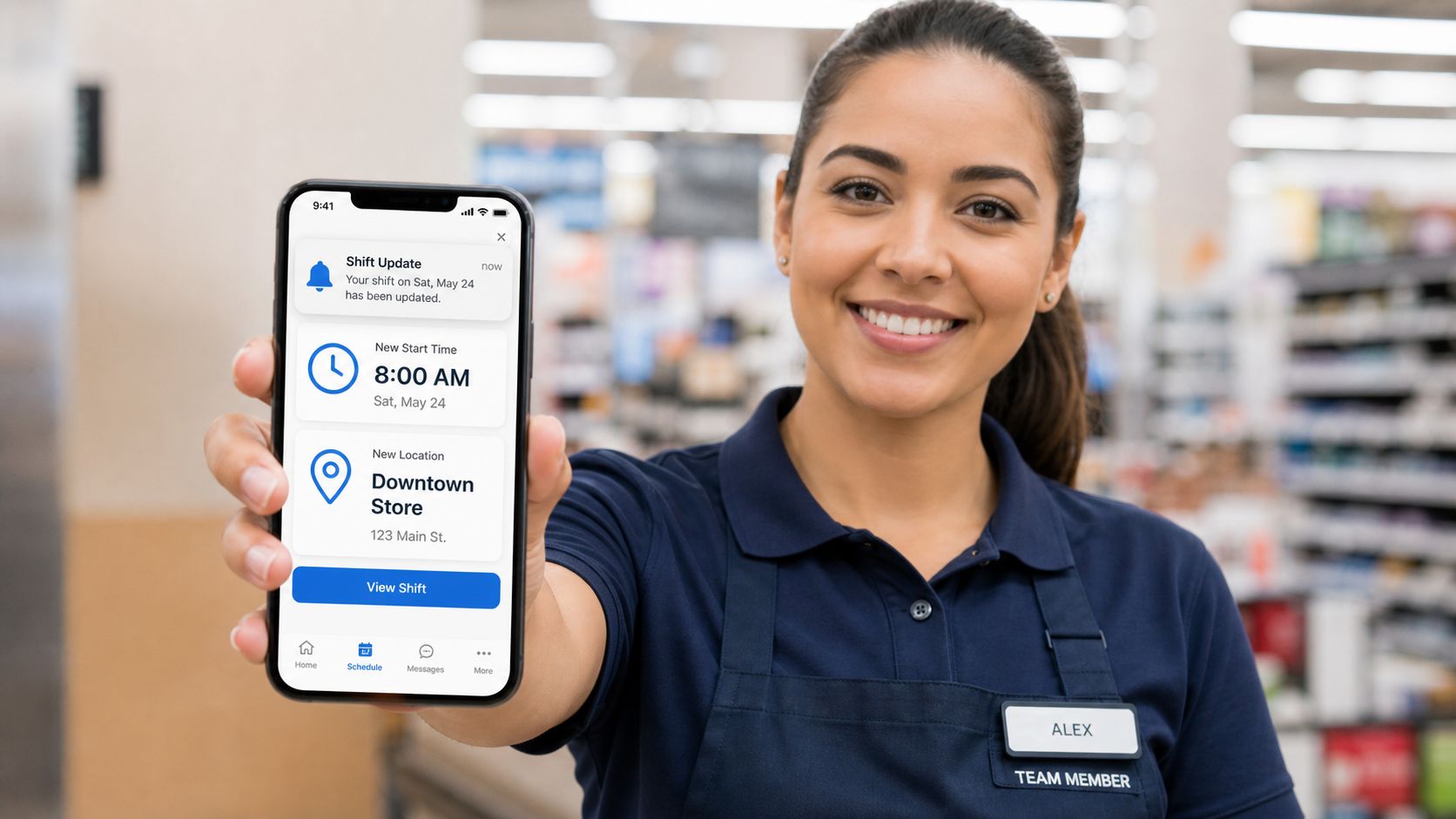
A restaurant group may need push notifications inside the scheduling app, plus visual prompts for multilingual teams. A hospital might use in-app alerts and SMS for urgent staffing or protocol updates. A distribution center may place safety briefs inside the task system workers already check at shift start.
The practical standard is simple. Start where frontline workers already are.
- Use existing tools first: Scheduling, task, point-of-sale, workforce management, and mobile apps usually outperform email for deskless populations.
- Design for constrained devices: Test on older phones, weak connections, and short attention windows.
- Favor clarity over format trends: Short videos and visual explainers can help, but only when they load fast and answer a real question.
- Keep urgency rare: If every push alert looks urgent, employees will stop reacting.
For teams improving frontline employee engagement, communication design has to reflect the work environment, not headquarters assumptions.
6. Measurement Beyond Engagement and Toward Business Outcomes
A message that gets read but does not change behavior has limited business value. Internal communications teams need a measurement model that tracks what employees understood, what managers reinforced, and what changed in day-to-day execution after the message went out.
That shift matters most in distributed organizations, where AI personalization can improve relevance but also make measurement more complex. A personalized message may lift attention for one audience and miss the mark for another. The job is not only to track reach. It is to connect targeting decisions, trust signals, and operational follow-through.
Better measures for a stronger operating case
A manufacturer can pair a safety campaign with two checks: a short comprehension quiz and supervisor observation on the floor a week later. A hospital can test whether staff understand a revised clinical workflow before go-live, then compare unit-level adherence after launch. A retailer can review whether stores with consistent manager briefings execute promotions more accurately and with fewer customer-facing errors.
Open rates, click rates, and read confirmations still help diagnose channel performance. They do not show whether communication worked. Better scorecards combine communication data with business indicators such as training completion, policy adherence, process adoption, incident reduction, service consistency, or speed to execution.
The strongest teams also measure trust, because trust affects whether employees act on what they hear. Pulse checks can assess whether employees believed the message, felt the rationale was clear, and knew where to raise concerns. That creates a more useful view of workforce experience outcomes than engagement metrics alone.
Measurement gets stronger when communications works alongside HR and operations, making workforce operations a key part of the comms conversation. The best dashboards connect message delivery to manager action, employee understanding, and operational results across remote, hybrid, and frontline environments.
Measure what employees understood, trusted, and did next. Everything else is supporting data.
7. Sense-Making and Context-Provision in Complex Change
A single announcement rarely works during change. Employees usually need a sequence. First the decision. Then the rationale. Then role impact. Then manager interpretation. Then updates as facts evolve.
That’s where internal communications trends in 2026 are pushing teams toward sense-making instead of broadcasting. The function is less about publishing a polished message and more about helping people understand what a change means in practice.
Context is what lowers uncertainty
During a merger, a healthcare system might need a running FAQ for clinicians, unit managers, and administrative teams because each group faces different concerns. During a system rollout, IT and internal comms should explain not only launch timing but also how daily workflow changes for each role. During a supply chain disruption, operations leaders need regular updates employees can use, including what remains uncertain.
A useful pattern looks like this:
- Initial announcement: What’s changing and why.
- Manager brief: How to explain it locally.
- Role-based FAQ: What it means for specific employee groups.
- Update rhythm: What changed since the last message.
- Feedback capture: What employees still don’t understand.
Sense-making is one of the clearest places where communication, operations, and employee experience intersect. Without that context layer, people fill gaps with rumor.
8. Internal Communications as a Driver of Culture in Daily Operations
Values only matter if employees can see them in decisions, workflows, recognition, and leader behavior. Internal communications plays a central role here because it translates abstract values into examples people can recognize in their own work.
Many culture programs often stall. They celebrate ideals in polished campaigns while employees experience contradictory policies, uneven manager behavior, or silence when the organization falls short.
Operationalize values, don’t just promote them
A healthcare employer that says wellbeing matters should explain how scheduling, staffing, and leader expectations reflect that claim. A manufacturer that prioritizes safety should highlight moments when frontline workers stopped a process to flag risk, and should show that leaders supported that choice. A retailer can build credibility by acknowledging when peak-period decisions strained teams and by communicating what will change next season.
Nearly 68% of internal communicators named employee experience their top priority in 2025 for the sixth consecutive year, while 45% identified AI as a central topic of interest. That pairing is telling. AI matters, but employee experience still anchors the agenda.
For organizations thinking more broadly about workforce experience, culture communication works best when it reflects operational reality. If values don’t show up in schedules, staffing, recognition, and decisions, no campaign will fix the gap.
9. Integration of Internal Communications with the Broader Workforce Ecosystem
Internal communications gets stronger when it is built into the systems employees already use to do their jobs. In practice, that means connecting messages to scheduling tools, collaboration platforms, HR workflows, task systems, and mobile apps so communication shows up at the point of action.
This matters most in hybrid, remote, and frontline environments, where a message sent to a central hub often gets missed, delayed, or stripped of context. Teams do not need more channels. They need fewer handoffs between information, decisions, and execution.
Integration beats channel sprawl
A retailer can push a location-specific update through the workforce scheduling platform when store hours or staffing rules change. A manufacturer can place production updates inside the task environment supervisors check before every shift. A healthcare system can combine staffing data with role-based mobile alerts so the right clinicians receive the right message without asking them to hunt for it between patients.
That approach also creates a better path for AI personalization. If communications teams can access approved signals from HR, scheduling, location, and role data, they can tailor content by audience, shift pattern, manager group, or work setting without creating dozens of manual versions. The trade-off is governance. Poor integration creates noise faster than it creates relevance, especially if systems send overlapping alerts or outdated messages.
Trust is part of the equation too.
When communication is tied to the workflow, employees can see whether the message matches what the system, manager, or shift plan requires. That alignment matters. A policy update that appears in one place while scheduling, payroll, or task instructions say something else will weaken confidence quickly. Here, the distinction between employee experience and operations blurs in a useful way. If you’re comparing employee experience vs workforce experience, internal communications sits at the point where context, systems, and execution meet.
The operating model is straightforward. Publish once, adapt by audience, deliver inside the tools people already use, and measure more than clicks. Track whether employees received the message in the right channel, whether managers reinforced it, whether frontline teams could act on it, and whether trust held up when policy met reality. That is how internal communications becomes part of the workforce ecosystem instead of a layer sitting beside it.
9-Point Comparison: Internal Communications Trends
| Item | Implementation Complexity 🔄 | Resource Requirements ⚡ | Expected Outcomes 📊 | Ideal Use Cases 💡 | Key Advantages ⭐ |
|---|---|---|---|---|---|
| AI-Assisted Content Creation and Personalization at Scale | 🔄 High, integrations, governance, prompt engineering, real-time loops | ⚡ Moderate–High, AI licenses, HR data access, training, integration effort | 📊 Scales personalization; ↑ engagement; faster multi-variant delivery | 💡 Large distributed workforces; multi-channel campaigns; time-sensitive ops updates | ⭐ Scales personalization without proportional headcount; data-driven optimization |
| Trust and Transparency as Measurable Business Drivers | 🔄 Medium, survey design, sentiment analysis, leadership audits | ⚡ Moderate, survey tools, analytics, leadership time and commitment | 📊 Measured trust metrics linked to retention, productivity, safety | 💡 Post-restructuring, credibility rebuilding, leadership communications | ⭐ Links communications to business outcomes; surfaces trust gaps early |
| Attention Management and Information Triage | 🔄 Medium, governance frameworks, channel rules, cross-functional buy-in | ⚡ Low–Moderate, coordination, calendars, tooling for filters | 📊 Reduced noise; improved open rates and comprehension; less alert fatigue | 💡 High-channel environments; frontline shifts; crisis periods | ⭐ Protects employee attention; increases message signal-to-noise ratio |
| Manager-Led Communication as Primary Engagement Channel | 🔄 Medium, manager kits, training, feedback loops, scheduling | ⚡ Moderate, training, scripted assets, dashboards | 📊 Higher retention of messages; improved trust and two-way dialogue | 💡 Frontline teams, dispersed crews, operational announcements | ⭐ Increases comprehension and trust by leveraging trusted relationships |
| Frontline-Specific Communication Strategy and Accessibility | 🔄 Medium–High, mobile-first design, integrations, multilingual assets | ⚡ Moderate, SMS/push costs, app integrations, media production | 📊 Ensures reach and comprehension for deskless workers; faster operational response | 💡 Retail, healthcare, manufacturing, hospitality with device-constrained staff | ⭐ Embeds messages in tools workers use; improves equity and compliance |
| Measurement Beyond Engagement: Business Impact & Outcome Metrics | 🔄 High, attribution models, cross-system data linkage, sophisticated analysis | ⚡ High, analytics talent, access to HR/ops data, dashboards | 📊 Demonstrable ROI; links comms to safety, retention, behavior change | 💡 Mature orgs seeking ROI proof; safety-critical operations | ⭐ Shifts communications to strategic driver with measurable business impact |
| Sense-Making and Context-Provision in Complex Change | 🔄 Medium, multi-part sequences, role-specific context, sustained cadence | ⚡ Moderate, content creation, manager enablement, update processes | 📊 Reduced anxiety; better change adoption; fewer rumors and turnover | 💡 Mergers, restructures, major technology or process change | ⭐ Improves adoption by explaining “why” and role-specific implications |
| Internal Communications’ Role in Culture & Values Operationalization | 🔄 Medium, values audits, recognition programs, manager coaching | ⚡ Moderate, cross-functional effort, storytelling assets, measurement | 📊 Stronger authenticity perception; improved retention and accountability | 💡 Values-driven organizations; scaling culture across frontline teams | ⭐ Operationalizes values with behavioral examples and accountability |
| Integration of Internal Communications with Broader Workforce Ecosystem | 🔄 Very High, API integrations, SSO, unified identity and analytics | ⚡ High, platform investments, vendor coordination, data governance | 📊 Real-time contextual messaging; automated notifications; unified analytics | 💡 Large employers with complex scheduling and frontline systems | ⭐ Eliminates silos; automates ops-driven communications; improves accuracy |
Turning Insights Into Action
The strongest internal communications trends in 2026 point in one direction. Better communication isn’t just about better messaging. It comes from better operating discipline.
That means choosing a few high-value AI use cases instead of automating everything at once. It means measuring trust with concrete questions employees can answer truthfully. It means reducing channel clutter so urgent messages still stand out. It means treating manager communication as an operational capability, not a side task. And it means designing differently for frontline workers whose day doesn’t revolve around email, laptops, or intranet visits.
The biggest opportunity is integration. When internal communications connects with HR technology, scheduling, task systems, collaboration tools, and operational rhythms, it stops acting like a standalone department and starts functioning like infrastructure for workforce experience. That’s the shift many organizations still need to make.
A practical starting plan is simple:
- Pick one business-critical workflow such as policy updates, safety communication, or manager briefings.
- Audit channel load so you know what employees already receive.
- Build manager toolkits for major announcements.
- Define one trust measure and one outcome measure before launch.
- Test with frontline and hybrid employees in real working conditions, not just with headquarters users.
That’s how communication becomes more credible, more targeted, and more useful. In 2026, the teams that stand out won’t be the ones publishing the most. They’ll be the ones that help employees understand what matters, know what to do next, and feel that the organization is designed to support how work happens.
FAQs on Internal Communications Trends
What are the top internal communications trends in 2026?
The biggest trends are AI-assisted personalization, trust measurement, attention management, manager-led communication, frontline-specific channel design, outcome-based measurement, sense-making during change, culture operationalization, and tighter integration with HR and operational systems.
Why is AI important in internal communications now?
AI helps teams create audience-specific message variations faster and with more consistency. It’s most useful when applied to repeatable use cases like policy updates, safety briefings, and manager versions of executive messages, with human review still in place.
How should internal communications teams measure success?
Teams should go beyond opens and clicks. Stronger measures include employee understanding, manager reinforcement, trust signals, policy adoption, safety compliance, and other business outcomes linked to the communication effort.
Why are managers so important in internal communications?
Managers are often the most trusted source employees have. They translate enterprise messages into local relevance, answer questions in real time, and help employees understand why a change matters to their team.
How should companies improve communication with frontline workers?
Start with the tools frontline workers already use, such as scheduling apps, mobile work apps, task systems, or SMS for urgent updates. Keep messages short, relevant, accessible on constrained devices, and designed for the actual pace of frontline work.
What’s the difference between more communication and better communication?
More communication increases volume. Better communication improves clarity, timing, targeting, trust, and action. In many organizations, better communication means fewer messages, fewer channels, and stronger manager support.