
A good shift schedule does more than put enough names on Tuesday afternoon.
In 2026, shift scheduling best practices come down to five connected disciplines: forecast the work accurately, publish schedules early, respect employee availability and rest, distribute difficult shifts fairly, and create a reliable process for the changes that will inevitably happen after publication.
That last part is where many schedules fall apart. A manager may create a perfectly balanced rota on Friday, only to spend the following week dealing with a sick call, childcare conflict, overtime problem, shift swap, and an employee who says they never saw the revised schedule.
The best scheduling process plans for change instead of pretending it won’t happen.
This guide explains how to build that process for hourly, frontline, retail, hospitality, healthcare, manufacturing, warehouse, and other shift-based teams. It also covers the 2026 U.S. compliance landscape, schedule fairness, fatigue, no-show prevention, labor forecasting, shift swaps, automation, and the metrics that show whether your scheduling practices are actually improving.
What Good Shift Scheduling Looks Like in 2026
A good employee schedule has to satisfy several people at once.
Operations needs enough qualified people to perform the work. Finance wants labor hours controlled. Employees need enough predictability to organize transportation, childcare, school, second jobs, and the rest of their lives. HR needs scheduling practices that can be applied consistently. Managers need a system they can actually operate when somebody calls out 45 minutes before a shift.
Those requirements can compete.
Scheduling too tightly around projected demand can leave no room for absences. Scheduling excessive backup capacity controls risk but inflates labor cost. Giving every employee complete choice may leave undesirable shifts uncovered. Ignoring employee preferences makes the schedule easier to build and harder to keep.
The goal is therefore not a mathematically perfect schedule.
It is a schedule that covers the work and remains workable once real people begin living with it.
A useful way to think about schedule quality is through six dimensions:
| Dimension | The question to ask |
| Coverage | Do we have enough qualified people when the work actually happens? |
| Predictability | Do employees know their hours far enough in advance to plan around them? |
| Stability | How often does management change the schedule after publishing it? |
| Employee control | Can employees record availability, request time off, swap shifts, or claim open hours through a defined process? |
| Fairness | Are unpopular shifts, hours, weekends, and opportunities distributed according to transparent rules? |
| Sustainability | Does the schedule allow adequate rest and avoid repeatedly relying on overtime or the same dependable employees? |
If one of these dimensions is consistently weak, another problem usually appears later.
Poor coverage creates overtime. Poor predictability creates conflicts. Poor stability makes published schedules difficult to trust. Poor employee control turns manageable conflicts into call-outs. Poor fairness creates resentment. Poor rest eventually becomes a fatigue and safety problem.
That is why shift scheduling belongs in workforce operations rather than being treated as an administrative calendar task.

Step 1: Forecast the Work Before You Schedule the People
One of the most common scheduling mistakes happens before a single employee is assigned.
Managers start with last week’s schedule.
That feels efficient because most businesses do have repeatable staffing patterns. The problem is that last week’s roster tells you who worked. It does not necessarily tell you how many people you needed.
Start with demand.
A restaurant can use reservations, historical sales, transactions by daypart, local events, weather, and promotions.
A retailer can look at transactions, foot traffic, deliveries, promotional calendars, seasonal patterns, and known product launches.
A warehouse may care about inbound volume, outbound orders, carrier schedules, backlog, equipment availability, and expected throughput.
A hospital has patient census, acuity, required staffing levels, licenses, specialties, and expected admissions.
A manufacturer has production plans, changeovers, line requirements, maintenance windows, certifications, and order volume.
The forecast does not have to be sophisticated at first. A simple comparison of expected workload against historical staffing can already improve a schedule built entirely from habit.
Turn workload into a staffing requirement
Do not jump straight from “Friday will be busy” to employee names.
First define how much coverage Friday requires.
A restaurant might determine that dinner needs one manager, three servers, one bartender, two line cooks, one prep cook, and one dishwasher between specific hours.
A distribution center may need 18 pickers, four packers, two equipment-certified employees, and one shift lead between 6 a.m. and 2 p.m.
This creates a staffing requirement separate from the people available to fill it.
That separation is useful because it exposes the real problem.
If six employees are available but you need eight qualified employees, you have a capacity problem.
Moving six names around a spreadsheet will not solve it.
Step 2: Schedule Skills, Certifications and Roles Before Names
Headcount can hide understaffing.
A shift with 12 employees is not fully staffed if nobody present can perform the function the operation depends on.
This is particularly important in healthcare, manufacturing, maintenance, security, transportation, food service, warehousing, and other environments where certain work requires a credential, qualification, supervisory role, or specific training.
Your scheduling process should therefore know more than whether somebody is available.
It should know what they are qualified to do.
A simple skill matrix may be enough:
| Employee | Supervisor | Forklift | First aid | Opening | Closing |
| Employee A | Yes | Yes | No | Yes | Yes |
| Employee B | No | Yes | Yes | No | Yes |
| Employee C | Yes | No | Yes | Yes | No |
Now imagine Employee A calls out.
You do not need “another employee.”
You need somebody who can replace the specific capability lost from the shift.
This is also why cross-training has a direct scheduling value. Training another person to close a store, operate a machine, supervise a shift, or perform a certified function removes a scheduling bottleneck.
A recurring clopening or overtime problem is sometimes a training problem disguised as a scheduling problem.
Step 3: Separate Employee Availability From Employee Preferences
Availability and preference should not be treated as the same thing.
Availability means when the employee can work.
Preference means when they would rather work.
That difference should be explicit in your scheduling policy.
Suppose an employee cannot work Tuesday evenings because of a class. That is a hard constraint.
Another employee prefers not to work Saturday evenings because they like having Saturday night free. That is a preference.
Both deserve consideration, but they are not operationally identical.
The scheduling process should capture recurring availability separately from temporary exceptions such as vacation, medical appointments, school events, childcare changes, or other time-off requests.
Then let employees update that information through one approved route.
Texting a manager is convenient until 45 employees are texting the same manager.
The schedule should not depend on somebody remembering a conversation from last Tuesday.
Set an availability cutoff
Create a regular deadline for availability changes and time-off requests.
For example, if schedules are published every Wednesday for the period beginning two weeks later, availability changes might be due the preceding Friday.
Employees then know when information has to be submitted.
Managers know when the inputs are ready.
Exceptions can still happen, but the normal process stops moving every day.
That consistency becomes particularly useful in multi-location operations where different managers otherwise develop their own scheduling rules.
Step 4: Use a Stable Core Schedule Where the Work Allows It
Not every shift needs to be rebuilt every week.
If the same operation repeatedly needs roughly the same jobs at the same times, create a core schedule around that stable demand.
Then manage the genuinely variable portion separately.
This is one of the most useful distinctions in shift scheduling.
Imagine a store that reliably needs 12 employees on Saturday morning. The exact Saturday traffic may fluctuate, but perhaps eight roles are required almost every week.
Those eight positions can form a stable core.
The remaining four can flex with demand, employee availability, open shifts, seasonal changes, or special events.
This is more predictable than rebuilding all 12 positions every week simply because the scheduling software makes it possible.
Research provides some support for this approach. The Stable Scheduling Study, a randomized field experiment conducted across Gap stores, tested a package that included more consistent schedules, advance notice, elimination of on-call shifts, easier shift swapping, and targeted staffing. The published Management Science analysis found a 5.1% increase in store productivity in the treatment group, driven by higher sales and fewer labor hours.
It was one retail experiment rather than a universal formula, but it provides unusually strong evidence that more responsible scheduling does not automatically conflict with operating performance.
Read the Management Science study
Read the Stable Scheduling Study report
The practical lesson is not “copy the Gap schedule.”
It is that schedule stability can be treated as an operating variable rather than an employee perk.
Step 5: Publish Earlier Than the Minimum You Think You Need
If your managers publish the schedule three days before the workweek because “that’s how we’ve always done it,” try moving the process earlier.
Two weeks is a useful operational target for many shift-based businesses.
It is not a universal federal requirement. It is, however, common in predictive-scheduling rules and gives employees meaningful time to flag conflicts, organize childcare or transportation, and arrange a shift swap before the problem becomes a same-day absence.
The Stable Scheduling Study also used two-week advance notice as one of its baseline scheduling practices.
The more important principle is consistency.
If employees know the schedule appears every Wednesday afternoon, they know when to check it and when to raise a problem.
If one manager posts Friday, another waits until Sunday night, and schedules are occasionally altered through a group text, the organization technically has a schedule but does not have a reliable scheduling process.
Use a publish date and a change window
A useful policy can distinguish three stages.
Draft period: Managers build the schedule while employee availability and time-off information are being resolved.
Published schedule: Employees receive the official schedule through one defined system.
Post-publication exception period: Changes are controlled, recorded, and communicated rather than quietly editing the calendar.
That third stage is particularly important.
Employees stop trusting published schedules when management edits them repeatedly without a clear notification.
A schedule employees have to check every day “in case it changed” is not genuinely predictable.
Step 6: Make Fairness a Rule, Not a Manager’s Memory
Fair scheduling does not mean every employee receives the exact same number of Friday nights, holidays, overtime hours, or preferred shifts.
Employees have different roles, availability, seniority, qualifications, contractual terms, and agreed working hours.
Fairness means the rules used to make those decisions are consistent and explainable.
That is a higher standard than “the manager tried to be fair.”
Start with undesirable shifts
Every operation has shifts that employees are less likely to want.
It might be Sunday morning.
It might be Friday night.
It could be an overnight shift, holiday, split shift, closing shift, or a location with a long commute.
Identify those shifts instead of pretending all shift assignments carry the same burden.
Then choose the rule.
You might rotate difficult shifts.
You might use seniority where an agreement requires it.
Employees may bid.
You may pay a shift differential.
Some teams use voluntary sign-ups before assigning the remaining hours.
The rule matters less than applying it consistently and making it understandable.
Audit the result, not only the intention
Managers often do not realize when schedules have become lopsided.
One dependable employee starts covering every Sunday because they rarely complain.
A strong employee keeps receiving overtime because the manager knows they will accept it.
The same supervisor closes every Saturday because only two people were ever trained to close.
Nobody intentionally created an unfair pattern, but the pattern exists.
A monthly scheduling audit can catch it.
Useful fairness measures include:
| Measure | What it can reveal |
| Weekend-shift distribution | Whether the same people repeatedly carry weekend coverage |
| Night/closing-shift distribution | Whether difficult hours are concentrated |
| Overtime by employee | Whether extra work is repeatedly falling to the same workers |
| Scheduled-hours variance | Whether comparable employees receive very different hours |
| Preference fulfillment | Whether certain employees’ requests are routinely favored |
| Employer-initiated changes | Whether some employees receive much less schedule stability |
| Rest-period exceptions | Whether the same people repeatedly work short turnarounds |
| Open-shift access | Whether extra-hour opportunities reach the full qualified pool |
Do not turn these numbers into an automatic accusation of bias. They are signals that tell the manager where to look.
There may be a legitimate reason.
The useful question is whether you can explain it.
Step 7: Protect Rest Between Shifts
A schedule can be fully staffed and still be badly designed.
An employee closes a restaurant at 11:30 p.m. and returns to open it at 6 a.m.
A hospital employee finishes a long shift and is asked to cover another because staffing is short.
A warehouse worker takes overtime immediately before their next scheduled shift.
Coverage is technically complete.
Recovery is not.
NIOSH’s current fatigue guidance identifies nonstandard schedules and extended hours as important contributors to work-related fatigue. Fatigue can slow reaction time, reduce concentration, affect short-term memory, and impair judgment.
NIOSH guidance on fatigue and work
For rotating work, NIOSH guidance also recommends minimizing consecutive night shifts, considering shorter shifts during evening and night work, and protecting recovery time after blocks of longer shifts. Its nursing guidance is industry-specific, but the fatigue principles are useful well beyond healthcare.
NIOSH guidance on long hours and shift work
Treat clopenings as an exception
A closing shift immediately followed by an opening shift, commonly called a clopening, deserves an explicit scheduling rule.
Some U.S. fair workweek laws already impose rest requirements or premium pay around short turnarounds. Even where no local rule applies, routinely creating short rest windows can make schedules harder to sustain.
Set a minimum-rest rule in your scheduling system where possible.
Then require an intentional exception rather than allowing the schedule to create short turnarounds silently.
The goal is not to pretend an emergency will never require somebody to return sooner.
The goal is to make sure it is actually an emergency.
Step 8: Design Shift Swapping Before Employees Need It
Shift swaps are sometimes treated as a workaround for a failed schedule.
They can be a normal part of a good one.
Employees’ lives will change after publication. Someone gets sick. A school schedule changes. Childcare falls through. Transportation becomes unavailable.
The question is whether that disruption becomes the manager’s emergency.
A controlled shift-swap process allows employees to solve some scheduling conflicts themselves while preserving the rules the company still needs to protect.
The swap should usually be checked against role, skills, qualifications, overtime, rest requirements, location rules, and any relevant scheduling law.
For example, two servers may be perfectly able to exchange equal shifts.
A cashier cannot automatically swap with a licensed pharmacy technician.
An employee sitting at 39 scheduled hours may create overtime by accepting an eight-hour shift.
Someone who takes the shift may create a rest-period problem with their next assignment.
A useful system therefore gives employees freedom inside operating rules.
Decide when responsibility changes
This point belongs in the written scheduling policy.
If Employee A offers a shift and Employee B requests it, who remains responsible before manager approval?
What happens if B changes their mind?
Is the original employee released as soon as another employee claims the shift, or only after approval?
Vague swap rules create no-shows because two employees can each believe the other person owns the shift.
The scheduling system should always show one person as responsible.
Step 9: Build Open Shifts and Backup Capacity Into the System
A no-show should not trigger a manager calling 15 employees one at a time.
Create a backup process before the absence occurs.
An open-shift pool can notify qualified employees who are available and legally eligible to work the hours.
A voluntary standby group can work in some environments, subject to applicable laws and pay rules.
A multi-location business may allow employees to pick up hours at another site if qualifications, labor rules, and operating procedures permit it.
Cross-trained employees widen the replacement pool.
Some operations maintain a small layer of planned flex capacity during the periods where absence or demand risk is highest.
The useful principle is that coverage should be a system, not a contact list stored in one manager’s head.
This is especially important when the manager who normally solves coverage is off.
Step 10: Audit Overtime Before You Publish
Many overtime problems are created in the schedule and discovered in payroll.
By then, the hours have already been worked.
The schedule should show managers projected regular and overtime hours before publication.
It should also recheck those totals when somebody picks up an open shift, changes locations, extends a shift, or agrees to a swap.
This becomes particularly important in multi-location businesses.
A manager may see that an employee has 24 hours at their store and happily offer another 16.
The employee may already have 12 scheduled hours at another location.
Now the company has an overtime issue that neither local manager saw.
Central visibility solves a problem local spreadsheets cannot.
Step 11: Check Compliance Before the Schedule Goes Live
Federal law is not the whole scheduling rulebook in the United States.
The federal Fair Labor Standards Act generally does not require employers to provide advance notice before changing an adult employee’s work schedule. The U.S. Department of Labor states that, apart from certain child-labor requirements, the FLSA has no general provisions regulating employee scheduling.
U.S. Department of Labor FLSA FAQ
State, local, industry, contract, and collective-bargaining requirements can be much more specific.
Your pre-publication scheduling check may need to consider advance notice, predictability pay, overtime, meal and rest rules, reporting-time pay, minor employees, required time between shifts, split-shift rules, employee classifications, leave, accommodations, licenses, union provisions, and industry-specific requirements.
Predictive scheduling and Fair Workweek laws in 2026
Fair Workweek rules remain jurisdiction-specific rather than a national standard.
The exact employer size, industries covered, employee eligibility, notice period, exceptions, premium amounts, and recordkeeping obligations vary considerably.
Oregon, for example, has a statewide predictive scheduling law covering certain large retail, hospitality, and food-service employers. Covered workers generally receive their schedules 14 calendar days in advance, and the law includes requirements around schedule changes, predictability pay, employee input, additional hours, and rest between shifts.
Oregon Bureau of Labor and Industries predictive-scheduling guidance
Several cities also have their own systems.
Seattle generally requires covered retail and food-service employers to post schedules 14 days ahead and addresses changes, access to hours, and short rest between shifts.
Seattle Secure Scheduling Ordinance
New York City’s rules differ between fast-food and retail employees. Philadelphia has a Fair Workweek law for covered service, retail, and hospitality employers. Chicago regulates covered industries through its Fair Workweek Ordinance. Los Angeles City and, since July 2025, unincorporated Los Angeles County have Fair Workweek requirements for covered large retail employers.
The 2026 evidence base has also become stronger. A Science Advances study using data from more than 87,000 hourly workers across 217 large retail and food-service employers found Fair Workweek laws increased the share of workers receiving at least two weeks’ advance notice by 13 percentage points, reduced clopening exposure by 8 percentage points, and reduced last-minute schedule changes by 6 percentage points. The researchers did not find broad evidence that employers offset those rules by reducing wages or benefits.
Read the 2026 Fair Workweek study
This is not a substitute for checking the law that applies to your locations.
A national retailer should not build one generic scheduling rule and assume it works everywhere.
Your system needs location-specific rules.
How Far in Advance Should You Publish Employee Schedules?
For many shift-based businesses, 14 days is a sensible operational default when forecasting allows it.
That does not mean every organization is legally required to publish 14 days early.
It means two weeks gives employees a useful planning window and aligns with several major Fair Workweek frameworks.
If your demand genuinely cannot be forecast with that level of certainty, do not make the entire schedule unstable.
Separate stable work from uncertain work.
Publish the stable core early.
Then maintain a smaller layer of open or flexible shifts for demand that genuinely cannot be known yet.
This is often better than keeping the entire workforce uncertain because 15% of the demand may change.
Fixed Schedules vs. Rotating Schedules
Neither model is automatically better.
A fixed schedule gives employees consistency. The same person may work Monday through Friday from 2 p.m. to 10 p.m. for an extended period.
This can be easier for childcare, transportation, sleep, and second-job planning.
The downside is that some employees can become permanently assigned to undesirable hours.
A rotating schedule moves employees through different shift periods or work/rest patterns.
This can distribute nights and weekends more evenly, but rotation itself can disrupt routines and sleep.
For 24/7 operations, ask three separate questions.
Does the work require rotation?
How quickly should shifts rotate?
Can employees select a stable shift instead?
Research guidance from sleep and occupational-health experts generally treats backward rotation and poorly designed night work cautiously because changing sleep timing is difficult.
Read the consensus recommendations on shift work
Do not rotate schedules merely because rotation appears fair on paper.
An employee who actively prefers permanent nights may value consistency more than receiving an equal number of mornings.
Fairness and sameness are not identical.
A Practical Approach to Reducing Shift No-Shows
No-shows are often discussed as an employee discipline problem.
Sometimes they are.
But “employee did not arrive” describes the outcome, not the cause.
A useful no-show strategy separates different failures.
| Why the shift was missed | Scheduling response |
| Employee genuinely forgot | Central schedule, acknowledgement and shift reminders |
| Employee did not see a change | One official schedule source and automatic change notifications |
| Employee was scheduled outside availability | Accurate availability records and validation before publishing |
| Personal conflict appeared after publication | Clear swap, release and open-shift process |
| Transportation or childcare failed | More schedule stability and earlier notice where possible |
| Employee was too fatigued after another shift | Rest rules and clopening controls |
| Employee became ill or had an emergency | Absence-reporting and backup-coverage process |
| Employee deliberately ignored the shift | Attendance policy and manager follow-up |
| Employee believed someone else took the shift | Explicit approval and responsibility rules |
| Replacement options were too narrow | Cross-training and a larger qualified backup pool |
This matters because automated reminders will not solve every row in that table.
A worker who cannot find childcare does not need a better reminder.
A worker scheduled outside the availability they submitted does not need stronger discipline.
A worker who simply chose not to show up despite knowing the schedule may need an attendance conversation.
Treating every absence as the same behavior produces weak scheduling policy.
Use reminders as a safety net, not as the scheduling system
Shift reminders are useful, particularly for irregular schedules.
They should reinforce a schedule employees already received.
They should not be the first time the employee discovers they are working.
For frequently changing schedules, consider an acknowledgement workflow for material schedule changes.
That gives managers evidence that the employee received the update and allows the employee to flag a problem before the shift begins.
What Should You Do When Somebody No-Shows?
The immediate response should be standardized enough that a manager does not have to invent it under pressure.
First confirm that the employee is actually absent and attempt contact through the approved route. There may be a safety or medical issue.
Then activate the coverage plan.
The replacement process should identify qualified employees who can accept the shift without violating overtime, rest, availability, or other rules.
Document what happened and what attempts were made to contact the employee.
After the immediate operating problem is contained, follow up.
Was the absence caused by a schedule error?
Did the employee misunderstand a swap?
Was there an emergency?
Is there a repeat attendance issue?
That distinction matters before applying discipline.
Consistency is particularly important. If one manager ignores repeated no-shows while another disciplines employees for a single incident, you have created a management problem on top of the attendance problem.
Make Schedule Changes Visible
One of the easiest ways to create a preventable no-show is to change the schedule silently.
Do not overwrite Tuesday’s 8 a.m. shift with 10 a.m. and assume the employee will notice.
A post-publication change should create a notification.
For material changes, record who initiated the change, when it occurred, whether the employee accepted it where consent matters, and whether additional compensation may apply under local rules.
This produces a useful change history.
It also lets you measure which locations or managers keep destabilizing schedules after publication.
A site with twice the company average for employer-initiated schedule changes may have a forecasting problem, staffing problem, manager-training problem, or local demand issue.
Without the data, every schedule change looks isolated.
Make Employee Schedule Communication Boringly Reliable
Employees should not have to ask where the real schedule lives.
Not in a photo posted to a group chat.
Not on the break-room wall plus a newer version in the manager’s spreadsheet.
Not in three apps.
Choose one source of truth.
For distributed and shift-based teams, an employee communication platform can give workers one place to receive schedule updates, operational announcements, and other time-sensitive information.
Employees should be able to check it on a device they realistically use, including a personal or shared mobile device where appropriate for the workforce.
Managers should communicate material changes through that same workflow.
For organizations changing scheduling systems, TurnOnWork’s guide to a frontline change-management communication plan covers the rollout problem in more detail. The new process is only successful when employees know which scheduling behavior has changed and stop using the old workaround.
Schedule Flexibility Should Work in Both Directions
Employers need flexibility because demand moves.
Employees need flexibility because life moves.
A sustainable scheduling model gives both sides a controlled way to adapt.
For managers, that may mean flex staffing, open shifts, cross-location coverage, voluntary overtime, and demand-based staffing ranges.
For employees, it may mean preference input, time-off requests, shift swaps, shift releases, open-shift claiming, or shift bidding.
Recent SHRM research on retaining deskless workers found scheduling practices among the strategies HR professionals rated most effective for retention. Flexible schedules, consistent hours, employee input, predictable schedules, and advance notice all ranked strongly, while some of those practices were still relatively uncommon.
Read SHRM’s research on retaining deskless workers
This is useful because employee control does not have to mean giving up operational control.
A worker can choose from eligible open shifts.
A manager can still restrict the pool to employees with the correct skill, location, rest window, and overtime status.
That is flexibility with rules.
Do Not Automatically Give Every Open Shift to Your Most Reliable Employee
Managers naturally call the employee who always says yes.
It solves tonight’s problem.
Repeat that pattern often enough and you may create tomorrow’s.
The same employee accumulates overtime.
They work consecutive difficult shifts.
Other employees lose access to extra hours.
The manager becomes dependent on one person.
That person eventually becomes exhausted or leaves.
An open-shift workflow should make the qualified opportunity visible to a broader pool where operationally appropriate.
Managers can then use transparent assignment rules such as first qualified acceptance, rotation, seniority, lowest current hours, or another approved method.
Which rule is correct depends on your environment.
The point is that the rule should be intentional.
Build Enough Slack Into the Schedule to Survive Reality
Labor optimization can go too far.
A schedule that meets the theoretical minimum headcount every hour has no resilience.
One late employee causes an immediate staffing gap.
One customer surge breaks the model.
One equipment problem moves workers into a different task and leaves another function exposed.
The right buffer depends on the cost of understaffing, demand variability, absence patterns, and the type of work.
A coffee shop and an ICU should not use the same philosophy.
But every operation should know the answer to this question:
What happens if one critical employee is unavailable?
If the answer is “the manager starts calling everybody,” the operating model needs work.
Scheduling Practices for 24/7 Operations
Round-the-clock schedules deserve additional care because the schedule influences sleep as well as attendance.
Try to keep shift patterns understandable. Constantly moving employees from evenings to nights to early mornings makes personal routines difficult and can increase fatigue.
Where rotation is necessary, review the direction and frequency of rotation.
Watch consecutive nights.
Review short turnarounds.
Avoid building repeated overtime on top of long scheduled shifts.
Track which employees repeatedly absorb unexpected coverage.
If employees can choose stable shift blocks without hurting operations, that can sometimes create more predictability than mandatory rotation.
NIOSH notes that a substantial share of the U.S. workforce works outside a regular daytime schedule, and its current work-fatigue research continues to focus on the health and safety implications of nonstandard hours.
NIOSH Center for Work and Fatigue Research
Scheduling here is not simply a staffing problem.
It is part of risk management.
Industry Differences Matter
The same principles apply across shift-based work, but the constraints differ.
| Industry | Scheduling priorities that deserve extra attention |
| Retail | Traffic forecasts, weekend fairness, minors, Fair Workweek rules in covered locations, opening/closing skills |
| Restaurants | Daypart demand, FOH/BOH skill balance, tips, clopenings, late call-outs, open shifts |
| Healthcare | Credentials, safe staffing requirements, continuity, fatigue, long shifts, specialist coverage |
| Manufacturing | Production plan, line certifications, shift handoff, overtime, maintenance, 24/7 rotations |
| Warehousing/logistics | Volume forecasts, equipment certifications, inbound/outbound peaks, seasonal labor, overtime |
| Hospitality | Occupancy, events, role coverage, late/early shifts, housekeeping demand, seasonal fluctuations |
| Field services | Geography, travel time, qualifications, job duration and emergency work |
A generic scheduling policy should therefore establish the principles while local scheduling rules handle the operational detail.
Should You Use AI for Shift Scheduling?
AI workforce scheduling is becoming much more common in workforce-management software, but it should solve a real scheduling problem rather than become another purchasing checkbox.
Automatic scheduling is particularly useful when managers are balancing large numbers of constraints.
A system can process forecasted demand, availability, skill requirements, labor cost, overtime exposure, location, time-off requests, minimum rest, and other rules faster than somebody manually moving names across a spreadsheet.
The risk comes from giving the optimizer the wrong objective.
If the system is told only to minimize labor cost, it may produce a schedule that looks efficient while giving one employee every closing shift or changing working hours substantially from week to week.
Managers should review generated schedules against four questions before publication:
Does it cover the work?
Does it follow the rules?
Is the distribution fair enough to explain?
Can employees realistically work it?
Automation should reduce repetitive scheduling work.
It should not make the reasons behind shift assignments impossible to explain.
If you are evaluating the technology itself, TurnOnWork’s comparison of job scheduling software for frontline and shift-based teams covers current platforms separately. This guide is about the operating practices those tools should support.
What Should a Shift Scheduling Policy Include?
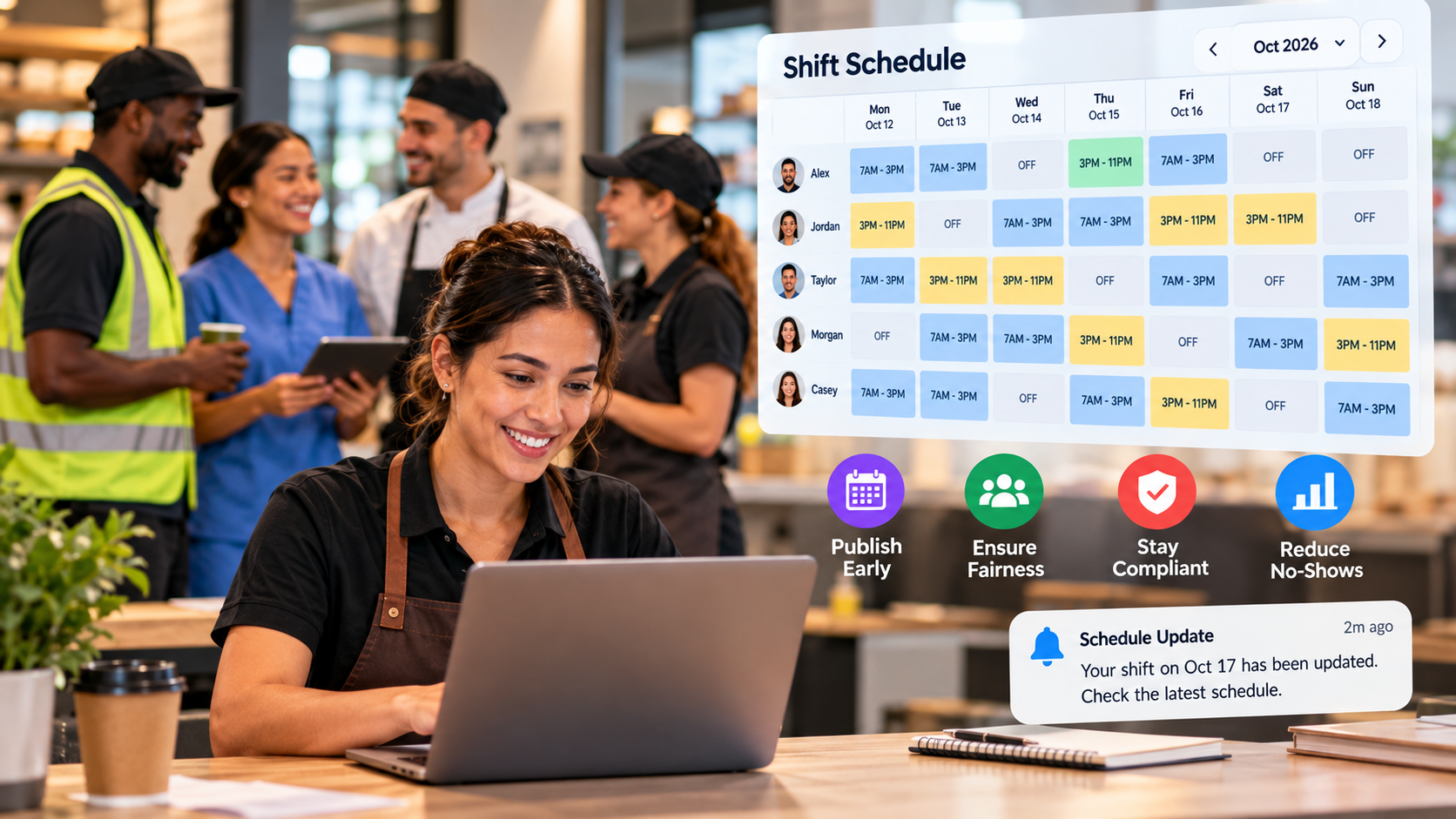
A scheduling policy should tell managers and employees how the system works before a conflict occurs.
It should define the normal schedule period, availability process, time-off deadline, publication day, how employees receive the schedule, rules for post-publication changes, shift swaps, open shifts, late call-outs, no-shows, overtime approval, rest expectations, and the escalation route when a schedule appears incorrect.
It should also explain which requests are preferences rather than guarantees.
Keep it readable.
A scheduling policy employees do not understand will eventually be replaced by informal local rules.
Managers need the same clarity.
If five supervisors interpret the shift-swap rule five different ways, employees will experience the scheduling process as arbitrary even if the written policy is technically consistent.
Measure Schedule Quality, Not Just Schedule Completion
Managers often treat a published schedule as proof that scheduling is done.
Publication is only the beginning.
The schedule creates operational data every week.
A useful workforce-operations dashboard could track:
| Metric | Simple definition | What it tells you |
| Advance notice | Average days between publication and shift | Predictability |
| Schedule stability | % of published shifts unchanged by management | Whether employees can trust the published schedule |
| No-show rate | No-show shifts ÷ scheduled shifts | Attendance outcome |
| Late call-out rate | Short-notice absences ÷ scheduled shifts | Coverage risk |
| Open-shift fill rate | Open shifts successfully filled ÷ open shifts posted | Flex-pool effectiveness |
| Time to fill | Average time to cover an open shift | Operational resilience |
| Overtime rate | Overtime hours ÷ total worked hours | Labor pressure |
| Understaffed-shift rate | Shifts below required coverage ÷ total shifts | Forecast and staffing quality |
| Preference fulfillment | Preference requests met ÷ eligible requests | Employee schedule control |
| Rest exceptions | Short-turnaround transitions ÷ shift transitions | Fatigue exposure |
| Employer change rate | Employer-initiated post-publication changes ÷ published shifts | Forecasting stability |
| Skill coverage | Shifts meeting required skill mix ÷ total shifts | Operational readiness |
Do not chase all twelve metrics on day one.
Choose the ones tied to the scheduling problem you are actually trying to solve.
If your problem is no-shows, track advance notice, last-minute changes, acknowledgements, swaps, call-outs, and no-shows together.
If your problem is overtime, look at coverage gaps, open-shift fill rates, overtime concentration, and forecast accuracy.
If your problem is retention, add schedule stability, preference fulfillment, hours consistency, and employee feedback.
This is also where workforce operations connects with employee experience. TurnOnWork’s employee engagement and retention guide discusses schedule predictability and flexibility as practical frontline retention levers rather than abstract culture initiatives.
A Simple Schedule Fairness Audit
Once per month, choose a comparable employee group and export the previous four to eight weeks.
Look at total hours, nights, weekends, holidays, closing shifts, schedule changes, overtime, and requested preferences.
Then ask where the differences come from.
Suppose four employees perform the same role.
One worked six weekends.
Another worked two.
That is not automatically unfair.
Maybe the second employee is unavailable on weekends.
Maybe the first asked for extra hours.
Maybe seniority rules apply.
But now you can explain the difference.
Fair scheduling improves when managers can explain patterns using documented rules instead of saying, “That’s just how the schedule worked out.”
A Better No-Show Dashboard Looks for Causes
Do not stop at recording that Employee A no-showed three times.
Record the conditions around the missed shift.
How far ahead was it published?
Was the shift changed?
Did the employee acknowledge the change?
Was the assignment outside their usual availability?
Was there a preceding late shift?
Had the employee attempted to swap it?
Was the absence reported through another channel?
Did the employee have previous attendance issues?
Patterns become much easier to see.
If one site has twice the company’s no-show rate but also publishes schedules three days later than other sites, start with the scheduling process.
If no-shows are concentrated among a small number of employees despite stable schedules, that may be an attendance-management issue.
Operational data helps you avoid solving the wrong problem.
A 30-Day Shift Scheduling Improvement Plan
You do not need to redesign every schedule immediately.
During the first week, document how scheduling actually works today. Record who creates schedules, when availability closes, when schedules are published, how changes are communicated, how swaps work, and what happens after a no-show. Compare the written policy with what managers actually do.
During the second week, establish the basic operating rules. Pick a consistent publication day, define employee availability and time-off deadlines, identify the official schedule source, set shift-swap responsibility rules, and create a backup-coverage process.
During the third week, add fairness and compliance checks. Review difficult-shift distribution, projected overtime, short rest periods, skills coverage, location-specific scheduling requirements, and employee-request patterns before publication.
During the fourth week, start measuring. Choose three to five metrics such as days of advance notice, employer-initiated schedule changes, no-show rate, overtime, and open-shift fill rate.
Then review the trends with managers.
Do not ask only whether the new process saves scheduling time.
Ask whether fewer shifts need to be repaired after publication.
That is usually the better sign that scheduling is improving.
Common Shift Scheduling Mistakes
The first is scheduling exclusively around average demand. Peaks and operational minimums matter more than the weekly average.
The second is treating the employee who always says yes as permanent backup capacity. Reliability should not become a penalty.
The third is changing schedules without making the change obvious. The schedule is only useful when employees believe it is current.
The fourth is using the same fairness rule for employees with fundamentally different contracts, skills, availability, or seniority obligations.
The fifth is buying scheduling software before defining the scheduling policy. Technology can enforce a good process or automate a bad one.
The sixth is measuring manager scheduling time while ignoring how much time the organization spends fixing coverage after publication.
The seventh is assuming a legally compliant schedule is automatically a good schedule.
Compliance is the floor.
A schedule can satisfy the law and still be unpredictable, exhausting, confusing, or unnecessarily difficult for employees to live with.
Frequently Asked Questions
What are the most important shift scheduling best practices?
Start with demand rather than last week’s roster, account for skills and availability, publish schedules consistently and as early as practical, distribute undesirable shifts using transparent rules, protect rest between shifts, allow controlled shift swaps, and maintain a backup process for absences.
Then measure how often the published schedule changes. A schedule that constantly needs repair is telling you something about forecasting, staffing, or management practices.
How far in advance should employee schedules be posted?
Two weeks is a useful operational target for many hourly businesses, but there is no general federal requirement that adult employee schedules be posted 14 days in advance.
Some state and local Fair Workweek laws do require specific notice periods. Oregon and several major city ordinances use 14-day requirements for covered employers, while other jurisdictions use different rules.
Always verify the requirements that apply to the employee’s location and industry.
Is it legal to change an employee’s schedule at the last minute?
Under the federal FLSA, employers generally can change adult employee schedules without advance notice unless another agreement or rule applies.
State or local predictive-scheduling laws can change that answer. Covered employers may have to obtain consent, provide predictability pay, or follow specific notice requirements.
Collective bargaining agreements, contracts, state reporting-pay rules, leave laws, and industry requirements may also matter.
What makes a shift schedule fair?
A fair schedule uses consistent and explainable rules.
That does not mean every employee receives identical hours or shifts. Availability, qualifications, seniority, employee requests, contracts, and business requirements differ.
Review the distribution of nights, weekends, overtime, schedule changes, and other difficult assignments to identify patterns managers may not notice while scheduling week to week.
How can employers reduce no-shows?
Start by separating the causes.
Publish schedules early enough to identify conflicts. Use one official schedule source. Notify employees when published shifts change. Keep availability current. Provide an easy process for time-off requests and swaps. Use reminders for irregular shifts. Maintain open-shift or backup coverage options.
When a no-show still happens, follow up to determine whether the cause was confusion, a life event, a scheduling error, or a genuine attendance problem.
Should employees be allowed to swap shifts?
Usually, yes, if the organization can control the process.
Shift swapping can resolve conflicts without forcing a manager to rebuild the schedule. Swaps should still be checked for qualifications, overtime, rest requirements, location rules, and other operating constraints.
Make it clear when a swap becomes final and who is responsible for the shift until approval.
How much rest should employees get between shifts?
There is no single general federal minimum rest period between adult employee shifts under the FLSA, although industry-specific and state or local rules can apply.
Some Fair Workweek laws address short turnarounds directly. Oregon, Seattle, and Los Angeles rules, for example, include protections around short rest periods for covered workers.
Even where no specific rule applies, repeated short turnarounds can contribute to fatigue. NIOSH recommends considering work schedules as part of fatigue prevention.
What is a clopening shift?
A clopening occurs when an employee works a closing shift and returns soon afterward for an opening shift.
A worker might close at 11 p.m. and be scheduled to return at 6 a.m. The seven-hour gap includes commuting, meals, getting ready for bed, and returning to work, leaving substantially less time available for actual sleep.
Some predictive-scheduling laws impose consent or premium-pay requirements on short turnarounds.
How do you schedule rotating shifts fairly?
Define which shifts are considered less desirable, decide how they will rotate, consider employee preferences, and review the distribution over several weeks rather than one schedule.
Be careful about rotating employees simply for symmetry. Some workers strongly prefer a stable evening or night schedule, and frequent changes can make sleep and personal planning harder.
How do you prevent overtime when scheduling?
Track total scheduled hours across every location before the schedule is published.
Recheck overtime exposure whenever employees claim open shifts, swap hours, or extend a shift. Managers should be able to see company-wide scheduled hours rather than only the hours assigned at their own location.
What metrics should be used to measure scheduling performance?
Start with days of advance notice, schedule stability, no-show rate, overtime, understaffed shifts, open-shift fill rate, employer-initiated schedule changes, rest exceptions, and skill coverage.
Then choose metrics based on the business problem. If the objective is reducing no-shows, advance notice and schedule-change data matter much more than measuring how quickly a manager created the original schedule.
Can AI create employee schedules automatically?
Yes. Modern workforce-management systems can generate schedules using inputs such as demand forecasts, employee availability, skills, labor cost, overtime limits, location, and scheduling rules.
The generated schedule should still be checked for operational coverage, compliance, fairness, rest, and whether the assignments are realistic for the employees expected to work them.
What is the difference between shift scheduling and workforce management?
Shift scheduling determines who is expected to work, when they work, and where they are assigned.
Workforce management is broader. It can include demand forecasting, scheduling, time and attendance, absence management, labor-cost control, payroll inputs, compliance, and workforce analytics.
A good scheduling process sits inside that wider operating system.
Final Take
The best shift scheduling practices are not tricks for filling a calendar faster.
They create a repeatable agreement between demand, employees, managers, and the rules the organization has to follow.
Forecast the work before assigning people. Publish the stable part of the schedule early. Give employees a controlled way to handle conflicts. Spread difficult shifts using rules you can explain. Protect recovery time. Catch overtime and compliance problems before publication. Build backup coverage before somebody calls out.
Then measure how often the schedule survives the week without emergency repair.
That is the test that matters.
A good schedule does not simply look complete when the manager clicks publish. It still works when real life starts happening.