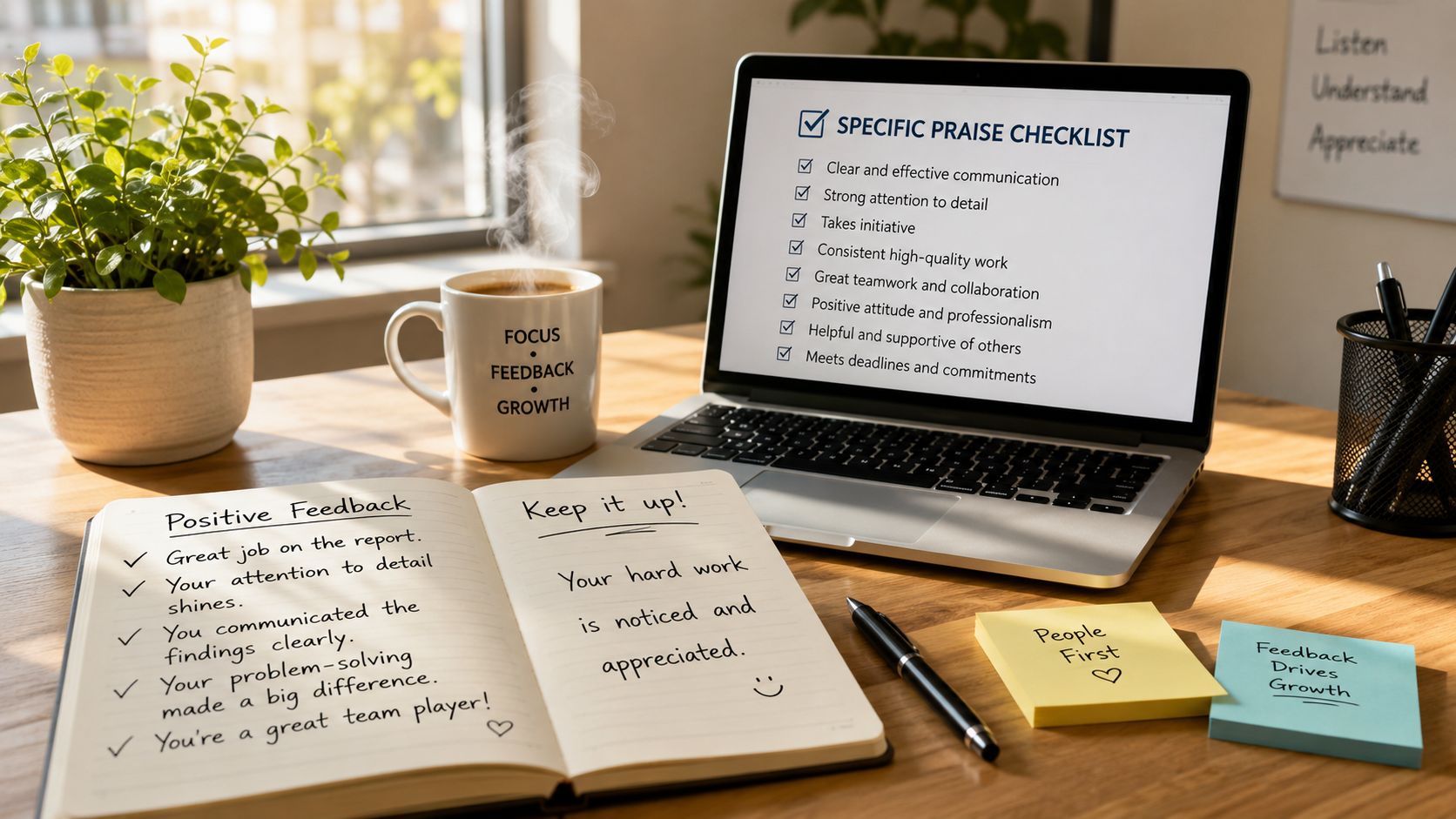
Effective positive feedback names the specific behavior, explains its impact, and signals what the employee should repeat or develop. Recognition works best when it’s timely, credible, and connected to work people can see and act on, not when it stops at “great job.”
That distinction matters because 81% of employees say appreciation from their boss motivates them to work harder. Employee recognition research. Yet praise can still fail when it’s vague, delayed, or disconnected from the employee’s actual context.
Key takeaways:
- Specificity beats enthusiasm: Name the action, not just the person’s positive qualities.
- Impact makes praise credible: Explain what changed for the customer, team, operation, or business.
- Context prevents overgeneralization: A strength shown in one situation may need development in another.
- The channel shapes the experience: Use one-on-ones, reviews, huddles, Teams, Slack, email, or recognition platforms intentionally.
- Follow-through turns praise into growth: Connect recognition to what the employee can repeat, learn, or take on next.
The following positive feedback examples use six practical models for common workplace situations. They apply to manager-to-employee feedback, peer recognition, performance reviews, asynchronous communication, and frontline operations. Together, they treat feedback as part of workforce experience, where communication, learning, recognition, technology, and operational execution reinforce one another.
1. The Specific Behavior and Impact Framework
The strongest everyday feedback usually follows a simple sequence: name what happened, explain why it mattered, and identify the behavior worth repeating. This gives employees usable information instead of a pleasant but ambiguous compliment.
A practical sentence pattern is:
When you [specific behavior], [clear impact occurred]. Keep doing that because [reason it matters].
For example, a manager might say, “When you flagged the inconsistent data before we sent the report to the client, you helped us avoid rework and protected the credibility of the account. That attention to detail is valuable.” The sentence works because the employee knows exactly what to repeat.
Here are more positive employee feedback examples using the same model:
- Teamwork: “When you stayed to help Maria debug the integration issue, you helped us hit the release deadline. Your willingness to support a teammate kept the work moving.”
- Communication: “Your project recap identified the decision, the open risk, and the owner for each next step. That made it easier for everyone to act without another meeting.”
- Initiative: “You noticed that the handoff process was creating duplicate work and proposed a simpler checklist. The team now has a clearer way to start each request.”
- Customer service: “You asked clarifying questions before recommending a solution. The conversation took longer, but you reduced the risk of solving the wrong problem.”
- Frontline execution: “You paused the line when you noticed the safety issue instead of working around it. That protected your coworkers and reinforced the right operating standard.”
Make written recognition concrete
Specific language matters even more in remote and asynchronous work because written messages don’t carry tone, facial expression, or immediate clarification. A Teams message such as “You handled that well” may be appreciated, but “Your risk summary made the decision easy for the product team” tells the employee what created value.
Collect observations during the flow of work rather than reconstructing them during a formal review. Project comments, Slack messages, task notes, and manager check-in prompts can help preserve the detail that makes feedback credible. A simple process for gathering observations also supports stronger manager behaviors that improve employee engagement.
For frontline employees, connect impact to outcomes they recognize, such as safety, accuracy, speed, customer experience, or team coordination. Abstract statements about “business value” are less useful than “your accurate stock count prevented the next shift from searching for missing items.”
Avoid invented impact
Don’t attach a dramatic business result unless you can verify it. If you don’t know whether an action saved money or shortened a process, describe the observable operational benefit instead.
The evidence review on workplace performance feedback found that feedback effectiveness depends on factors including goal clarity, timing, source credibility, and whether the recipient can act on the information. The practical implication is direct: positive feedback should be designed for use, not merely delivered for effect.
2. The Growth Trajectory Feedback Model
Growth-focused feedback compares an employee’s current capability with their own earlier performance. It’s especially useful when someone is learning a role, adopting a new system, or building confidence before they’re fully proficient.
Use this pattern:
“I’ve noticed you’ve improved at [skill]. Earlier, you [previous behavior]. Now, you [current behavior]. The next step is [development challenge].”
A manager could say, “When you joined the project, you waited for direction before raising concerns. Now you’re identifying gaps early and proposing ways to address them. That shows stronger ownership. Let’s build on it by having you lead the next risk review.”
This model works because it recognizes progress without pretending the employee has mastered everything. Consider these feedback examples for employees:
- Presentation skills: “Earlier in the year, you relied heavily on your notes. In today’s meeting, you explained the data clearly and answered questions without losing the thread. Let’s keep developing your storytelling.”
- Customer service: “You used to move quickly to a solution when a customer raised a concern. Recently, you’ve been listening first and reflecting the issue back. Customers are getting a more thoughtful response from you.”
- New technology: “At first, the inventory system required frequent corrections. Your recent entries have been accurate, and you’re now spotting inconsistencies before they affect the next shift.”
- Team collaboration: “During the last project, you focused mostly on your own deliverables. This time, you coordinated dependencies and kept other teams informed. That broader awareness is a meaningful step.”
- Team resilience: “The last outage created confusion. This time, the team divided responsibilities, communicated clearly, and documented the fix. Your response showed stronger operating discipline.”
Turn progress into a next step
Praise that only looks backward can become a dead end. After describing improvement, ask, “What do you notice about your own progress?” Then agree on a specific challenge, such as leading a meeting, training a colleague, owning a handoff, or presenting a recommendation.
A lightweight progress tracker can help managers refer to patterns rather than isolated impressions. It might include the skill being developed, observable examples, the employee’s reflection, and the next opportunity to practise. That record is useful in one-on-ones and performance reviews, but it shouldn’t become a bureaucratic scoring exercise.
For remote employees, written feedback can document progress clearly, while a short video or voice conversation can add warmth when the message involves confidence or identity. For frontline teams, use concrete indicators such as accuracy, safe process execution, customer handling, or confidence with a new workflow.
A career growth and development survey template can help teams gather employee perspectives about development needs. The important point is to connect the feedback conversation to an opportunity the employee can access.
Practical rule: Don’t praise improvement without making the next practice opportunity visible.
3. The Peer Multiplier Recognition Format
Peer recognition becomes more useful when it captures both the original action and the people affected by it. This is the peer multiplier approach. It works well in Slack, Teams, email, recognition platforms, team meetings, and performance documentation.
Use this structure:
“I want to recognize [person] for [specific action]. It mattered because [impact]. [A colleague, customer, or team] also observed [supporting detail].”
For example:
I want to recognize Jordan for helping the warehouse team test the new picking process. Jordan listened to each shift’s concerns, updated the checklist, and made the handoff easier. The night team used the revised version immediately, which gave us a clearer process across shifts.
The third-party detail should be factual and permission-based. Never invent a quote or imply that someone endorsed a statement they haven’t seen.
Here are useful positive feedback examples for coworkers:
- “I appreciated how you summarized the customer interviews after the workshop. Your recap turned a long discussion into clear themes and decisions.”
- “You made space for quieter voices during the planning meeting. That brought useful concerns into the discussion before we committed to the plan.”
- “You stepped in during the launch without taking over. You clarified the blocker, found the right owner, and helped us keep moving.”
- “You created a practical onboarding checklist for the warehouse floor. New hires can now follow the process with less guesswork.”
- “You handled the cross-team disagreement by asking questions before defending your position. That kept the conversation productive.”
Build recognition into communication systems
Recognition is easier to sustain when people know where and how to give it. A dedicated channel such as #recognition can make contributions visible, but public recognition shouldn’t become the only acceptable form. Some employees prefer private messages, written feedback in a one-on-one record, or recognition during a shift huddle.
The IZA field experiment on employee recognition found that unannounced public thank-you recognition increased subsequent productivity by about 5.2% when everyone in a group received a card, and about 5.6% when recognition went to the top three performers. Those findings support recognition as a practical effort signal, but they don’t mean managers should turn praise into a public ranking system.
Recognition platforms such as Bonusly, HeyTaco, and Karma can reduce friction, while tools such as Microsoft Teams and Slack can support recognition in the flow of work. Technology won’t solve weak recognition language, though. A vague message remains vague when it appears in software.
Use an engagement calendar or recurring communication rhythm, such as the Turn On Work employee engagement calendar, to prompt recognition without forcing identical messages or artificial quotas.
4. The Situational Strength Feedback Model
A person can show a real strength in one context and still need development in another. Situational feedback recognizes that difference instead of turning one successful moment into a broad personality judgment.
Use this format:
“I’ve noticed you’re strong at [capability] in [specific context]. When [situation], you [observable behavior]. That’s a capability to build on, and here’s where we can apply or extend it.”
For example, “When you’re working directly with customers, you listen carefully and ask strong questions. I’ve seen that consistently in service calls. In internal planning meetings, you participate less, so let’s explore how to bring that same curiosity into team decisions.”
Other manager feedback examples include:
- Data and influence: “Your data analysis is strong, especially when you’re working independently. The next opportunity is translating the findings into a recommendation that a nontechnical audience can act on.”
- Customer troubleshooting: “You’re methodical when diagnosing technical issues, and customers can see that you’re taking the problem seriously. In emotional complaints, slow down before moving to the solution so the customer feels heard.”
- Frontline judgment: “You move quickly on routine tasks without sacrificing accuracy. During process changes, you pause to understand the new steps before acting. That judgment is valuable, and teaching others that approach could be your next contribution.”
- Meeting contribution: “You bring strong ideas in small groups. In larger meetings, you hold back, so let’s find a way for you to prepare one point in advance.”
- Problem-solving: “You’re effective when the problem is clearly defined. When the situation is ambiguous, you sometimes wait for direction. Let’s practise making and communicating reasonable assumptions.”
Use patterns, not one-off impressions
Situational feedback requires more evidence than a single memorable event. Compare observations across customers, shifts, projects, meetings, and communication channels. Peer and skip-level input can reveal strengths a direct manager doesn’t see, particularly in remote work where informal observation is limited.
This model also helps managers make better work assignments. Someone might receive a stretch opportunity that uses an established strength while developing a related capability. A strong customer troubleshooter could lead a service playbook project. A careful operator could train new hires, provided the manager also supports their coaching skills.
In performance reviews, separate competencies rather than issuing one sweeping judgment. “Strong collaborator” is less useful than “creates alignment during cross-functional handoffs, but needs to communicate decisions more consistently after meetings.”
For frontline teams, context matters because employees may move between customer service, equipment operation, stock control, training, and safety tasks in the same shift. Praise should reflect the situation in which the strength appeared.
5. The Operational Impact and Relationship Pairing Format
Good work has both an outcome and a method. The operational impact and relationship pairing format recognizes what the employee achieved and how they worked with other people to achieve it.
Use this sentence structure:
“You achieved [specific outcome], and the way you did it, through [observable relationship behavior], strengthened the team. That combination matters because [reason].”
A performance review example might read: “You delivered the financial reforecast on time and within the agreed accuracy expectations. You also made the process collaborative by sharing context with the other departments and clarifying what you needed from them. That helped people contribute without duplicating work.”
This model produces stronger performance feedback examples than outcome-only praise:
- Workflow improvement: “You simplified the intake process and reduced confusion for the team. You also involved every shift before finalizing the change, so the new process reflected how the work is done.”
- Project delivery: “You completed the launch deliverable on time. You also made tradeoffs visible and kept the team informed, which helped people adjust without unnecessary stress.”
- Customer retention: “The team improved the customer experience by creating a clearer support playbook. You supported frontline staff patiently while they learned it, so the operational change didn’t stay trapped in a document.”
- Cross-functional work: “You resolved the recurring customer issue by coordinating with operations, product, and support. Your follow-through gave each group a clear role and prevented the problem from being passed around.”
- People leadership: “You kept the project within its agreed scope. You also checked in with team members during the busiest weeks, which helped protect focus and maintain trust.”
Make the relationship behavior observable
“Collaborated well” is too broad. Replace it with the behavior a colleague could recognize:
- “Asked each shift for input before changing the workflow.”
- “Shared the decision and its rationale in the project channel.”
- “Gave credit to the people who contributed.”
- “Checked whether the new process worked in practice.”
- “Raised the concern directly without blaming the previous owner.”
The approach fits the workforce-experience perspective because operational performance and employee experience are connected. A process can be fast but fragile if it creates confusion, hides information, or depends on one person. A supportive team can also struggle if nobody owns the outcome. Strong feedback names both.
For remote teams, use peer and skip-level input to surface relational work that managers may miss. For frontline teams, pair safety, quality, speed, or accuracy observations with communication, mentoring, and handoff behavior.
Resources on workforce operations can help leaders connect employee-facing practices with the systems and workflows that shape daily execution.
6. The Future-Focused Potential Feedback Template
Future-focused feedback links an observed capability to a possible next opportunity. It should clarify what the employee did, which capability it suggests, and how they can test that capability. The conversation must leave room for employee choice, because a manager’s view of potential does not establish the employee’s career direction.
Use this model:
“In [current context], you showed [observable behavior], which is building [capability]. A useful next opportunity could be [development action], if that direction interests you.”
The examples should match the work and the setting:
- Potential team lead: “You handled the escalated customer situation calmly, asked focused questions, and found a workable solution. That shows the judgment a team lead needs. If you want to explore that path, we can identify a coaching opportunity and a project where you can practise.”
- Technical growth: “Your technical work is strong, and you explain complex concepts clearly to nontechnical stakeholders. That combination could support future work in architecture or product. I’d like to connect you with someone who can help you examine those options.”
- Frontline advancement: “You follow safety procedures consistently and help coworkers remember the steps without making them feel criticized. That combination supports trainer or shift-lead work. We can review which skills those roles require.”
- Cross-functional leadership: “When engineering and operations disagree, you ask clarifying questions instead of defending your team. You are building the ability to connect groups, which you could practise through a cross-functional initiative.”
- Knowledge multiplication: “You documented the process and helped new hires learn it without being asked. You are extending your contribution from individual execution to building capability for others.”
Use the model in one-on-ones and performance reviews, then adapt it for peer recognition or an asynchronous channel. A short written version can name the behavior, capability, and suggested opportunity without turning recognition into a promotion signal.
Pair potential with an actual pathway
Potential feedback loses credibility when no next action follows. Agree on a project, mentor, shadowing opportunity, skill matrix, training session, or temporary responsibility. Record the commitment and revisit it while the conversation and opportunity remain connected.
For remote employees, make mentoring and stretch assignments visible instead of relying on informal access. For frontline employees, name advancement paths such as trainer, lead, supervisor, or specialist when those roles exist, and explain the capabilities each requires.
Avoid vague labels such as “high potential.” They can create confusion and perceived favoritism when employees cannot see how decisions are made. Specific capability language is fairer: “You create clarity during uncertain handoffs” gives the employee something to repeat and develop.
A succession planning framework can help connect observed capability with development pathways. Keep the discussion grounded in evidence, operational opportunities, and the employee’s own choice.
Comparison of 6 Positive Feedback Frameworks
| Method | Implementation Complexity | Resource Requirements (speed/effort) | Expected Outcomes | Ideal Use Cases | Key Advantages |
|---|---|---|---|---|---|
| The Specific Behavior + Impact Framework | Medium, needs specific examples/data | Needs observation/data, Moderate | Clear, actionable behavior change; measurable business linkage | Manager→employee, async written feedback, remote/frontline contexts | Pinpoints repeatable actions; credible; reduces bias |
| The Growth Trajectory Feedback Model | Medium, requires baseline tracking | Baseline & coaching time, Moderate | Increased learning motivation and retention; visible skill gains | One-on-ones, development plans, ramping roles, early-career/frontline training | Celebrates progress; builds psychological safety; drives next-step coaching |
| The Peer-Multiplier Recognition Format | Low–Medium, depends on peer participation | Platform + peer input, fast | High social proof, wider visibility, scalable recognition impact | Remote/hybrid teams, public recognition channels, nomination programs | Peer credibility; scalable; documents contributions for records |
| The Situational Strength Feedback Model | High, needs nuanced, multi-context evidence | Multiple-context evidence, Slow | Better role-fit clarity; targeted deployment of talent; fairer assessments | Role transitions, uneven-skill employees, succession planning, coaching | Avoids overgeneralization; identifies where people truly excel |
| Operational Impact + Relationship Pairing Format | High, must observe outcome and how it was achieved | Cross-source input & time, Slow | Balanced recognition of results + teamwork; sustainable performance gains | Performance reviews, retrospectives, high-stakes frontline operations | Reinforces how work is done as well as what is delivered; highlights leadership potential |
| The Future-Focused Potential Feedback Template | Medium–High, needs follow-through and opportunities | Follow-up & development investments, Moderate | Increased retention of high-potential talent; clearer career pathways | One-on-ones, mentoring, succession/talent conversations, frontline advancement | Signals readiness for stretch roles; guides concrete development steps |
Turn Good Feedback Into a Reliable Practice
The six models work best as a flexible manager toolkit, not a script library. Choose the model according to the purpose of the conversation:
- Specific behavior and impact for everyday recognition and clear reinforcement.
- Growth trajectory for progress over time and learning conversations.
- Peer multiplier for distributed recognition and social proof.
- Situational strength for nuanced capability feedback.
- Operational impact and relationship pairing for reviews, retrospectives, and culture.
- Future-focused potential for development and career conversations.
A reliable feedback workflow has six steps:
- Observe the behavior. Record what the employee did, said, changed, prevented, or enabled.
- Name the context. Include the project, customer interaction, shift, meeting, system, or decision.
- Explain the impact. Connect the action to quality, safety, speed, customer experience, learning, trust, or execution.
- Choose the right channel. Use private conversation for nuance, public recognition for shared learning, and accessible channels for frontline employees.
- Invite a response. Ask what the employee noticed, what helped, or what they want to try next.
- Record the next action. Capture the development opportunity, process change, follow-up, or behavior to continue.
Manager checklist
- Everyday recognition: Did I give feedback close to the observed behavior?
- One-on-ones: Did I connect praise to progress or a next practice opportunity?
- Performance reviews: Did I separate outcomes, behaviors, context, and development?
- Peer input: Did I make it easy for colleagues to share specific observations?
- Remote communication: Did I choose a channel that preserves clarity and warmth?
- Frontline huddles: Did I make the feedback accessible across shifts, locations, and device constraints?
- AI-assisted drafting: Did a human manager verify the facts, context, tone, and employee preference before sending?
- Follow-through: Did the recognition lead to a conversation, opportunity, or repeatable operating practice?
Recognition frequency matters, but message volume isn’t the same as quality. Employees recognized weekly are reported as 9 times more likely to feel a sense of belonging, 6 times more likely to see a long-term future with their company, and 2.6 times more likely to be highly productive in the cited workforce analysis. Recognition frequency analysis: The useful management question is not “How many messages did we send?” It’s “Did the right people receive credible feedback they could use?”
Track coverage, channel reach, response quality, development follow-through, and representation across locations, shifts, roles, and employee groups. That approach helps leaders see whether recognition reaches quiet contributors, deskless workers, remote employees, and cross-functional partners, without turning appreciation into a volume contest.
Positive feedback examples FAQs
What makes positive feedback specific?
Specific feedback identifies an observable behavior, the context in which it occurred, and its impact. “You did a great job” is praise. “You summarized the customer’s concern before proposing a solution, which kept the conversation focused” is usable feedback.
How can managers avoid generic praise?
Replace personality labels with evidence. Instead of “You’re a great communicator,” say, “Your update separated the decision, risk, and next step, so the team knew how to respond.” If you can’t identify what the person did, wait and gather a clearer observation.
What are good positive feedback examples for employees?
For performance, recognize a concrete result and the behavior behind it. For teamwork, name how the employee helped others coordinate. For initiative, explain which problem they noticed and what they did before being asked. For growth, compare current behavior with an earlier baseline and identify the next challenge.
How should managers tailor feedback for coworkers and employees?
Manager feedback can connect behavior to goals, development, and role expectations. Coworker feedback should focus on the shared work, the support provided, and the effect on collaboration. Frontline feedback should use practical operating language, while remote feedback should include enough context to stand alone in writing.
How often should positive feedback happen?
Give it when the observation is fresh and meaningful, rather than saving every example for a formal review. The cited Gallup summary reports that 61% of employees are engaged when they receive feedback and recognition from their manager at least weekly, compared with 38% when feedback is weekly but recognition is less frequent. Workplace recognition analysis: Quality, relevance, and equitable coverage should guide the rhythm.
How can organizations measure adoption without creating a recognition contest?
Measure whether feedback reaches different employee groups, whether recipients respond or act on it, whether development commitments are completed, and whether employees describe the feedback as clear and credible. Avoid using message count as the primary success measure.
Positive feedback changes work when employees can recognize the behavior, understand the impact, and see how to use the information again.
If you’re building a more consistent feedback practice, start with one team, choose two models that fit its work, and review the results after several one-on-ones or shift huddles. Use the observations to refine your language, channels, and follow-through, then extend the practice across your distributed, hybrid, office, and frontline workforce.
Turn On Work helps workforce leaders connect employee engagement, internal communication, HR technology, AI, and workforce operations. Explore its practical templates and guidance, then create a feedback workflow that makes good work visible and gives employees a clear next step.