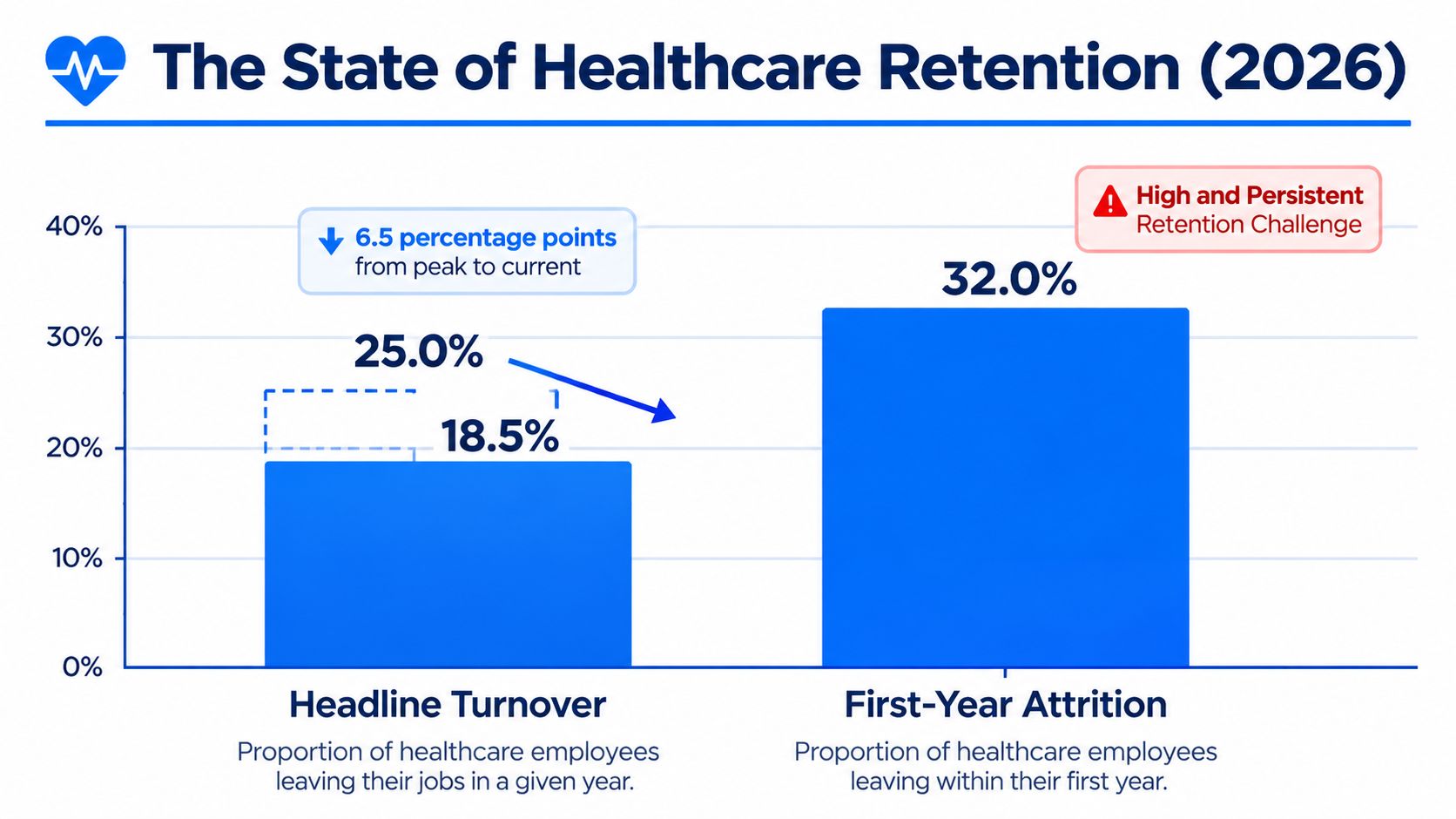
The clearest warning sign in employee retention in healthcare isn’t the headline turnover rate. It’s what happens after a new hire accepts the job. The 2026 NSI report puts U.S. hospital turnover at 18.5%, while 29.5% of newly hired hospital employees and 22.3% of newly hired registered nurses leave within their first year. Retention improves when HR, managers, communications, technology, and workforce operations treat the first year as an actively managed employee journey.
Key Takeaways
- Early-tenure retention deserves priority. First-year exits concentrate risk where onboarding, scheduling, and manager support should be strongest.
- A checklist only works when ownership is visible. HR, operations, preceptors, and managers need assigned tasks, deadlines, and handoffs.
- Manager behavior is measurable. Span of control, check-in cadence, and follow-up ownership directly shape the early employee experience.
- Technology should remove friction. Mobile access to schedules, knowledge, tasks, feedback, and support matters most for frontline teams.
- Turnover is a lagging indicator. Engagement, psychological safety, survey participation, check-in completion, and unresolved issues provide earlier signals.
Why Early-Tenure Retention Is the Highest-Leverage Intervention
Employee retention in healthcare is improving at the headline level, but first-year attrition remains a concentrated operational risk. The 2026 NSI National Health Care Retention and RN Staffing Report records 18.5% hospital turnover and 17.6% national RN turnover, up from 16.4% the prior year. The same report finds that 29.5% of newly hired hospital employees and 22.3% of newly hired RNs leave within their first year. These figures come from the 2026 NSI National Health Care Retention and RN Staffing Report.
Those numbers change the intervention point. A hospital staff retention plan that begins after an employee has entered an exit process is already late. The more useful question is whether the organization made the first shift, first week, first month, and first several quarters workable enough for a new employee to build confidence and commitment.
Why headline turnover can mislead
Healthcare turnover has remained unusually persistent since the pandemic era. NSI’s 2023 report recorded 22.7% hospital turnover and 22.5% RN turnover, while hospitals recaptured 5.65% of talent lost during the Great Resignation, equivalent to about 975,000 employees, including 142,375 RNs and a 4.17% RN add rate. By 2024, national RN turnover had fallen to 16.4%, and one analysis reported that average U.S. healthcare turnover declined from 20% in 2022-23 to 18% in 2023-24. The historical context is summarized in this healthcare workforce retention analysis.
A lower healthcare turnover rate doesn’t prove that the employee experience is healthy. It may reflect slower labor movement, successful rehiring, delayed departures, or retention in established roles while new hires continue to leave. HR leaders should separate hospital employee retention, nursing staff retention, and early-tenure retention instead of relying on one enterprise average.
The first year is an operating system
The first 90 to 365 days combine several systems that employees experience as one job:
- Workload and staffing: Can the employee complete core work safely and sustainably?
- Scheduling: Does the schedule provide enough stability to plan life outside work?
- Communication: Can the employee find policies, changes, contacts, and answers without chasing several channels?
- Manager support: Does someone notice confusion, overload, or isolation early?
- Development: Does the new hire see a credible path to competence and career growth?
- Belonging and safety: Can the employee raise concerns without being dismissed or punished?
A systematic review of 34 studies covering 58,188 participants found recurring retention determinants including job satisfaction, career development, work-life balance, leadership involvement, organizational support, flexible shift patterns, and lower workplace aggression. The systematic review of rural and remote health-workforce retention also highlights a practical danger: organizations can overemphasize patient aggression while missing colleague aggression, which may have an even stronger negative effect on intention to leave.
Generic burnout messaging misses this operating detail. A resilience webinar can’t compensate for a broken handoff, an unpredictable schedule, inaccessible training, or a manager who doesn’t follow up. The first step in healthcare retention strategies is therefore diagnostic: identify where the employee journey breaks, then assign operational owners to repair it. Leaders can use a practical first 90 days employee experience framework to map those moments before designing another broad engagement initiative.
Building a Customizable Healthcare Onboarding Checklist
A healthcare onboarding checklist should manage the employee journey for the first year, not just document orientation completion. The core design principle is simple: every action needs an owner, a due point, a handoff, and a way to confirm that the employee can perform the work.
A useful checklist has two layers. The first layer is consistent for everyone, including employment documentation, safety requirements, access credentials, organizational purpose, escalation routes, and essential policies. The second layer changes by role, work setting, clinical risk, schedule, and level of experience.
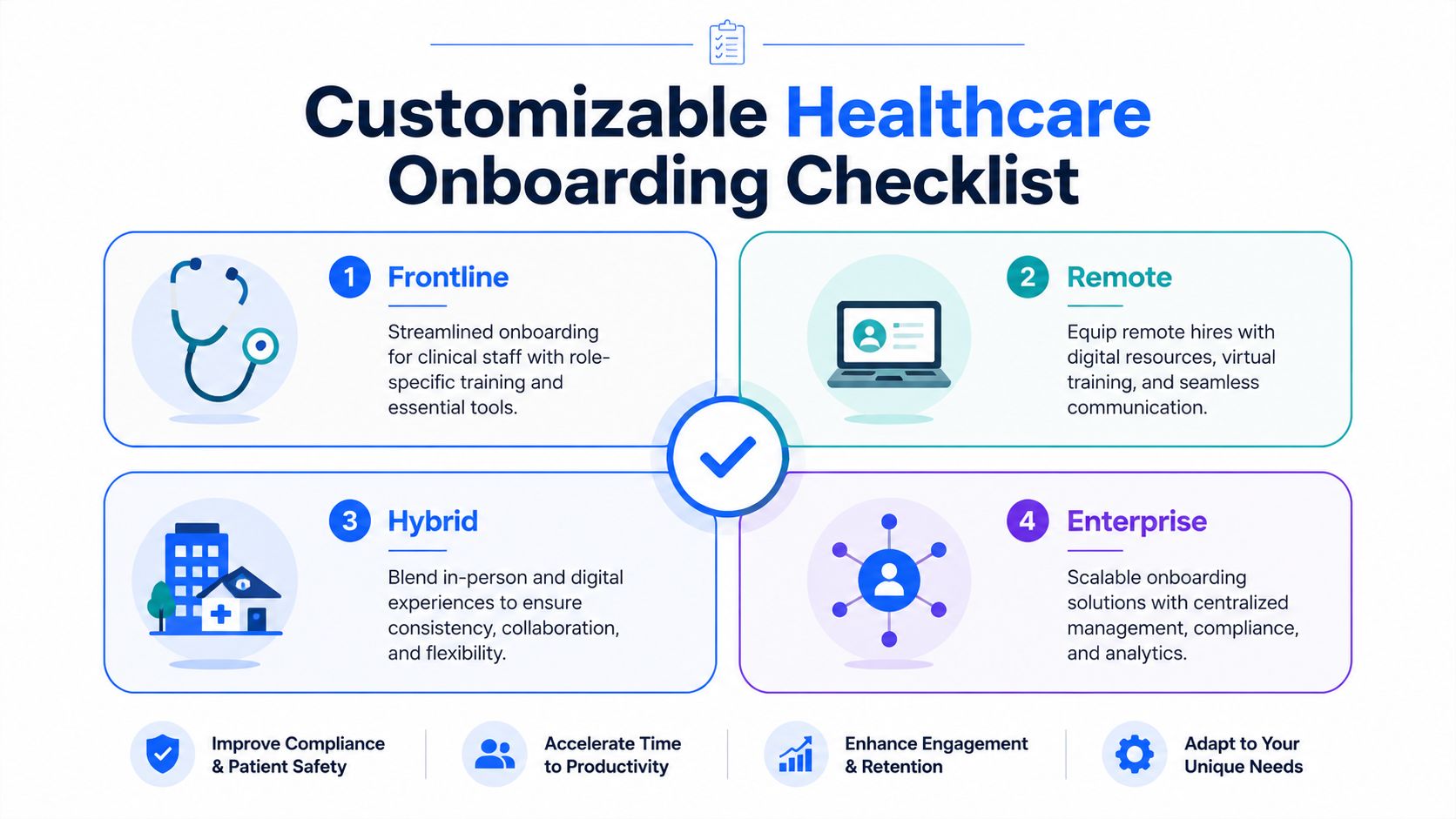
The four-part checklist design
Before the first shift, HR should confirm employment records, required credentials, access requests, payroll setup, location details, uniform or equipment needs, and the name of the person meeting the hire. Operations should verify that the employee appears correctly in scheduling and workforce systems. The manager should send a short message explaining where to go, what to bring, and what the first day will feel like.
During the first week, the manager owns role clarity. That includes reviewing responsibilities, patient or client service expectations, escalation procedures, team norms, break practices, and the employee’s initial schedule. A frontline worker may need mobile access to tasks, schedules, policies, and learning content. A remote employee may need stronger virtual introductions, secure access, and a clear method for asking questions asynchronously.
By the first 30 to 45 days, the checklist should test capability rather than attendance. Can the employee complete defined tasks? Do they know who approves schedule changes? Can they locate current procedures? Has a preceptor or supervisor observed the required skills? Clinical employees often need structured preceptorship and transition-to-practice support rather than a general orientation deck.
At six and nine months, the organization should review progress, workload, development, relationships, and intent to stay. These conversations should produce actions, not merely a survey record. A frontline onboarding experience checklist can help teams keep consistent fundamentals while adapting delivery to clinical, hybrid, remote, and enterprise contexts.
Assign ownership at each handoff
Use a simple responsibility model:
| Onboarding activity | Primary owner | Handoff or proof |
|---|---|---|
| Employment and compliance setup | HR | Employee record and required completion |
| Schedule and workspace readiness | Operations | First schedule confirmed |
| Role ramp and performance expectations | Direct manager | Milestone review |
| Clinical transition support | Preceptor or educator | Observed competency |
| Communication and knowledge access | HR or internal communications | Employee finds required information |
| Follow-up and risk resolution | Direct manager | Documented action and completion |
The biggest failure is treating onboarding as a one-time event. New hires often know whether the organization is coordinated before they know whether the job is right for them. When systems contradict one another, managers redirect questions, or access arrives late, the organization teaches the employee that friction is normal.
Build the checklist into the tools people already use. A task in a workforce enablement platform should show the owner and deadline. A reminder should reach a manager where they work, not sit unnoticed in an HR dashboard. A check-in should capture the issue, the promised action, and the date someone will return with an answer.
The Manager Behavior Framework That Moves Retention Metrics
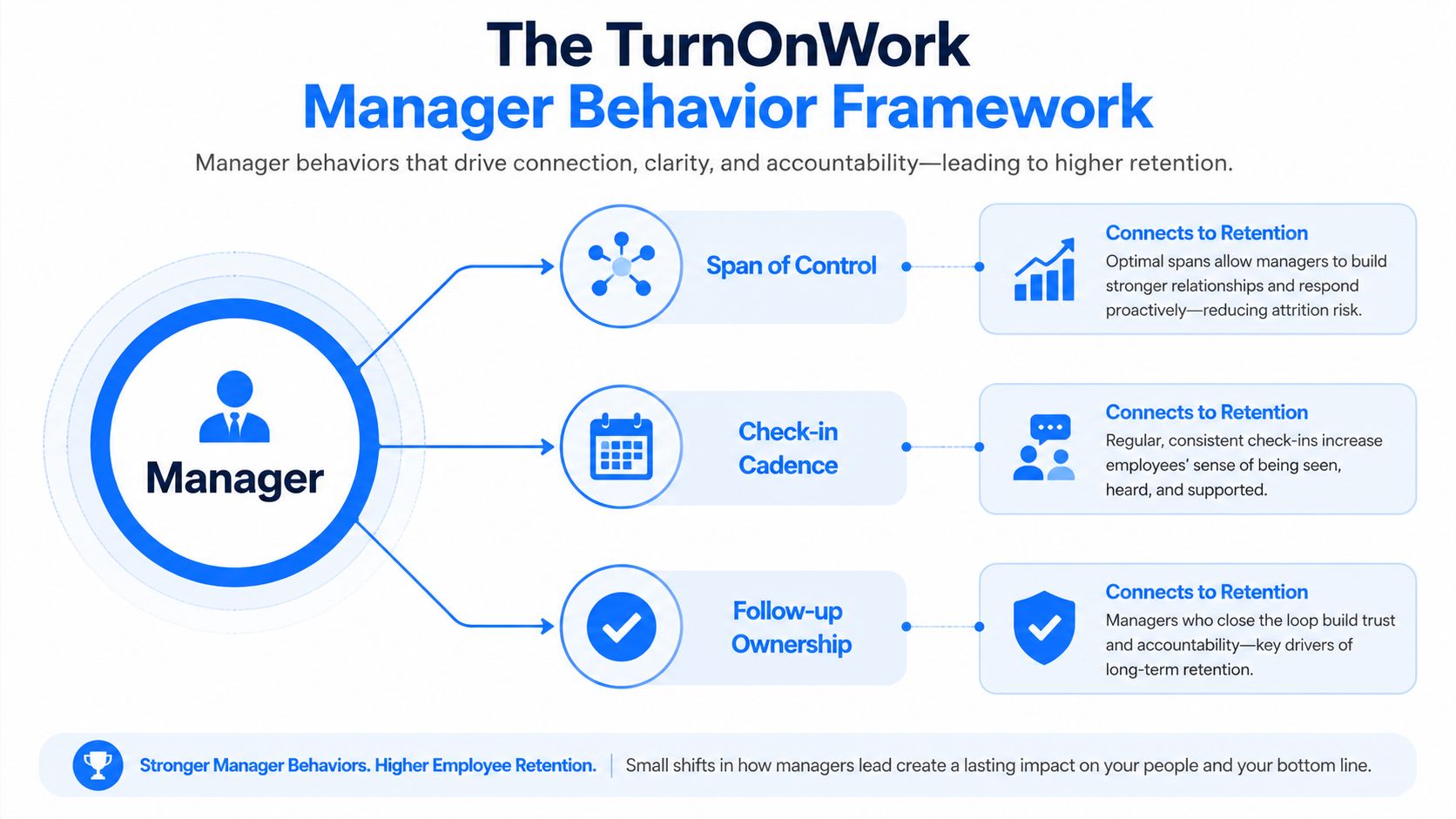
The TurnOnWork Manager Behavior Framework treats retention as the result of three controllable manager conditions: span of control, check-in cadence, and follow-up ownership. This is a TurnOnWork editorial model, not an established industry standard. It translates early-tenure retention research into operating decisions that HR and operations leaders can inspect.
Span of control determines attention capacity
In a national analysis of more than 5,000 nurse managers overseeing 75,000 nurses, teams with managers responsible for 90 or more direct reports saw early-tenure turnover as high as 40%, while teams under 45 staff averaged 27%. The findings are described in the AONL and Laudio national analysis of early-tenure nurse turnover.
A hospital can’t always reduce a manager’s span of control quickly. It can, however, redesign support around that constraint. Assign a trained preceptor, create a consistent escalation partner, provide a team lead for daily questions, and use technology to surface missed check-ins or unresolved requests. These substitutes don’t remove the manager’s accountability. They protect the manager’s limited attention while keeping ownership clear.
Cadence creates predictable support
The practical cadence is:
- Day 30 or 45: Ask what is unclear, what creates avoidable friction, and what support is missing.
- Month six: Review capability, workload, relationships, scheduling, and development.
- Month nine: Discuss future goals, risk of leaving, and the conditions that would support another year.
- After every concern: Record the action, name the owner, and return with an answer.
The same analysis found that 30- or 45-day check-ins improved first-year retention by 6 points, while six- or nine-month check-ins improved it by 13 points. Delegated check-ins reduced retention by 15%. Those findings make the ownership issue explicit: a check-in isn’t a formality that can be handed off without consequences.
Practical rule: If a manager can’t answer what the employee raised, who owns the response, and when the response is due, the organization hasn’t completed the check-in.
Measure manager follow-through
Track check-in completion, time to resolve employee-raised issues, milestone completion, and repeated concerns by unit. Don’t use these measures as a compliance contest. Use them to identify managers who need smaller spans, administrative support, coaching, or protected time for people leadership.
A manager behavior review should ask three questions: Did the conversation happen? Did the manager hear a specific risk? Did the employee see a credible response? That is the difference between a retention program that produces records and one that changes the employee experience. Additional guidance on manager behaviors and employee engagement can help translate those expectations into manager routines.
Technology and Communication Tools for Workforce Retention
Healthcare technology supports retention when it reduces the work required to find information, complete tasks, communicate changes, and ask for help. It fails when an organization adds another disconnected portal and expects frontline employees to absorb the complexity.
Platforms such as HubEngage can also support employee communication, engagement, recognition, and feedback workflows, particularly when organizations want these activities connected within a broader employee experience program.
Deskless workers need mobile, low-friction access to schedules, shift information, policies, learning, recognition, and urgent operational updates. Hybrid clinical teams may need richer collaboration, searchable knowledge, asynchronous discussion, and reliable access from multiple locations. Enterprise systems need governance, so employees don’t receive contradictory messages from HR, nursing leadership, local operations, and compliance.
| Workforce Segment | Primary Tool Categories | Key Features for Retention | Implementation Priority |
|---|---|---|---|
| Frontline and deskless | Mobile workforce app, scheduling, task management | Shift visibility, microlearning, alerts, two-way feedback, offline-friendly access | Remove daily friction first |
| Clinical and hybrid | Secure collaboration, knowledge base, learning platform | Searchable procedures, role-based communities, competency tracking, escalation paths | Connect learning to clinical milestones |
| Remote care teams | Video collaboration, employee communication software, digital onboarding | Reliable access, manager check-ins, virtual peer support, clear documentation | Prevent isolation and information gaps |
| Enterprise healthcare | Employee engagement platform, HRIS integrations, analytics | Segmentation, workflow triggers, consistent governance, manager dashboards | Reduce fragmentation across systems |
Select tools by employee task
Start with an employee journey map. List the moments where a worker needs information or action: accepting a shift, finding a policy, reporting a concern, completing training, requesting support, or understanding a schedule change. Then ask whether the current tool resolves that moment in one place.
AI can help classify feedback, summarize recurring themes, recommend relevant knowledge, or flag missing follow-up. It shouldn’t decide that an employee is disloyal or automatically label someone as a flight risk. Human judgment remains essential, particularly when signals may reflect workload, disability, family circumstances, safety concerns, or a temporary operational disruption.
Recognition tools can reinforce team contribution, but recognition won’t repair chronic understaffing or unreliable scheduling. Listening systems can identify problems, but surveys without visible action reduce trust. Turn On Work publishes practical guidance on employee communication tools that can support channel selection and governance.
Use a small pilot with one workforce segment, define the employee task it should improve, and monitor adoption alongside issue resolution. The right tool should make a manager’s response faster and an employee’s next action clearer.
The Engagement-Retention Mismatch in Modern Healthcare
A stable headline turnover rate can hide weakening healthcare employee engagement. Recent benchmarks report turnover around 18% for all healthcare workers and 17% for nurses, yet only 52% of advanced practice providers say leadership responds to feedback and 55% say they have a voice. The same benchmark reports that 24% of Gen Z RNs left in the past year, while 74% say mistakes are treated as learning opportunities, down from 77%. These figures appear in the State of Nursing 2025 engagement trends report.

The implication is uncomfortable. Healthcare worker retention may appear acceptable because employees haven’t yet resigned, while trust, voice, and psychological safety are eroding underneath the average. Younger clinicians and APPs can signal disengagement before an enterprise dashboard shows a turnover spike.
Segment the signal before choosing the fix
Don’t ask only whether engagement is up or down. Compare:
- New hires with established employees
- Nurses with APPs, technicians, support staff, and administrative teams
- Gen Z employees with other career stages
- Units with different manager spans
- Day, night, weekend, and rotating shifts
- Respondents with nonrespondents
The intervention should match the behavior. If employees don’t believe leaders respond, close the feedback loop publicly. If they lack voice, create structured forums with decision rights. If mistakes aren’t treated as learning opportunities, train managers to distinguish accountability for unsafe conduct from punishment for honest reporting.
Engagement is an operational input
Press Ganey’s 2025 reporting, based on feedback from 2.3 million U.S. healthcare workers, found that disengaged employees are 1.7 times more likely to leave. The report also says engagement declined by 0.02 points year over year in 2024, while turnover fell from 20% to 18%. Those findings are available in Press Ganey’s healthcare employee engagement reporting.
This is why pay and staffing can’t be the only levers in a healthcare employee retention plan. Compensation matters, but employees also judge whether leaders listen, whether tools support safe work, whether colleagues cooperate, and whether managers keep promises. Retention teams should treat engagement signals as operational warnings, not as a separate culture score.
Measuring and Improving Retention Continuously
Measure retention as a leading-and-lagging system. Turnover tells you who already left. Engagement, psychological safety, check-in completion, schedule stability, unresolved requests, and survey silence can show where risk is forming.
Press Ganey’s 2026 employee experience materials report that disengaged caregivers are 2.6 times more likely to leave, with turnover at 24% in low-engagement systems versus 15% in high-engagement systems. The same source reports that 34% of employees who plan to leave within three years exit within one year, and 26% of survey nonrespondents leave within a year, compared with 15% of survey respondents. See the 2026 Press Ganey employee experience materials for the full context.
Build a retention dashboard that prompts action
Track these measures by unit, role, tenure band, manager, and shift pattern:
- Lagging outcomes: Voluntary turnover, regrettable turnover, first-year turnover, internal transfers, and vacancy duration.
- Early signals: Intent to stay, engagement, psychological safety, workload concerns, schedule friction, and recognition.
- Execution measures: Onboarding task completion, milestone completion, manager check-ins, preceptor contact, and time to close employee-raised issues.
- Listening health: Response rates, nonresponse patterns, qualitative themes, and whether leaders publish actions taken.
Don’t combine every signal into one opaque score. A manager needs to know whether the problem is a missing check-in, a schedule pattern, inaccessible knowledge, or a safety concern. HR needs the segmented pattern. Operations needs the intervention owner.
Close the feedback loop
Use pulse surveys, targeted listening sessions, exit interviews, stay conversations, and frontline channels. Employees who lack desk access may need mobile surveys, scheduled team listening, or facilitated conversations rather than a link sent to an email inbox.
A 2024 Press Ganey report found that one in five healthcare employees who were at their organization in 2022 left in 2023, rising to one in four among employees in their first two years. It also reported that 33% of disengaged employees were at risk of leaving within the next calendar year, while 69% were engaged or highly engaged at the time of the study. The 2024 healthcare employee experience report supports treating early tenure and engagement as connected lifecycle measures.
Use survey answer analysis practices to identify themes, then publish a short “you said, we did, next step” update. Employees don’t need every request approved. They need a clear explanation of what will change, what won’t, and who owns the decision.
Employee Retention in Healthcare FAQs
What is employee retention in healthcare?
It is the ability of a healthcare organization to keep employees over time, especially in roles where continuity, skill, and team coordination affect care delivery. Effective healthcare workforce retention includes hiring, onboarding, manager support, development, scheduling, communication, and employee experience.
How can hospitals improve employee retention in 2026?
Start with first-year retention. Map the employee journey, strengthen onboarding, assign manager follow-up, stabilize scheduling where possible, improve access to operational information, and segment engagement data by role, tenure, shift, and manager.
What are effective nurse retention strategies?
Use structured orientation, preceptorship, transition-to-practice support, career development, protected check-ins, workload review, and visible responses to feedback. A systematic review reported an average 18% decrease in turnover and 13% increase in retention for orientation and transition-to-practice programs, with results varying by program design, as documented in this systematic review of nurse-turnover interventions.
What should leaders do when manager spans can’t be reduced?
Add support without hiding accountability. Use preceptors, team leads, educator coverage, automated reminders, and clear escalation routes, while keeping the direct manager responsible for the relationship and response.
How do organizations measure healthcare staff retention?
Pair healthcare staff turnover with first-year exits, intent to stay, engagement, psychological safety, check-in completion, milestone progress, survey participation, and time to resolve employee concerns. Segment the results so leaders can act on local causes rather than averages.
Employee retention in healthcare improves when organizations manage the first year as a designed experience, not an administrative interval. Build the checklist, assign the manager behavior, connect the tools, and review the signals every month. Start with one high-turnover unit, map its first 365 days, and give HR and operations leaders a shared action plan for the next 30 days.