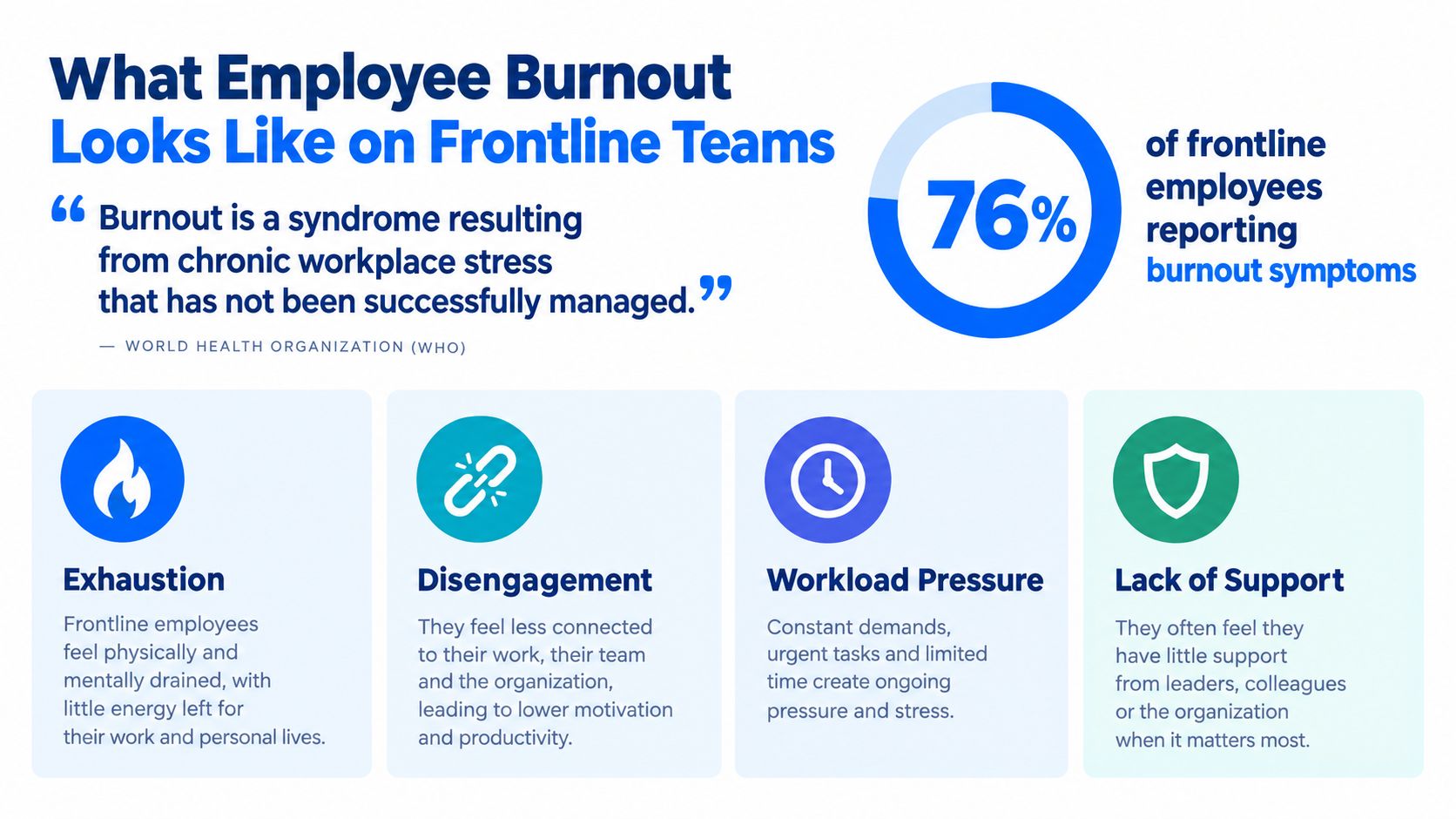
76% of frontline employees reported feeling burned out in 2025, and employee burnout is best reduced by fixing workload, schedules, staffing, recognition, and communication, not by asking people to become more resilient. That distinction matters because a burned-out nurse, retail associate, or plant operator can’t meditate away a short-staffed shift. Managers who treat exhaustion, detachment, and declining effectiveness as operating signals can change the conditions producing them. Managers who treat them as attitudes usually add another program and watch absence and quits rise.
What Employee Burnout Looks Like on Frontline Teams
Employee burnout is a syndrome resulting from chronic workplace stress that hasn’t been successfully managed, and on frontline teams it shows up as exhaustion, mental distance from the job, and reduced professional efficacy. The World Health Organization definition in ICD-11, adopted in 2019 classifies burnout as an occupational phenomenon and a factor influencing health status, not as a medical disease. That placement is practical. It ties burnout to work conditions you can inspect, rather than to a vague failure of coping.
Key Takeaways
- Work design comes first: Staffing, hours, rest, and task load explain more than wellness participation.
- Frontline flexibility is specific: Predictability, shift swapping, and protected breaks matter where remote work isn’t possible.
- Recognition is operational: Missed feedback and invisible effort feed detachment, especially in deskless roles.
- AI can help or harm: Assistive tools remove friction, monitoring tools add strain.
- Measure operations, not sentiment alone: Pair surveys with overtime, absence, errors, schedule stability, and retention.
Healthcare shows why this isn’t abstract. Documentation burden, for example, turns clinical expertise into after hours administration, which is why the PatientNotes resource for physician wellbeing is useful context for leaders looking at documentation driven strain. Longitudinal physician data also shows capacity consequences, since in a prospective study of approximately 2,000 physicians, each one point increase in burnout on a seven point scale was associated with a 30% to 40% greater likelihood of reducing professional work effort during the following 24 months, as reported in Mayo Clinic Proceedings research on physician burnout trends30625-5/fulltext).
For frontline employee engagement and a credible frontline employee value proposition, that means the promise can’t stop at purpose statements. Pay visibility, a workable schedule, tools that function on a phone, and a manager who notices good work are the employee value proposition employees experience. If those basics fail, EVP for frontline workers reads as recruitment copy, not a reason to stay.
The Three Dimensions and What They Look Like in Practice
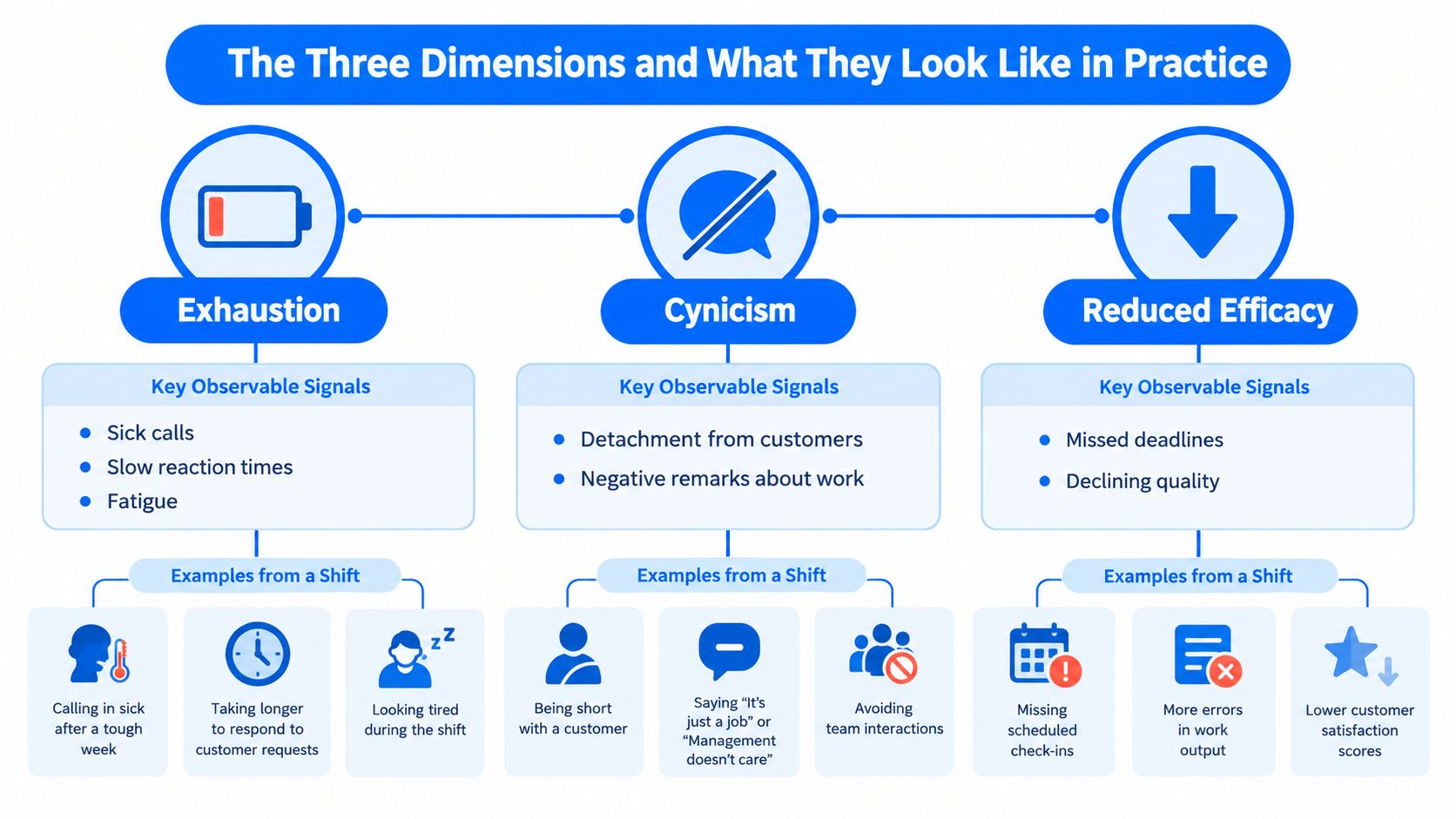
You can spot all three dimensions during a normal shift if you know where to look, and you don’t need a survey to see the first warnings. Surveys help, but deskless employees may rarely open an engagement platform, and quarterly results arrive after rosters, errors, and resignations have already moved. Floor level observation gives managers earlier, more actionable evidence.
Exhaustion
Exhaustion looks like energy that doesn’t recover between shifts. Watch for rising sick calls, slower reaction times late in a run of shifts, missed breaks, and employees who stop volunteering for tasks they handled easily before. In manufacturing, it can appear as near misses near the end of overtime stretches. In retail, it’s the associate who’s still present but visibly depleted during every peak.
Ask a simple operational question first. Did rest gaps shrink, overtime concentrate on the same reliable people, or staffing fall below the level the workload assumes?
Detachment and Cynicism
Detachment is increased mental distance from the job. Employees go flat with customers, skip huddles, stop raising problems, and refuse optional work they’d once have accepted. The language changes too. Jokes turn bitter, handovers get terse, and new initiatives get dismissed before they’re explained.
Detachment is often self protection. People pull back from work that keeps taking more than it returns.
Don’t discipline the tone before you check the cause. Cynicism frequently follows months of short staffing, ignored escalations, or recognition that only reaches day shift and headquarters staff.
Reduced Professional Efficacy
Reduced efficacy shows up in output. Task completion takes longer, rework rises, documentation gets thinner, and capable employees start double checking basic steps because they no longer trust their own concentration. A strong picker makes uncharacteristic errors. An experienced care worker misses details in a handover. A team lead stops coaching because every hour goes to covering gaps.
That pattern separates burnout from ordinary end of shift tiredness. Fatigue improves after rest. Burnout persists, spreads across the three dimensions, and starts changing behavior, quality, and willingness to stay. When you see exhaustion plus detachment plus declining effectiveness together, you’re not looking at a bad week. You’re looking at frontline workforce retention risk with a visible operational trail.
Why Workload Design Beats Wellness Programs
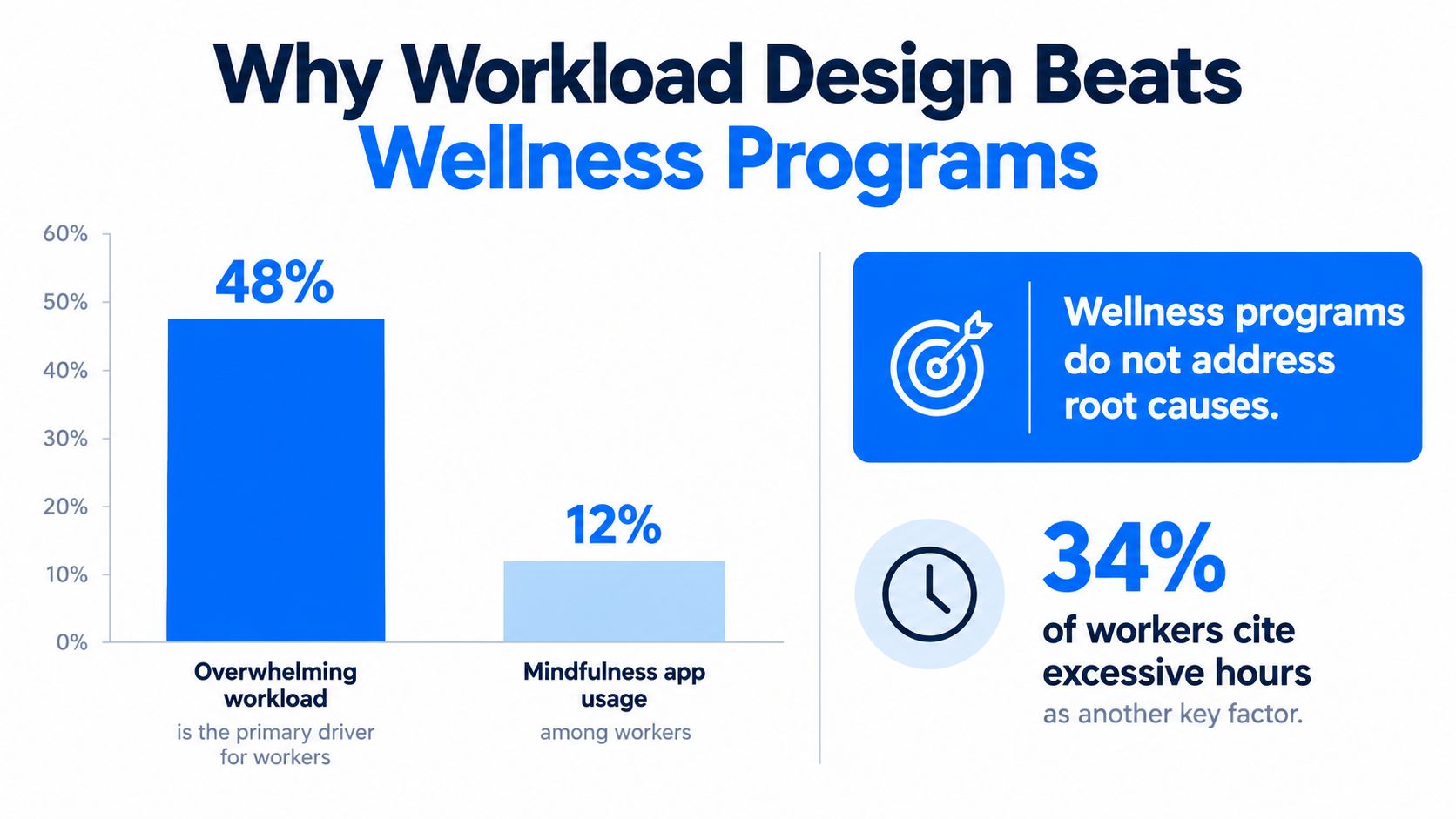
Wellness programs don’t fix employee burnout when the job itself requires too much work, too many hours, or too little recovery. Mindfulness apps, resilience training, and employee assistance programs can support individuals, but they’re weak primary interventions for a rota that’s structurally understaffed. The stronger levers are boring, controllable, and already sitting in operations meetings.
A 2026 survey of 1,500 desk based professionals across North America, Europe, and Asia found overwhelming workload at 48%, excessive hours at 40%, and difficulty balancing work and family responsibilities at 37%, as summarized in DHR Global reporting on leading burnout drivers. The same reporting notes lack of recognition rose from 17% in 2025 to 32% in 2026, and Gallup’s 2026 global workplace report found 40% of employees experienced substantial stress the previous day. Those aren’t arguments for a better poster campaign. They’re arguments for redesigning demand.
Where Managers Actually Have Control
Start with the decisions reviewed in workforce operations planning and execution, because that’s where burnout is often manufactured:
- Staffing levels: Is planned headcount based on real demand, absence, training time, and break coverage, or on a best case day?
- Shift design: Do rotations protect sleep and predictability, or do they reward whoever can absorb chaos?
- Escalation rules: Can frontline staff resolve common problems, or does every exception wait for a supervisor?
- Manager spans: Does each manager have time to coach, recognize, and follow up, or only time to chase tasks?
- Communication load: Are updates prioritized and actionable, or does every department send everything to everyone?
The trade off is real. Cutting workload in one place can shift it to colleagues or extend service delays. That’s why you should distinguish acute overload, which needs temporary surge support, from chronic understaffing, which needs headcount, demand reduction, or a service promise change. Calling both problems resilience issues hides that choice.
Practical rule: If an intervention doesn’t remove work, add capacity, protect recovery, or increase control, don’t expect it to move burnout for long.
Measure success through workload, absence, errors, schedule stability, and retention. Participation in a wellbeing webinar tells you who had time to attend. It doesn’t tell you whether frontline employee experience improved. Fewer initiatives, better work design, and honest capacity decisions will do more for frontline workforce engagement than a crowded calendar of wellness activity layered onto an impossible shift.
How Flexibility Actually Works on the Frontline
Frontline flexibility doesn’t mean working from home, it means giving location bound employees more predictability, control, and recovery inside shift based work. Generic advice fails because healthcare, retail, manufacturing, and hospitality face different constraints. A nurse can’t take a ward round remotely. A line operator can’t move production to a quieter hour. The lever has to fit the work.
Scale differs by sector too. Recent global research found burnout especially high in financial services and healthcare at 81%, and in retail, hospitality, and food service at 78%, as reported in UKG analysis of frontline burnout and workforce strain. The same coverage notes that after pay, schedule flexibility is the second most important factor influencing frontline retention, while low pay is the leading quit reason for 51% of workers in non acute healthcare. That’s why frontline employee benefits and a frontline employee value proposition have to include scheduling reality, not just perks designed for office staff.
Frontline Flexibility Levers by Industry Context
| Industry | Highest-leverage lever | What to measure |
|---|---|---|
| Healthcare | Advance shift notice, protected breaks, staffing buffers | Rest between shifts, missed breaks, absence |
| Retail | Predictable schedules, fair access to hours, easy shift swaps | Schedule changes, swap success, turnover |
| Manufacturing | Rotation limits, recovery days after heavy runs | Overtime concentration, errors, near misses |
| Hospitality | Workload smoothing, transparent tips, break protection during peaks | Peak staffing gaps, guest complaints, quits |
| Logistics | Control over task sequencing where safety allows | Pace related errors, injuries, completion time |
Use shift scheduling best practices for 2026 frontline teams as an operating discipline, not an administrative afterthought. Publish schedules early, make swapping legitimate rather than a favor, protect rest between shifts, and staff for breaks instead of treating breaks as time employees steal from the floor. Paid leave only helps if people can take it without returning to punishment by backlog.
Control matters in smaller ways too. Letting an experienced employee sequence non urgent tasks, choose between equivalent assignments, or flag an unsafe pace without retaliation can reduce strain even when the shift itself is fixed. Manager recognition belongs in the same conversation, because flexibility without respect still feels transactional.
Technology won’t rescue a bad model. A scheduling app that makes last-minute changes easier for management but less predictable for staff is not a frontline workforce strategy. It’s faster disruption. The test is whether employees gain recovery and control, not whether headquarters gains visibility. For EVP strategy for hourly employees, that test separates employee value proposition examples worth copying from slogans. Predictable hours, usable swaps, adequate staffing, and managers who recognize work in the moment are retention tools frontline employees can verify on their next roster.
When AI Helps and When It Adds Load
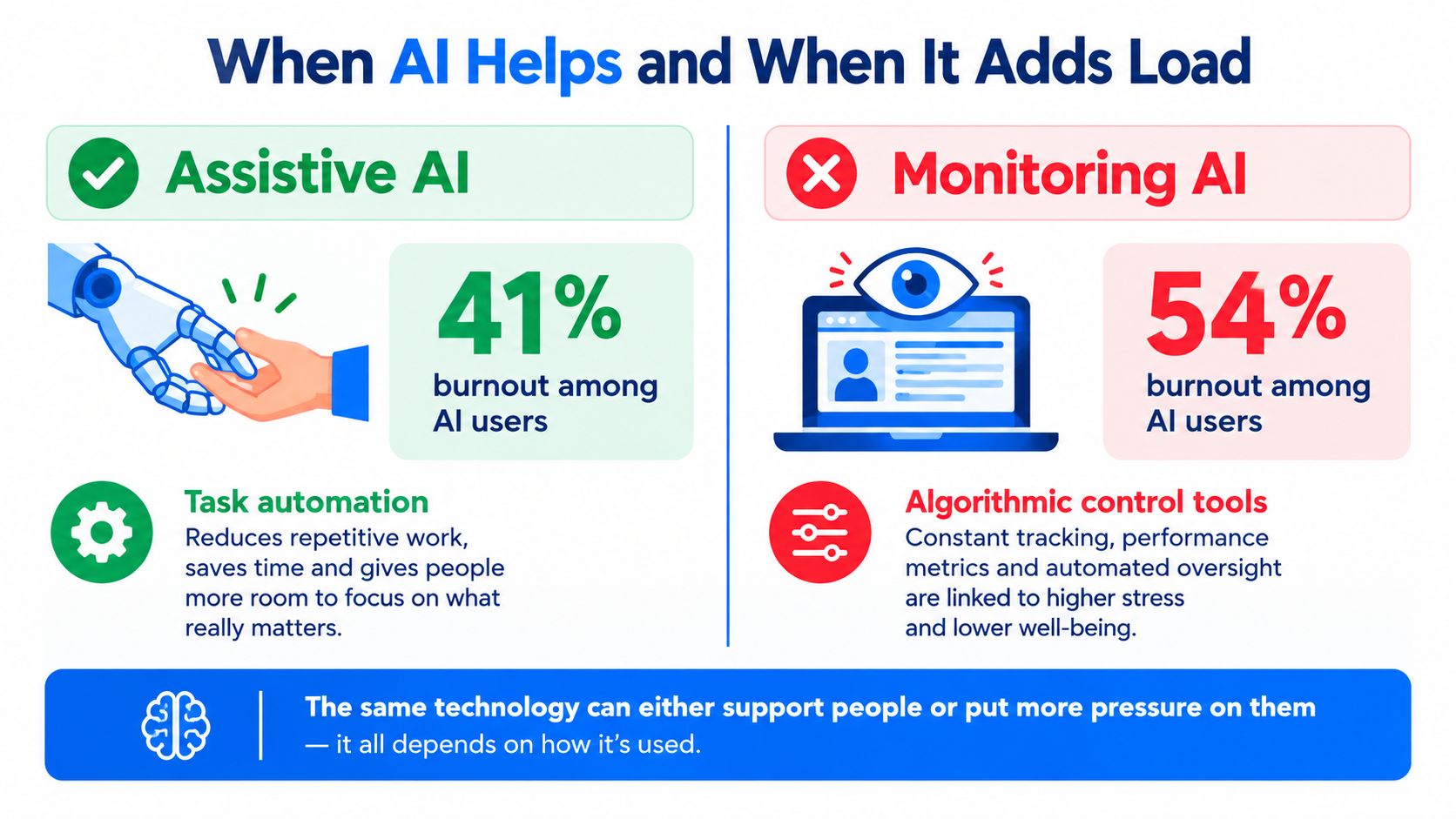
AI reduces employee burnout when it removes administrative friction, and it increases strain when it intensifies monitoring, pace pressure, or loss of autonomy. That distinction should drive every employee facing a technology decision in 2026. The label AI tells you nothing. The workflow tells you everything.
A 2025 report covering 8,200 frontline employees across 10 countries found 41% of workers who used AI reported burnout, compared with 54% of non users, as summarized in UKG perspectives on the frontline workforce and AI. The same source material notes assistive AI was generally associated with lower burnout or exhaustion in randomized and pre or post-healthcare studies, while monitoring and algorithmic control systems were associated with greater burnout or related psychosocial strain.
The Assistive Column
Helpful tools find knowledge fast, draft routine documentation, prioritize tasks, translate instructions, and make shift swaps easier. In hospitality, even narrow automation can protect staff attention during service, which is why practical examples such as AI phone answering for restaurants are worth evaluating through a workload lens rather than a novelty lens. If the phone stops pulling a host away from guests, that’s friction removed.
The harmful column looks different. Systems that score every movement, tighten expected pace automatically, or flag normal variation as underperformance teach employees they’re being watched, not supported. Add poor training and no override path, and you’ve created another source of cognitive load.
Before deploying anything covered under AI workforce management for frontline operations, ask the vendor direct questions:
- What work disappears: Which minutes, clicks, calls, or forms are removed on day one?
- Who keeps control: Can employees correct, override, or appeal an automated decision?
- What’s measured: Is data used for coaching and staffing, or for surveillance and discipline?
- How transparent is it: Can staff see what’s collected and why?
- What training is included: Do deskless workers get paid in workflow training on the devices they use?
If a tool saves managers time by moving effort onto frontline staff, it isn’t reducing burnout. It’s relocating it.
Pilot with the teams who’ll live with the tool, compare absence, errors, task time, and employee feedback before and after, and kill products that add logins without removing work. That’s how AI supports frontline employee experience instead of becoming another fragmented system employees blame, correctly, for making the shift harder.
A TurnOnWork Diagnostic for Frontline Managers
The TurnOnWork Frontline Burnout Diagnostic is an editorial framework that pairs each burnout dimension with an operating lever and a measurable signal, so managers can act in one review meeting instead of launching a vague wellbeing initiative. Read operational data first and the engagement survey second. Surveys miss context, lag behind roster changes, and underrepresent employees who don’t sit at desks.
Pair the Signal With the Lever
Exhaustion maps to staffing, overtime concentration, missed breaks, and rest gaps. Pull the last schedule cycle and identify who absorbed the extra hours, how often breaks were skipped, and where demand exceeded planned coverage. If the same dependable employees carry every gap, you’ve found a retention risk, not a commitment success story.
Detachment maps to recognition frequency, reach of frontline employee communication, and feedback loops. Employee experience data gets blunt here. A 2025 global study found 75% of frontline workers felt burned out, 55% were dissatisfied with their overall employee experience, and 42% said their organization treated them like a number, according to the UKG global study of frontline workforce perspectives. Communication gaps deepen that problem, since only 39% of employees described organizational communication as very helpful in the 2024 Deskless Report, compared with 62% of executives who believed communication was effective, as covered in Manufacturing.net reporting on frontline communication gaps.
Reduced efficacy maps to training access, tool fragmentation, unclear priorities, and rework. Count the systems an employee must open to finish one routine job. Check whether new starters can reach standard operating procedures from a phone on the floor. Review rework by shift and location before you blame individual performance.
A 30 Minute Manager Checklist
Use employee listening strategy for deskless and frontline teams to capture what the data can’t explain, then answer these questions with your supervisors:
- Where is demand unfunded: Which hours, sites, or tasks routinely run below required staffing?
- Who gets recognized: Does recognition reach nights, weekends, and lower visibility roles, or only day shift?
- What reaches employees: Which messages were received, understood, and acted on, not merely sent?
- Where does work bounce: Which approvals, missing tools, or unclear instructions create rework?
- What will you stop: Which report, meeting, or low value task can be removed this month?
That last question protects credibility. A frontline employee EVP strategy that only adds programs while keeping every old demand will deepen cynicism. The best employee value proposition for frontline workforce teams is often subtractive. Fewer duplicate updates, clearer priorities, working tools, and a manager who closes the loop on feedback. That’s frontline employee engagement built into operations, and it’s how to create an EVP for frontline employees that survives contact with a real Tuesday shift.
Connecting Burnout to Business Outcomes
Burnout is a business cost, not only a sentiment score, and leaders act faster when managers translate it into capacity, quality, and retention language. A 2025 study estimated burnout costs U.S. companies between $4,000 and $21,000 per employee annually, which could equal as much as $5 million per year for a 1,000 person company, as reported in CNBC coverage of burnout costs and AI. The same reporting noted employees spent approximately 2.6 hours per day, or 13 hours per week, on tasks AI could potentially handle.
That framing changes the budget conversation. You’re no longer asking for a wellbeing perk. You’re protecting throughput, safety, service quality, and the experienced employees who train everyone else. It also connects directly to the cost of employee turnover on frontline teams, because replacing burned out staff restarts the cycle with heavier loads for whoever remains.
Build one measurement view that combines burnout signals with overtime, absence, turnover, task completion time, error rates, schedule stability, and adoption of employee facing tools. Smaller organizations don’t need a complex platform to start, and practical HR insights for SMBs can help leaders connect people management routines to company performance without building an enterprise bureaucracy. What matters is reviewing the indicators together, by site and shift, so a good average doesn’t hide one location in trouble.
Your Next 30 Days
- Week one: Audit overtime concentration, missed breaks, schedule changes, and absence by team.
- Week two: Remove one low value task, duplicate report, or unnecessary approval from frontline workflows.
- Week three: Fix one communication gap, such as handover quality, message reach, or feedback follow up.
- Week four: Review errors, rework, quits, and employee feedback with supervisors, then publish what changed and what happens next.
That’s also how to measure employee value proposition delivery. Don’t ask only whether employees like the EVP statement. Check whether schedules stabilized, recognition reached every shift, tools removed minutes of work, and experienced employees stayed. An employee value proposition strategy earns belief when operations prove it. For frontline workforce retention, proof beats messaging every time, because employees judge the frontline employee value proposition by the next roster, the next paycheck conversation, and whether their manager notices strain before it becomes a resignation.
FAQs on Employee Burnout
How Is Burnout Different From Normal Fatigue
Normal fatigue improves after rest and time off. Burnout persists and combines exhaustion with detachment and reduced effectiveness, so performance, customer interactions, and motivation keep declining even after a break.
What’s the Highest Leverage Change This Quarter
Fix the worst workload or scheduling bottleneck first. Protect breaks, stabilize schedules, reduce overtime concentration, or remove one recurring low value task. Those changes affect recovery daily.
Can Remote Employees Burn Out Less Than Frontline Staff
Remote work removes commuting and some scheduling constraints, but it doesn’t immunize anyone against excessive workload, unclear priorities, or poor recognition. Frontline risk is more often tied to staffing, pace, physical demands, and limited schedule control.
How Long Does Recovery Take
There’s no reliable universal timeline in the evidence used here. Recovery depends on whether chronic workplace stressors change. Time off without workload, staffing, or control changes often produces only temporary relief.
Ready to turn these diagnostics into a practical frontline workforce strategy for your managers? Explore Turn On Work’s workforce experience coverage, bring the 30 minute diagnostic to your next operations review, and start by removing one workload, scheduling, or communication failure your teams can feel on their very next shift.