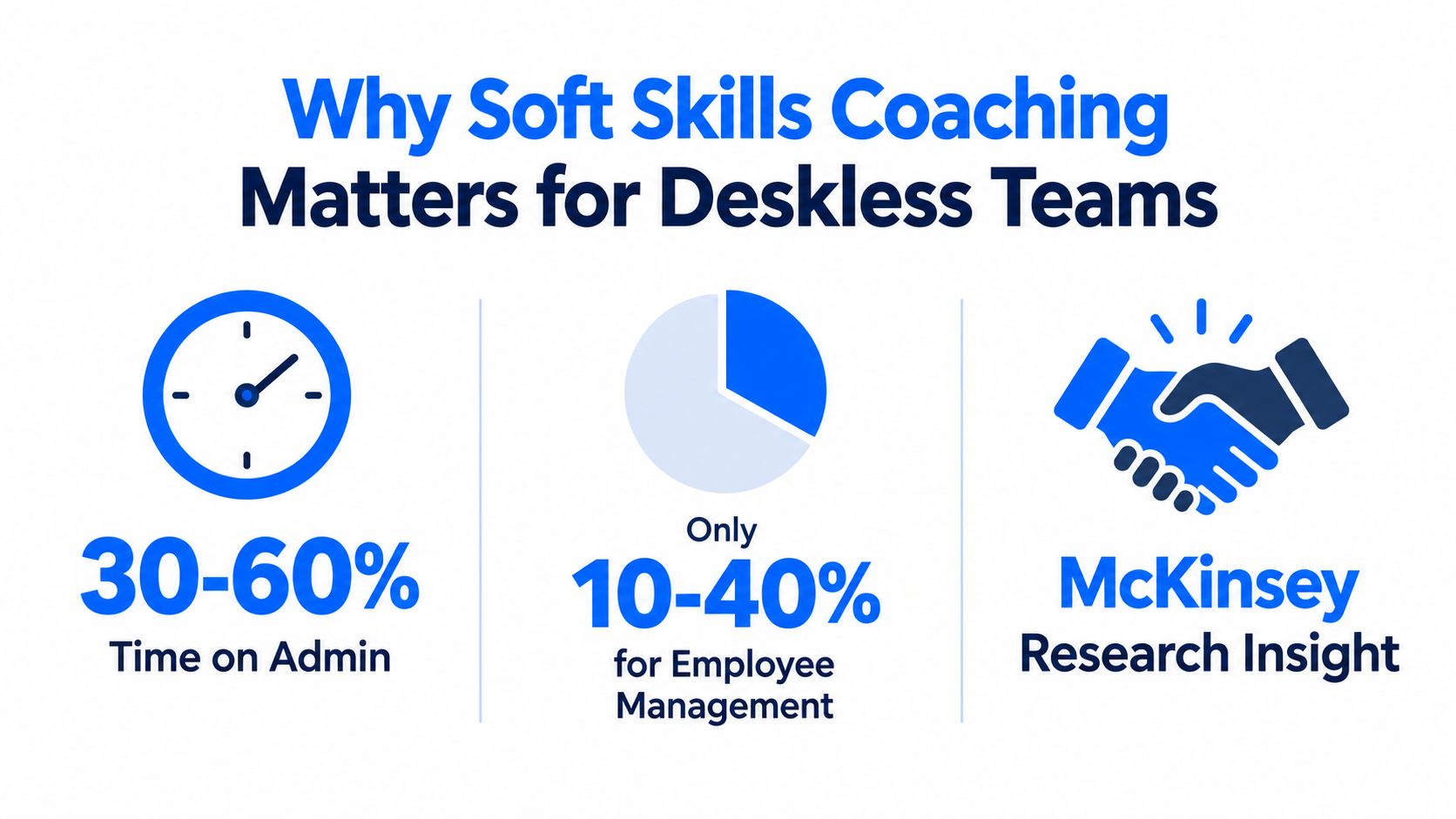
Deskless managers need daily micro-interactions for soft skills coaching because their jobs are structurally overloaded. McKinsey finds they spend 30% to 60% of their time on administrative work and meetings, while only 10% to 40% goes to managing employees, including coaching.
That makes traditional soft skills training a poor fit on its own. A manager may understand active listening, feedback skills, conflict resolution, and empathy, but still fail to use them when a shift is busy, a customer is waiting, or staffing changes disrupt the plan. Effective soft skills coaching for deskless managers embeds short practice, observation, and reinforcement into the work itself.
Why Soft Skills Coaching Matters for Deskless Teams
The hidden problem isn’t a lack of leadership theory. It’s a lack of usable management time. McKinsey reports that frontline managers spend 30% to 60% of their time on administrative work and meetings, another 10% to 50% on non-managerial tasks, and only 10% to 40% managing employees. Only 11% of surveyed companies structured frontline-management roles so managers could focus on coaching and developing direct reports. McKinsey’s frontline-management research makes the operational implication clear: coaching can’t depend on long, protected sessions that rarely survive the shift.
The Workforce Experience Lens
TurnOnWork treats workforce experience as the intersection of employee engagement, internal communications, HR technology, AI, frontline enablement, and workforce operations. That lens changes the coaching question from “Which course should managers complete?” to “What behavior must a manager use during this workflow, and what support makes that behavior easier?”
A retail supervisor needs to recognize good customer service while the evidence is fresh. A healthcare charge nurse needs to raise a concern without humiliating a colleague. A field-services manager needs to coach decision making through a mobile workflow rather than wait for an office meeting. These are soft skills for managers, but they’re also execution skills.
McKinsey found that best-practice companies push managers to spend 60% to 70% of their time on the floor, much of it in high-quality individual coaching. At those companies, executives were satisfied with frontline-manager performance at 39% versus 20% overall, and 71% said training emphasized leadership skills compared with 53% overall. This practical guide to manager as a coach for OKRs also helps connect development conversations with operating priorities.
Practical rule: If coaching isn’t visible in the workflow, it will lose to the workflow.
One-time soft skills training usually fails because information decays without practice, feedback, and reinforcement. A workplace coaching meta-analysis found a medium positive effect across organizational outcomes and concluded that coaching is effective across thousands of data points. The meta-analysis supports a repeated model, while TurnOnWork’s guidance on manager behaviors and employee engagement shows why communication and manager behavior belong inside the employee experience strategy, not in a separate learning silo.
Key takeaways
- Use micro-coaching: Short, repeated interactions fit compressed manager schedules better than classroom-heavy programs.
- Coach behaviors, not abstract traits: Focus on communication, recognition, accountability, and difficult conversations.
- Match the cadence to the work: Daily reinforcement, weekly practice, and monthly development serve different purposes.
- Connect tools to execution: Mobile access, timely prompts, and useful data matter as much as course content.
- Measure the chain: Track coaching activity, behavior change, employee signals, and operational outcomes together.
The Coaching Cadence Framework for Frontline Managers
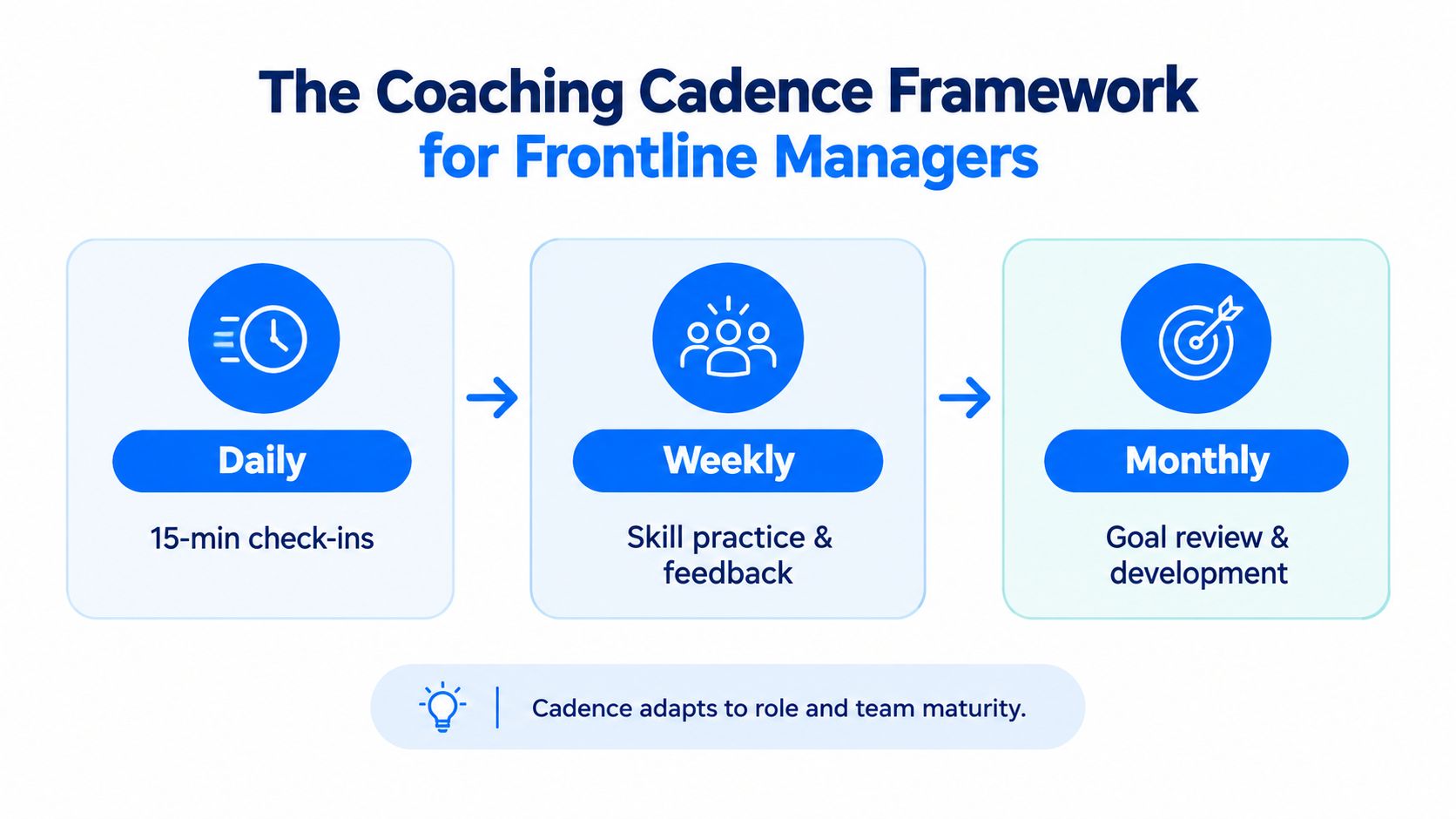
A good coaching cadence gives managers daily reinforcement, weekly practice, and monthly development conversations. The exact format should adapt to role, team maturity, shift pattern, and operational risk. The purpose isn’t to create more meetings. It’s to make coaching predictable enough that managers don’t postpone it indefinitely.
Daily coaching for live behavior
Daily coaching should be brief and connected to an actual moment. A supervisor might observe a customer interaction, ask one reflective question after a handoff, or recognize a technician who explained a delay clearly. A quick check-in can be built into a pre-shift huddle, task transition, or end-of-shift reset.
Use immediate coaching when the behavior affects safety, dignity, customer trust, compliance, or team coordination. Correct privately when the issue could embarrass the employee, involves sensitive performance feedback, or requires a fuller conversation. Public recognition can reinforce a visible team standard, but the manager should still be specific about what the employee did and why it helped.
Weekly coaching for skill practice
Weekly coaching is where managers rehearse a skill instead of merely discussing it. Choose one behavior, such as active listening or conflict resolution, and use a real scenario from the prior week. Ask the employee to describe what happened, identify the decision point, and try a better response through a short role-play.
A weekly huddle can include:
- One observed behavior: Name what happened without exaggeration.
- One employee reflection: Ask what the employee noticed and intended.
- One practice round: Rehearse a coaching conversation, escalation, or customer response.
- One next-shift commitment: Define what the employee will try next.
Managers can use an employee engagement calendar to coordinate recognition, listening prompts, and development moments without turning every interaction into a formal review. For teams using learning technology, an automate coaching delivery guide can help translate scheduled learning into reminders and follow-up.
Monthly coaching for development
Monthly conversations should look beyond the immediate shift. Review progress, aspirations, recurring barriers, and the support the manager can provide. This is the right place for goal review, development planning, mentoring arrangements, and discussion of leadership skills for frontline managers.
The cadence should flex. A new employee may need more frequent practice, while an experienced employee may benefit from greater autonomy and less frequent observation. A high-risk operational period may call for more immediate coaching, but the manager should reduce administrative friction elsewhere rather than just adding another obligation.
Designing Role-Specific Coaching Curricula
A strong curriculum starts with the moment where performance breaks down, not with a generic competency list. Identify the role’s critical interactions, then map the soft skills that make those interactions work. A store manager may need recognition, customer service skills, and difficult conversations. A maintenance lead may need problem solving, adaptability, and accountability. A home-care supervisor may prioritize empathy, emotional intelligence, and leadership communication.
Build from real operating moments
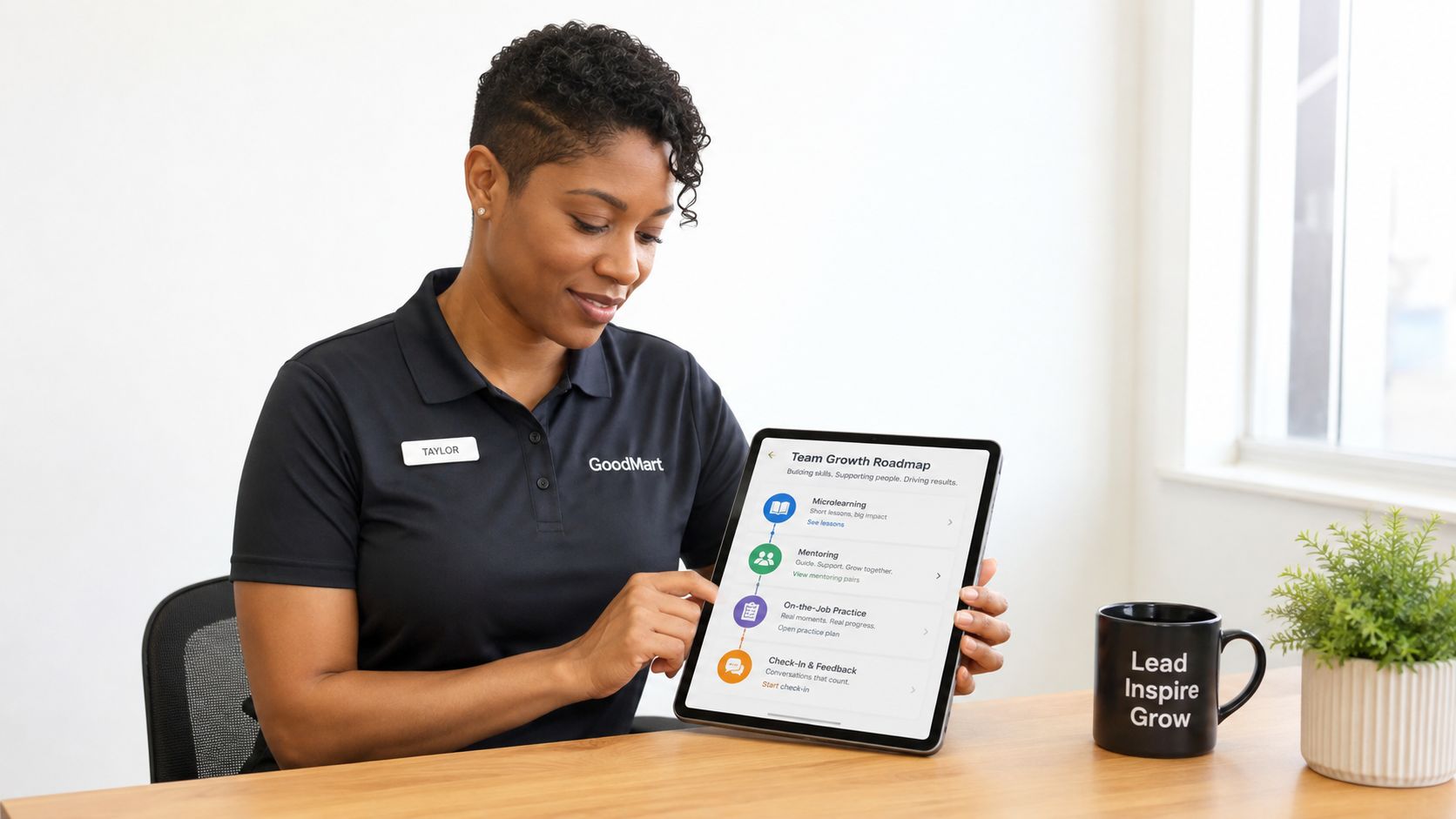
Consider a GoodMart-style retail team. The manager observes an associate rushing through a customer explanation. The daily intervention is a private question: “What did the customer still need to understand?” The weekly practice is a role-play using a common product question. The monthly conversation links communication quality to the associate’s development goal and readiness for greater responsibility.
That sequence distinguishes soft skills training from coaching. Training introduces a concept or method. Coaching observes how someone applies it, gives feedback, and creates another opportunity to practice. An employee may complete a lesson on empathy, but the manager must still notice whether the employee listens before proposing a solution.
A useful curriculum follows the work: teach the principle, observe the behavior, practice the response, and revisit the result.
Use mobile delivery without losing human judgment
Deskless teams need access through the tools they already use during work, such as an employee app for frontline and deskless workers, a messaging channel, a task platform, or shared shift resource. Keep each learning prompt narrow. A short scenario, a response choice, and a manager discussion prompt are more practical than a long module that assumes uninterrupted screen time.
AI can support delivery by generating role-play scenarios, adapting prompts to a role, summarizing themes from manager notes, or helping an employee rehearse a difficult conversation. It shouldn’t decide whether an employee is ready for promotion, infer sensitive traits, or replace the manager’s judgment. Human coaches provide context, accountability, and trust.
Use a skills inventory to identify gaps in the 2026 skills inventory assessment, then look beyond the standard competency list for behaviors such as curiosity, judgment, and the ability to create psychological safety. A useful curriculum is narrow enough to practice and broad enough to reflect how the role operates.
Choosing the Right Coaching Approach for Your Team
No single coaching model fits every deskless operation. Manager-led coaching provides the strongest connection to daily work, peer coaching spreads practice across a team, and external mentoring offers perspective that an employee’s direct manager may not have. The right choice depends on team size, operational complexity, manager capacity, and the sensitivity of the skill.
A practical decision matrix
| Operating condition | Best starting approach | Why it fits | Main trade-off |
|---|---|---|---|
| Small team with an accessible supervisor | Manager-led coaching | Feedback can follow observed work quickly | Quality depends on manager coaching skills |
| Large team with consistent routines | Peer coaching supported by manager review | Builds shared language and distributes practice | Peer feedback can become vague or overly friendly |
| Complex or emotionally demanding work | Manager-led coaching plus external mentoring | Combines operational context with independent perspective | Requires careful coordination |
| Limited manager capacity | Microlearning with scheduled manager prompts | Reduces preparation and keeps practice moving | Technology can’t replace observation |
| New supervisors | Structured frontline manager training followed by coaching | Gives managers a common foundation and rehearsal | Initial structure can feel rigid |
Coaching isn’t only for top performers or employees with performance problems. High performers need stretch assignments, emerging managers need leadership practice, and struggling employees may need clear feedback and support. Treating coaching as punishment makes employees hide uncertainty, which removes the very information managers need to improve execution.
Match the model to the risk
A warehouse team with repetitive handoffs may benefit from peer observation and quick manager feedback. A hospitality team handling service recovery may need manager-led coaching because tone, judgment, and customer context matter. A distributed field-service team may combine mobile prompts, recorded examples, and periodic mentoring because the manager can’t observe every customer interaction.
Research from Catalyst supports focusing on concrete manager actions. Its 2024 study found positive manager actions were strongly associated with work satisfaction, r = .59, work engagement, r = .61, organizational commitment, r = .66, lower intent to leave, r = -.37, and lower burnout, r = -.36. Catalyst’s frontline employee team-dynamics research points toward coaching communication, recognition, and support rather than teaching leadership theory in isolation.
A lightweight microlearning platform for frontline teams can support the cadence, but the platform should remain subordinate to the coaching relationship. Choose tools that make the right behavior easier, not tools that create another dashboard for managers to maintain.
Measuring Coaching Impact and ROI
Measure coaching as a chain, not as a single completion number. Start with whether coaching happened, then examine whether behavior changed, whether employees experienced a better manager relationship, and whether operations improved. This approach makes soft skills development more credible without pretending that every business result can be attributed to one intervention.
Use leading and lagging indicators
Leading indicators show whether the program is alive:
- Coaching activity: Track completed observations, practice conversations, recognition moments, and follow-up notes.
- Behavior evidence: Look for specific examples of active listening, clear handoffs, useful feedback, or appropriate escalation.
- Manager confidence: Ask managers whether they can apply the skill during a live shift.
- Employee voice: Use short pulse questions about communication, support, fairness, and recognition.
Lagging indicators show whether the operating environment is improving:
- Engagement and trust: Compare employee sentiment over time and across teams, while accounting for local conditions.
- Retention signals: Review avoidable exits, transfer patterns, and recurring manager-related themes.
- Performance outcomes: Connect relevant soft skills to quality, service recovery, safety behavior, or task completion.
- Customer experience: Examine complaints, compliments, and escalation patterns where customer interaction is central.
Gallup found that after adding a Manager Enablement Index to a companywide engagement survey, 83% of frontline managers in the top quartile were engaged, compared with 11% in the bottom quartile. Gallup also recommends requiring leaders to develop coaching skills and use them for frequent, strengths-based feedback to managers. Gallup’s frontline-manager engagement findings support measuring manager enablement as part of the employee experience, not treating engagement as an employee-only issue.
Build an evidence trail
Before launch, define the behavior the program should change and the operational signal it should influence. During the pilot, collect a baseline, record coaching activity, and gather employee feedback. After implementation, compare patterns while documenting other changes, such as staffing, scheduling, or process redesign.
Internal communications also affect whether employees understand and trust the program. Use the guidance on internal communications ROI to connect message reach, manager reinforcement, and employee response. The aim isn’t to claim a perfect causal result. It’s to show a defensible relationship between better coaching practice and better workforce experience.
Piloting and Scaling Coaching Programs
Start small enough to learn and broad enough to expose operational variation. A useful pilot includes managers from different shifts, locations, or role types, rather than only the most enthusiastic participants. The pilot should test the workflow, not just the content.
Five steps for a practical rollout
- Select the pilot group. Choose a manageable mix of managers and employees. Confirm that schedules, devices, and operational coverage can support brief coaching moments.
- Define success metrics. Select one or two target behaviors, employee-experience measures, and relevant operating signals. Avoid measuring everything at once.
- Choose AI-enabled technology carefully. Look for mobile access, simple prompts, role-play support, manager notes, permissions, and usable reporting. Confirm how human review, privacy, and data retention work before deployment.
- Train the coaches. Managers need practice in observation, active listening, feedback skills, difficult conversations, and follow-through. Give them scripts, examples, and a way to ask for help.
- Scale organization-wide. Publish the operating rhythm, adapt examples by role, and provide local champions. Scale the behavior and workflow, not merely the course library.
Make adoption part of operations
Put coaching prompts inside existing huddles, shift handoffs, one-to-ones, and performance conversations. Schedule the work where managers already look, whether that’s a mobile app, workforce-management platform, or team communication channel. Turn On Work publishes practical workforce-experience guidance across employee engagement, internal communications, HR technology, AI, and frontline operations, which can help teams evaluate the surrounding experience rather than purchase a coaching tool in isolation.
Use a launch checklist:
- Workflow fit: Identify the exact shift moments where coaching can occur.
- Manager capacity: Remove unnecessary reporting or duplicate meetings.
- Role relevance: Replace generic scenarios with local examples.
- Employee safety: Explain how notes and feedback will be used.
- Review cycle: Set a date to assess evidence and adjust the cadence.
Common Mistakes and How to Avoid Them
The most common failure is calling a course a coaching program. A course can provide language and models, but coaching requires observation, practice, and feedback in the context where the behavior matters.
Five avoidable failures
- One-time training: Replace a single event with spaced prompts, role-play, and follow-up observation.
- Classroom-first design: Move learning to mobile, huddles, shift transitions, and live work. Deskless managers rarely have reliable time for long sessions.
- Generic competencies: Tie each skill to a recognizable moment, such as a customer complaint, missed handoff, or safety concern.
- Public correction: Preserve dignity. Recognize visible good work publicly, but handle sensitive correction privately.
- No measurement plan: Define the target behavior and employee signal before selecting technology.
Blink found that 27% of frontline managers spend 15 minutes or less communicating with their team each day. Blink’s frontline-management research reinforces why manager coaching techniques must work in small windows. A manager who has only a brief communication window can’t sustain a program that depends on lengthy preparation, complex forms, or separate administrative routines.
Operational test: If a manager can’t use the coaching method during a real shift, simplify the method before adding more content.
A practical implementation checklist is simple: choose one behavior, create one short practice scenario, define one daily prompt, schedule one weekly review, and capture one employee signal. Then adjust based on what managers and employees actually experience. Soft skills coaching for deskless managers works when communication, tools, data, and operational execution reinforce one another. It fails when learning sits apart from the work.
Soft Skills Coaching Deskless Managers FAQs
What is soft skills coaching?
Soft skills coaching is repeated, practical guidance that helps someone improve behaviors such as communication skills, active listening, empathy, feedback, conflict resolution, teamwork, and decision making. Unlike one-time training, coaching includes observation, practice, feedback, and follow-up.
What is soft skills coaching for frontline managers?
It is a structured way to help managers apply people skills during real frontline work. A manager might rehearse a difficult conversation, receive feedback on a team huddle, or practice recognition after observing customer service behavior.
How often should managers coach frontline employees?
Use a layered cadence. Daily coaching should address immediate behaviors and recognition, weekly coaching should create deliberate practice, and monthly conversations should review development and goals. The frequency should reflect team maturity, role risk, and manager capacity.
What is the difference between coaching and performance management?
Coaching develops capability through questions, practice, observation, and feedback. Performance management sets expectations, documents performance, and addresses consequences when standards aren’t met. The two can support each other, but employees need to know which type of conversation they’re having.
Why isn’t one-time soft skills training enough?
People don’t reliably transfer a concept into a pressured work situation without practice and reinforcement. Deskless managers also face severe time constraints, so the most useful design combines short learning moments with live coaching conversations.
How long should a frontline coaching conversation take?
The length should match the purpose. An in-the-moment correction may take only a brief exchange, while a weekly coaching conversation needs enough time for reflection and practice. The design principle is to protect the quality of the conversation rather than impose one universal duration.
How can AI support manager coaching?
AI can generate role-specific scenarios, support conversation practice, suggest reflection prompts, and organize coaching themes. Human managers should retain responsibility for context, judgment, sensitive feedback, and employment decisions.
If your organization manages retail, healthcare, hospitality, logistics, manufacturing, field service, or another deskless workforce, start with one role and one behavior. Map the daily, weekly, and monthly moments where that behavior matters, equip managers with a mobile-friendly prompt and practice routine, and review employee feedback after the pilot. That is the practical path to building a coaching system that improves workforce experience without adding another disconnected training initiative.