
Internal communications ROI shows whether a communication initiative creates more financial value than it costs. The standard formula is ROI (%) = (Monetary Benefits − Total Program Costs) ÷ Total Program Costs × 100. Metrics such as opens, clicks, survey responses, and engagement scores can show whether communication is working. However, they are not financial ROI by themselves. To calculate ROI accurately, start with a clear business outcome. Then establish a baseline, estimate how much of the improvement came from communication, assign a monetary value where appropriate, and compare the benefit with the total cost.
Internal Communications ROI Formula
There is no universally accepted ROI formula used only for internal communications. When a communication initiative produces a business benefit that can be isolated and assigned a monetary value, teams can apply the standard ROI formula:
Internal Communications ROI (%) = (Monetary Benefits − Total Program Costs) ÷ Total Program Costs × 100
A second useful measure is the benefit-cost ratio, or BCR:
BCR = Monetary Benefits ÷ Total Program Costs
ROI shows the net financial return after program costs have been deducted. BCR shows how much measured benefit was produced for each dollar of program cost.
The arithmetic is usually the easy part. The harder part is deciding which business benefits can reasonably be linked to communication.
ROI is not the same as communication effectiveness
An email open, content view, survey response, or employee acknowledgement can tell you something useful. None of those measures financial return by itself.
A practical internal communications measurement hierarchy is:
Reach → Engagement → Understanding → Action → Business Outcome → Monetary Impact
| Measure | What It Tells You | Financial ROI? |
| Reach | Did the intended audience receive the communication? | No |
| Engagement | Did employees open, view, click, or interact with it? | No |
| Understanding | Did employees understand the message? | No |
| Action | Did employees do what the communication asked them to do? | Not by itself |
| Business outcome | Did an operational or people’s result change? | Potentially |
| Monetized attributable benefit | What financial value can reasonably be linked to communication? | Yes |
Established communications measurement frameworks make a similar distinction between communication activity, audience outcomes, and wider organizational impact.
It also reflects a broader shift covered in our guide to internal communications trends in 2026. Leadership still needs reach and engagement data, but those numbers become much more useful when they connect to employee action and a measurable business result.
What Counts as a Monetary Benefit?
The monetary benefit depends on what the communication was designed to change.
There is no need to turn every employee outcome into dollars. Use financial ROI where the value can be estimated in a way that Finance, HR, or the relevant business owner would be comfortable defending.
Reduced employee or manager time
Suppose a clearer benefits campaign reduces the number of repeated questions employees send to HR.
If the team can measure the reduction in handling time and has an approved labor-cost value, those saved hours may form part of the monetary benefit.
The same approach can apply when managers spend less time repeating operational updates or employees spend less time searching for information.
Lower rework or error costs
Internal communication may support a process change intended to reduce mistakes.
If the organization already tracks the cost of correcting those mistakes, the measured reduction may be converted into a monetary benefit.
Communication should not automatically receive credit for the whole improvement. Other operational changes may have contributed as well.
Reduced support demand
A communication initiative may reduce help-desk tickets, HR questions, or other internal support requests.
The useful outcome is not simply that employees read the message. It is whether support demand changed and whether a reasonable portion of that improvement can be linked to communication.
Faster adoption or completion
Internal communications often supports benefits enrollment, policy acknowledgement, technology adoption, onboarding, training completion, or another defined business process.
If faster or higher adoption creates a measurable financial benefit, that value may be included in the ROI calculation after the communication contribution has been assessed.
Employee engagement and sentiment require more care. A higher engagement score may be an important outcome, but it should not automatically be converted into retention savings, productivity gains, or revenue without a defensible link between them.
Internal Communications Metrics to Track
The metrics you track should follow the business objective.
If the goal is policy awareness, understanding and acknowledgement may matter most. If the goal is technology adoption, completion and usage are more relevant. If the goal is reducing support demand, ticket volume and handling time matter alongside communication reach.
Useful internal communications metrics include:
- Reach: The number or percentage of the intended audience that received the communication.
- Open or view rate: Whether employees opened or viewed the content.
- Click-through rate: Whether employees interacted with a link or call to action.
- Acknowledgement rate: Whether employees confirmed receipt of important information.
- Survey response rate: How much of the target audience provided feedback.
- Understanding: Whether employees correctly understood the message or change.
- Completion or adoption rate: Whether employees took the intended action.
- Time saved: Measured reduction in employee, manager, HR, or support time.
- Error or rework volume: Whether a communication-supported process produced fewer avoidable mistakes.
- Business outcome: The operational or people result the communication was intended to influence.
Employee communication platforms such as HubEngage and Workvivo can provide inputs such as reach, content engagement, opens, clicks, surveys, and audience-level results. Survey platforms such as Qualtrics can add more structured employee feedback and experience data.
Those measures help explain what happened between message delivery and the eventual business result. They should feed the ROI analysis rather than be mistaken for ROI themselves.
If employee surveys are part of your measurement process, our guide on how to analyze employee survey answers covers how to move from response data to themes, priorities, and action.
Measuring frontline and deskless communication
For deskless and shift-based workforces, internal communication measurement should reflect the channels employees actually use.
A warehouse worker, field employee, nurse, retail associate, or plant worker may not spend the day in a corporate inbox. Mobile content views, SMS reach, push notifications, acknowledgements, survey participation, task completion, and location-level results may therefore tell you more than email opens.
Platforms designed for employee communication, including HubEngage and Workvivo, can support communication outside the traditional email inbox. What matters for measurement is not how many channels a platform offers. It is whether the data reflects how employees actually receive and act on information.
For real-time internal communications, such as urgent operational or safety updates, ask a more direct question:
Did the intended audience receive the information in time to take the required action?
For the wider planning behind distributed and frontline communication, see our guide to building an internal communication strategy for a distributed workforce.
How to Calculate Internal Communications ROI in 7 Steps
1. Define the business outcome
Start with the problem, not the easiest metric to collect.
Examples include:
- HR receives too many repeated questions about a benefits process.
- Adoption of a new internal system is below target.
- Employees regularly miss a required process step.
- Managers spend too much time repeating the same operational update.
- Frontline employees are missing time-sensitive information.
Then define what should change if the communication works.
“Improve employee communication” is too broad.
“Reduce repeat benefits questions handled by HR” is measurable.
2. Establish a baseline
Measure the situation before changing the communication.
Depending on the objective, the baseline might include:
- support-ticket volume
- average handling time
- completion rate
- technology adoption
- error volume
- manager time
- employee understanding
- existing workforce reach
Without a baseline, it is difficult to show whether the result actually improved.
3. Define the communication intervention
Record what the organization is changing.
That might be:
- a new employee communication platform
- a benefits campaign
- a manager communication program
- clearer onboarding content
- SMS alerts for frontline workers
- a new communication cadence
- redesigned policy communications
This matters later when you need to explain what may have contributed to the result.
4. Measure the change
Compare the business result with the baseline.
Suppose the objective was to reduce repeated questions to HR.
Measure the number of questions and the time spent handling them before and after the campaign. At the same time, measure whether employees received, understood, and acted on the communication.
That gives you both sides of the measurement story: communication performance and business change.
5. Isolate the communication contribution
This is where an ROI calculation either becomes credible or starts to fall apart.
A business result rarely changes because of communication alone.
A fall in support tickets could also result from a process redesign. Software adoption may increase after training. Employee retention can change because of compensation, management quality, hiring conditions, or other factors.
Estimate only the portion of the improvement that can reasonably be connected to the communication initiative.
Depending on the program and available data, teams may use:
- comparison groups
- before-and-after analysis
- employee or manager feedback
- trend analysis
- controlled pilots
- estimates from subject-matter experts
- other evidence that helps separate the communication effect
If the connection is weak, say so. Reporting a positive business outcome without forcing it into a financial ROI calculation is better than claiming value that cannot be defended.
6. Convert the attributable benefit into money
Once the communication contribution has been isolated, determine whether the benefit can reasonably be assigned a monetary value.
Use an approved financial value wherever possible.
For example, if employee time savings are being monetized, agree with Finance on the appropriate labor-cost basis instead of choosing an arbitrary hourly figure.
7. Include the costs and calculate ROI
Now compare the attributable monetary benefit with the full program cost.
The following numbers are illustrative only. They are not industry benchmarks.
| Input | Illustrative Figure |
| Total communication program cost | $30,000 |
| Verified attributable time saved | 500 hours |
| Finance-approved labor value | $40/hour |
| Value of time saved | $20,000 |
| Other attributable cost savings | $25,000 |
| Total monetary benefit | $45,000 |
| Net benefit | $15,000 |
| ROI | 50% |
| Benefit-cost ratio | 1.5:1 |
The calculation is:
ROI = ($45,000 − $30,000) ÷ $30,000 × 100 = 50%
The benefit-cost ratio is:
BCR = $45,000 ÷ $30,000 = 1.5:1
In this illustrative example, every $1 of measured program cost is associated with $1.50 in attributable monetary benefit. After deducting the original investment, the net ROI is 50%.
These figures show how the calculation works. They do not represent a recommended or typical internal communications ROI.
What Costs Should You Include?
Using only the software subscription as the cost base can overstate ROI.
The total program cost should include the meaningful resources required to deliver and measure the initiative.
Depending on the program, that may include:
- employee communication software or platform costs
- internal team time
- agency or vendor fees
- content and design production
- implementation
- training
- distribution
- employee or manager participation time
- surveys and research
- measurement and reporting
Not every initiative will include every cost.
The point is simple: don’t compare the full benefit of a program with only part of its cost.
Internal Communications Executive Reporting Template
An executive report should make the logic behind the ROI calculation easy to follow.
Leadership should be able to see what the communication was meant to change, what actually changed, how much of that change is being attributed to communication, what value was assigned to it, and what the team recommends next.
| Report Field | What Leadership Should See |
| Business objective | The problem or result the communication was designed to influence |
| Baseline | Performance before the communication initiative |
| Communication reach | How much of the intended audience received the message |
| Employee outcome | Understanding, acknowledgement, adoption, or intended action |
| Business outcome | What operational or people measure changed |
| Attribution basis | Evidence used to connect part of the change to communication |
| Monetary benefit | Financial value assigned to the attributable result |
| Total program cost | Full measured investment |
| ROI / BCR | Financial result when calculation is appropriate |
| Trend | Movement versus the baseline or previous reporting period |
| Next action | What the team recommends continuing, changing, testing, or stopping |
The reporting view will often pull data from more than one place.
A platform such as HubEngage or Workvivo can provide communication and engagement data. Qualtrics can contribute structured employee survey data. HR, Finance, or operational systems provide the business and financial measures used to calculate the actual return.
If your workplace already reports through a business intelligence tool such as Microsoft Power BI, those different datasets can be brought into the same management view.
A simple executive summary template
A leadership summary does not need to be long.
Objective: Reduce repeated HR questions about a new benefits process.
Baseline: [Previous query volume and handling time]
Employee outcome: [Reach, understanding, acknowledgement, or completion result]
Business outcome: [Measured change]
Attribution basis: [How the communication contribution was estimated]
Monetary benefit: [$X]
Program cost: [$X]
ROI: [X%]
Next action: [Continue, change, expand, or test]
A leadership team can do far more with this than with a dashboard of open rates that never explains what changed as a result.
Common Internal Communications ROI Mistakes
Calling engagement metrics ROI
An 80% open rate may be useful. It is still an open rate.
Keep communication effectiveness metrics and financial ROI separate.
Claiming the entire business result
If adoption rises after a communication campaign, communication may have contributed. That does not mean it caused the entire increase.
Isolate the contribution before monetizing the result.
Monetizing outcomes without a defensible value
Do not assign a dollar value to improved sentiment or employee engagement simply because a calculation is possible.
Use financial values that can be explained and supported.
Leaving meaningful costs out
Counting the value of employee time saved while ignoring the internal time required to plan and deliver the program creates an incomplete comparison.
Include the meaningful costs associated with producing the result.
Reporting ROI without showing the methodology
A 60% ROI figure means little if leadership cannot see the baseline, attribution method, monetary benefit, and costs behind it.
Show enough of the calculation for the result to be understood and challenged.
Tools That Can Help
Internal communications teams rarely get everything they need from one platform. Communication software can show whether employees saw or interacted with a message, while survey tools can help measure understanding and sentiment. Business intelligence tools are useful when those results need to be compared with HR, operational, or financial data.
The important point is that these tools provide evidence for an ROI analysis. They do not calculate or prove the financial return by themselves.
HubEngage
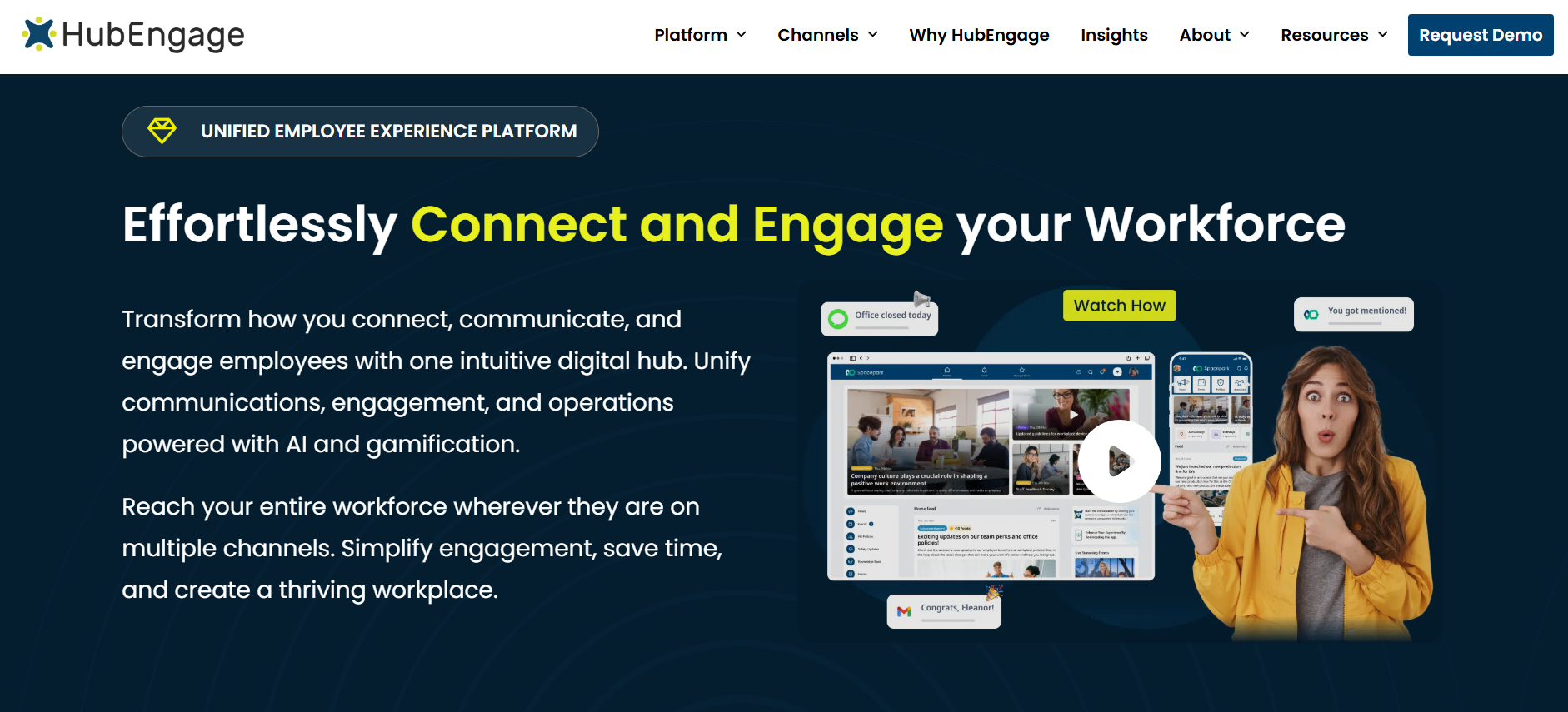
HubEngage brings employee communications, surveys, recognition, and engagement features into one platform. It is particularly relevant for companies that need to communicate with both office-based and frontline employees across different channels.
Communication teams can use HubEngage to look at measures such as content views, opens, clicks, survey participation, and engagement across different employee groups.
That data becomes more useful when it is tied to a specific outcome. For example, a company rolling out a new policy could first check whether employees received and engaged with the communication. It could then compare those results with policy acknowledgements, support requests, or another measurable business result.
HubEngage therefore covers an important part of the measurement process: showing what happened after a message was distributed and how employees responded.
If you are comparing platforms for this purpose, our guide to employee communication tools covers common features, use cases, and buying considerations.
Workvivo
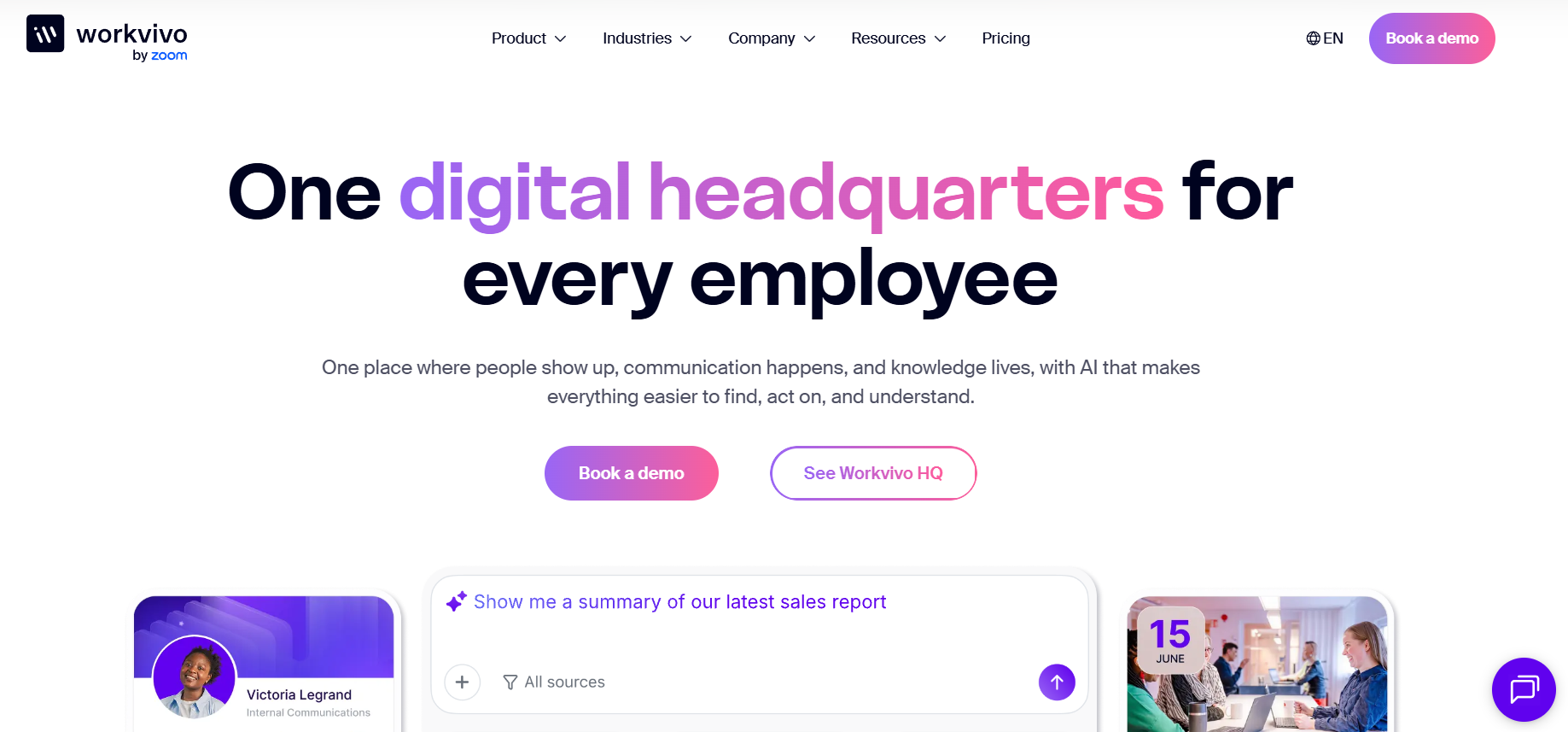
Workvivo is another employee communication and engagement platform. Teams can use it to distribute company updates, understand content performance, and see how employees interact with workplace communications.
Its reporting capabilities are useful when communication teams want to compare engagement across locations, departments, or employee groups rather than looking only at an organization-wide number.
For example, a campaign may perform well overall but have much lower engagement among frontline employees in one region. That difference is often more useful than a single average engagement rate because it tells the team where communication may need to change.
Workvivo data can support an ROI analysis, but it still needs to be combined with the business result the campaign was intended to influence.
Qualtrics
Qualtrics becomes useful when the measurement question goes beyond whether employees opened or clicked a message.
Surveys can help teams understand whether employees actually understood a change, how they felt about it, and whether responses differ across parts of the workforce. This is especially helpful for communication around organizational change, employee experience, benefits, onboarding, or other initiatives where perception and understanding matter.
For instance, an email platform may show that 85% of employees opened an announcement. A survey can help answer the more important question: did they understand what they were expected to do next?
These findings can strengthen an ROI analysis, although survey results should not automatically be assigned a financial value. They still need a credible connection to a measurable business outcome.
Microsoft Power BI
Microsoft Power BI is useful later in the measurement process, particularly when communication data has to be combined with information from several systems.
A communications team might have engagement data in one platform, survey results in another, support-ticket information elsewhere, and cost figures from Finance. Power BI can bring those datasets into a common reporting view.
This makes executive reporting easier.
Instead of showing leadership a dashboard filled only with opens and clicks, the team could report campaign reach alongside completion rates, support demand, time saved, program costs, and the resulting financial calculation.
For larger or recurring communication programs, that combined view can make the connection between communication activity and business results much easier to explain.
FAQ
What is the formula for internal communications ROI?
When a communication benefit can be isolated and converted into money, use:
ROI (%) = (Monetary Benefits − Total Program Costs) ÷ Total Program Costs × 100
Reach, opens, clicks, survey responses, and other communication metrics should not be entered directly into the financial formula unless they lead to a separate business benefit that can be valued defensibly.
What is a good internal communications ROI?
There is no universal internal communications ROI benchmark that applies across every organization or program.
A compliance campaign, benefits initiative, employee-app rollout, onboarding program, and operational communication campaign create different forms of value and have different costs. Compare results with your own baseline, previous initiatives, and agreed investment expectations rather than applying an unsupported industry percentage.
Can employee engagement be included in internal communications ROI?
Employee engagement can be an important communication or business outcome, but an improved engagement score is not automatically financial ROI.
If the organization can demonstrate that a change in engagement contributed to a measurable business result and can isolate and value that contribution responsibly, it may form part of a wider ROI analysis. Otherwise, report engagement separately as an employee outcome.
How often should internal communications ROI be reported?
The reporting frequency should match the business decision and how quickly the underlying outcome changes.
Communication metrics may be reviewed weekly or monthly, while financial ROI is often more useful after a defined campaign, initiative, or measurement period. For recurring programs, ROI can also be included in monthly or quarterly leadership reporting once enough outcome data is available.
Make the Measurement Plan Before the Campaign
Internal communications ROI is easier to measure when the process starts before the campaign launches.
First, define the business result you want to influence. Next, establish a baseline and decide how you will measure the communication contribution. If financial values are involved, agree on those values in advance.
Then track reach, engagement, understanding, and employee action. These metrics help explain how communication contributed to the final business result.
Finally, calculate financial ROI only when the connection is defensible. If it is not, report the business outcome clearly without forcing it into a dollar value.