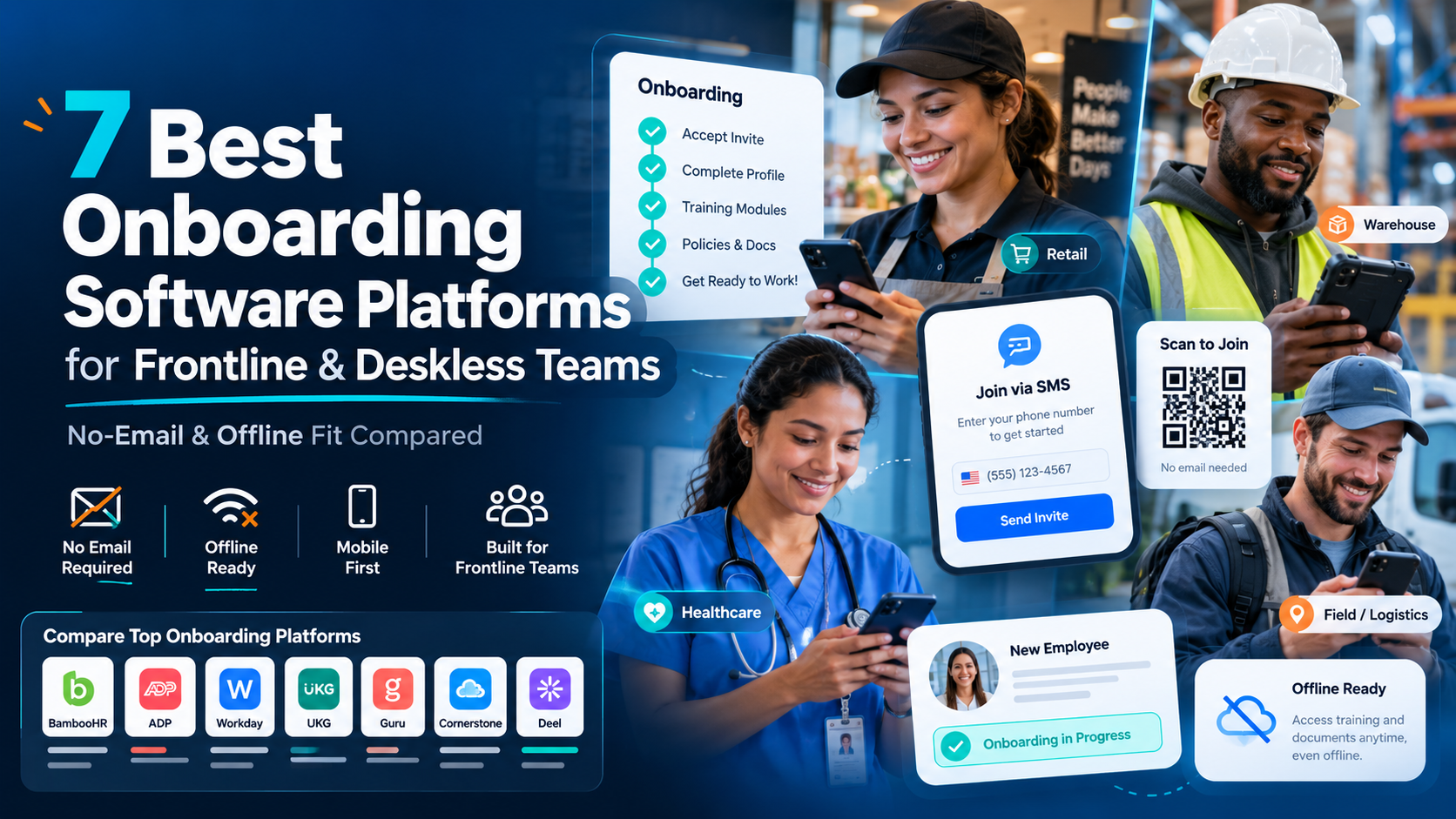
An employee value proposition for frontline employers is the practical exchange between an organization and its hourly, deskless, or field-based employees. It includes pay and benefits, but also schedule control, accurate payroll, safe conditions, capable managers, recognition, usable technology, development, and a genuine voice at work. The strongest frontline EVP is not a slogan. It’s a promise employees can verify during an ordinary shift.
Key Takeaways
- Pay and tangible benefits come first, but they won’t compensate for unreliable schedules, unsafe conditions, or repeated payroll errors.
- Flexibility must be operational, with mobile access to shift selection, availability, swaps, and time-off workflows.
- Managers deliver the EVP locally, so supervisors need authority, training, communication tools, and realistic workloads.
- Frontline employee communication must reach workers where they work, often through mobile and task-based channels rather than email or intranets.
- Measure the promise against employee feedback and operational outcomes, including eNPS, retention, absenteeism, payroll accuracy, and schedule stability.
Why Most Frontline EVP Strategies Fail
Purpose and culture can’t compensate for a worker who can’t plan next week’s childcare, doesn’t understand their pay, or has to use outdated equipment to complete a basic task. The popular employer-brand approach starts with a message about belonging and purpose. A credible frontline employee value proposition starts with the conditions employees experience on Tuesday morning.
The distinction matters because frontline workers judge the employment deal through repeated operational moments. A 2024 global frontline workforce study found that 55% of respondents were dissatisfied with their overall employee experience, 42% said their organization treated them like a number, and 75% reported burnout. The same study found that 49% of frontline employees in organizations with both frontline and corporate staff saw two separate workplace cultures. These findings are reported in UKG’s global frontline workforce study.
That gap appears when corporate employees receive timely information, development access, and recognition while deskless employees receive a noticeboard update, a rushed briefing, and no practical route to raise a concern. An EVP that promises inclusion but excludes the people who can’t regularly access the intranet is not an inclusion strategy. It’s a communications failure backed by an operating model.
The promise has to survive contact with the shift
The most damaging frontline EVP failures are often mundane:
- Unpredictable scheduling prevents employees from planning family, transport, education, or second jobs.
- Payroll errors make the employer appear careless with the one exchange employees can verify immediately.
- Poor tools force workers to search for procedures, repeat tasks, or rely on whichever manager happens to be nearby.
- Weak manager support turns recognition, flexibility, and psychological safety into personal favors rather than dependable practices.
- Unequal access creates a visible divide between the corporate workplace and the frontline workplace.
This is what workforce experience debt looks like in practice. The organization may have invested in policies, platforms, and employer-brand language, yet employees still carry the cost of disconnected systems and inconsistent execution. Leaders assessing that problem can use Turn On Work’s perspective on workforce experience debt to examine where operational friction has accumulated.
Practical rule: If a frontline employee can’t experience an EVP benefit during a shift, the benefit is probably still a promise rather than part of the employment proposition.
Reframing the EVP as an operational promise changes ownership. HR may define the offer, communications may express it, and technology may enable it, but operations and frontline managers make it real. That means the EVP should specify what employees can expect from scheduling, pay administration, information access, safety, supervision, recognition, and progression. It should also specify how leaders will know when delivery has failed.
Core Components of a Frontline Employee Value Proposition
A strong frontline employee value proposition combines a clear economic exchange with a reliable daily experience. The economic exchange includes competitive base pay, predictable premiums, benefits eligibility, and transparent explanations of total rewards. The daily experience includes manageable work, useful tools, respectful treatment, recognition, employee voice, and access to development.
A 2025 study of 269 retail frontline workers found that transactional EVP factors, including compensation and tangible benefits, significantly influenced intention to stay. Relational factors, including the psychological contract and perceived organizational support, weren’t significant mediators in that sample. The practical conclusion isn’t that culture is irrelevant. It’s that relational language can’t substitute for a clear and credible economic offer. The findings come from the 2025 retail frontline EVP study.
Start with the economic exchange
For an EVP for frontline workers, make the offer easy to understand before adding aspirational language.
- Pay clarity: Show base pay, premiums, overtime rules, deductions, and the conditions attached to incentives in plain language.
- Benefits access: Explain eligibility, enrollment, paid leave, health support, and financial wellbeing resources at the moments employees need them.
- Schedule value: Define how much notice employees can expect, how availability is recorded, and how shift changes are handled.
- Growth value: Show the skills, training, and performance evidence required to move into a different role.
- Recognition value: Make appreciation visible and consistent instead of leaving it to individual manager memory.
The offer should be segmented by role, shift pattern, location, tenure, employment status, and local operating constraints. A warehouse picker, hospital support worker, restaurant supervisor, contractor, and franchise employee may work under the same brand while experiencing different scheduling rules, benefits, risks, and progression paths.
Treat wellbeing and belonging as operating conditions
The 2024 global study found that 59% of frontline employees might quit because of negative interactions with managers, coworkers, or customers, while 27% cited insufficient workplace flexibility. It also found that 19% said their manager never recognized them. These findings are summarized in Workplace Intelligence’s frontline workforce research.
Recognition and psychological safety therefore need a delivery mechanism. Managers need time to give useful feedback, employees need a safe way to report mistakes or risks, and leaders need to respond visibly. In the same research, 66% of frontline employees said their feedback usually influenced organizational change, and 81% said they felt psychologically safe enough to express opinions, ideas, or mistakes without fear of retaliation. Those are not abstract culture outcomes. They describe whether employees believe speaking up has value.
Technology belongs in the EVP because it determines whether workers can act on the offer. Deloitte reports that only 23% of frontline workers believe they have the technology needed to be productive, while 80% say their employers provide few opportunities for workplace connection. Its analysis estimates that a strategically integrated technology mix can raise productivity by an average of 22%. The operational logic is straightforward: disconnected systems increase searching, duplication, escalation, and execution errors. See Deloitte’s analysis of frontline worker technology.
Use Turn On Work’s employee experience strategy guidance to connect these components into one workforce experience rather than separate HR initiatives. The test is simple: can an employee understand the offer, access it, and see evidence that the organization keeps its side of the exchange?
Designing Flexibility and Technology Enablement
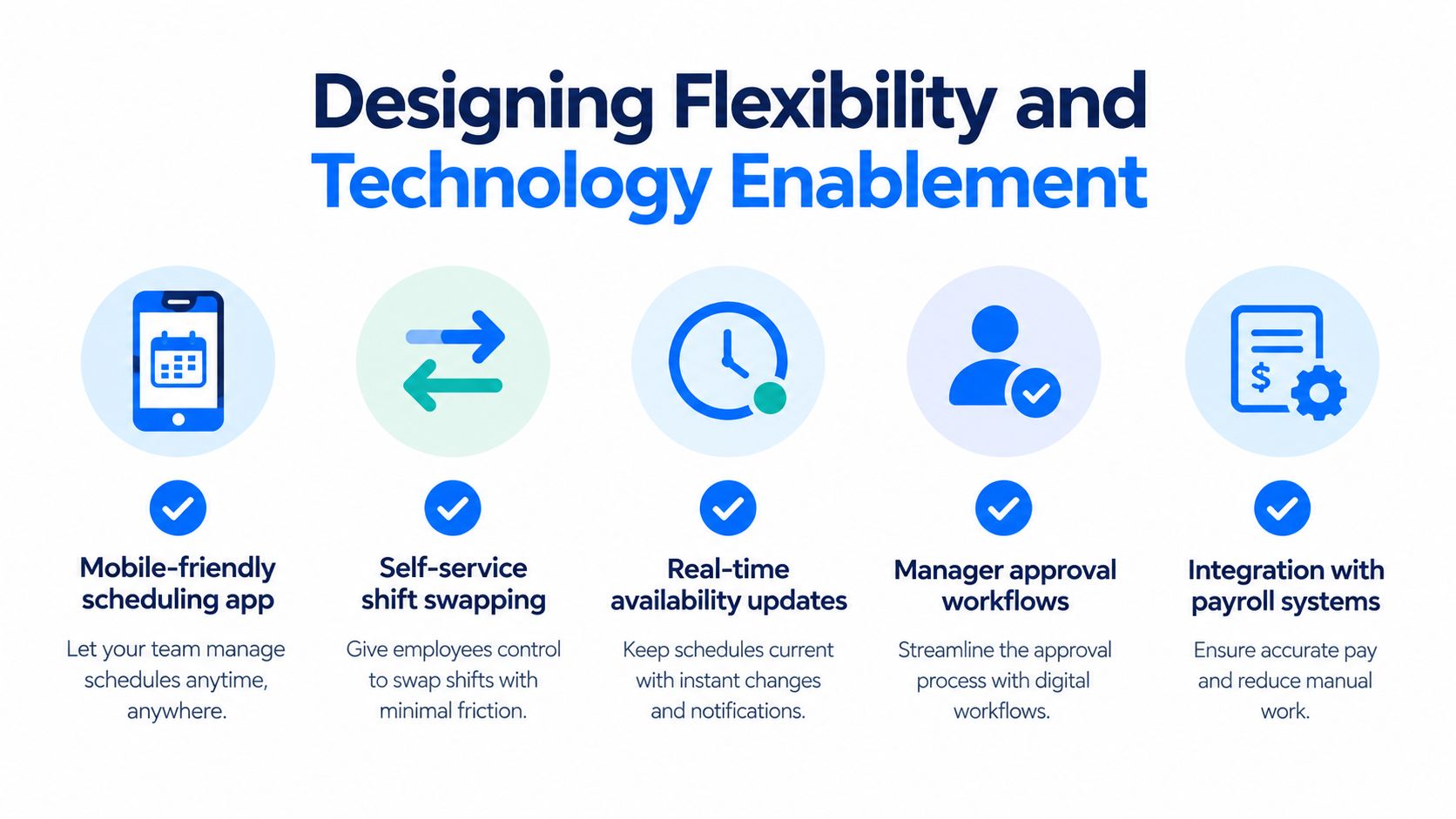
Flexibility becomes part of a frontline employee value proposition only when employees can act on it. A policy that asks managers to “be flexible” leaves the decision itself to individual supervisors. A workable offer defines how employees view schedules, update availability, request time off, swap shifts, report absences, and receive answers when the process fails. UK research found that 79% of frontline workers consider choosing shifts aligned with their skills and preferred hours highly important, rising to 87% among parents or employees with caregiving responsibilities. It also found that 73% considered flexibility apps relevant to their roles, and 71% said they would use such tools often if available. These findings appear in the 2025 Beekeeper Frontline Workforce Report.
Build schedule control into the workflow
Set the operating rules before selecting an app. Define which shifts employees may choose, how far ahead they can update availability, who approves swaps, how coverage risks are reviewed, and what happens when a request is declined. Employees should receive consistent consideration without needing a personal relationship with a supervisor.
A practical design sequence includes:
- Map the scheduling journey: Record availability, schedule publication, shift selection, swaps, time-off requests, absence reporting, and the payroll handoff.
- Remove duplicate entry: Connect workforce management with payroll so approved changes do not have to be entered again by a supervisor or administrator.
- Design for mobile use: Put schedules, procedures, safety alerts, training, and employee support on the device workers use during the day.
- Protect exceptions: Provide human escalation for disputes, urgent care needs, safety matters, pay questions, and situations the rules cannot resolve.
- Measure execution: Review schedule changes, approval time, missed notifications, payroll corrections, task completion, and adoption by site or shift.
Self-service can give employees more control, but it can also transfer administrative work to them. A worker should not need several disconnected apps to swap a shift, check a policy, confirm pay, and report an absence. Use Turn On Work’s employee experience strategy guidance to connect these activities into one workforce experience. The practical test is whether employees can understand the offer, access it, and see that the organization keeps its side of the exchange.
Specify the employee-facing service level
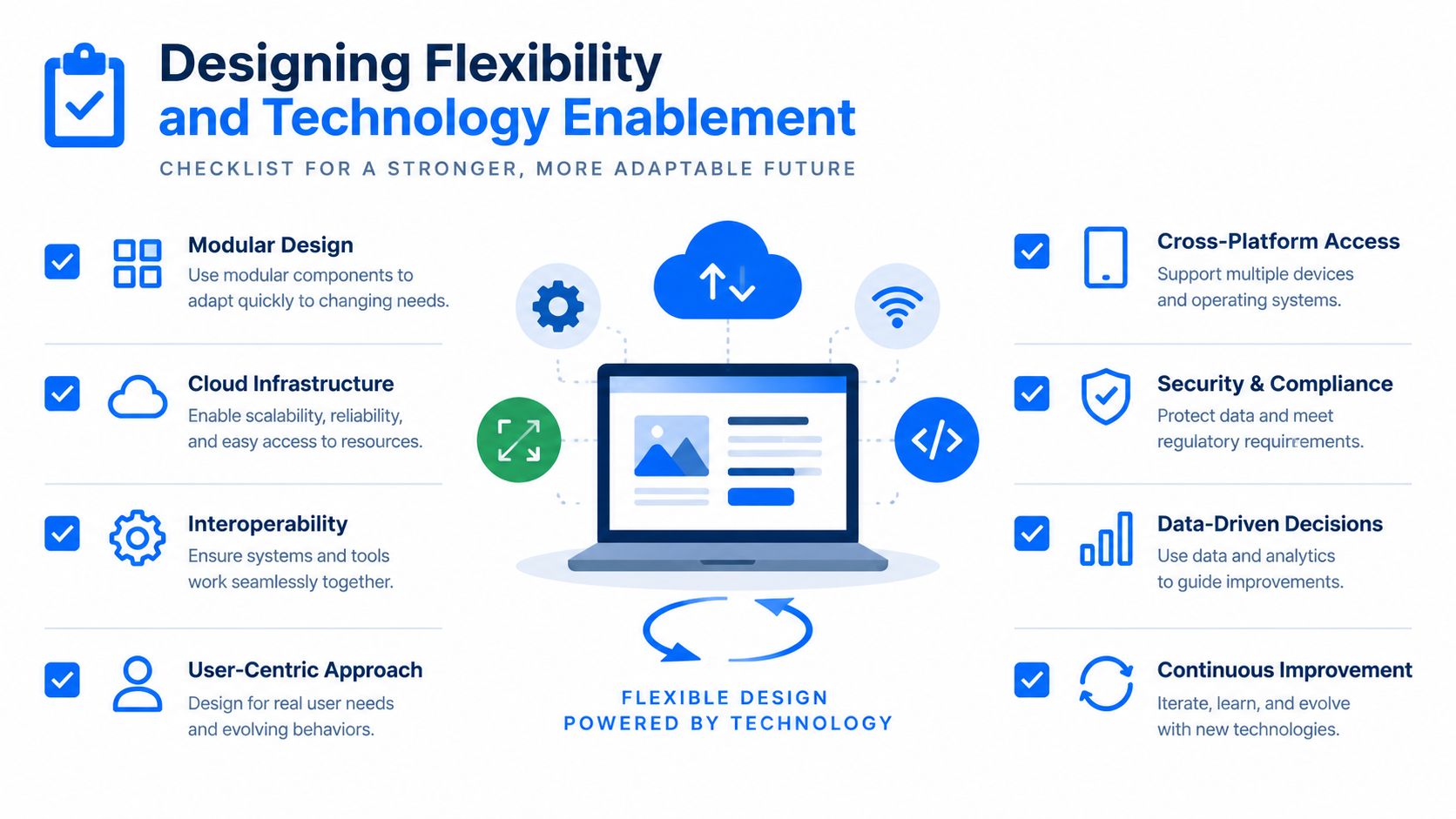
Treat technology access as part of the employment exchange. Set requirements for simple authentication, low-bandwidth access, offline capability where working conditions require it, multilingual support, accessibility, and integration with workforce-management and payroll systems. These requirements determine whether the promised flexibility survives contact with a busy shift.
Communication must accompany each operational action. A schedule change needs a clear notification and acknowledgment path. A safety update needs the relevant procedure or task. A benefits message needs an explanation of eligibility and a route to help. That turns frontline employee communication into work enablement rather than message distribution.
AI can reduce friction when its role is specific and controlled. UKG’s 2025 global research reported that 38% of frontline employees currently use AI at work, while 78% would trust AI for practical tasks, including searching the handbook, summarizing benefits, and managing schedules or availability. The same reporting cited Boston Consulting Group research in which only 25% of frontline workers said leadership had provided proper direction on AI use. The evidence is available through TechrSeries’ coverage of frontline AI and communication research.
Start with approved AI uses. Connect the assistant to trusted knowledge, explain what data it can access, train managers and workers, and retain human escalation for pay, leave, safety, and employment questions. Use Turn On Work’s frontline superapp selection guide to assess whether a platform supports communication and operations together. Track employee feedback through eNPS alongside operational measures, so the organization can see whether technology improves the daily employment experience or only adds another channel.
Measuring Engagement with Employee Net Promoter Score
Employee Net Promoter Score, or eNPS, measures whether employees would recommend their employer as a place to work. It can provide a simple directional signal for a frontline EVP, but it shouldn’t be treated as a complete engagement measure or as proof that the EVP works.
The calculation subtracts the share of detractors from the share of promoters. Neutral responses don’t increase either group. The result is useful only when leaders examine the reasons behind it, compare teams consistently, and connect feedback with operational evidence.
Use eNPS as a listening loop
For shift-based teams, survey design matters as much as the question. Offer mobile access, avoid requiring a desk or corporate login, translate where necessary, and collect responses across different shifts, sites, roles, and employment arrangements. Keep the invitation clear about confidentiality and explain what leaders will do with the answers.
Ask the recommendation question alongside targeted drivers such as:
- Schedule control: Can you plan your life around the hours you receive?
- Manager experience: Does your supervisor treat you fairly and recognize good work?
- Work enablement: Can you access the information and tools needed to perform?
- Pay confidence: Do you understand your pay and trust it to be accurate?
- Employee voice: Do leaders act on issues raised by frontline employees?
Don’t set a universal target without a baseline. The relationship between eNPS and retention depends on the workforce, labor market, role mix, manager quality, and operating conditions. For broader context on employee engagement and UK workplace data, HR Management 365’s workplace engagement coverage can complement your internal analysis.
Interpret movement, not a made-up ideal
| eNPS Score Range | Interpretation | Recommended Action |
|---|---|---|
| Below zero | More employees are detractors than promoters. This signals material trust or experience problems. | Segment the comments and identify the operational issues leaders can fix first. |
| Around zero | Positive and negative advocacy are broadly balanced. The EVP may be inconsistent across teams or moments. | Compare sites, shifts, roles, and managers, then prioritize one or two recurring causes. |
| Above zero | More employees recommend the organization than criticize it. This is an encouraging signal, not a guarantee of retention. | Protect the practices that support advocacy and test whether they correlate with operational outcomes. |
| Improving over time | Employee advocacy is moving in a positive direction. | Check whether the change follows specific actions, and verify it against retention and absence data. |
| Declining over time | The lived experience is deteriorating or confidence in leadership is falling. | Close the loop quickly, publish actions, and assign accountable owners. |
The most useful frontline employee engagement dashboard joins eNPS with 90-day retention, voluntary turnover, absenteeism, schedule changes, time-to-fill, payroll corrections, safety incidents, training completion, and manager-level results. Don’t claim that a higher score caused better retention. Use the data to identify relationships, investigate differences, and test whether an intervention changes both sentiment and operating outcomes.
A good feedback loop has four steps: listen, diagnose, act, and report back. Employees should hear what leaders learned, what will change, what can’t change yet, and when the organization will review progress. Turn On Work’s eNPS guidance for frontline teams offers a practical reference for building that loop.
Communicating the EVP to Deskless Workers
A frontline EVP fails at the point of use if employees cannot access it during a shift. Communication must reach workers through the tools they already use, then help them complete a task, make a choice, or get support. A 2025 report found that only 1% of company communicators believed they were reaching deskless or frontline employees effectively. More than half wanted greater control over their technology stack, while only 15% were satisfied with their current tools, according to TechrSeries’ report on the frontline communication gap.
Put the message beside the action
An email about benefits does little for confidence if a worker cannot find eligibility information while making a choice. Recognition messaging loses credibility when supervisors lack a quick way to acknowledge performance. A safety commitment becomes operationally weak when the alert arrives after the task has started.
Build communication around the employee’s next action:
- Hiring: Explain pay, scheduling expectations, benefits, progression, and working conditions in practical terms.
- Onboarding: Deliver training, procedures, contacts, and early check-ins through channels new hires can access.
- Scheduling: Pair roster updates with the reason for the change, an acknowledgment option, and a route for questions.
- Performance: Link feedback to specific behaviors, skills, recognition, and next steps.
- Change: Publish the policy update with the required task, deadline, manager explanation, and confirmation process.
- Exit: Record the reason for departure and send the insight to leaders who control the relevant process.
This is the difference between frontline employee communication and corporate broadcasting. Organizations can use frontline employee communication guidance to connect reach with action. A mobile message that produces a completed training task, an acknowledged policy, or an accepted schedule change matters more than an announcement that employees can see but cannot use.
Use AI without removing judgment
An AI assistant can help a worker search a handbook, understand benefits, check availability, or find a procedure. It should not make sensitive employment decisions or become the only route for resolving pay, safety, leave, or conduct concerns.
Show the answer, identify the source policy, and state when the information was last reviewed. Provide a clear human escalation route, especially for payroll corrections, safety reports, and leave questions. Managers also need guidance on what AI can and cannot handle. The operational goal is shorter search and waiting times while preserving accountability, privacy, and human judgment.
Common Mistakes in Frontline Workforce Strategy
The most common error is treating every hourly worker as one audience. A hospital support team, retail associate, delivery driver, manufacturing operator, contractor, franchise employee, supervisor, and unionized team may all be described as frontline, but their working realities and available choices differ.
A 2025 survey of 8,200 frontline employees found that work schedules were the leading retention factor after pay, while 45% said they would start looking for another job after two wage errors. The findings are reported in UKG’s 2025 frontline workforce research. A universal EVP that says “we offer flexibility” won’t answer how a particular employee selects shifts, reports a payroll problem, or gets support when a manager is unavailable.
The manager layer determines local credibility
Corporate leaders can approve a policy, but a frontline manager decides whether the schedule is changed, whether recognition is given, whether feedback is escalated, and whether a new tool is used. Managers often carry staffing, productivity, service, and compliance pressure at the same time. Asking them to deliver a richer EVP without authority, training, or staffing support creates another promise the organization can’t keep.
Use this practical checklist before launch:
- Segment the audience: Separate hourly employees, supervisors, contractors, franchisees, and unionized teams where their offers or constraints differ.
- Map the moments: Review hiring, onboarding, scheduling, absence, performance, promotion, pay, and exit.
- Test local authority: Identify which benefits a supervisor can approve and which require central intervention.
- Check access: Confirm that every worker can receive information, complete required actions, and request help without a desk.
- Close feedback loops: Assign owners for survey themes and publish actions back to each site or team.
- Audit the claim: Compare recruitment language with actual schedules, pay practices, tools, development, and manager behavior.
A useful Turn On Work editorial model is the Promise, Proof, Permission, and Performance test. Every EVP statement should have proof in the employee experience, permission for the local manager to deliver it, and a performance measure that shows whether the promise is holding. “We support flexibility” needs schedule data and a swap process. “We invest in growth” needs accessible training and visible progression. “We listen” needs a response record, not only a survey.
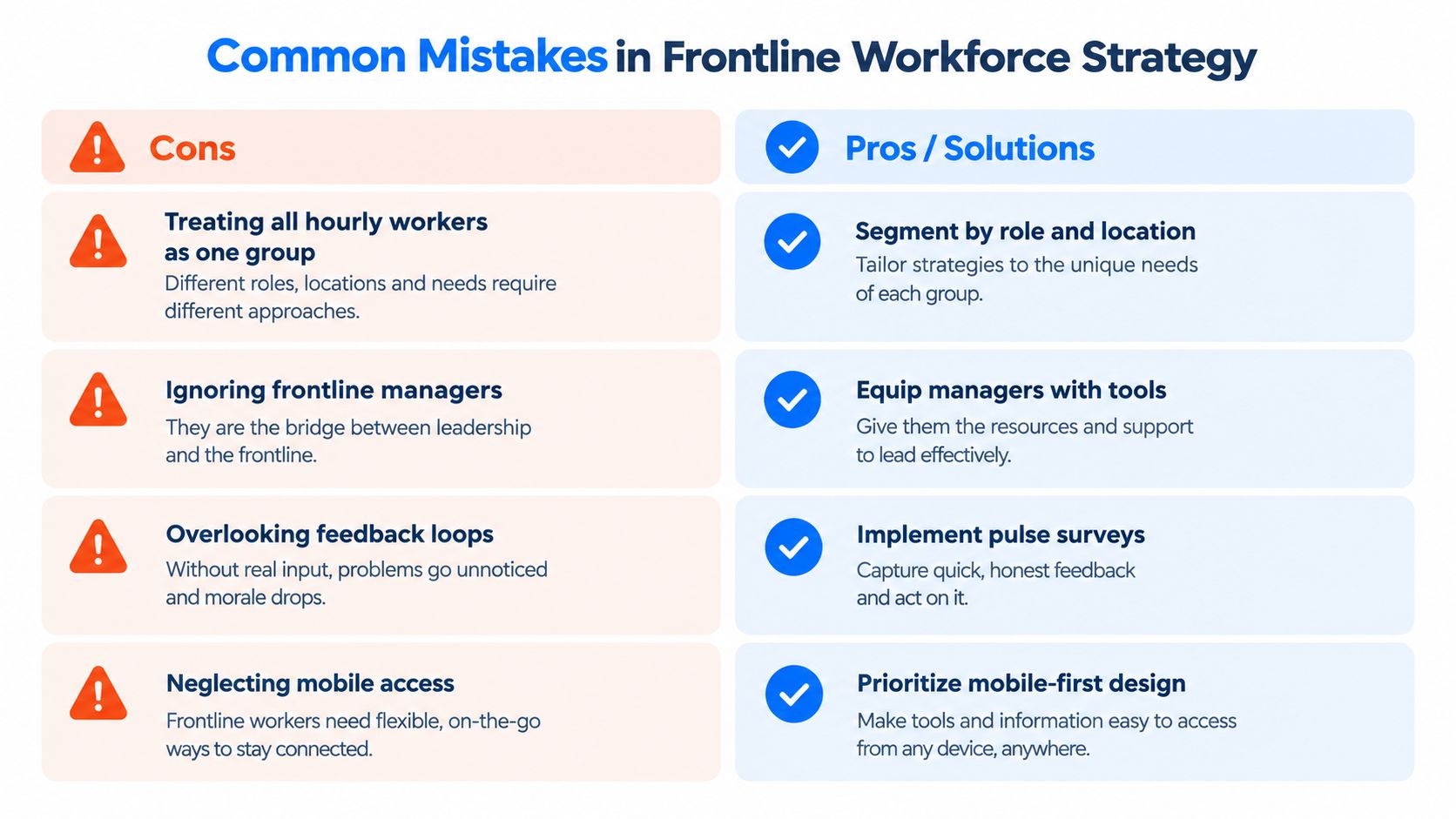
Don’t use technology to conceal a broken process. A scheduling app won’t create flexibility if managers reject every request. A pulse survey won’t create trust if leaders ignore the results. And an AI assistant won’t improve the frontline workforce employee experience if its knowledge is incomplete or its escalation path leads nowhere.
Frontline Employee Value Proposition FAQs
What is an employee value proposition for frontline workers?
It’s the complete employment exchange experienced by hourly, deskless, and field-based employees. It includes pay, frontline employee benefits, scheduling, safety, tools, manager behavior, recognition, development, communication, and employee voice. The promise is credible only when daily operations deliver it.
How do you create an EVP for frontline employees?
Start with employee research and an operational audit. Identify what different roles and locations value, document the current experience across hiring, scheduling, pay, work, development, and exit, then define a small set of promises with clear owners and proof points. Test the offer with frontline employees before publishing it.
What are useful employee value proposition examples for frontline workers?
Examples include predictable scheduling with self-service shift swaps, clear pay and premium explanations, mobile access to procedures and safety alerts, visible recognition, paid development pathways, and a reliable way to report problems. The best EVP strategy for hourly employees connects each promise to a process employees can use.
How should employers balance compensation and relational factors?
Make the economic exchange explicit first. The retail study cited earlier found that compensation and tangible benefits significantly influenced intention to stay in its sample. Then strengthen manager quality, recognition, psychological safety, development, and belonging so the offer remains sustainable in daily work.
How do you measure employee value proposition performance?
Use eNPS as a directional feedback loop, then segment the results by role, location, shift, tenure, and manager. Connect the findings with retention, absenteeism, payroll accuracy, schedule stability, safety, training, and offer acceptance. A higher sentiment score matters most when leaders can link it to actions and improved workforce outcomes.
The most defensible employee value proposition frontline strategy is operational before it is promotional. Audit what employees experience, make pay and scheduling credible, equip managers to deliver the promise, connect communication to work, and use eNPS to identify where reality diverges from the offer. Start with one frontline population, review its highest-friction moments, and publish a practical improvement plan with owners, measures, and a date for employee follow-up.
If your organization’s frontline EVP still lives mainly in job adverts, policy documents, or corporate intranets, begin an operational audit this month. Map the employee journey from hiring through exit, test mobile access to schedules and information, review payroll and manager pain points, and ask frontline teams which promise matters most on their next shift.