Frontline workers make up about 80% of the global workforce, yet only 14% report receiving training, while 86% want it. Frontline competency mapping bridges that gap by turning implicit skills into measurable, actionable capability data without requiring an LMS.
The surprising part is that many organizations don’t need more training content first. They need a clearer view of who can perform critical work, who needs coaching, which managers can validate capability, and whether employees can access the information required to do their jobs. A practical map connects employee engagement, internal communications, HR technology, AI, and workforce operations in one operating view.
What Frontline Competency Mapping Actually Solves
Frontline competency mapping is a structured process for identifying, measuring, and tracking the capabilities workers need to perform critical tasks safely and consistently. A useful map compares the capability a role requires with the proficiency a worker currently demonstrates. It can live in a spreadsheet, shared document, or operational platform. It doesn’t depend on an LMS.
The workforce gap behind this work is documented in Training Industry’s overview of skills mapping for frontline employees. The practical implication is straightforward. If frontline workers are visible only as job titles, leaders can’t reliably see who can operate equipment, follow a process, handle a customer issue, communicate a shift change, or coach a colleague.
A frontline competency framework makes those capabilities explicit. In retail, it might include product guidance, cash handling, stock control, conflict resolution, and opening procedures. In manufacturing, it might cover equipment use, quality checks, safety routines, process adherence, and escalation. The framework should describe observable work, not personality labels.

Key Takeaways
- Map work, not titles: Define the capabilities behind critical tasks, then link them to specific roles and operating conditions.
- Use evidence, not confidence: Combine manager observation, peer input, self-assessment, and operational records instead of relying on one opinion.
- Prioritize risk: A gap in a safety-critical task deserves attention before a gap in a lower-risk administrative skill.
- Treat communication as capability: A worker can’t perform consistently if policy changes, safety notices, or task instructions don’t reach them.
- Keep the map alive: Update it when processes, equipment, customer expectations, or technology change.
This reframing also changes how leaders think about employee experience. A worker who receives a schedule but can’t find the current procedure is poorly enabled. A worker who completes training but can’t use the knowledge during a shift is poorly enabled. A worker whose manager has no reliable way to validate progress is poorly supported.
Competency data can also improve hiring and internal mobility, provided it describes the work clearly. Organizations assessing candidates for customer-facing roles can use a structured approach such as assessing sales candidates at scale, then connect the evidence to the same capabilities used after hiring. That creates continuity between selection, onboarding, coaching, and deployment.
Practical rule: If a competency can’t be observed, discussed, or connected to a real task, it probably isn’t ready for a frontline map.
The map should also sit beside workforce metrics rather than inside a separate HR reporting process. Look at scheduling coverage, task completion, quality issues, safety observations, communication reach, and coaching activity together. Turnover matters here too, which is why the operational consequences described in the cost of employee turnover among frontline teams belong in the same conversation.
Why Static Skills Inventories Fail Frontline Teams
A static skills inventory answers, “Who has this skill?” A useful frontline capability model answers, “Who can perform this task, in this location, under current operating conditions, and what evidence supports that conclusion?”
That distinction matters because frontline work changes by shift, site, equipment, product mix, customer demand, and local process. A worker may be competent on one machine but not another. A retail associate may handle routine returns confidently but need support during an escalation. A care worker may understand a procedure in theory but still need observed practice in the local environment.
The inventory problem
A spreadsheet filled with employee names and skill labels creates false precision. It encourages managers to mark people as trained, qualified, or experienced without recording the task observed, the conditions involved, or the level of independence demonstrated.
Self-assessment has a place, especially for uncovering hidden experience and employee development goals. It shouldn’t be the only evidence. The strongest frontline skills assessment combines:
- Manager observation: A supervisor watches the employee complete the task using a consistent rubric.
- Peer input: Experienced colleagues identify practical strengths that may not appear in formal records.
- Operational evidence: Quality checks, task records, incident reviews, rework, customer feedback, or completed work provide context.
- Employee voice: The worker explains where instructions are unclear, where tools create friction, and which capabilities are being used outside the formal role.
A structured organized-retail study illustrates this approach by assessing personal, knowledge, job-related, communication, interpersonal, functional, and technical competencies through questionnaires completed by frontline workers. The study involved 200 workers and 176 valid responses, as described in the published competency-mapping research. The value of that structure isn’t the questionnaire itself. It’s the decision to define capability categories instead of asking managers to make broad judgments.
Rank gaps by operational risk
Frequency alone shouldn’t determine priority. A rarely used emergency procedure may deserve more attention than a frequently used low-risk task. Score each gap against three questions:
| Question | What to examine |
|---|---|
| What can go wrong? | Safety, quality, service, compliance, or continuity consequences |
| How often is the capability needed? | Every shift, occasional demand, seasonal work, or unusual event |
| How quickly can the gap be closed? | A short coaching session, supervised practice, or deeper redevelopment |
This is also why skills data should be connected to the broader workforce system. A useful skills inventory isn’t an end state. It should inform coaching, task allocation, scheduling coverage, and employee development. For a broader view of how capability data differs from a simple list of skills, see Turn On Work’s skills inventory assessment guide.
The practical alternative to a static inventory is a role-specific, on-shift capability model. It links each role to a manageable set of important capabilities, realistic situations, an observation method, and an operational signal. Readers exploring this distinction can also review Croft’s perspective on skills-based tools, particularly the argument for grounding skills data in actual work rather than abstract labels.
The Three-Stage Competency Mapping Framework
A reliable competency mapping process follows three stages: design the capability model, implement it in daily work, and evaluate whether it improves readiness and execution. This model is adapted from a healthcare frontline approach that built a role-neutral competency dictionary, mapped competencies to roles, and embedded training and assessment scaffolding for institutional use.
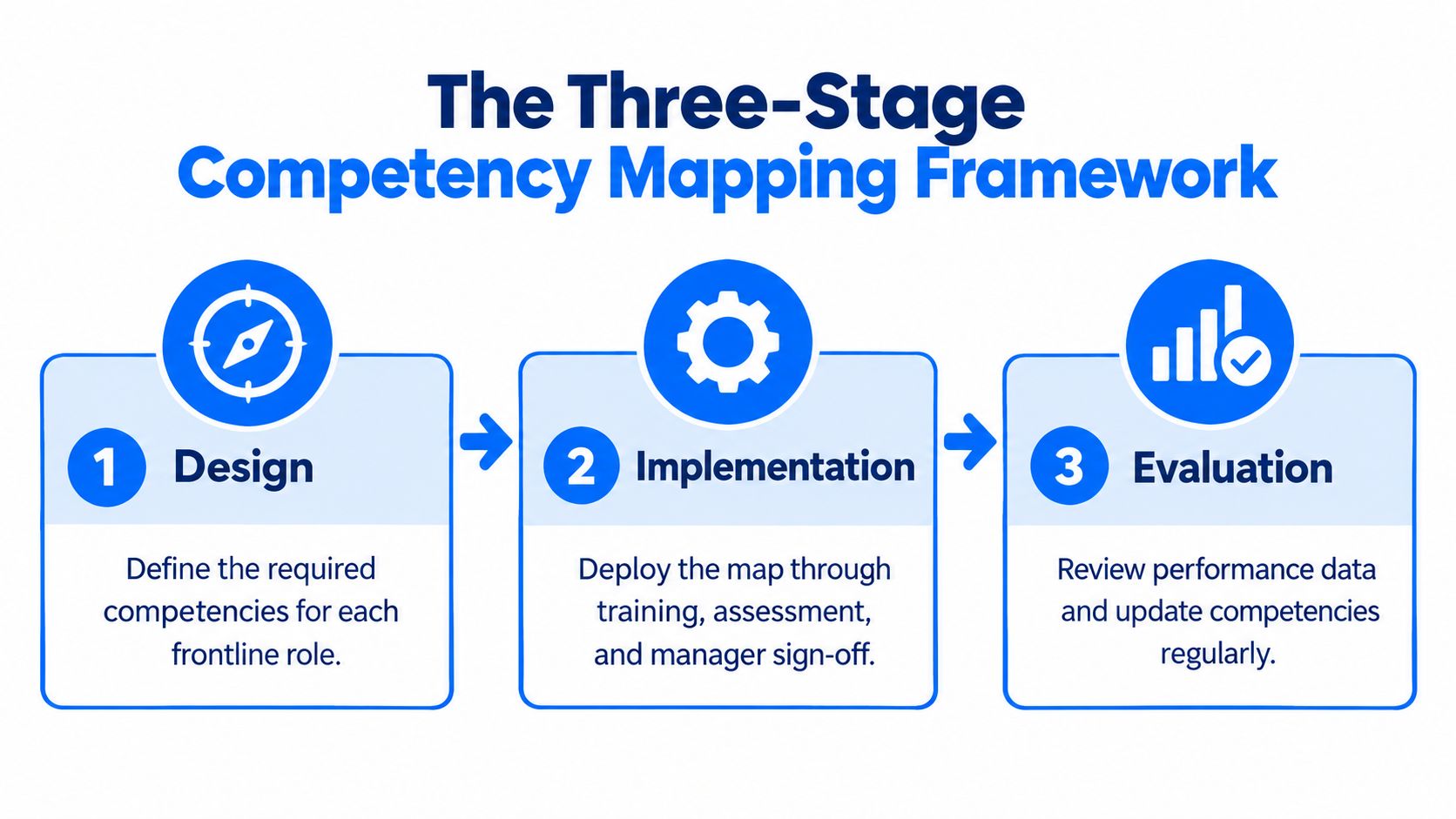
Stage one design the dictionary
Start with capabilities that appear across roles, then add domain-specific requirements. A practical dictionary usually includes:
- Functional skills: The task knowledge needed to complete core work.
- Behavioral skills: Communication, teamwork, adaptability, judgment, and escalation.
- Domain skills: Equipment, systems, products, clinical procedures, or production methods.
- Intervention skills: Coaching, incident response, handover, translation, or other capabilities needed in specific situations.
Write each competency as an observable action. “Good communicator” is too vague. “Explains a process change to the next shift, confirms understanding, and records unresolved questions” is assessable.
Use graded proficiency levels, but keep the descriptions practical. A simple model might distinguish exposure, assisted performance, independent performance, and coaching capability. These are editorial labels, not a universal standard. The right levels are the ones managers can apply consistently.
Stage two implement by role and location
Map required proficiency to each role, then compare it with current proficiency for each worker. Don’t stop at the enterprise level. Record differences across sites, floors, departments, brands, or production lines because local conditions can change what competence requires.
For every assessment, capture four fields:
- Capability: The skill or behavior being assessed.
- Required level: What the role demands in the relevant setting.
- Evidence: What the worker did, where, and under what conditions.
- Validation: Who observed or confirmed the evidence and when.
A manager sign-off should confirm an observation, not merely approve a status. If a worker can complete a machine setup independently but still needs help with fault escalation, record both facts. That level of detail makes the employee competency matrix useful for coaching and scheduling.
Stage three evaluate and refresh
Connect the map to training, practice, and review. A gap should produce an action, such as a demonstration, a shadow shift, a job aid, a supervised task, or a follow-up observation. The evaluation stage asks whether the action changed demonstrated capability and whether the operating signal improved.
That signal might be fewer process errors, more reliable handovers, better task completion, or stronger coverage for a critical shift. The map shouldn’t claim causation where the evidence doesn’t support it. It should help managers ask better operational questions.
A connected view of roles, skills, tasks, and knowledge can also support a broader work graph for frontline operations, especially when capability information needs to travel between people, processes, and systems.
Building Competency Maps Without an LMS
Competency mapping without an LMS works when the organization designs a disciplined evidence process before choosing a tool. A spreadsheet can store a useful matrix, but it can’t create clear definitions, consistent observation, or manager accountability by itself.
A lightweight setup can use a shared spreadsheet, a role sheet, a mobile-friendly observation form, and a folder of current procedures. Each row represents a worker and each capability has separate columns for required level, current level, evidence date, validator, development action, and review status. Protect the master structure, limit editing rights, and give managers a simple way to record evidence during or immediately after a shift.
Compare the operating choices
| Approach | Strength | Trade-off | Best fit |
|---|---|---|---|
| Spreadsheet and shared forms | Fast to launch and easy to adapt | Requires governance, version control, and manual follow-up | A pilot, small team, or budget-constrained site |
| Existing HR or operations tools | May connect skills with people and scheduling data | Configuration and adoption can be uneven | Organizations with usable systems already in place |
| Dedicated skills platform | Stronger workflows, permissions, reporting, and refresh cycles | Requires budget, implementation work, and user adoption | Distributed operations with complex governance |
A spreadsheet competency tracking process should distinguish required versus current proficiency at the individual, location, and brand level. It should also show when a record was last validated. An annual review alone won’t keep the picture accurate when procedures, automation, equipment, and customer expectations change.
Use the smallest workable workflow
Start with one role and a small set of high-risk capabilities. Ask a manager to observe the work, record evidence in plain language, and discuss the result with the employee. Let the worker add context or challenge an inaccurate assessment, but keep final validation tied to evidence and an accountable manager.
The four operational pillars matter here: scheduling, task management, training and learning, and communications. A frontline role isn’t fully enabled if the worker has the right skill but can’t receive the schedule, find the task, access the current instruction, or hear the change that affects the work. Research summarized in the WorkJam and Forrester frontline workforce report connects these pillars with frontline operational maturity and workforce outcomes.
An internal knowledge base can provide the procedure layer that a skills matrix lacks. For practical guidance on structuring that information, see Turn On Work’s internal knowledge base resource. The important design choice is to place knowledge where work happens, rather than expecting a worker to search through a separate repository after the task has begun.
Integrating AI Literacy and Communication Access
AI literacy belongs in a frontline competency map by use case, not as a generic digital skill. A worker may know how to use AI for knowledge lookup but not for translation, scheduling support, or task guidance. Managers should validate the specific workflow and the judgment required around it.
A 2025 UKG and Workplace Intelligence study reported that 38% of frontline employees were using AI in their roles, compared with 31% in 2024, and that 53% believed their employer was preparing them properly for an AI-driven workplace. The report also found that frontline employees using AI reported lower burnout, 41% compared with 54% for those not using AI. These figures come from the UKG and Workplace Intelligence report on AI and the frontline workforce.
The operational lesson isn’t to add an AI course to every role. Map the actual behavior:
- Knowledge lookup: Finds the current procedure, checks the source, and applies the instruction to the task.
- Scheduling support: Uses an approved tool to understand availability or shift information without overriding manager judgment.
- Translation: Uses translation support appropriately, then confirms meaning where safety or service quality is involved.
- Task guidance: Follows generated assistance while recognizing when a human escalation is required.
Human judgment remains a competency. AI can reduce search and repetition, but the employee still needs to recognize uncertainty, protect sensitive information, and escalate decisions that exceed the tool’s authority.
Treat communication access as an operating capability
Organizations can improve this communication layer by using an employee communication platform such as HubEngage, which helps organizations reach frontline employees across multiple communication channels.
A technically capable worker can still fail when essential information doesn’t reach them. Microsoft survey data cited in industry coverage reports that 63% of frontline workers and almost 70% of frontline managers say leadership messages don’t make it to them, as documented in the Frontline Workers report.
Add communication access to the map. Assess whether a worker can receive a critical update, identify the current version of a procedure, confirm that a manager has interpreted the change, and raise a question through a reliable channel. Separate communications that must be pushed, such as urgent safety notices, from information that belongs inside the workflow, such as a revised task instruction.
Workforce experience becomes an operating discipline here. A tool such as Turn On Work’s practical AI use cases for HR can inform the technology discussion, but the competency map should remain grounded in what workers and managers must do during real work.
Common Mistakes and How to Avoid Them
The most common mistake is treating the map as a finished document. Frontline competency mapping should behave more like a controlled operating record. It needs an owner, a validation method, a refresh trigger, and a clear response when a gap appears.
Mistake one: relying on self-assessment alone
Self-assessment reveals confidence, experience, and development interests. It doesn’t prove independent performance. Pair it with manager observation and, where appropriate, peer input or operational evidence.
Use a competency assessment rubric with behavioral anchors. For example, an employee at an assisted level may complete a stock transfer with prompts. An independently capable employee completes it accurately, follows the local process, and handles a normal exception. A worker ready to coach others can explain the reasoning, spot a common error, and intervene safely.
Mistake two: using generic competencies
“Teamwork,” “ownership,” and “digital skills” can belong in a framework, but they aren’t enough for a retail employee, manufacturing operator, healthcare worker, or field service technician. Add the context that makes the capability observable.
A retail employee may need to resolve a return while protecting the customer relationship and following the approval path. A manufacturing worker may need to identify an abnormal machine condition and stop or escalate according to the process. A healthcare frontline worker may need to combine functional, behavioral, domain-specific, and intervention skills. A field service employee may need to diagnose a problem, explain the next step, and document the visit accurately.
Mistake three: refreshing only annually
Refresh the map when a process changes, a new tool is introduced, an incident reveals a gap, a site has a recurring quality issue, or a manager sees a new capability being used. Regular review doesn’t mean reassessing every employee constantly. It means keeping role requirements and evidence current enough to support decisions.
Mistake four: ignoring manager calibration
Two managers may apply the same proficiency label differently. Run short calibration sessions using the same scenario, evidence examples, and rubric. Compare decisions, discuss the difference, and clarify what counts as independent performance.
Finally, don’t use the map only for reporting. Give employees a visible development action and give managers a specific coaching responsibility. If the record doesn’t change scheduling, coaching, knowledge access, or task support, workers will experience it as another administrative exercise.
Your Implementation Checklist and Next Steps
Start small, but design for operational use from the first record. A frontline competency map becomes valuable when a manager can use it to make a safer assignment, target a coaching conversation, improve shift coverage, or place current instructions beside the task.
Launch the first map
- Choose one operational role: Select a role with meaningful safety, service, quality, or coverage implications.
- List critical capabilities: Describe the work in observable terms, including technical, behavioral, communication, and tool-related capabilities.
- Set practical proficiency levels: Define what exposure, assisted performance, independent performance, and coaching readiness look like.
- Create the evidence fields: Capture the observed task, context, date, validator, current level, required level, and next action.
- Pilot with managers: Ask managers to assess real work, compare interpretations, and refine unclear descriptions.
- Discuss results with employees: Let workers add evidence, identify barriers, and choose a realistic development action.
- Connect the action to operations: Use the result in coaching, scheduling, task guidance, knowledge access, or peer support.
- Set refresh triggers: Review records after process changes, new technology, incidents, or recurring performance problems.
Choose the right level of tooling
A small team can begin with a spreadsheet and shared form. A distributed organization may need stronger permissions, workflow controls, mobile access, and connections to scheduling or task systems. The decision should follow operational complexity, not software fashion.
Use the TurnOnWork operational capability model as an editorial framework for checking four dependencies: Can employees receive the schedule? Can they find and complete the task? Can they learn or refresh the capability? Can they receive and confirm important communications? A gap in any one of these areas can make an apparently competent worker less effective.
The first useful output isn’t a polished dashboard. It’s a trusted list of capabilities, evidence, risks, and actions that a manager can use during the next shift. Build that trust, then expand the map across sites, roles, and brands.
If your organization still tracks frontline skills through informal conversations or disconnected spreadsheets, choose one role this week and build a small evidence-based map. Define the critical tasks, ask managers to validate current proficiency, and connect every gap to a specific coaching or workflow action. That is how frontline competency mapping becomes a workforce operations capability rather than another HR file.