The week before peak demand, the floor is already noisy, the phones are ringing, and the new hires are still learning where the scanner lives. Seasonal employee onboarding works when it gives temporary workers just enough structure to become safe, useful, and confident within two weeks. The best plans compress compliance, role practice, manager check-ins, and communication into a tight daily rhythm, while keeping the work simple enough for frontline teams to repeat across shifts and locations.
Key takeaways
- Two weeks can work if you focus on role readiness, not broad culture training.
- Managers need a script and a schedule, or onboarding slips when the rush starts.
- Micro-learning plus hands-on practice is often better than long classroom sessions.
- Cohorts help at scale, but only if local managers can still tailor the work.
- The day-14 exit criteria should be written on day 1, so everyone knows what “ready” means.
1. The Compressed Onboarding Sprint
A two-week sprint works when you treat seasonal employee onboarding as a sequence of daily milestones, not a loose orientation. The goal is simple, get each hire to a safe first shift, then to repeatable performance, without flooding them with everything at once.
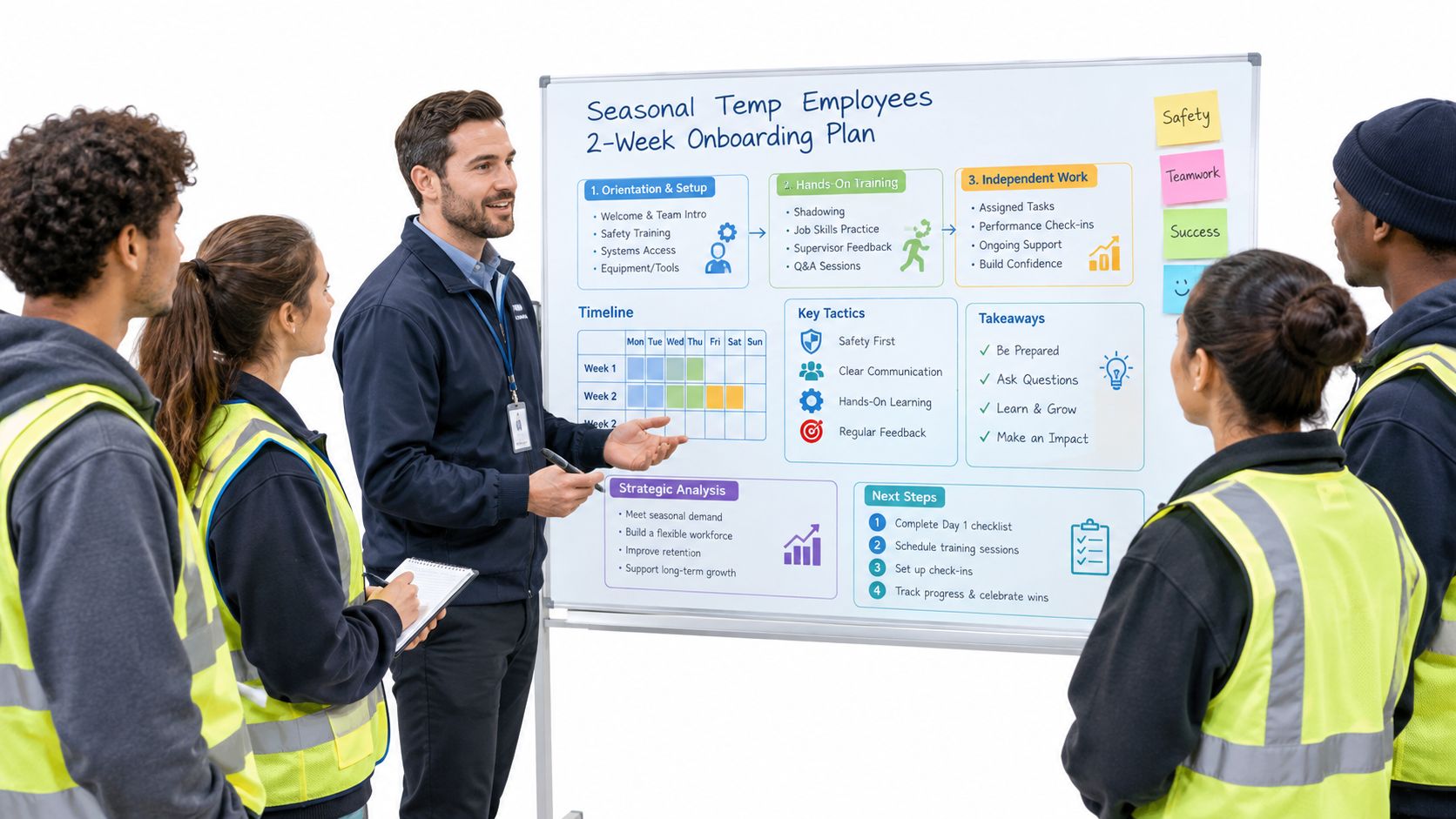
One useful way to think about it is a Turn On Work two-week operating model. Day 1 covers identity, schedule, policies, and system access. Days 2 to 5 focus on the small set of tasks that make the first shift possible. Days 6 to 10 move into supervised repetition. Days 11 to 14 confirm independence, with a manager sign-off on the skills that matter most for the role.
The best teams build communication into the sprint. That means daily huddles, short mobile reminders, and a visible progress path so nobody has to guess what comes next. In a retail setting, that might mean a cashier sees a short flash card in the internal app before each shift, while HR pre-loads tax forms and managers run 15-minute check-ins to catch gaps early. The same logic fits warehouse and hospitality roles, where a tight, repeatable cadence reduces confusion during peak season.
Platforms like HubEngage’s employee communication app help frontline teams stay connected through mobile updates, announcements, and team messaging, making communication easier during seasonal onboarding
Practical rule: If a task can’t be explained, observed, and confirmed within the first two weeks, it probably isn’t part of minimum viable first-shift readiness.
What makes the sprint work
The first mistake is trying to make the two weeks feel like a full-time classroom course. That usually creates fatigue and leaves managers with a stack of unfinished follow-up. A better approach is to define a few role-critical outputs and build the schedule backward from them.
- Pre-load systems early: Test mobile access, data sync, and HR workflows before hiring starts.
- Time-box buddy support: Give peers a clear role, a start date, and a finish date.
- Write the finish line: Share Day 14 exit criteria on Day 1.
- Plan catch-up paths: If someone misses a day, give them a prorated catch-up route instead of skipping content.
- Track misses in the system: Use HRIS alerts so managers don’t have to spot every gap manually.
For a deeper employee-experience lens on the first stretch after hire, see Turn On Work’s first 90 days perspective.
2. The Cohort-Based Wave Model
A cohort model works best when you’re onboarding 50 or more seasonal hires and need consistency across sites. It starts with a centralized kick-off, then shifts execution to local managers so people learn the actual job in the place where they’ll do it.
This model fits retail chains, multi-site hospitality groups, and distributed operations where managers need one shared standard. The strength is alignment. Everyone hears the same policy language, the same pay and schedule rules, and the same expectations for escalation. The risk is fatigue if the opening session drags on too long or tries to cover every role in one room.
A better version uses a short, centralized launch, then role-based breakouts and local follow-through. The kick-off should be tight, clear, and mobile-friendly. Send pre-work a few days ahead so the first day is less about setup and more about confirmation. Then use regional coaches or onboarding champions to support local managers who are responsible for the actual floor training.
A cohort event should create belonging, not replace the manager.
Communication matters more than the format itself. A private group space for the cohort helps new hires ask questions without slowing down the class. It also gives supervisors a live view of recurring confusion, which can be turned into better FAQs or a better checklist for the next wave.
An example of the mindset is the kind of frontline focus discussed in Turn On Work’s guide to employee onboarding experience for frontline teams, where the point is less about ceremony and more about execution.
Where wave onboarding breaks down
The model fails when the central session tries to carry all the weight. If every policy, task, and exception lands on day one, people leave with information but not competence. It also fails when local managers don’t get a clean handoff from HR.
Use the wave model when you need shared messaging, standardized compliance, and visibility across sites. Don’t use it as a substitute for hands-on training. The best result comes from a short central event, then location-level practice that reflects the actual shift pattern, customer flow, and equipment in each unit.
3. The Hybrid Micro-Learning and Hands-On Model
The fastest way to build usable skill is to put short learning right before the task and then follow it with supervised practice. That’s the logic behind a hybrid micro-learning model for temporary employee onboarding. It works especially well for deskless teams because it respects shift pressure and keeps the learner close to the actual work.
This model is strong when attention is limited. Three- to five-minute videos, short quizzes, and role playlists in a mobile app keep the content manageable. Then the employee moves straight to a station, a register, a picker path, or a service task, where a trainer or buddy watches the first attempt and corrects the miss before it becomes habit.
The media works best when it’s simple. Use plain language, subtitles, and visual steps. In noisy or fast-moving environments, the employee should be able to glance at the screen, confirm the next action, and keep going. That matters for front-line work where long explanations often get lost in the pace of the shift.
A micro-learning platform approach for frontline teams makes sense here because it supports short, repeatable learning bursts instead of one long intake session. The point isn’t fancy content. It’s timing, access, and consistency.
How the station-based version works
The station version works best when each task has a named owner. A cashier station, a stock room process, or a kitchen prep step should have a checklist, a trainer, and a clear sign-off process. If the employee can explain the step back in their own words, you’ve got a better signal than a timestamp alone.
Use this model when operational flow changes often. It’s a strong fit for retail seasonal employee onboarding, warehouse seasonal worker onboarding, and hospitality teams where one trainer can support several hires in a shift. It also reduces the classroom burden on managers who don’t have time for long group sessions.
Keep the learning close to the floor. If the task happens at the register, train at the register.
A core trade-off is speed versus depth. This model is fast, but it only works if the videos stay current and the station checklists don’t drift. Version control matters. So does quarterly review of the content library, because a stale clip can create more confusion than no clip at all.
4. The Manager-Owned Accountability Model
The strongest onboarding plans often fail for one reason, the manager isn’t owning them. A manager-owned model fixes that by giving frontline leaders a playbook, weekly competency tracking, and an escalation path when someone falls behind.
This is the model to choose when your site leaders are capable, your job steps are stable, and your operation needs accountability more than creativity. It works because it ties onboarding to the daily reality of the shift. The manager sees the gaps, the coach sees the trend, and HR sees the pattern across locations.
The best version uses role-mapped playbooks. A new hire should not receive a generic onboarding bundle if the job has clear differences by station, shift, or location. The playbook should spell out what “good” looks like, what gets checked on each day, and what gets escalated if the hire misses a step.
The internal structure matters too. If district leaders only see completion, they miss the more useful signal, which is whether the employee can do the work without help. That’s why the frontline competency mapping approach is useful. It ties role expectations to observable behavior, not just attendance at training.
What managers need to own
Managers need fewer tasks, not more tasks. They need a short checklist, a weekly review rhythm, and an escalation path that doesn’t require chasing five different systems. When they have that, they can focus on coaching instead of paperwork.
- Daily observation: Watch one task at a time.
- Weekly review: Confirm which skills are done, shaky, or missing.
- Escalation trigger: Route repeated misses to HR or a regional coach.
- Shared notes: Keep one visible record for the manager and support team.
The danger is overload. If managers are already covering scheduling, customer issues, and labor gaps, onboarding becomes the first thing they rush. This model works only if the organization trims other friction, gives them a dashboard, and lets them spend time where it matters, on the floor with the employee.
5. Aggregated Implementation Guidance and Notable Patterns
The best seasonal programs borrow from all four models, but they don’t mix them randomly. The pattern that works is clear. Use a short cohort launch for scale, micro-learning for timing, manager-owned playbooks for accountability, and a two-week sprint to define the finish line.
That combination fits seasonal workforce management because it balances speed and support. It also gives internal communications a real job. Messages can reinforce the daily priority, remind people where to go next, and make the work feel coordinated instead of chaotic. That’s the difference between a pile of tasks and a usable employee experience.
Turn On Work’s editorial model would put communication, employee engagement, technology, AI, and operations in the same workflow. The point isn’t to automate everything. The point is to reduce confusion, shorten time to productivity, and give managers a system they can use under pressure.
A few practical patterns show up again and again in strong onboarding plans:
- Use short content first: Keep modules brief, focused, and mobile-friendly.
- Protect manager time: Give supervisors a script and a cadence, not a blank page.
- Design for noise and motion: Assume the employee is learning on the floor, not in a quiet room.
- Make progress visible: Use dashboards, status flags, and checklists everyone can see.
- Plan for missed days: Build catch-up routes into the process from the start.
For a broader technology view, see Turn On Work’s comparison of onboarding software for frontline and deskless teams. The right system usually isn’t the one with the most features. It’s the one that makes the manager’s job simpler and the employee’s next step obvious.
The common mistake is overinvesting in generic orientation and underinvesting in role-specific readiness. Another is treating seasonal work as disposable, which usually weakens return intent and puts more pressure on the next hiring cycle. A better approach is to use the first season to capture preference data, note performance patterns, and keep the relationship warm for the next round.
Seasonal Employee Onboarding, 5-Model Comparison
| Model | 🔄 Implementation complexity | ⚡ Resource requirements | 📊 Expected outcomes | 💡 Ideal use cases | ⭐ Key advantages |
|---|---|---|---|---|---|
| The Compressed Onboarding Sprint (14‑Day Role‑Focused) | High, tight 14‑day cadence; HRIS/LMS integrations needed | Moderate–High, mobile LMS, automation, buddies, manager time | Fast time‑to‑productivity (5–7 days); measurable daily milestones | High‑volume seasonal frontline roles (retail, QSR, warehouses) | Rapid ramp, strong compliance, mobile‑first engagement |
| The Cohort‑Based Wave Model (Synchronized 50+ Hires) | Medium‑High, centralized kickoffs and cross‑site coordination | High, event logistics, centralized content, dashboards | Consistent, scalable compliance; stronger cohort identity | Large batch hires across regions; multi‑location seasonal rollouts | Scale efficiency, centralized tracking, consistent brand experience |
| Hybrid Micro‑Learning + Hands‑On Model | Medium, content sequencing + station scheduling | Moderate–High, short‑form video production, training stations, app | High retention and faster skill transfer for task work | Task‑based frontline roles needing just‑in‑time skill practice | Better retention, lower classroom costs, just‑in‑time delivery |
| Manager‑Owned Accountability Model (Playbooks + KPIs) | Low–Medium, process depends on manager capability | Low–Moderate, playbooks, dashboards, manager time | Improved local consistency; earlier interventions for at‑risk hires | Distributed sites with capable managers or limited tech access | Manager ownership, resilient to outages, stronger manager‑hire bonds |
| Aggregated Implementation Guidance & Notable Patterns | Variable, synthesis requires tailoring to context | Variable, draws on combinations of tech, people, content | Balanced outcomes when models are combined; fewer common pitfalls | Design phase for operations choosing or blending approaches | Actionable tips, common pitfalls, cross‑model best practices |
Matching an Onboarding Model to Your Peak-Season Reality
The right seasonal employee onboarding model depends on three things, site count, manager capacity, and content readiness. If you have many locations and strong central HR support, the cohort-based wave model gives you consistency. If your work changes fast and tasks are easy to demonstrate, the hybrid micro-learning model usually gets people productive sooner. If your managers are strong operators, the manager-owned model creates the most accountability. If you need to compress the whole ramp into 14 days, the sprint model gives you the cleanest finish line.
The biggest mistake is choosing a model based on software alone. Technology helps, but it won’t fix a weak workflow, a vague checklist, or a manager who never checks in. The right plan starts with operational reality, then chooses the communication cadence, the learning format, and the tracking method that fit the site.
Use this decision lens this week. Pick one model, test the tools and mobile access before the first hire starts, and write the Day 14 exit criteria in advance. If your team needs a practical publishing and operations lens on the issue, Turn On Work is built around that intersection of communication, engagement, technology, AI, and frontline execution.
FAQs on Seasonal Employee Onboarding
What is seasonal employee onboarding?
It’s the process of getting temporary hires ready to work safely and productively during a short peak period. Good onboarding covers access, scheduling, role training, communication, and manager check-ins, not just forms.
How do you onboard seasonal workers quickly?
Focus on the tasks they must perform in the first shift, then use short, role-specific training with hands-on practice. A two-week plan works best when managers have a checklist and the employee has visible day-by-day milestones.
What should be in a seasonal employee onboarding checklist?
The checklist should include identity and system access, pay and schedule setup, safety and compliance steps, role-specific training, a buddy or trainer assignment, and a clear Day 14 readiness review.
How is seasonal employee onboarding different from permanent onboarding?
Seasonal onboarding is more compressed and more operational. It prioritizes first-shift readiness, clear scheduling, and task competence, while permanent onboarding can spend more time on broader development and long-term culture.
What are the biggest mistakes to avoid?
The biggest mistakes are overloading day one, leaving managers without a playbook, and assuming completion equals competence. Another common miss is skipping communication after the hire starts, which leaves people guessing about shifts, expectations, and support.