
Key takeaways
-
A complete handover transfers responsibility, not just information. Employees need to understand the current situation, outstanding work, operational risks, and actions they are expected to take.
-
The most reliable format combines documentation with conversation. Written or digital records preserve details, while verbal discussions allow employees to clarify uncertainties and confirm priorities.
-
Standardized templates reduce ambiguity. A useful shift handover template captures equipment or service status, safety concerns, unresolved issues, assigned owners, deadlines, and receiving-team acknowledgment.
-
Common failures are often accountability failures. Missing ownership, vague instructions, outdated records, and unconfirmed handoffs can leave important tasks unattended even when messages have been delivered.
-
Digital tools improve visibility when the underlying process is sound. Centralized logs, alerts, and issue tracking can support multiple shifts and locations, but software cannot replace human judgment or required safety procedures.
What Is Shift Handover Communication, and Why Does It Matter?
Shift handover communication is the process of transferring essential information, operational context, and accountability from employees finishing a shift to those taking over. It creates continuity when the people responsible for a workplace, production process, service operation, or patient population change.
A good handover allows incoming employees to understand the situation without having to reconstruct the previous shift through scattered messages, incomplete records, or conversations with people who have already left.
Consider a manufacturing facility where the evening shift discovers an intermittent fault on a packaging machine. Maintenance inspects the equipment but cannot complete the repair before the night shift begins. If the next team receives only a general update saying that the machine had problems earlier, employees may not know whether it is safe to operate, which restrictions remain in place, or who is responsible for the next inspection.
The handover needs to distinguish what happened from what remains true and what must happen next.
The UK Health and Safety Executive’s guidance on shift handover identifies three essential activities: preparation by outgoing personnel, communication between outgoing and incoming teams, and cross-checking by incoming personnel. Although developed in a UK safety context, these principles are useful for US employers designing operational handovers.
Shift handover, shift reports, and shift logs are not the same
These terms are frequently used interchangeably, but they serve different purposes.
| Document or activity | Primary purpose | Typical content |
|---|---|---|
| Shift handover | Transfer operational context and responsibility | Current risks, priorities, outstanding work, ownership, acknowledgment |
| Shift handover report | Summarize what the outgoing team needs to communicate | Completed activities, exceptions, equipment status, unresolved issues |
| Shift handover log | Maintain a chronological record | Timestamped events, incidents, observations, actions |
| Shift handover checklist | Verify that required topics have been addressed | Safety, staffing, equipment, outstanding tasks, confirmation |
| End of shift report | Record what happened during the completed shift | Work completed, productivity, incidents, staffing, results |
An end of shift report may show that a maintenance request was submitted. The handover must establish whether the next team needs to monitor the equipment, who will follow up with maintenance, and whether the receiving supervisor has accepted responsibility.
That difference matters particularly for frontline and deskless teams, where employees may not share a workspace, attend the same meetings, or have access to the same communication systems.
Which Shift Handover Format Works Best?
The best shift handover format combines a consistent record with a communication method appropriate to the operational risk. Verbal, paper-based, and digital formats each have strengths, but none should be selected solely because it is convenient for managers.
| Handover format | Advantages | Limitations | Best fit |
|---|---|---|---|
| Verbal briefing | Immediate clarification, questions, and context | No reliable record unless documented; information can be forgotten | Small teams, urgent updates, direct supervisor handoffs |
| Paper handover form | Simple, familiar, works without connectivity | Difficult to search, share across locations, or track unresolved items | Small operations and environments with limited technology access |
| Shared spreadsheet or document | Low setup complexity, consistent fields, shared history | Version conflicts, manual tracking, inconsistent permissions | Teams with predictable workflows and modest handover volume |
| Digital shift handover system | Searchable records, assignments, timestamps, reminders, possible integrations | Requires reliable access, configuration, training, and governance | Multi-shift, multi-location, or complex operations |
| Hybrid written and verbal handover | Combines persistent records with two-way confirmation | Requires planned overlap and consistent execution | Safety-sensitive operations and complex frontline environments |
Why verbal handovers are still necessary
A written report can state that production is behind schedule. A conversation can explain that the delay is connected to a recurring equipment issue, that a temporary operating restriction remains active, and that a specialist has been contacted.
This context is difficult to replace with a checklist alone.
Verbal communication also allows the receiving employee to question information that appears inconsistent. For example, a warehouse supervisor may notice that an incident is marked resolved even though a restricted-access area remains closed.
The objective is not to hold lengthy meetings for every routine shift. It is to reserve direct conversation for information where misunderstanding could affect safety, service continuity, or operational decisions.
Why documentation is equally important
Verbal briefings become less reliable when employees are distracted, when shifts do not overlap, or when several people need access to the same information.
A consistent written or digital record preserves the operational status at the point of transfer. It also makes outstanding work visible beyond the two people involved in the conversation.
The strongest approach is therefore not verbal versus written communication. It is determining which information must be recorded, which information requires discussion, and how the organization confirms that the next team understands its responsibilities.
What Should a Shift Handover Template Include?
A useful shift handover template should capture the current operational state, significant changes, unresolved issues, immediate priorities, and an identifiable transfer of responsibility.
The form should be specific enough to support decisions without requiring employees to write a detailed account of every routine activity.
Copyable shift handover report template
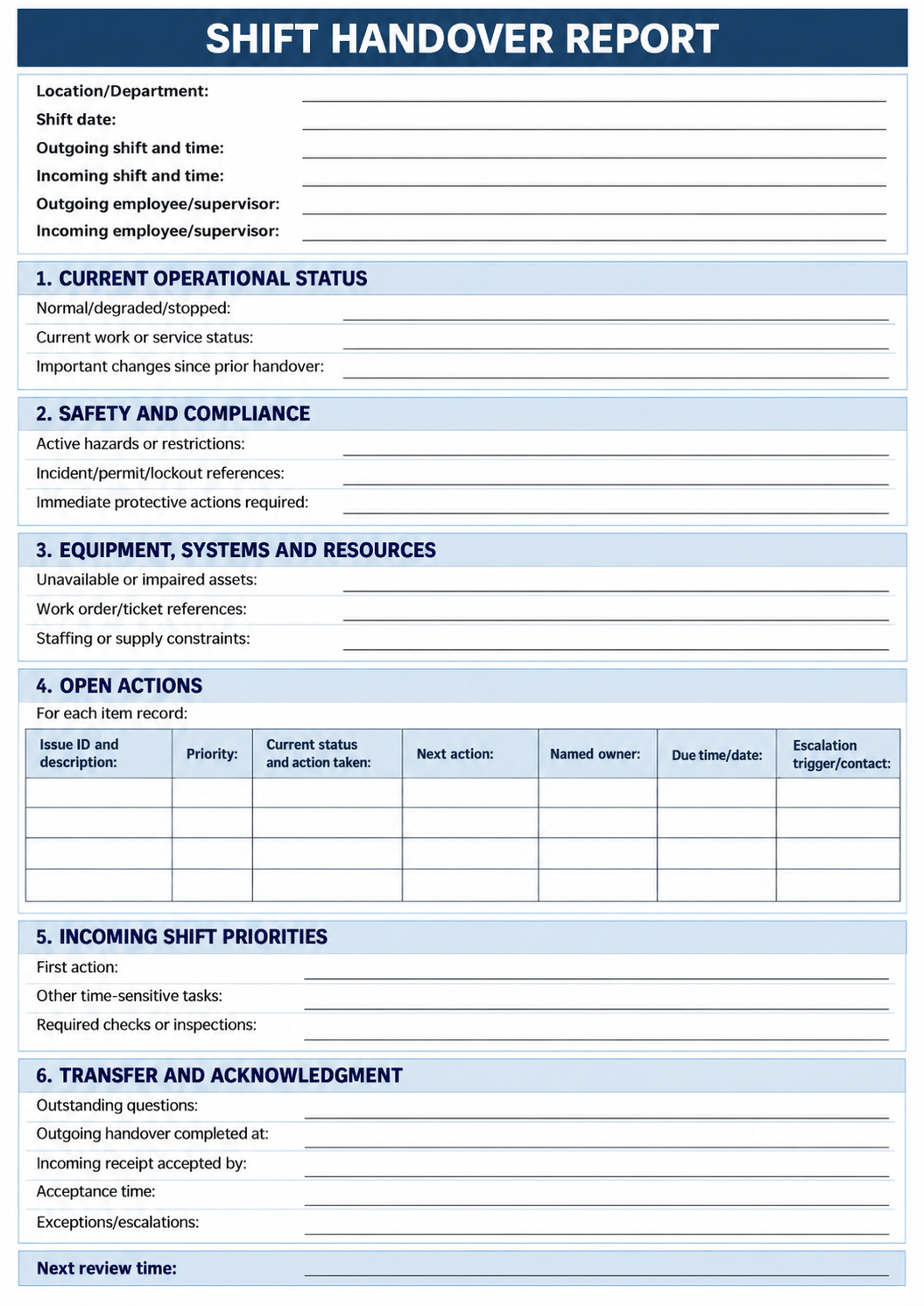
The template is a general operational aid, not a substitute for legally required safety, clinical, or industry-specific records.
The most consequential part of this shift handover form is the outstanding-action section. Without a specific next action, named owner, and expected completion time, the incoming team may be aware of a problem without knowing who is responsible for resolving it.
Teams should also distinguish between not applicable, not checked, and confirmed normal. Those statements communicate different things. Leaving a field blank should not be interpreted as evidence that no problem exists.
Filled shift handover example: Warehouse operations
The following fictional example shows how a completed report might look during a warehouse shift change.
| Field | Example entry |
|---|---|
| Location | Distribution Center A, Shipping |
| Shift | October 13, 2026, 2:00 PM–10:00 PM |
| Outgoing supervisor | Alex M. |
| Incoming supervisor | Jordan R. |
| Operating status | Shipping active; one loading position unavailable |
| Work completed | 18 of 22 planned outbound loads processed |
| Safety status | Dock Door 4 remains closed pending maintenance clearance |
| Equipment issue | Intermittent door sensor fault; Maintenance Ticket #4821 |
| Outstanding work | Four outbound loads require reassignment or scheduling |
| Priority | High: maintain restricted access to Dock Door 4 |
| Named owner | Jordan R., night-shift supervisor |
| Next action | Verify maintenance response and redistribute remaining loads |
| Deadline | 10:30 PM for load reassignment |
| Escalation | Contact operations manager if an alternate loading position cannot be confirmed |
| Acknowledgment | Jordan R. accepted at 9:55 PM |
This handover example is useful because it separates the operational problem from the required action.
The outgoing team has not simply reported a door fault. It has identified the affected asset, explained the restriction, connected the issue to a maintenance record, and assigned the next decision.
The acknowledgment establishes who is taking operational responsibility. It does not authorize reopening the dock or bypassing any safety restriction. That decision must follow the facility’s approved procedure.
How Does an Effective Shift Handover Process Work?
An effective shift handover process follows a repeatable sequence: prepare information, verify current conditions, identify exceptions, communicate priorities, confirm understanding, transfer responsibility, and track unresolved work.
The steps should be built into normal operations rather than treated as an administrative task employees complete only when time permits.
Step 1: Prepare the handover before the shift ends
The outgoing employee reviews operational logs, work orders, incidents, staffing changes, and outstanding tasks. This preparation should happen while relevant information is still accessible and colleagues are available to clarify uncertainties.
In busy operations, waiting until the final minutes creates pressure to rush the report or omit details.
Step 2: Verify the current operational status
The outgoing team distinguishes confirmed facts from assumptions. Equipment availability, current orders, open incidents, inventory discrepancies, and work restrictions should be checked against the appropriate operating systems or designated employees.
A machine that was repaired earlier, for example, should not automatically be described as available if an authorized return-to-service check is still pending.
Step 3: Separate critical exceptions from routine information
Safety hazards, regulatory concerns, service disruptions, equipment restrictions, and decisions requiring immediate attention should appear prominently.
A useful shift change communication hierarchy is: immediate hazards first, time-sensitive operational issues second, unresolved work third, and general updates last. Routine achievements belong in the shift report but should not bury urgent information.
Step 4: Conduct a two-way handover discussion
The outgoing employee walks through significant changes and outstanding actions. The incoming employee reviews the information, asks questions, and identifies contradictions or missing details.
For higher-risk operations, the discussion should include relevant operating personnel rather than relying exclusively on a manager who may not know every technical condition.
Step 5: Confirm understanding of critical actions
The receiver explains back the important condition, required action, and escalation path. This is more reliable than asking whether everything is understood and receiving a routine yes.
In healthcare, this principle is reflected in AHRQ’s TeamSTEPPS handoff guidance, which emphasizes acknowledgment and clarification when responsibility changes.
Step 6: Record acceptance of responsibility
The receiving employee or designated supervisor confirms the handover according to the organization’s procedure. The record should show who accepted it and when.
Receipt does not necessarily mean every issue is resolved. It means that ownership of the remaining work has transferred to an identified person or team.
Step 7: Review and close outstanding actions
The incoming team incorporates accepted tasks into its work plan. Open issues remain visible until a responsible person verifies completion, documents an approved transfer, or escalates the issue.
Managers should review recurring and overdue items rather than allowing each shift to pass the same problem to the next.
This procedure provides continuity, but it needs a defined exception path. When an incoming supervisor is unavailable, equipment is in an uncertain state, or a critical safety condition has not been verified, employees should follow the designated escalation and safe-state procedures instead of recording a routine handover as complete.
What Is a Practical Shift Handover Checklist for Frontline Teams?
A frontline shift handover checklist should confirm three things: the outgoing team has recorded accurate information, the incoming team understands its priorities, and unresolved work has an accountable owner.
The following shift changeover checklist can be used as a general operational starting point.
Interactive Shift Handover Checklist
Select completed items to review coverage.
Reset
0/12
Before the handover
During the handover
After the handover
Copy checklist with selections. A completed checklist is not proof that equipment is safe, clinical care has been transferred, or required controls are satisfied. Applicable procedures must still be followed.
A checklist must also reflect how employees actually work. Manufacturing technicians may need equipment isolation information, while retail teams may need cash control, store security, and customer-service follow-up.
Organizations should maintain a small common checklist and add role-specific sections where they provide genuine operational value.
How Can SBAR Improve Shift Handoff Communication?
SBAR helps employees communicate complicated situations in a consistent order: Situation, Background, Assessment, and Recommendation or Request. It is particularly useful when an issue needs clear explanation and a decision rather than a simple status update.
SBAR is an established communication framework used in healthcare. The Agency for Healthcare Research and Quality includes it in its TeamSTEPPS communication tools. Its structure can also be adapted for other operational settings when appropriate.
| SBAR component | Question answered | Shift handover example |
|---|---|---|
| Situation | What is happening now? | “The refrigeration unit is operating above its normal temperature range.” |
| Background | What led to the situation? | “The issue began during the afternoon shift, and maintenance has been contacted.” |
| Assessment | What is known about its impact? | “The affected inventory has been isolated pending a quality decision.” |
| Recommendation | What should happen next? | “Maintain the hold, review the monitoring records, and obtain authorized clearance before releasing inventory.” |
This structure is preferable to a vague handover such as “refrigeration had problems earlier.”
It explains the current condition, provides relevant history, identifies a concern, and establishes the next required action.
However, SBAR is not a complete shift handover procedure by itself. It does not automatically provide an issue register, durable record, acceptance mechanism, or complete safety assessment.
Healthcare teams may also use tools such as I-PASS, which incorporates illness severity, patient summary, action list, situation awareness, contingency planning, and synthesis by the receiving clinician.
Organizations should use the structured handoff method required by their clinical setting or operating procedure rather than replacing established workflows with a generic template.
What Are the Most Common Shift Handover Failures?
Most shift handover failures occur when critical information is missing, difficult to interpret, or disconnected from a clear responsibility. A form may be submitted on time while the actual communication fails.
The following problems are especially important when reviewing shift handover communication problems across multiple teams.
| Common failure | Operational consequence | Practical prevention |
|---|---|---|
| Vague updates | Incoming employees cannot determine the actual condition | Record observable facts, status, and required action |
| No named action owner | Issues are repeatedly passed between shifts | Assign one accountable owner for each open action |
| Missing verbal confirmation | Critical instructions may be misunderstood | Use direct discussion and check-back for high-risk items |
| Outdated handover documents | Employees make decisions using incorrect information | Require a current timestamp and verify status before transfer |
| Excessive routine detail | Important warnings become difficult to find | Put hazards and exceptions first |
| Separate, conflicting records | Teams disagree about the current status | Define an authoritative record for each issue type |
| Untracked carryovers | Old problems remain unresolved | Retain issue IDs, aging, deadlines, and escalation rules |
| Poor channel access | Some employees never receive the update | Test access across shifts, sites, languages, and devices |
Failure 1: Information is delivered without confirming understanding
Sending an email, posting an update, or uploading a shift handover document proves that information was made available. It does not prove that the receiving employee has understood the instruction.
This distinction matters in operations where employees must change their behavior based on the information.
A night-shift team may receive a notice about a restricted area but misunderstand whether the restriction applies to a specific machine, production line, or entire section of the facility.
For significant instructions, the receiving employee should have an opportunity to clarify the scope and confirm the required action.
Failure 2: Managers treat open issues as someone else’s responsibility
An employee may document an unfinished task correctly but leave its ownership unclear.
If the outgoing supervisor assumes that the next team will manage it, and the receiving supervisor assumes maintenance or another department owns it, the problem may remain unattended.
This is not simply a communication-format problem. It is a responsibility-design problem.
Each outstanding item should have an accountable owner, even when multiple departments must contribute to its resolution. When ownership moves between people or teams, that transfer should be explicit.
Failure 3: Employees work from different versions of the truth
A paper report might state that a fault remains open, while a group message says the issue was resolved and a maintenance ticket shows that further inspection is pending.
These conflicting records are particularly damaging when operations span several shifts.
A better approach is to distinguish the authoritative operational record from supporting communication channels. The maintenance system may remain the source of truth for work orders, while the shift handover references the relevant work order and explains its operational implications.
Copying the same status into multiple disconnected systems without a reconciliation process increases the risk of contradiction.
Failure 4: The organization has a reporting culture but no resolution process
Some teams produce detailed handover reports every day while repeatedly documenting the same unresolved problems.
The reports may be complete, but management has not established how overdue issues are reviewed, prioritized, escalated, and closed.
The corrective action is to examine issue aging and accountability, not simply require longer reports.
The objective of a shift handover is to support decisions and continuity. More documentation is not necessarily better documentation.
How Should Shift Handover Procedures Change by Industry?
The fundamental handover principles remain consistent across industries, but the information that must be transferred depends on operational risks, work processes, and applicable requirements.
A manufacturing shift handover is not interchangeable with a nursing handover or a hotel front-desk report.
Manufacturing: Equipment status, isolation, and production continuity
Manufacturing shift handover should prioritize equipment condition, safety controls, production exceptions, quality issues, and unfinished maintenance.
Incoming operators need to know whether equipment is operating normally, under restriction, out of service, or awaiting authorized clearance. They may also need information about batch status, inspection holds, abnormal readings, nonconforming material, and maintenance coordination.
Safety requirements deserve special attention. OSHA’s lockout/tagout standard, 29 CFR 1910.147, specifically requires procedures during shift or personnel changes to maintain continuity of hazardous-energy protection under paragraph (f)(4). A general handover form does not replace those procedures.
For operations involving covered highly hazardous chemical processes, OSHA’s Process Safety Management standard establishes additional requirements concerning operating procedures, training, and management of change.
A manufacturing handover should therefore distinguish routine production information from safety-critical conditions requiring a formal process.
Example: An outgoing supervisor may report that a conveyor remains isolated, reference the applicable maintenance documentation, identify outstanding work, and confirm which authorized employees will handle the required transfer under the established lockout/tagout procedure. The handover must not independently authorize restarting the conveyor.
Warehouses and distribution centers: Work-in-progress and physical hazards
Warehouse handovers require visibility into unfinished orders, equipment availability, loading and receiving conditions, inventory discrepancies, staffing, and restricted work areas.
A warehouse shift handover procedure should record any changes affecting the safe movement of people or materials, including unavailable equipment, damaged storage systems, and blocked routes.
It should also connect unfinished operational work to the systems used to manage that work. For example, a shipping exception should reference the warehouse management system or relevant ticket rather than exist only in a supervisor’s notebook.
Useful warehouse-specific additions to the template include pending inbound and outbound loads, equipment defects, inventory holds, dock restrictions, carrier exceptions, and staffing constraints.
Healthcare: Patient safety and the transfer of clinical responsibility
Nursing shift handover requires a clinically appropriate, standardized exchange of patient information, changes in condition, treatments, medications, pending tests, risks, care priorities, and contingency plans.
The receiving clinician needs an opportunity to ask questions and clarify clinical responsibilities. Information must be handled using approved systems and applicable patient privacy safeguards.
A material development in 2026 is the Joint Commission’s introduction of National Performance Goals for hospitals and critical access hospitals, effective January 1, 2026. These replaced the former National Patient Safety Goals chapter for those programs. The Right Patient, Right Care goal includes having a process for hand-off communication. The underlying requirement includes the opportunity for discussion between the sender and receiver of patient information.
Nursing handover documentation should be maintained in authorized clinical systems and adapted to the organization’s patient-care policies. Generic employee chat applications should not be assumed appropriate for protected health information.
For healthcare teams, the relevant consideration is not simply whether a mobile tool can deliver messages. It is whether the complete workflow meets clinical, privacy, security, and organizational requirements.
Retail and hospitality: Customer experience and service continuity
Retail and hospitality shift handovers place greater emphasis on service readiness, customer follow-up, staffing, inventory availability, cash controls, and facility conditions.
A retail store manager may need to communicate:
-
An unresolved customer complaint and the promised follow-up.
-
A security concern or restricted area.
-
An inventory shortage affecting a promotion.
-
A staffing gap or change in floor coverage.
-
A point-of-sale problem affecting customer transactions.
In hotels, the equivalent handover may involve guest requests, maintenance problems, room readiness, service recovery, and coordination between the front desk, housekeeping, and engineering.
The receiving team needs enough context to continue the service without asking the customer or guest to explain everything again.
However, customer and employee personal information should be limited to what authorized staff need, using approved systems and access controls.
For multi-location retailers and hospitality operators, the challenge extends beyond individual handovers to consistent frontline employee communication between local sites and central support teams.
How Can Teams Track Unresolved Issues Between Shifts?
Unresolved issues should remain in a shared, accountable workflow until they are completed, formally reassigned, or escalated. Rewriting the same problem in a new report every shift is not an adequate tracking method.
A practical issue record should preserve its identity as responsibility changes.
At minimum, it should contain the issue description, severity, current status, action history, accountable owner, next action, deadline or review point, escalation conditions, and verification of closure.
The TurnOnWork Three-Gate Continuity Test
TurnOnWork recommends a simple editorial model for checking whether an unresolved issue can transfer reliably between shifts.
This is a TurnOnWork framework, not an established industry standard, regulatory assessment, or substitute for technical safety procedures.
1. Visible
Is the current issue and its actual status recorded?
2. Owned
Is there a named owner and a defined next action?
3. Accepted
Has the receiving person confirmed the transfer?
TRY THE MODEL
0 / 3
Transfer checks are incomplete
Reset
Every gate must pass for a routine issue transfer. Critical hazards still require the applicable safety controls and escalation procedures regardless of the score.
Applying the model to a real workflow
Suppose a store’s payment terminal is experiencing intermittent failures.
The outgoing shift records the terminal’s condition, references the support ticket, and notes the workaround authorized by management. That satisfies visibility.
The incoming assistant manager is assigned responsibility for checking the support response before the next customer rush. That creates ownership.
The assistant manager confirms receipt and knows whom to contact if the problem continues. That establishes acceptance.
If the manager never receives the information, the first two gates may be complete, but the transfer itself is not.
This distinction helps explain why a completed handover document does not necessarily indicate a completed handover.
How the model connects communication to employee experience
Poor shift handovers affect employees as well as operations.
Workers may spend the first part of a shift investigating issues that colleagues already understand, receive blame for problems they did not know existed, or encounter safety and service situations without adequate context.
A predictable handover gives incoming employees a clearer starting point. It also makes it easier to raise uncertainties without appearing unprepared.
For HR, employee experience, and frontline leaders, that makes handover quality a shared operational and workforce issue rather than a reporting responsibility assigned solely to supervisors.
Should Organizations Use Digital Shift Handover Software?
Digital shift handover software is useful when teams need searchable records, consistent forms, time-sensitive notifications, issue ownership, and visibility across multiple shifts or locations. It is not automatically necessary for every workplace.
The central buying question is whether the current handover problems arise from poor access to information, weak task tracking, inconsistent procedures, or a combination of all three.
Different software categories solve different parts of the problem.
| Software category | Primary contribution | What buyers should verify |
|---|---|---|
| Digital forms and inspections | Standardized data capture, checklists, supporting evidence | Offline use, required fields, timestamps, exception handling |
| Maintenance and work-order systems | Equipment issue ownership and repair status | Links between handovers and work orders, status consistency |
| Workforce operations platforms | Shift-aware tasks, schedules, operational updates | Assignment and escalation workflows, role permissions |
| Employee communication platforms | Targeted updates, mobile access, employee messaging | Frontline enrollment, delivery reach, acknowledgments |
| Integrated operational systems | Connected records and automated status exchange | Integration reliability, authoritative data sources, audit history |
Digital forms are not the same as operational ownership
A digital form can make the handover easier to complete and store. It may also reduce missing fields through required entries.
However, if an unresolved issue is recorded in a form and never assigned to a responsible person, the organization has digitized the documentation problem without fixing the accountability problem.
Buyers should examine how a reported exception becomes an actionable item and whether that item remains visible until it is resolved.
Employee communication platforms serve a complementary role
Shift handover records often sit in operational systems, but important updates must still reach the people affected by them.
A platform such as HubEngage’s employee communications hub provides multi-channel messaging, mobile access, targeted communication, notifications, and read acknowledgments. These capabilities are relevant when organizations need to distribute shift-related instructions and reach frontline employees who may not regularly access email.
That does not make an employee communications platform a replacement for a maintenance-management system, a clinical handoff record, or a specialized safety workflow. Organizations should verify the required integrations, action tracking, and approval processes before treating any platform as their system of record.
For a broader comparison of mobile access, messaging, and frontline workforce requirements, see TurnOnWork’s guide to frontline employee communication apps.
What AI can and cannot do for shift handovers in 2026
AI-assisted summaries, search, and translation are increasingly relevant to digital workplace tools. They may help employees locate historical information, condense routine activity logs, or prepare a draft handover from existing records.
The limitation is that a concise summary is not necessarily a complete or correct operational instruction.
An AI-generated handover might omit a rare but safety-critical condition, confuse the status of two equipment assets, or summarize a resolved incident without preserving an active restriction.
A responsible implementation should keep human review in place for operationally significant information, preserve links to authoritative source records, restrict access to sensitive information, and prevent an AI summary from independently approving equipment changes, clinical decisions, or safety-critical closures.
Translation should also be validated when the meaning of technical or safety terminology matters.
In practice, AI is best treated as an aid to preparing or finding information, while authorized employees remain responsible for verifying conditions, making decisions, and accepting handovers.
What Are the Best Practices for Standardizing Shift Handover Across Multiple Locations?
Multi-location organizations should standardize essential handover requirements while allowing each site or role to document the conditions that matter locally.
A single generic form may appear efficient but can miss important differences between a distribution center, manufacturing plant, hotel, and retail store.
Establish one core standard
Every location should follow common rules for recording the current status, reporting exceptions, identifying open actions, assigning responsibility, acknowledging receipt, and escalating unresolved problems.
This creates a shared definition of a completed handover without forcing every team to report the same operational details.
Add role-specific modules
Manufacturing teams may require equipment and production fields. Warehouse teams may need loading and inventory exceptions. Retail locations may prioritize security, staffing, and customer service.
These additions should be controlled and reviewed so that local customization does not produce dozens of incompatible documents.
Define communication ownership
Operations leaders should own the operational accuracy and execution of handovers. Site supervisors should manage local participation and follow-up. Safety or clinical leaders should control relevant specialized procedures. IT should support system access, security, and integrations.
Internal Communications and HR can help address broader access, language, and employee communication barriers.
A useful related resource is TurnOnWork’s multichannel internal communications audit checklist for deskless organizations, which examines channel access, message timing, employee understanding, and accountability across shifts and locations.
Test the procedure across real shift conditions
A process that works during a weekday morning shift may fail overnight when fewer managers are available, mobile reception is inconsistent, or support teams are off-site.
Pilot the handover process across representative locations, including weekends, overnight shifts, and periods of high activity. Observe whether employees can actually find and complete the record, whether they receive sufficient handover time, and whether unresolved issues reach the correct owners.
Training should use realistic scenarios, including unexpected equipment faults, absent receiving supervisors, incomplete information, and competing operational priorities.
Which Shift Handover KPIs Should Managers Track?
The most useful shift handover KPIs measure whether responsibility is transferred reliably and outstanding work progresses toward resolution. Counting completed forms or messages sent provides only a partial view.
A balanced measurement approach combines process reliability, issue resolution, and employee feedback.
| KPI | How to measure it | What it reveals |
|---|---|---|
| On-time handover completion | Handovers completed by the defined deadline ÷ expected handovers | Process consistency |
| Receiving-team acknowledgment rate | Handovers acknowledged by the required cutoff ÷ handovers requiring acknowledgment | Whether receipt is confirmed |
| Open actions with assigned owners | Open actions with a valid owner ÷ total open actions | Accountability coverage |
| Overdue open-action rate | Open actions past their due time ÷ total open actions | Resolution backlog |
| Average or median issue age | Elapsed time from issue opening to verified closure | How long problems remain unresolved |
| Repeated carryover count | Number of issues transferred repeatedly without meaningful progress | Escalation and ownership weaknesses |
| Handover-related incidents or rework | Validated cases where inadequate transfer contributed to a problem | Potential operational impact |
These are suggested management measures, not universal industry benchmarks.
Organizations should establish their own definitions and baselines before setting targets. A handover acknowledgment, for example, should have a clearly defined deadline, and issue aging must account for differences in severity and the type of work involved.
Avoid treating form completion as proof of quality
A team can achieve a high handover completion rate while still missing important risks.
Similarly, a growing number of documented issues may initially reflect improved reporting rather than worsening performance.
Managers should interpret the metrics together and review actual records periodically.
An especially useful exercise is to select a sample of open issues and trace each one from the original report through ownership changes, escalation, and closure. This reveals whether the communication process maintains continuity across several shifts, not merely between two employees.
Employee feedback should also be part of the evaluation. Ask whether the incoming team had enough information to begin work, whether urgent issues were easy to identify, and whether responsibilities were genuinely clear.
How Can Managers Improve Shift Handover Without Adding Unnecessary Administration?
Improving handovers usually begins with simplifying the information transfer, not creating longer reports.
Managers should first identify where information is being lost and then adjust the procedure to address those failures.
A practical implementation sequence is:
-
Review existing handovers. Compare completed reports with actual operational issues, observing both successful and unsuccessful shift transitions.
-
Identify recurring gaps. Look for missing safety information, unclear ownership, outdated status records, access problems, and unresolved carryovers.
-
Design a common template. Keep essential fields consistent and add industry-specific requirements where needed.
-
Train outgoing and incoming employees together. Practice two-way discussions, clarification, acknowledgment, and exception escalation.
-
Pilot the process across representative shifts. Include overnight teams and employees with limited access to computers or corporate email.
-
Review the first results and adjust. Remove redundant fields, improve instructions, and resolve barriers that employees encounter during actual work.
One important consideration is the time allocated for the transfer. If employees are expected to complete a detailed handover while simultaneously closing operations or leaving at a fixed shift-end time, quality can suffer.
The handover should be treated as part of the operational workflow, with appropriate scheduling, supervision, and compliance with applicable working-time and pay requirements.
Managers should also protect employees’ ability to report unresolved issues without turning every handover into a performance judgment. A culture that penalizes employees simply for documenting problems may encourage incomplete or overly optimistic reports.
A better management question is whether the issue was communicated accurately, assigned appropriately, and handled according to the organization’s procedures.
Frequently Asked Questions About Shift Handover
How long should a shift handover take?
There is no universal duration that fits every workplace. A small retail team may need only a brief discussion and report review, while an industrial facility or clinical unit may require a more detailed, structured exchange. The time should reflect operational complexity, risk, and the number of unresolved issues rather than an arbitrary time limit.
Who is responsible when the incoming employee is late or absent?
The organization should have a designated backup or escalation procedure. The outgoing team should not assume responsibility has transferred merely because a report was submitted. A supervisor or other authorized person may need to accept the handover, and any unresolved safety-critical conditions must remain subject to the applicable protective procedures.
Can a digital shift handover replace a face-to-face briefing?
Digital handovers can support teams that do not overlap physically, but a digital submission is not equivalent to two-way confirmation. For critical or complex conditions, organizations should provide a reliable way for the receiver to ask questions and confirm understanding, whether through direct conversation or an approved remote communication process.
What should happen when an unresolved issue lasts several shifts?
The issue should retain a consistent identifier, current status, owner, action history, and escalation path. Managers should review its age and determine why progress has stalled. Repeatedly passing it to the next shift without a decision or escalation is not a satisfactory resolution process.
Building a Shift Handover Process Employees Can Trust
Effective shift handover communication depends on more than a detailed report or a well-designed checklist. It requires accurate information, reliable access, two-way clarification, and an unambiguous transfer of responsibility.
For organizations managing frontline and deskless teams, the strongest handover process is one that works under real operating conditions: during overnight shifts, staff shortages, equipment problems, changing customer demands, and periods when employees have limited time or connectivity.
Start with a common shift handover format, make outstanding actions traceable, and verify that the incoming team has accepted responsibility. Then measure whether those actions are resolved and whether employees have the information they need to perform their work safely and effectively.
A successful handover is not simply one that has been recorded. It is one that enables the next shift to continue operations with a clear understanding of current conditions, remaining risks, and what must happen next.