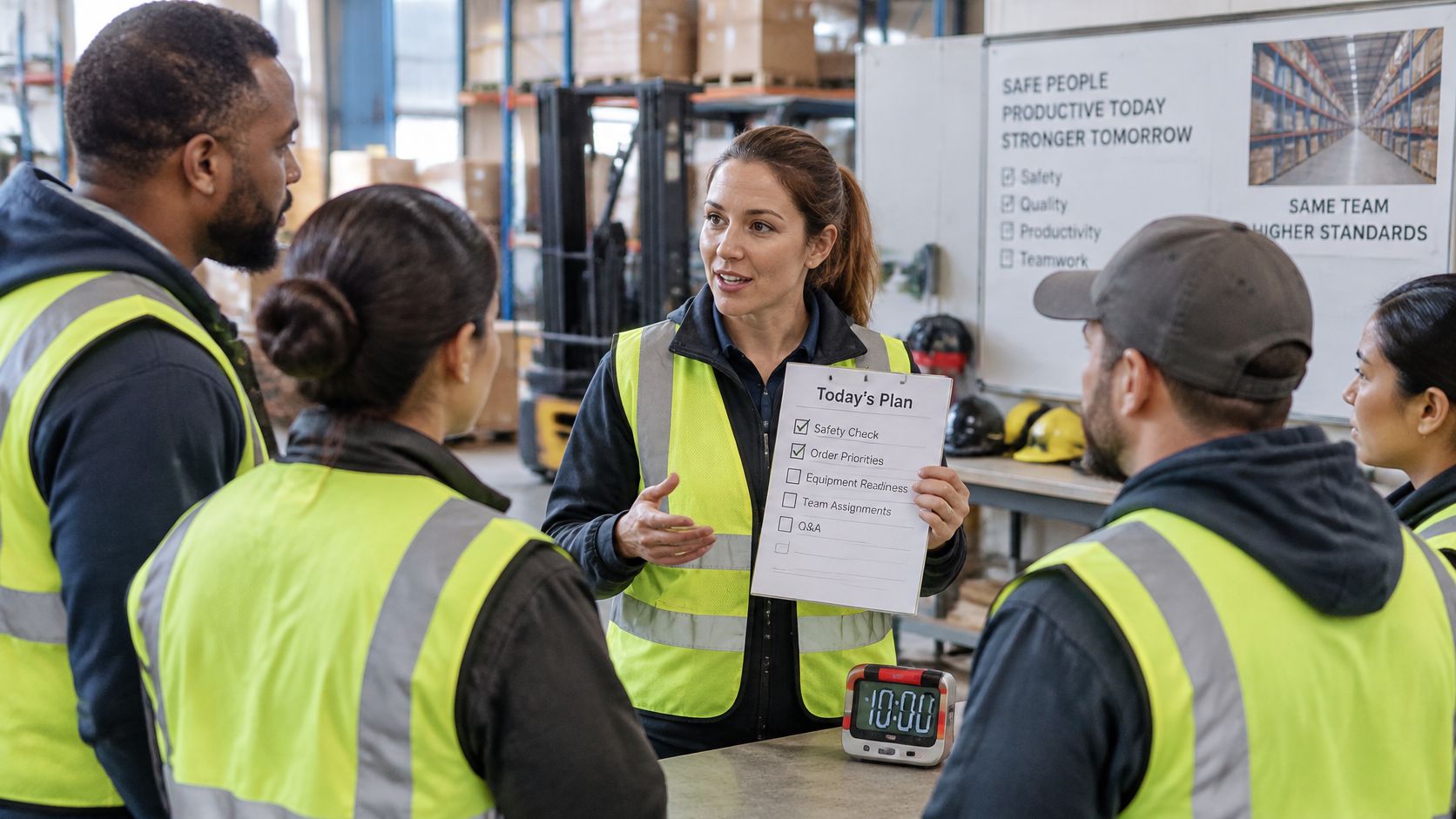
At 6:52 on a Tuesday morning, a warehouse supervisor stands at the end of aisle four with a clipboard and eight people in front of her, four of them checking their phones. The shift starts in eight minutes. The dock schedule moved twice overnight, a forklift is down with a charger fault, and the aisle where a pallet rack was clipped last night is still blocked.
She can say all of that in ninety seconds. What she can’t do in ninety seconds is find out whether anyone heard it or settle the question that stops work: who moves the pallets out of bay six before the first truck arrives.
Most huddles fail on that second part. The information gets delivered, nothing gets written down, and the same three items come back tomorrow with slightly worse tempers. What follows is a template built to be run rather than admired: a timed grid, a one-page record, a facilitator’s script, four industry variations, and a measurement table that keeps the huddle honest.
10-Minute Pre-Shift Agenda and Run Sheet
Key Takeaways
- Ten minutes, seven blocks. One crew can cover safety, changes, priorities, questions, actions and a recap inside the window before work starts.
- Every block closes with an output. Attendance logged, control confirmed, changes restated, action log updated. A block that produces nothing visible is a speech.
- Workers talk for most of it. The supervisor opens the meeting, then hands over the hazard description, the questions and the teach-back.
- No item is done without an owner and a deadline. Anything the room can’t resolve is escalated the same morning, to a named person.
The grid below is the default for one crew of six to fifteen people on a shift with a fixed start time. Print it, tape it inside the supervisor’s clipboard, and run the same sequence until it no longer needs the paper.
| Minutes | Agenda block | What to cover | Output |
|---|---|---|---|
| 0-1 | Open and attendance | Shift, date, location and who is present | Attendance logged |
| 1-2 | Safety focus | One task hazard and the control for it | Control confirmed by a worker |
| 2-4 | Changes today | Staffing gaps, equipment out of service, demand shifts, workflow changes | Changes restated |
| 4-6 | Shift priorities | Two or three goals for the shift | Priorities listed |
| 6-8 | Worker questions | Open floor for concerns and blockers | Questions captured |
| 8-9 | Actions | Owner, task and deadline for each open item | Action log updated |
| 9-10 | Recap and confirm | Repeat-back question and written recap | Recap sent to the team channel |
The output column does the heavy lifting. Seven visible artifacts come out of ten minutes, and each one is checkable by someone who wasn’t in the room. That’s the difference between a briefing and a control.
Pre-Shift Meeting Template: a timed grid, a one-page record, and an action log that somebody actually closes.
The Facilitator Run Sheet
- Open with the objective. Name the shift goal in one sentence, confirm who is present, and start the clock where people can see it.
- Name one task hazard and show the control. Then ask a worker to describe the control in their own words before you move on.
- Read out only the changes that affect this crew. Staffing gaps, equipment out of service, demand shifts, workflow changes. News that belongs to another team goes in the recap or nowhere.
- Ask what’s blocking the work and what information is missing. Then stop talking and let the room answer.
- Confirm two critical controls with a teach-back. “What do you do first if the guard is removed?” A nod isn’t confirmation. A correct answer is.
- Assign an owner, task and deadline to every open item. Anything the room can’t fix goes to a named manager with a time attached.
- Repeat the decisions and escalation contacts. Send the recap to the team channel before people walk back to the floor.
The format works because it’s short, job-specific and participatory rather than a compliance script. The UK Health and Safety Executive’s guidance on consulting employees describes toolbox talks in the same terms, as brief discussions about health and safety issues relevant to particular jobs where workers explore risks and how to control them, and it stresses two-way discussion and listening to concerns before decisions are made.
Two adjustments cover most real-world variations. Larger teams shorten the changes block to a single headline and move the detail into the recap, because a 40-person huddle can’t absorb nuance. Split shifts add one line for remote staff, naming who sends them the recap and when.
Keep personal medical detail out of the group entirely. State the operational effect, such as who is covering a station, and route the reason to a restricted HR or leave system.
What a Pre-Shift Meeting Is and Why It Matters
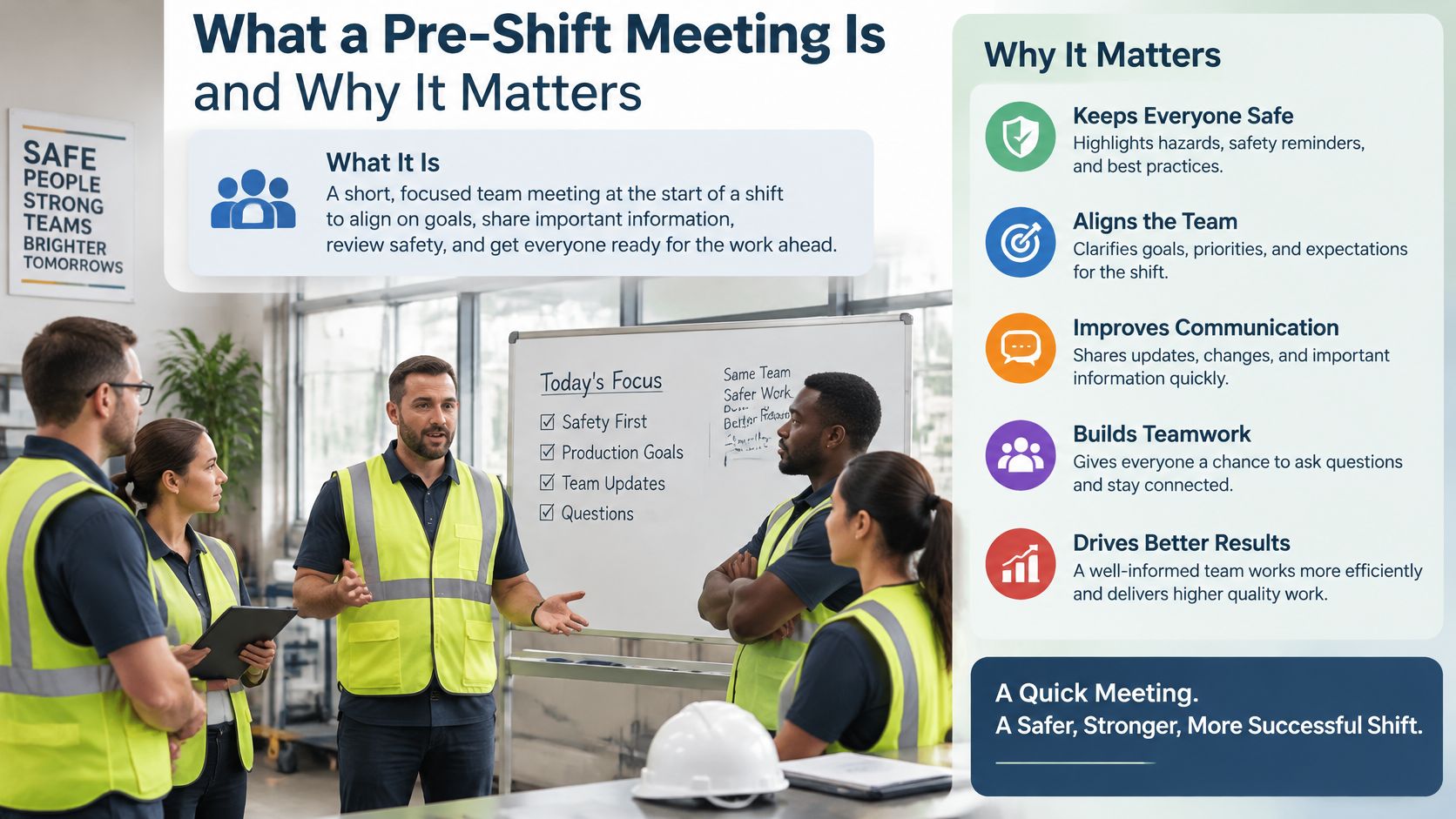
A pre-shift meeting is a short, structured team briefing held before employees start a scheduled shift. It covers safety, operational priorities, staffing, performance updates and the immediate challenges the crew will meet in the next few hours. Run properly, it functions as an operational control rather than a verbal announcement: every item raised gets an owner, a decision or an escalation path, and the huddle leaves a record the next shift can check against reality.
The practice descends from toolbox talks in safety-driven industries, and the research on those talks is unusually concrete. In one stage of a 2016 CDC-supported study on construction pre-shift meetings, 25% of the 28 workers surveyed, seven people, reported that their companies never held safety meetings at all. When researchers tested visual formats with 30 workers, line drawings let them identify hazards from more than 1.5 meters farther away than photographs did. In a third stage with supervisors from eight construction crews, 82% preferred a newly developed toolbox-talk format over longer investigation reports, and that format cut preparation and presentation time by 15 minutes.
The finding worth internalizing is that structure changes the three things that decide whether a huddle survives a busy week: whether supervisors adopt it, how long preparation takes, and whether workers can name the hazard afterwards. That last point deserves the most attention. Headcount tells you who stood in the room, and whether a worker can name the hazard and its control tells you the huddle worked. I track those separately, because a full attendance sheet alongside zero retained information is a failed control with tidy paperwork.
Who delivers the briefing matters too. In the 2025 Employee Communication Impact Study run with YouGov across 1,044 U.S. employees and 3,574 employees globally, 51% of respondents named direct managers as their most trusted information source, according to Staffbase’s summary of the study.
If you’re still deciding how the safety content itself gets taught, it’s worth comparing safety training delivery formats before standardizing on a room-and-slides approach that keeps nobody’s attention.
A template is a working tool. What matters is whether the next shift can read what this one decided, and who still owes an answer.
Printable Huddle Record Fields
A huddle that leaves no record is a conversation. A huddle that leaves a record is an operational control, because the page shows what was raised, what was answered and what is still open. The form below fits on one side of A4 and takes about ninety seconds to complete once it is part of the routine.
| Field | What to write | What it preserves |
|---|---|---|
| Shift, date and location | Shift name, date, site or work area | Which crew and place the record covers |
| Leader and attendees | Facilitator name and names of everyone present | Who heard the briefing |
| Planned work and non-routine tasks | Main jobs and any one-off tasks | Scope of the shift |
| Task-specific hazards and controls | One or two hazards with the control for each | Controls the crew confirmed |
| PPE or equipment checks | Required items and equipment status | Readiness before work starts |
| Changes from the prior shift | Staffing, equipment, demand or workflow changes | What differs from the last shift |
| Open near misses and corrective actions | Near misses and fixes still open | Unfinished safety follow-up |
| Worker questions and concerns | Questions raised and responses given | Two-way input and answers |
| Owners and due dates | Name and deadline for each unresolved item | Accountability and escalation status |
| Attendance and acknowledgment | Signatures or confirmed receipt | Who received the briefing |
The third column is why the form exists. Without a written response and an escalation status, attendance becomes the only measurable output, and attendance proves nothing except that people were standing there. OSHA’s guidance on worker participation pushes in the same direction: workers should be involved in establishing, operating, evaluating and improving the safety and health program, have access to the information they need to participate, and be able to report hazards and near misses without retaliation. Safety meetings also belong inside paid working hours.
For distributed or multilingual crews, write the two or three critical controls in plain language and add visual prompts. Translate those controls rather than the whole page, and close with a repeat-back question that checks understanding.
Before the record closes, run a three-part check on every item raised: what was raised, what was agreed in response, and who owns the next step. In practice the facilitator writes the first line as the worker speaks, the second as the room agrees the response, and the third before moving to the next block. Items that stay open carry the same three entries into the next shift, with the response line updated to show what changed. Once a month, read the records back and mark every item missing an entry, because those are the items that resurface as an incident, a missed delivery or an argument.
Pair the page with a live list so actions do not live in two places. Turn On Work’s guide to task management for frontline teams covers how to keep assigned work visible between shifts.
Pre-Shift Meeting Examples for Retail, Hospitality, Manufacturing and Warehouses
Keep the grid, change the content. That single rule handles most of the variation between settings, and the reason to enforce it is relevance. In a 2025 survey of deskless employees, more than half said company-wide updates were only somewhat relevant to their roles and 21% called them completely irrelevant, according to Reworked’s report on deskless communication.
Retail. The changes block needs the most time: staffing gaps across the floor, a promotion starting today, a returns policy change that will generate questions at the counter. The watch-out is that customer-facing detail crowds out the safety block, so name the hazard first and keep the promotion to two sentences.
Hospitality. Spend the time on priorities: covers booked in blocks, items that are off the menu, allergen updates for anything prepped differently. The watch-out is allergens specifically. A verbal note at 4:55pm is not a control, so confirm allergen changes in writing on the record and have the kitchen repeat them back.
Manufacturing. The safety block earns the extra minute: line changeovers, any lockout or tag-out change, PPE required for a new task. The watch-out is quantity. One hazard named clearly and confirmed by a worker beats five hazards read quickly and confirmed by nobody.
Warehouses. Changes carry the weight: dock schedule shifts, forklift routes closed for repair, carrier delays that change picking order. The watch-out is the night and early shifts, who must receive the same routing change through the same record rather than by rumour at the handover.
Say a warehouse crew arrives to find aisle seven closed because a rack upright was damaged overnight. The supervisor states the detour, asks two forklift drivers to restate it, and logs the rack repair with an owner and a deadline in the same breath. That’s the whole example: one closed aisle, two confirmations, one named owner.
If the hazard well runs dry, a list of 50 toolbox talk topics keeps the safety block specific to the work in front of the crew.
Mobile Recaps for Late, Remote and Deskless Workers
The huddle is the synchronous checkpoint. The recap is the record that reaches everyone who wasn’t standing in the circle, and it should contain four things: decisions, assigned actions, deadlines and escalation contacts. Nothing else.
Deskless research points the same way. In the FirstUp white paper on connecting deskless workers, 61% of workers said more timely and relevant updates would improve their performance and productivity, 51% preferred mobile methods such as text or push notifications, and 42% preferred critical company information straight from managers.
Send the recap through the team’s approved mobile or operational channel within the first hour of the shift. That timing matters more than the format, because a recap read at lunch has already missed the decisions it describes.
- In-person huddle: discussion, hazard confirmation, teach-back.
- Group message: the recap itself, one thread, same day.
- Push notification: urgent changes that alter the shift, and only those. Follow push notification best practices so urgent stays urgent.
- Email: records nobody needs to act on during this shift.
Channel ownership is a design decision, not an afterthought. Turn On Work’s internal communication strategy for distributed workforces treats it that way, with clear ownership for the recap template centrally and for the local send on site. That mapping, plus how information moves between central and local teams, stops five versions of the same recap from circulating.
Keep personal or health details out of every group channel. Name the operational effect and move the rest to a restricted system.
The routine is three steps. The supervisor reads the recap once before sending it, a named person confirms receipt for anyone who missed the huddle, and open questions land with a named owner before the shift ends.
Urgent changes that alter the shift, and only those. For staffing adjustments, schedule updates, or last-minute operational changes, HubEngage’s guide to mobile push notifications for employee schedule changes explains how mobile alerts can help reach frontline workers in time.
Measuring Whether Your Pre-Shift Huddles Work
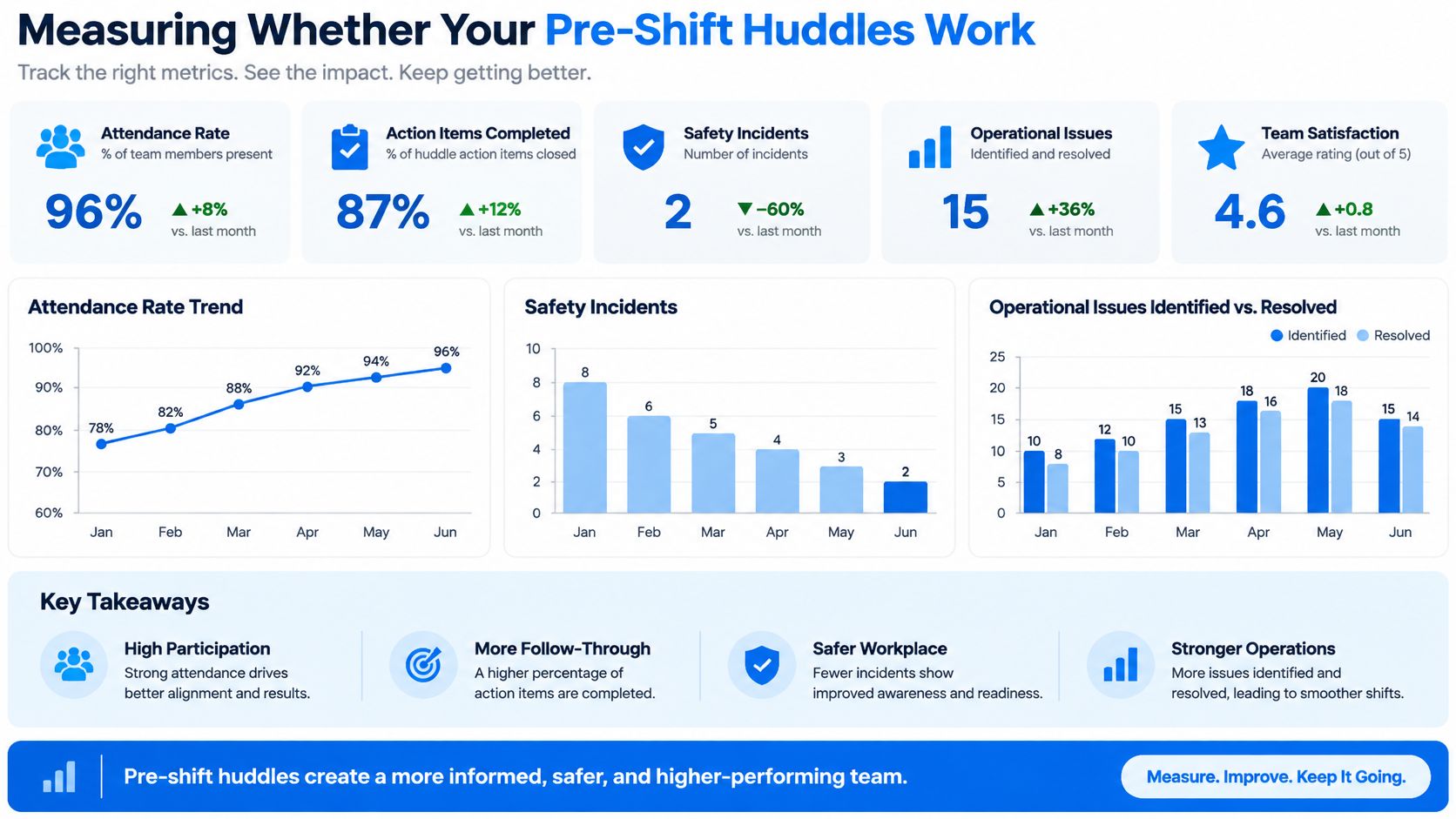
Two metric families answer two different questions. Distribution and completion metrics show that a huddle happened. Outcome metrics show whether it changed what people know or do. Mixing them produces the most common reporting error in frontline operations: a rising completion rate reported as if it were a safety result.
| Metric | Type | How to calculate | What it shows |
|---|---|---|---|
| Huddle completion rate | Distribution | Huddles held divided by scheduled shifts | Whether the meeting happens |
| Hazards raised per huddle | Participation | Hazards logged divided by huddles held | Whether workers speak up |
| Overdue actions | Follow-through | Open actions past their due date | Whether issues get closed |
| Repeat issues | Outcome | Same hazard or blocker logged again within four weeks | Whether fixes hold |
| Teach-back confirmed | Understanding | Workers who answered the control question correctly divided by attendees | Whether critical controls are understood |
No benchmark values appear in that table because none are established for this topic. Set your own baseline over the first four weeks, then compare month to month. Meeting length on its own is a poor measure: a fast huddle that resolves nothing scores well and changes nothing.
The caution is well documented. In an evaluation of digital delivery indexed by the CDC, 56 residential-construction supervisors in Oregon received a fatality-focused toolbox talk by text every two weeks for three months, against an Oregon OSHA standard requiring at least one safety meeting a month. Adherence to that standard improved by 19.39%, yet the researchers found no statistically significant change in self-reported communication quality or supervisor-rated employee safety performance. Getting the meeting to happen is a solved problem. Proving it worked is not.
Knowledge is the more encouraging half of the picture. A 2025 scoping review published in the journal Safety found that 11 of 14 toolbox-talk studies evaluated safety knowledge or safety attitudes and beliefs, and every study measuring safety knowledge reported improvement after the intervention.
So build the record to answer the outcome question, not just the attendance one. Include a measurable hazard topic, worker questions and a follow-up field. For the wider measurement layer, Turn On Work’s internal communications KPIs and metrics guide sets out how to pair reach metrics with understanding and action, and our guide on measuring employee engagement for frontline and deskless teams covers the listening side that sits around the huddle record.
Common Pre-Shift Meeting Mistakes and Fixes
Three failures survive even a well-written run sheet, and each has a specific fix.
- The huddle is the first thing cut on a busy day. Pressure hits the calendar before it hits anything else, and the ten minutes look like the cheapest ten minutes to lose. Fix it with a fixed time, a standing agenda and a named backup facilitator, so no single absence kills the briefing.
- Items get raised and nobody gets named. A list of concerns with no owner is a diary entry. Fix it by refusing to close a raised item without a name and a deadline, and by escalating whatever the room can’t resolve to a manager before the shift ends.
- Personal details leak into the group. Someone explains a colleague’s absence by describing their medical situation to twenty people. Fix it by moving the reason into a restricted HR or leave process and logging only the operational consequence, such as who covers the station.
The steps in the run sheet handle the rest: the single hazard focus, the filtered changes block, the teach-back and the action log.
A huddle that is fast but never followed up loses trust faster than no huddle at all. People stop raising things when the same blocked aisle appears on the list for three weeks with no name next to it. The recap and the action log matter more than the ten minutes in the room.
Pre-Shift Meeting Versus Shift Handover
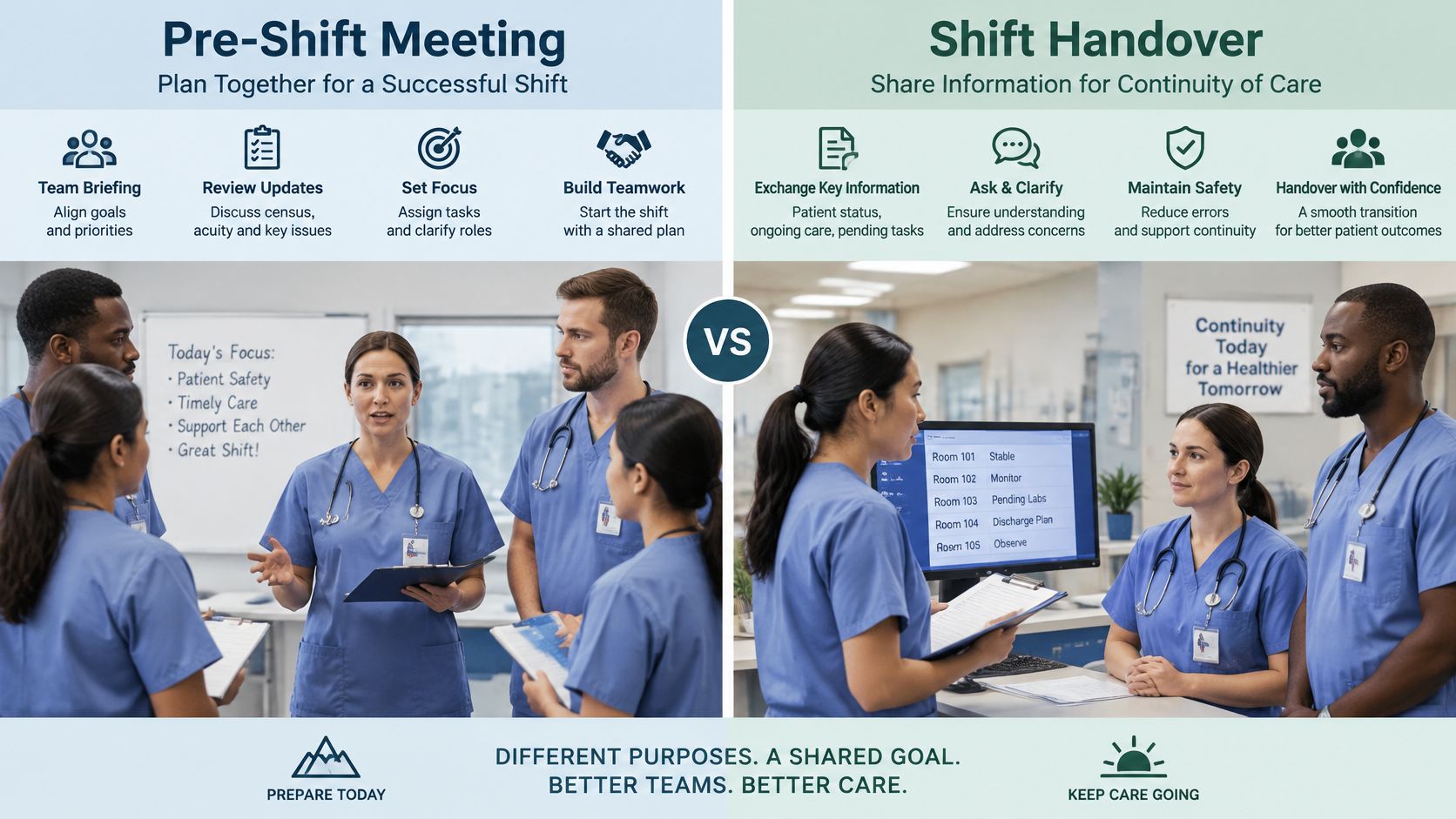
A shift handover transfers unfinished work, open safety concerns and responsibility from the outgoing team to the incoming team. It answers a different question from the huddle, which is why running one well doesn’t fix the other.
| Aspect | Pre-shift meeting | Shift handover |
|---|---|---|
| Purpose | Align the incoming crew on the shift ahead | Transfer unfinished work and open concerns |
| Timing | Before the shift starts | At the change of shift |
| Who speaks | Supervisor leads, workers answer and raise issues | Outgoing crew briefs the incoming crew |
| Content | Safety focus, changes, priorities | Open jobs, unresolved safety concerns, responsibility |
| Output | Owners, tasks and deadlines logged | Handover notes accepted by the incoming crew |
The two connect more tightly than often realized. Handover notes are the main input for the changes block of the huddle, so a team that reads them before the meeting runs a shorter and more accurate briefing. A team that skips them spends the huddle reconstructing what happened overnight.
Turn On Work publishes a shift handover communication guide with practical formats for transferring unfinished work, safety concerns and responsibility between teams.
The decision rule is simple. If the question is what happened on the last shift, use the handover. If the question is what this shift needs, use the pre-shift meeting.
Run Your First Pre-Shift Huddle on Your Next Shift
Pick one format and stop deliberating. Use the ten-minute grid for a crew of six or more, or a five-minute version for small teams that folds the changes block into the recap. Then print the ten-field record and leave it at the supervisor’s station, not in an office drawer.
Run the huddle with the seven-step sheet on five consecutive shifts and complete the record every time. Five is enough to expose friction: who arrives late, which block overruns, which items never get owners.
After two weeks, read the measurement table. If completion is high but overdue actions are climbing, the problem is follow-up, not the meeting, so tighten the action log. If hazards are rarely raised, rotate who leads the questions block and test whether workers can name the control in their own words. For teams that need a wider plan around the huddle, Turn On Work publishes a frontline employee communication guide.
The next shift starts whether or not you have a template. Print the record, set a ten-minute timer, and run the seven steps exactly as written for five shifts before you change anything. Then send your results to the Turn On Engagement newsletter, where we compare notes with operations leaders running the same experiment on retail floors, hospital wards and warehouse docks.