The best AI tools for HR teams in 2026 include HubEngage, Culture Amp, Lattice, Leena AI, Moveworks from ServiceNow, Workday, Eightfold AI, and Visier. These tools solve different HR problems rather than competing feature for feature across one category.
In this comparison, HubEngage is a strong fit for frontline employee sentiment and communications, Culture Amp for structured employee listening, and Lattice for connecting engagement with manager and performance workflows. Leena AI and Moveworks focus more heavily on employee self-service and HR support. Workday brings AI agents into existing H
CM processes, Eightfold AI specializes in recruiting and talent workflows, and Visier focuses on conversational people analytics.
The right choice depends on whether your priority is employee sentiment analysis, an HR chatbot, employee self-service, workflow automation, recruiting automation, or workforce analytics. For this guide, we looked at what each product is actually built to do rather than treating every AI feature as interchangeable.
Research and product information checked August 13, 2026. Public prices are included where vendors publish them. Quote-based pricing is identified as such rather than estimated.
Best AI HR Tools in 2026 at a Glance
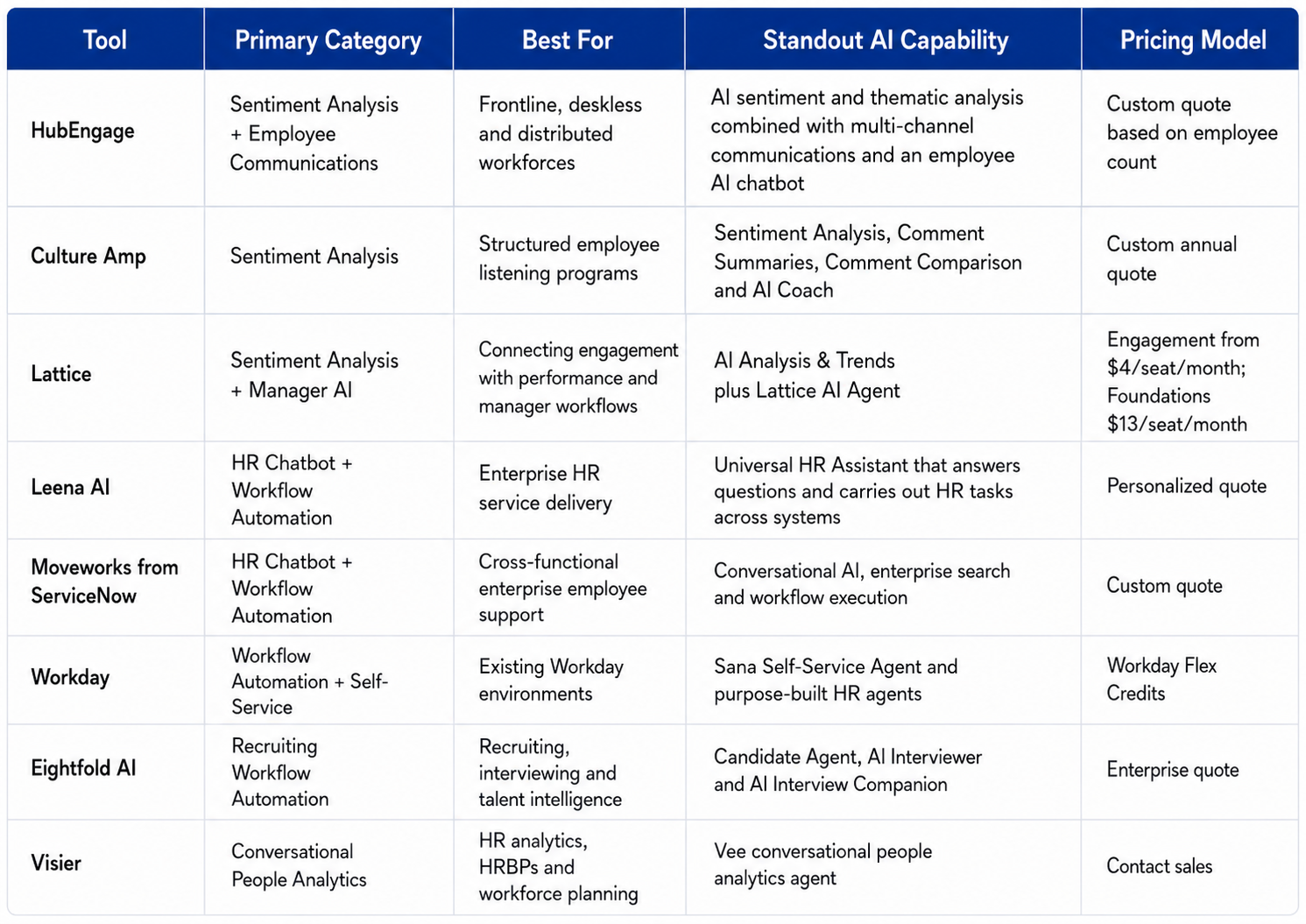
HubEngage’s current survey and communications pages document AI sentiment and thematic analysis, multi-channel distribution and its AI chatbot. Culture Amp currently lists Sentiment Analysis, Comment Summaries, Comment Comparison and AI Coach. Lattice’s current pricing page lists Engagement at $4 per seat per month and Foundations at $13 per seat per month.
How We Compared These AI Tools for HR
This is a research-based comparison, not a hands-on product test.
We reviewed each vendor’s current product pages, pricing information, documentation and recent 2025–2026 announcements. Rather than score products against a generic AI checklist, we compared the eight tools around the three categories in the title:
- Employee sentiment analysis: How effectively can HR collect, interpret and act on employee feedback?
- HR chatbots and conversational AI: Can employees ask questions, find information and complete routine HR requests through conversation?
- Workflow automation: Can the AI actually perform or coordinate HR work rather than simply generate text?
We also looked at the buyer each product is built for, its wider HR technology focus, current product availability and whether the vendor publishes pricing.
This approach is similar to the structure used by current high-quality software comparisons, which pair an early verdict and comparison table with clear “best for” positioning, methodology, detailed feature explanations and pricing rather than presenting a long list of feature names.
That may sound like a small distinction, but in our view it’s what makes a comparison like this genuinely useful. No arbitrary numerical scores were added, and vendor performance claims are not treated as independent evidence.
Why HR Teams Are Adding AI Tools Now
The notable development in 2026 isn’t simply that more HR products have an AI feature. The AI is increasingly being connected to actual HR processes.
Lattice made its AI Agent for 1:1 meetings available to customers in June 2026. Eightfold launched Candidate Agent in July 2026. Workday made Sana for Workday and its Self-Service Agent available globally in March 2026. ServiceNow, after completing its acquisition of Moveworks in December 2025, made EmployeeWorks generally available in 2026.
That changes how HR buyers should compare software.
A sentiment-analysis tool that helps interpret thousands of survey comments solves a different problem from an employee assistant that can submit a leave request. A recruiting agent that interacts with candidates is solving another problem again.
So the more useful comparison isn’t which HR platform has the most AI features. It’s which part of HR work the AI is actually designed to improve.
1. HubEngage: Best for Frontline Employee Sentiment and Communications
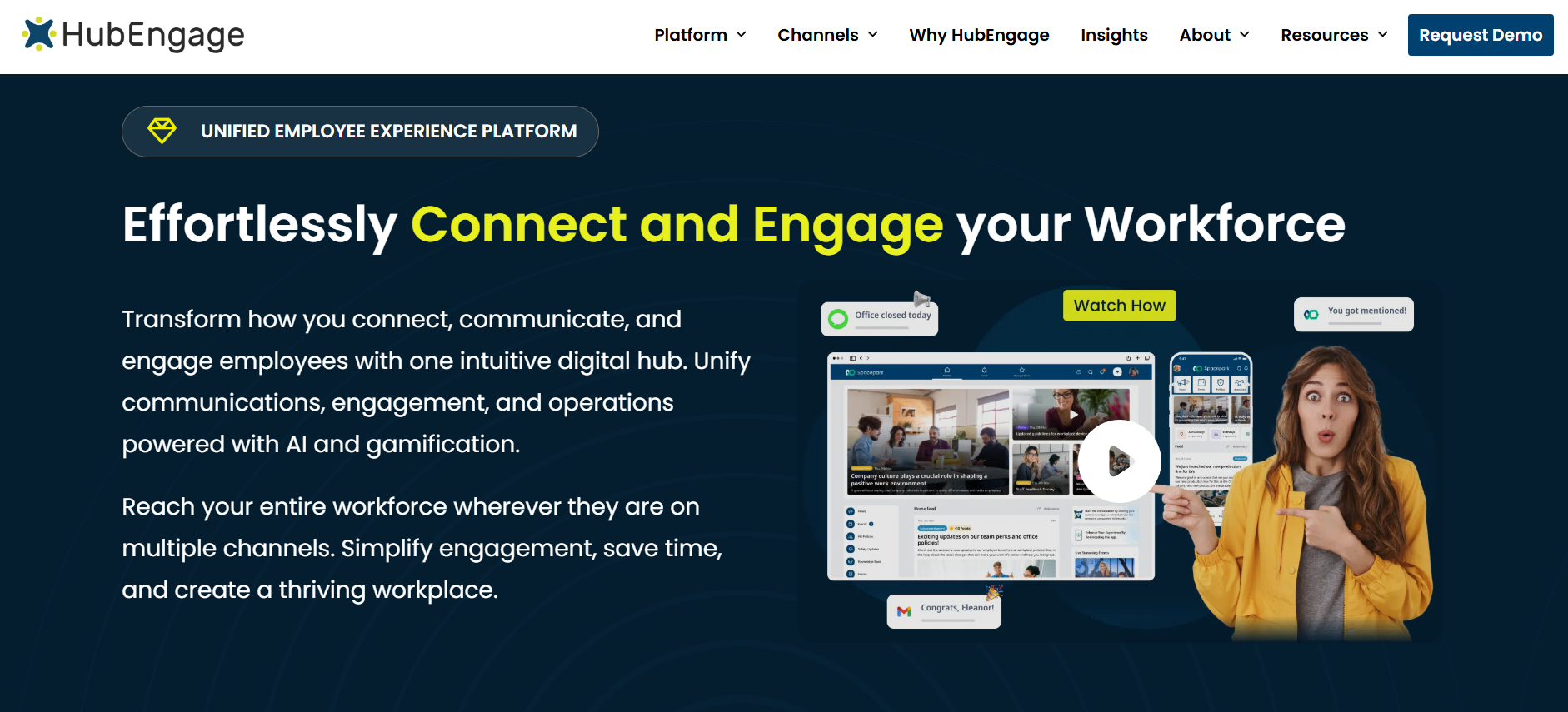
HubEngage covers internal communications, surveys and forms, recognition, social engagement, messaging and an employee AI chatbot as part of its employee experience platform.
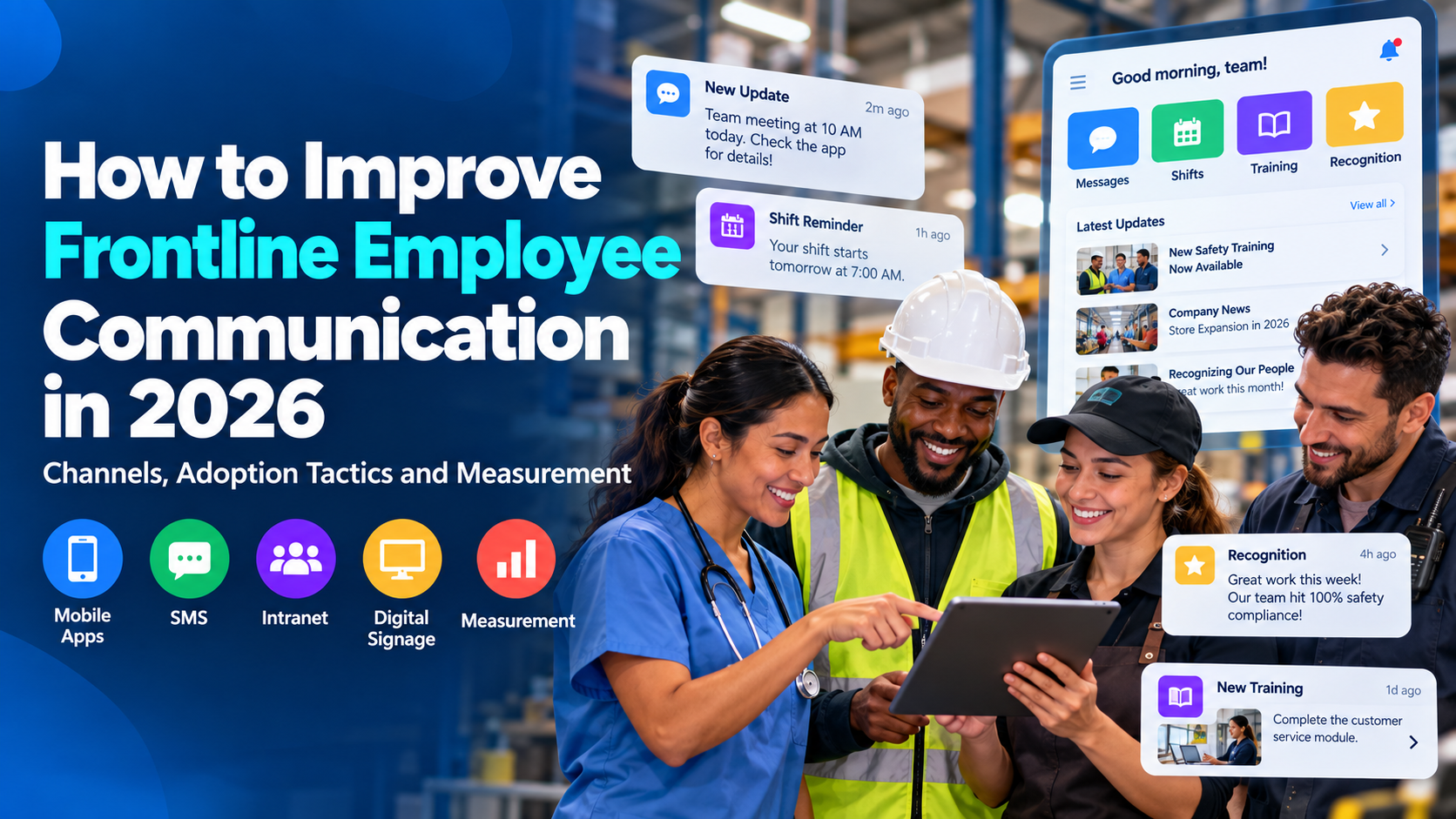
For this comparison, the clearest differentiator is how it connects employee listening and multi-channel employee communications. That matters for organizations where part of the workforce is frontline, deskless, distributed or simply doesn’t spend much of the day in corporate email.
Category: Sentiment Analysis and Employee Communications AI + Chatbot
Best for: Organizations that need to collect feedback from frontline employees and communicate with the same workforce across several channels.
What HubEngage’s AI features actually do
- AI sentiment and thematic analysis helps HR interpret open-text employee feedback. HubEngage’s Survey & Forms Hub analyzes written survey responses for sentiment and recurring themes, allowing HR teams to identify patterns without manually categorizing every response.
- Survey distribution is designed to extend beyond corporate email. Surveys can be distributed through web, mobile apps, SMS, email and digital signage. The platform also supports reminders, recurring surveys, multilingual surveys and QR-code access.
- AI is also used on the employee-communications side of the platform. HubEngage currently documents AI-assisted content creation, scheduling and translation, along with AI search and content summaries. Communications can be distributed through mobile, web, email, SMS, Microsoft Teams, Slack, WhatsApp and digital signage.
- The AI chatbot can answer questions and initiate employee actions. HubEngage says organizations can connect sources such as Google Drive, SharePoint, OneDrive, knowledge bases, LMS platforms and websites. The chatbot can also support actions such as applying for leave, filing a ticket or submitting a form.
How HubEngage compares
HubEngage overlaps with Culture Amp on employee listening, but it takes a broader approach to employee communication and reach.
Culture Amp is more specialized around survey analysis, benchmarks and structured engagement programs. Lattice connects engagement more directly with performance management. HubEngage makes more sense where feedback collection and internal communications need to reach the same distributed employee population.
That makes it particularly relevant for retail, healthcare, manufacturing, hospitality and other environments with significant frontline workforces. The appeal here is fairly straightforward: collecting feedback is more useful when you can reliably reach the people you’re asking for it from.
Organizations mainly looking for recruiting automation, advanced performance management or deep workforce analytics will find Eightfold AI, Lattice or Visier more specialized for those jobs.
Pricing: HubEngage does not publish a fixed per-user price. Its survey product states that pricing is based on employee count, with monthly, annual and multi-year contract options.
2. Culture Amp: Best for Structured Employee Sentiment Analysis
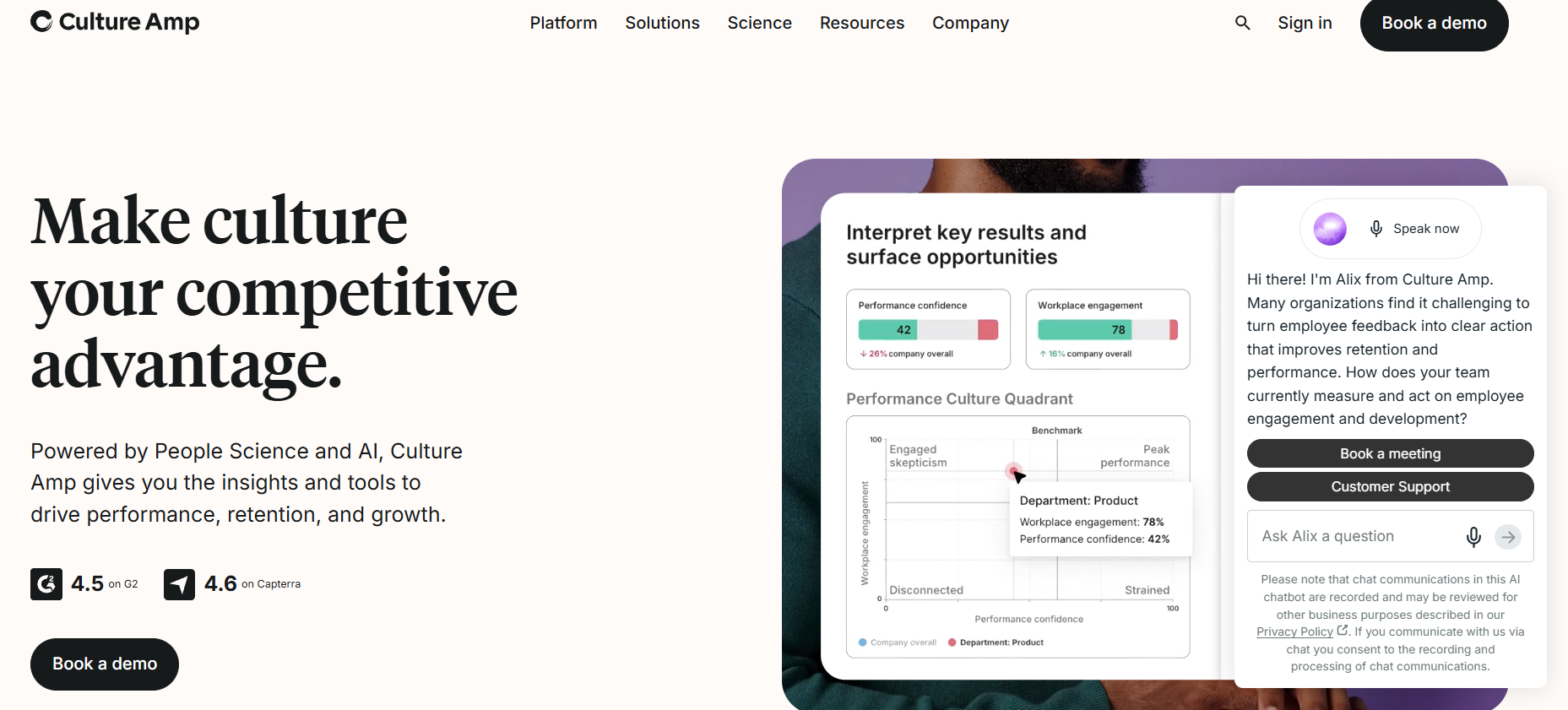
Employee listening sits much closer to the center of Culture Amp’s product. The platform covers employee engagement, performance and development, with a strong emphasis on structured feedback programs.
Its clearest fit in this comparison is structured employee listening, particularly for organizations that want survey programs, text analytics, benchmarks and AI-assisted analysis in one system.
Category: Sentiment Analysis
Best for: HR and People teams running recurring engagement, pulse, onboarding, exit or other employee-feedback programs.
What Culture Amp’s AI features actually do
- Sentiment Analysis categorizes employee comments by sentiment and topic. Culture Amp updated its sentiment and topic classification system in 2025 to use an LLM-based model that considers both the comment and the survey question when applying tags.
- AI Comment Summaries condense written survey feedback. Summaries can separate positive, negative and neutral feedback and provide topic-level summaries, giving HR teams a faster starting point when reviewing large volumes of survey comments.
- Comment Comparison helps identify differences between employee populations. The feature is designed to compare comments from higher- and lower-scoring groups so HR teams can investigate why employee experiences differ.
- AI Coach helps move from analysis toward action. Culture Amp currently lists AI Coach alongside its Engage AI capabilities, while its wider platform connects employee listening with performance and development.
Culture Amp Engage also includes engagement and pulse surveys, candidate, onboarding and exit surveys, eNPS, benchmarks, text analytics and action planning.
How Culture Amp compares
Culture Amp is the more specialized employee-listening option in this group.
Compared with HubEngage, it places more emphasis on survey science, benchmarking and structured analysis. Lattice comes at the problem from another direction, bringing engagement data closer to performance-management and 1:1 workflows.
It is also fundamentally different from Leena AI and Moveworks. Those products are primarily designed to answer employee questions and complete service requests, not to run a mature engagement-survey program.
If your central question is “What are employees telling us, and what patterns exist across the organization?”, Culture Amp is one of the most relevant options here.
Pricing: Culture Amp uses custom annual pricing based on employee count, products and service tier. Its current AI page says Culture Amp AI is presently available to users without an additional AI charge, although access still depends on the relevant Culture Amp subscription.
3. Lattice: Best for Connecting Engagement With Manager and Performance Workflows
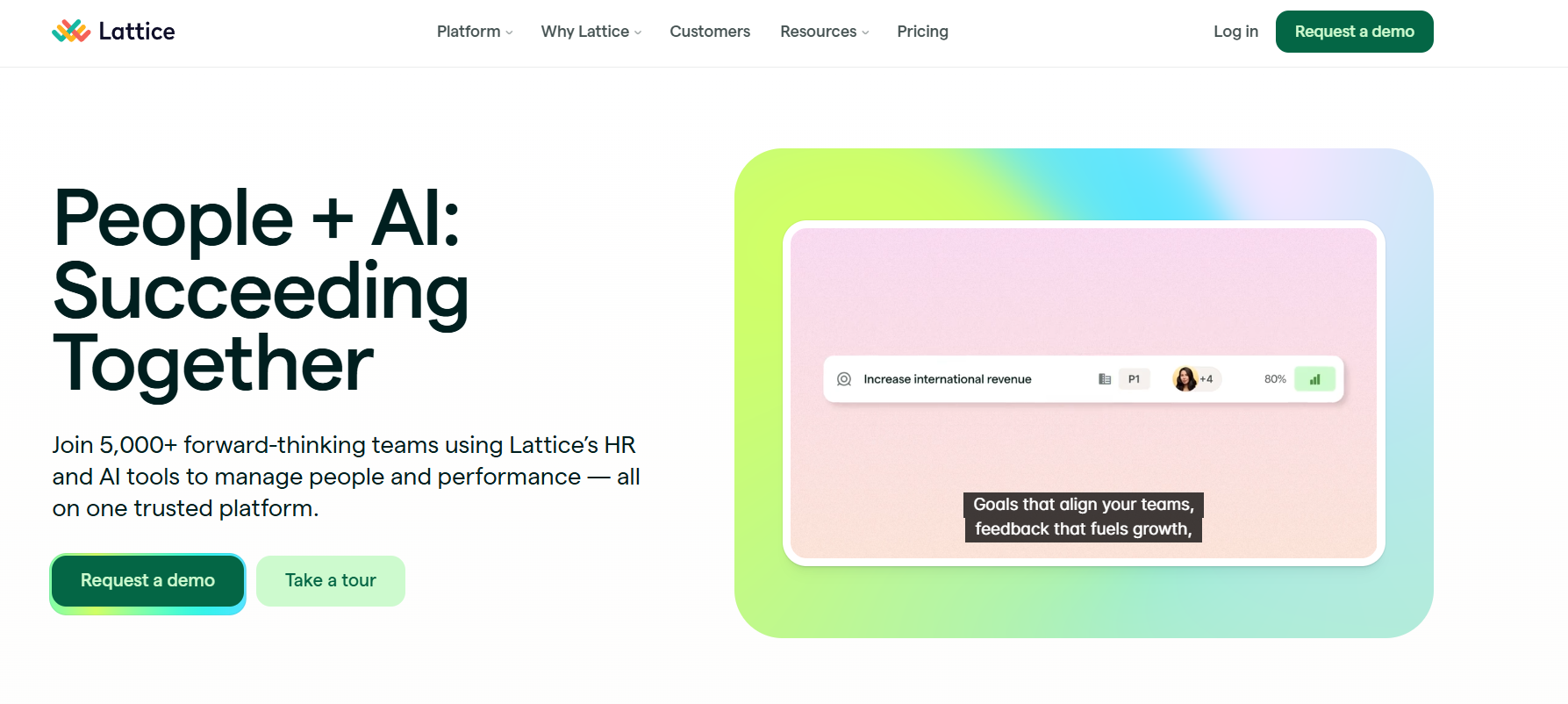
With Lattice, engagement is part of a wider system that also covers performance management, goals, career development, analytics and AI.
That puts it somewhere between a traditional sentiment platform and a broader talent-management system. Engagement data doesn’t have to sit by itself. It can be used alongside the performance, feedback and 1:1 information managers already work with in Lattice.
Category: Sentiment Analysis and Manager AI
Best for: Organizations that want employee listening connected with performance management and manager workflows.
What Lattice’s AI features actually do
- Lattice Engagement includes AI Analysis & Trends. The current product includes pulse surveys, onboarding and exit feedback, surveys, action planning, eNPS and AI-supported analysis.
- The Lattice AI Agent works with company and people information inside Lattice. The agent is positioned as more than a question-answer chatbot: it can answer HR questions, work with analytics and provide managers with contextual guidance.
- The AI Agent now works directly in 1:1 meetings. In June 2026, Lattice made this functionality available across Zoom, Google Meet and Microsoft Teams. It can produce summaries, action items, next-meeting agendas and coaching insights.
- Performance, goals and development sit in the same product family. This is the important comparison point: teams can connect engagement findings with performance reviews, feedback, goals and development rather than treating survey results as a separate HR dataset.
How Lattice compares
Lattice makes sense when employee listening is only one part of a wider manager and performance-management strategy.
Culture Amp offers deeper employee-listening specialization. HubEngage has stronger frontline communication and distribution overlap. Lattice’s particular strength in this comparison is that engagement data sits closer to the manager’s everyday workflow.
It is less suited than Leena AI or Moveworks to high-volume HR service requests such as policy questions, leave administration or employee helpdesk automation.
Pricing: Lattice currently lists Engagement at $4 per seat per month, Performance at $10 per seat per month, and Foundations at $13 per seat per month. Contracts are billed annually, and Lattice lists a $4,000 minimum annual agreement.
4. Leena AI: Best for Enterprise HR Service Delivery
Leena AI’s current product story goes well beyond the idea of a simple FAQ chatbot. It is an enterprise agentic-AI platform with prebuilt AI assistants for HR, IT and finance.
Its HR product is currently centered on Harrison, its Universal HR Assistant. Harrison is designed to answer common employee questions and perform HR work across connected enterprise systems.
Category: HR Chatbot and Workflow Automation
Best for: Enterprise HR operations and shared-services teams managing large volumes of routine employee requests.
What Leena AI’s HR features actually do
- The Universal HR Assistant covers common Tier-1 HR requests. Current use cases include leave and attendance questions, benefits, payroll queries, reimbursement support and onboarding-related work.
- Leena can update connected enterprise systems rather than only returning an answer. The current HR page documents actions across systems such as Workday and ServiceNow and positions the assistant as a way to update multiple systems from the same conversational interaction.
- Employees can access the assistant across common workplace channels. Leena currently lists mobile, web, Microsoft Teams, Slack and phone as supported touchpoints.
- Its integration layer is built for enterprise HR stacks. Leena says more than 200 additional enterprise integrations are available alongside its pre-connected systems.
How Leena AI compares
Leena AI sits much closer to Moveworks than it does to Culture Amp or HubEngage.
Its main job is employee service delivery. In practical terms, that means helping employees get answers and complete routine HR work without every request ending up with the HR service desk.
The distinction between Leena and Moveworks is mostly one of scope and platform positioning. Leena now markets specialized AI Colleagues for back-office functions, while Moveworks has a broader enterprise-assistant and search heritage and is now part of ServiceNow.
Neither should be the first choice if the main goal is a sophisticated employee-engagement survey program.
Pricing: Leena AI’s current HR Service Delivery pricing page offers personalized quotes tailored to the organization’s requirements rather than a fixed public price.
5. Moveworks from ServiceNow: Best for Cross-Functional Employee Support
Moveworks combines conversational AI, enterprise search and workflow execution across HR, IT, finance and other workplace functions.
One current detail matters here. ServiceNow completed its acquisition of Moveworks on December 15, 2025. Moveworks technology is now being integrated more deeply with the ServiceNow AI platform.
Category: HR Chatbot and Workflow Automation
Best for: Large enterprises that want one conversational employee-support layer spanning HR and other business functions.
What Moveworks does for HR
- Employees can use natural language for common HR needs. Moveworks currently highlights onboarding, enterprise search, PTO, payslips and profile changes as HR use cases.
- The platform combines search with action. Moveworks can search knowledge and business systems and then automate workflows, which is an important distinction from a chatbot that only retrieves answers.
- HR teams can automate routine requests, triage and approval paths. Moveworks’ current HR product positioning includes task automation and employee self-service across the employee lifecycle.
- The ServiceNow combination is already visible in EmployeeWorks. ServiceNow introduced EmployeeWorks in February 2026, combining Moveworks’ conversational AI and enterprise search with ServiceNow’s portal and workflows. ServiceNow states that EmployeeWorks is generally available.
How Moveworks compares
Moveworks is one of the broader platforms in this comparison.
Leena AI is also strong in HR service delivery, but Moveworks’ value becomes particularly clear when employee requests regularly cross HR, IT, finance and other departments. That broader reach is useful, although it also explains why the product isn’t a direct substitute for a dedicated employee-listening system.
Organizations primarily evaluating sentiment analysis should look more closely at HubEngage, Culture Amp or Lattice.
Pricing: Moveworks does not publish a standard list price. Its current pricing page offers flexible custom pricing based on organizational requirements and package scope.
6. Workday: Best for AI Inside Existing HCM Workflows
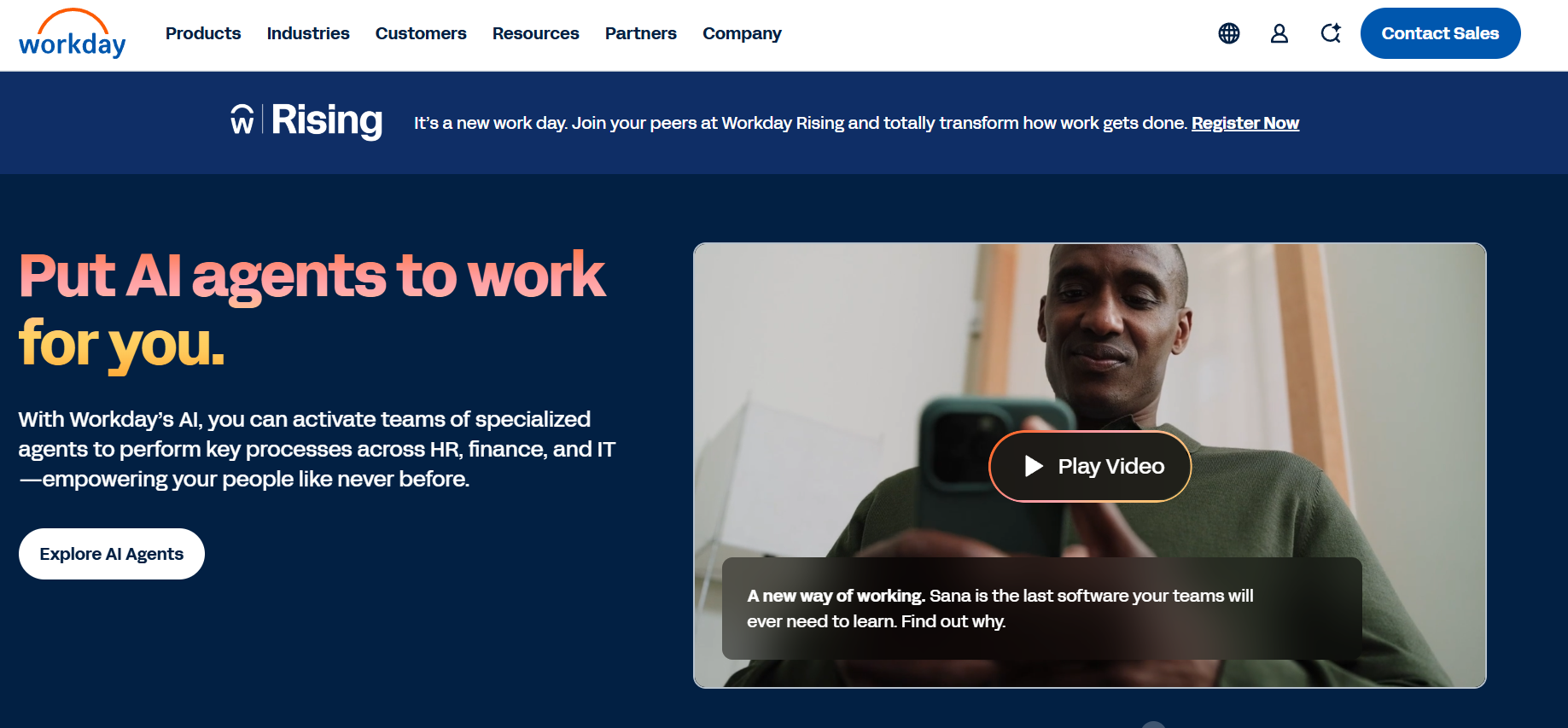
Workday’s 2026 AI offering is increasingly centered on Sana and purpose-built AI agents working inside HR and finance processes already managed through Workday.
For existing Workday customers, that makes the proposition quite different from adding another standalone HR chatbot.
Category: Workflow Automation and Employee Self-Service
Best for: Organizations already using Workday HCM that want AI connected directly to existing HR data and workflows.
What Workday’s AI features actually do
- Sana Self-Service Agent handles employee questions and routine tasks. Workday made Sana for Workday and Self-Service Agent available globally in March 2026. The agent launched with more than 300 skills across areas including pay, time and absence.
- Employees can complete common HR actions conversationally. Current examples include checking time-off balances, viewing payslips, updating personal details and requesting leave. The Self-Service Agent is also available through Microsoft 365 Copilot and Gemini Enterprise.
- Workday currently lists several HR-specific agents. Its agent catalog includes Candidate Experience Agent, Recruiting Agent, Talent Mobility Agent, Frontline Agent and Payroll Agent, among others.
- These agents are designed to perform work, not simply answer questions. Workday states that agents can complete tasks and support multistep processes within existing organizational controls and permissions.
How Workday compares
Workday is most compelling when the buyer already has substantial HR operations inside Workday.
Instead of adding a separate employee assistant and rebuilding integrations around it, Sana and Workday agents can work closer to the existing HCM environment. That’s a meaningful advantage for the right buyer, but only if the broader Workday context already makes sense.
It also makes Workday a less direct comparison to Culture Amp or HubEngage. Those tools have employee listening or engagement closer to the center of their value proposition.
For a company that does not already use Workday, the buying decision is substantially larger than selecting an individual AI HR tool.
Pricing: Workday AI agents are purchased through Workday Flex Credits. Workday describes this as a usage-based model, and Workday subscriptions include an allocation of credits. Workday does not publish a single standard dollar price that applies to every HR AI deployment.
7. Eightfold AI: Best for Recruiting and Talent Workflow Automation
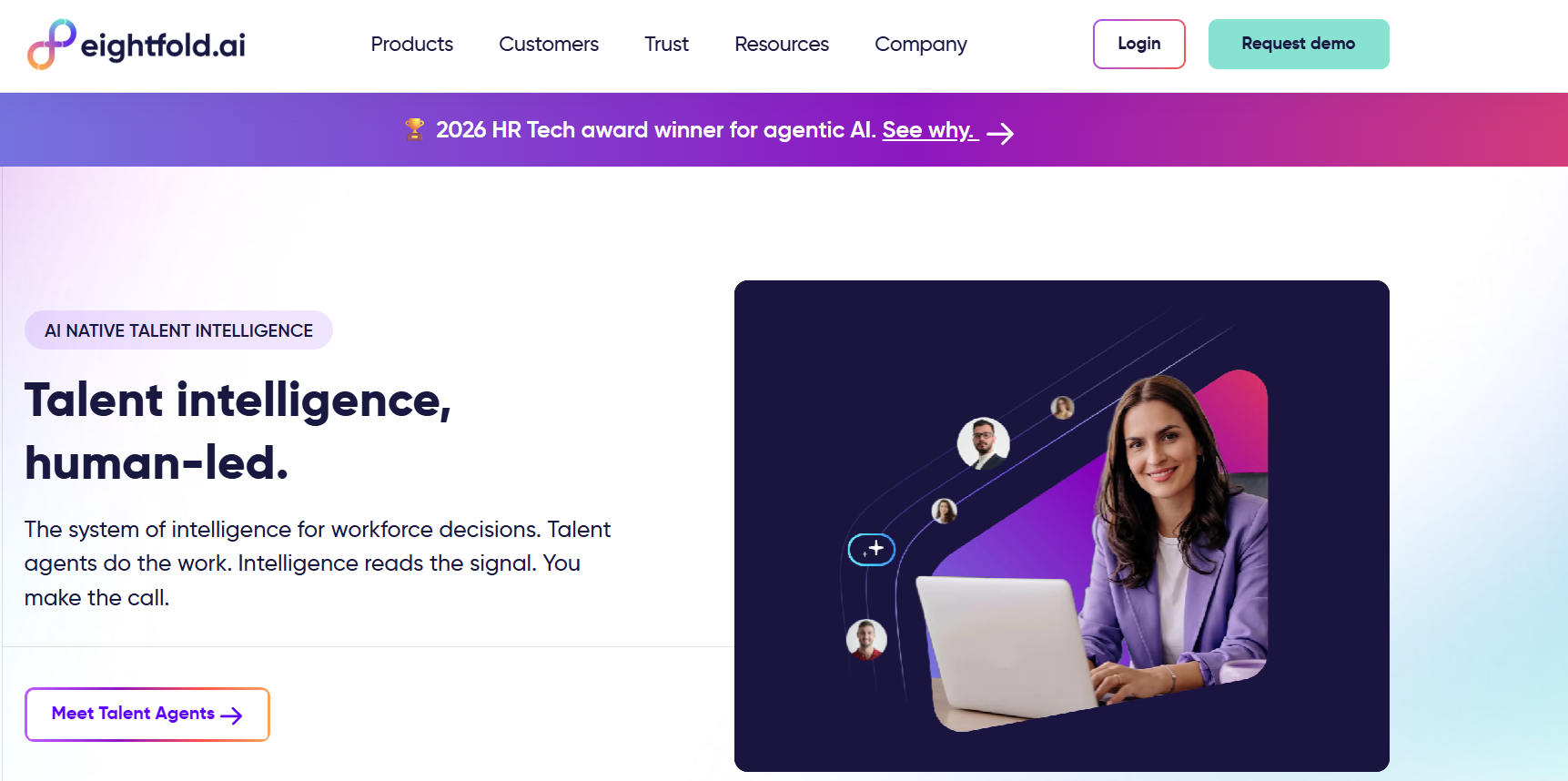
Recruiting and talent intelligence are the center of Eightfold AI’s product rather than an adjacent use case. The platform focuses on recruiting, talent management, workforce planning, internal mobility and skills.
Its 2026 product direction is increasingly centered on Talent Agents that participate in specific stages of the hiring process.
Category: Recruiting and Talent Workflow Automation
Best for: Talent acquisition teams, high-volume recruiting environments and enterprises building skills-based hiring processes.
What Eightfold AI’s features actually do
- Candidate Agent manages a conversational candidate journey. Eightfold introduced Candidate Agent on July 15, 2026. It covers role discovery, applications, scheduling, reminders and interview handoff. It supports more than 24 languages and channels including SMS and WhatsApp. Candidate Agent is generally available for organizations with Eightfold’s Personal Career Site enabled.
- AI Interviewer is designed for AI-led interviewing at scale. Eightfold originally launched AI Interviewer in 2025 and expanded its Talent Agents further in 2026 to support additional interview scenarios.
- AI Interview Companion assists human interviewers. It joins human-led interviews in Zoom, Google Meet or Microsoft Teams, records and takes notes, can provide private prompts and produces a structured feedback draft for the interviewer to review.
- The technology sits inside a broader talent-intelligence platform. This connects recruiting workflows with Eightfold’s talent acquisition and talent-management products rather than treating interviewing as an isolated AI feature.
How Eightfold AI compares
Eightfold AI is the most recruiting-specific option in this group.
It isn’t a direct substitute for Culture Amp’s employee-listening capabilities, HubEngage’s frontline communications, or Leena AI’s HR service desk automation. Its role in this list is different.
That matters because “workflow automation” in HR includes recruiting workflows as well as employee administration.
If the question is “Which AI HR tool is built specifically around recruiting and talent workflows?”, Eightfold is one of the clearest fits among these eight.
Pricing: Eightfold AI does not display a standard public list price on the current product pages reviewed. Enterprise buyers are directed to request a demo and discuss deployment with the company.
8. Visier: Best for Conversational People Analytics
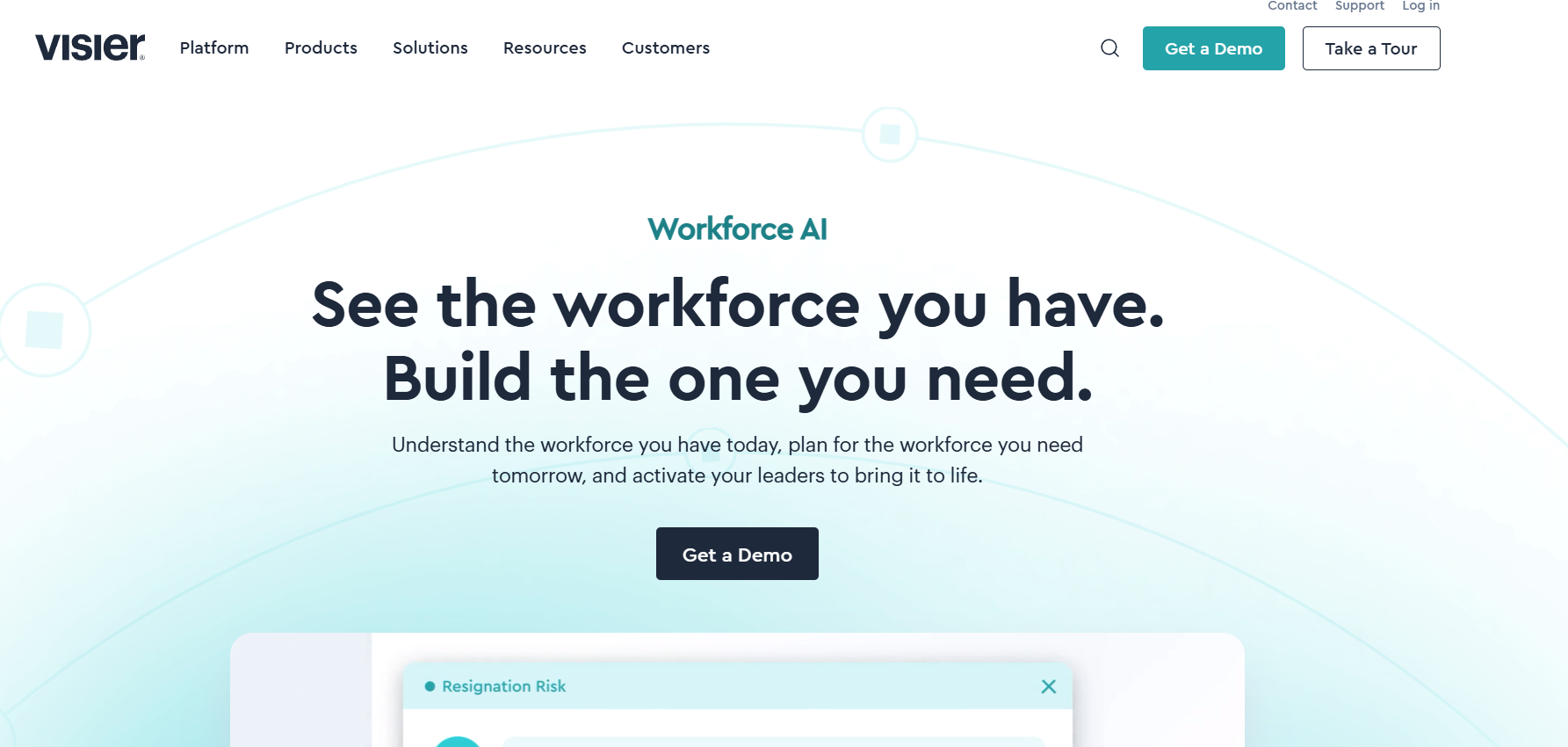
Visier approaches HR AI through workforce intelligence and people analytics rather than employee service delivery or communications.
Its main AI differentiator here is Vee, a conversational people-analytics agent that lets HR leaders, HRBPs and managers ask workforce questions in natural language rather than requiring every question to become a new dashboard or analyst request.
Category: Conversational AI and People Analytics
Best for: People analytics teams, CHROs, HRBPs and managers that need easier access to workforce data.
What Visier’s AI features actually do
- Vee answers people-data questions in natural language. Users can ask workforce questions and receive contextual answers without needing an analytics background. Vee can also suggest follow-up questions to continue the analysis.
- Vee is available in several work environments. Visier currently supports Vee in Microsoft Copilot, Microsoft Teams, Slack and Visier itself, as well as integrations through APIs.
- Vee Boards apply AI to executive workforce analysis. The boards are designed to identify trends, outliers and areas of concern and explain workforce information in a form intended for business leaders.
- Visier has continued updating Vee in 2026. Its Winter 2026 release made Vee for Slack available and moved usage-based tuning into general availability. Visier also now bundles its MCP Server with Vee so governed people data can be connected to compatible AI agents.
How Visier compares
Vee is a conversational AI product, but it shouldn’t be confused with an HR service chatbot.
Leena AI and Moveworks answer questions such as “How much leave do I have, and can I submit a request?”
Visier is better suited to questions such as “How has regrettable turnover changed in this part of the organization?”
That’s a useful distinction. Visier is one of the strongest specialist options for people analytics in this comparison, but it isn’t the obvious choice for employee communications, survey distribution or transactional HR support.
Pricing: Visier does not display standard public pricing for Vee or Visier People on its current product pages. Buyers are directed to request a demo or speak with sales.
Which AI HR Tool Should You Choose?
The eight platforms become much easier to compare once you start with the problem rather than the product.
Choose HubEngage if the priority is employee sentiment plus frontline employee communications, particularly when surveys and information need to reach workers beyond corporate email.
Choose Culture Amp if the priority is structured employee listening, sentiment analysis, survey benchmarks and action planning.
Choose Lattice if you want employee engagement connected with performance reviews, 1:1s and manager workflows.
Choose Leena AI if the main problem is HR service delivery and you want employees to get answers and complete routine requests across several HR systems.
Choose Moveworks from ServiceNow if you need cross-functional employee self-service spanning HR, IT and other enterprise systems.
Choose Workday if you already run substantial HR processes on Workday and want AI agents embedded into those existing workflows.
Choose Eightfold AI if your priority is recruiting, interviewing and talent workflow automation.
Choose Visier if you want HR leaders and managers to query workforce analytics conversationally.
No tool in this list is the best fit for every one of those scenarios. That’s exactly why comparing them only by the number of AI features listed on a product page doesn’t tell you very much.
Frequently Asked Questions
What are the best AI tools for HR teams in 2026?
The best AI tools for HR teams in 2026 include HubEngage, Culture Amp, Lattice, Leena AI, Moveworks from ServiceNow, Workday, Eightfold AI and Visier.
HubEngage, Culture Amp and Lattice are the most relevant options in this comparison for employee sentiment and engagement. Leena AI and Moveworks focus more heavily on HR chatbots and employee self-service. Workday is suited to AI automation inside HCM workflows, Eightfold AI specializes in recruiting and talent automation, and Visier specializes in conversational people analytics.
Which AI tool is best for employee sentiment analysis?
For employee sentiment analysis, HubEngage, Culture Amp and Lattice take different approaches.
HubEngage connects AI sentiment and thematic analysis with multi-channel survey distribution and employee communications. Culture Amp provides dedicated sentiment analysis, text analytics and AI comment analysis inside a mature employee-listening platform. Lattice combines engagement analysis with performance and manager workflows.
The best fit depends on whether your broader requirement is frontline communication, structured employee listening or performance management.
How does AI sentiment analysis work in HR software?
AI sentiment analysis processes written employee feedback to identify patterns such as positive, negative or neutral sentiment, recurring themes and topics.
Its main value is scale. Instead of manually categorizing hundreds or thousands of open-text survey responses, HR teams can identify patterns first, then investigate the comments behind those patterns.
Culture Amp, for example, uses an LLM-based system for sentiment and topic tagging, while HubEngage documents AI-driven sentiment and thematic analysis for employee surveys.
Do AI HR chatbots replace HR employees?
The current products in this comparison are primarily designed to automate repeatable HR service work and assist employees, not remove the need for HR teams.
Leena AI can handle routine areas such as leave, benefits and payroll questions. Moveworks supports HR self-service and workflow automation. Workday explicitly states that its agents are designed to augment human workers rather than replace them.
Employee relations, sensitive cases, policy decisions, organizational planning and situations requiring judgment still require human involvement.
What is the difference between employee engagement and employee experience?
Employee experience covers the broader relationship an employee has with an organization, including recruiting, onboarding, everyday work, communication, development and departure.
Employee engagement is more specifically about how connected, motivated and involved employees feel within that experience.
This matters when comparing HR software. A dedicated engagement product may concentrate on surveys and feedback, while an employee experience platform can also include communication, recognition, knowledge access, employee support and other workplace interactions.
How should you evaluate an AI HR tool?
Start with a specific workflow or employee problem.
If your priority is employee feedback, compare survey reach, sentiment analysis, segmentation and action planning.
If it is employee self-service, test the quality of answers, permissions, connected data sources and which actions the chatbot can actually complete.
If it is workflow automation, identify which steps the AI executes, where human approvals remain and which HRIS or business applications it connects with.
For a frontline workforce, also test how employees access the product. Mobile, SMS, digital signage or other non-email channels may materially affect adoption.
For people analytics, evaluate data governance and whether managers can safely access only the workforce information they are authorized to see.
Final Take
The best AI HR tool in 2026 depends on the HR problem being solved.
HubEngage combines employee sentiment with frontline communications. Culture Amp specializes in structured employee listening. Lattice links engagement with performance and manager workflows. Leena AI and Moveworks focus on employee self-service. Workday embeds AI into HCM processes. Eightfold AI concentrates on recruiting and talent automation. Visier makes workforce analytics conversational.
That makes the most useful buying question simple: Do you need AI to understand employees, answer employees, automate HR work, improve hiring, or analyze workforce data?
Once that question is clear, the shortlist becomes much easier to build.