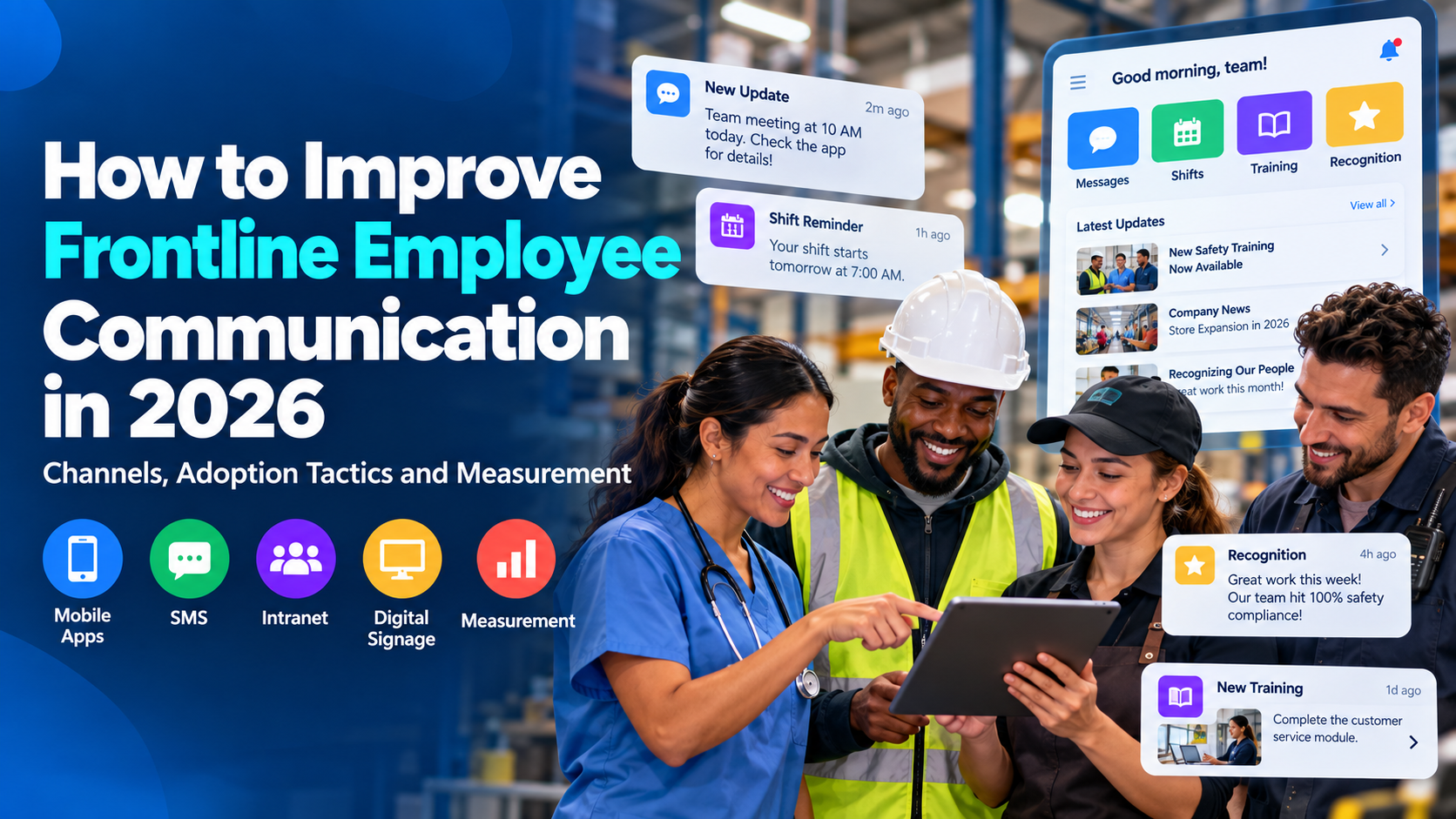
The nine platforms worth comparing for employee recognition across frontline, remote and hybrid teams in 2026 are HubEngage, Chime Workplace, Bonusly, Nectar, Motivosity, Awardco, Achievers, Guusto and Workhuman.
After looking closely at how each platform handles recognition, frontline access, delivery methods, analytics and pricing, we’ve placed HubEngage first for this particular use case. The reason is fairly practical. Recognition sits alongside employee communications, frontline task management, surveys, social engagement and multi-channel delivery, which makes it relevant for employers looking for a task management and recognition tool for frontline staff, not just a standalone recognition feed.
That doesn’t make it the automatic choice for every company. The rest of the shortlist gets more interesting once you narrow down what you actually need.
Bonusly, Nectar and Motivosity are strong options when frequent peer recognition across distributed teams is the priority. Awardco, Achievers and Workhuman are better suited to larger and more structured recognition programs. Guusto is particularly worth looking at when employees don’t regularly have email or desktop access.
Chime Workplace is the outlier in the group, and that’s worth explaining upfront. It isn’t a conventional peer-to-peer employee recognition platform. We’ve included it because Salt gives employers a way to reward hourly and frontline employees based on time worked and selected workforce behaviors, while connecting those rewards with a broader financial wellness offering.
If recognition is only one part of a wider deskless-workforce problem, our guide to improving frontline employee engagement across distributed teams looks at communication, manager support, tools and execution together.
For this comparison, we checked current vendor feature, pricing and frontline-access pages rather than relying on older recognition-software roundups. Where a vendor doesn’t publish pricing or a capability couldn’t be verified from its current materials, we’ve said so rather than filling in the gaps.
How to Recognize Frontline Employees
The best way to recognize frontline employees is to make recognition frequent, specific and easy to receive during the normal workday. A warehouse associate, nurse or store employee shouldn’t need a laptop or corporate inbox just to see that their work was noticed.
In practice, that means recognition has to fit the way frontline employees actually work. A program that looks good inside an HR dashboard but rarely reaches the shop floor isn’t doing much.
A practical recognition program should combine:
- Manager recognition for strong performance, safety, customer service and other observable work.
- Peer-to-peer recognition so appreciation doesn’t depend entirely on supervisors.
- Recognition tied to real moments, such as shift achievements, project completion, training, service milestones or customer praise.
- Mobile, SMS, QR-code, kiosk, print or shared-screen delivery for employees who don’t work at desks.
- Consistent follow-through so recognition happens throughout the year rather than only during annual awards.
Recognition also works better when the message says what the employee actually did well. Managers looking for practical wording can use these positive feedback examples for common workplace situations as a starting point rather than falling back on generic praise.
Good frontline engagement software should make all of this easier without turning every thank-you into a complicated HR workflow.
Best Employee Recognition Software Compared
| Tool | Best For | Frontline/Deskless Support | Standout Feature | Pricing Model |
| HubEngage | Frontline recognition tied to broader employee engagement | Yes | Recognition connected with communications, tasks, and platform-wide gamification | Custom quote |
| Chime Workplace | Hourly-worker rewards and financial wellness | Yes | Salt rewards employees for time worked and selected behaviors | No cost for Chime Workplace; certain optional service fees may apply |
| Bonusly | Peer recognition for distributed and hybrid teams | Yes | Social recognition, rewards and manager insights across web and mobile | Free up to 8 users; Team from $5/user/month; Organization custom |
| Nectar | Frontline, remote and hybrid recognition programs | Yes | Recognition without requiring a work email, plus SMS, mobile and Kiosk Mode | Custom quote |
| Motivosity | Recognition plus workplace culture and connection | Yes | Native mobile app, ThanksCards and multiple recognition formats | Custom quote |
| Awardco | Enterprise and deskless recognition programs | Yes | AwardCodes in the U.S., plus mobile, kiosk and SMS recognition options | Custom quote; small-business packages available from $3,000 |
| Achievers | Global enterprise recognition | Yes | Recognition across mobile, desktop, QR codes, cards and kiosks | Custom quote |
| Guusto | Frontline and offline recognition | Yes | SMS, QR, print, mobile and manager-routed recognition | Free plan; Lite $150/month; seat-based Essential and Premium plans |
| Workhuman | Large global recognition programs and recognition analytics | Yes | Social Recognition plus Human Intelligence and Workhuman iQ | Contact Workhuman for commercial pricing |
1. HubEngage
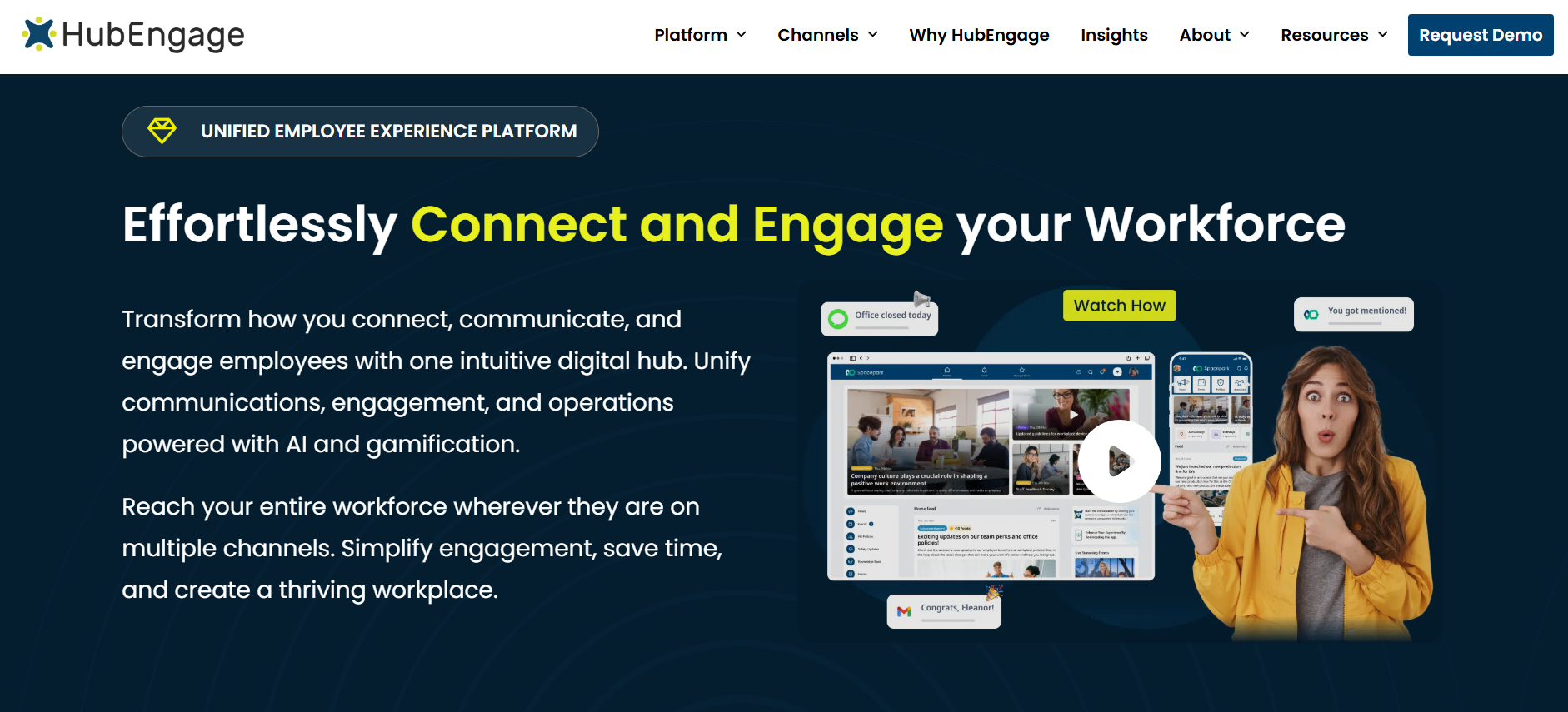
HubEngage approaches recognition as one part of a wider employee engagement platform for frontline workers, remote teams and office employees. Instead of asking employers to run recognition in a separate app, it can sit alongside communications, surveys, social engagement, messaging and workforce tools such as task management.
That broader setup is what makes HubEngage relevant here. The recognition program can be connected to other ways employees already interact with the organization rather than becoming another destination they have to remember to visit.
Best for: Organizations that want recognition tied to frontline communication, engagement and daily workforce activity.
Key features
- Peer and manager recognition can reinforce specific achievements and company values, with customizable recognition programs rather than only generic thank-you messages.
- Milestone recognition can be automated for events such as birthdays, work anniversaries and other recurring employee moments.
- Points, gift cards and gamification can be attached to recognition and wider participation, including communications, surveys and social activity.
- Recognition can be surfaced across web, mobile apps, email, SMS and digital displays, helping companies reach employees outside the traditional office.
- Recognition Score and analytics help administrators track activity, identify top recognizers and performers, and see how employees are participating in the program.
One reason HubEngage fits this particular list is that recognition isn’t isolated from daily operations. Its workforce-management capabilities also include task creation, assignment, tracking and status visibility alongside communication and engagement tools.
That overlap is useful when recognition needs to reflect real frontline work rather than live in a separate HR feed. For a closer look at that operating layer, see our guide to task management for frontline teams.
Frontline/remote/hybrid fit: Strong. HubEngage offers iOS and Android employee apps and supports communications and recognition across mobile, web, SMS, email and digital signage. Some content can be cached offline, although full platform access requires an internet connection.
Pricing: Custom quote based on employee count and selected modules. HubEngage does not publish a fixed recognition-only list price on its current Recognition Hub page.
2. Chime Workplace
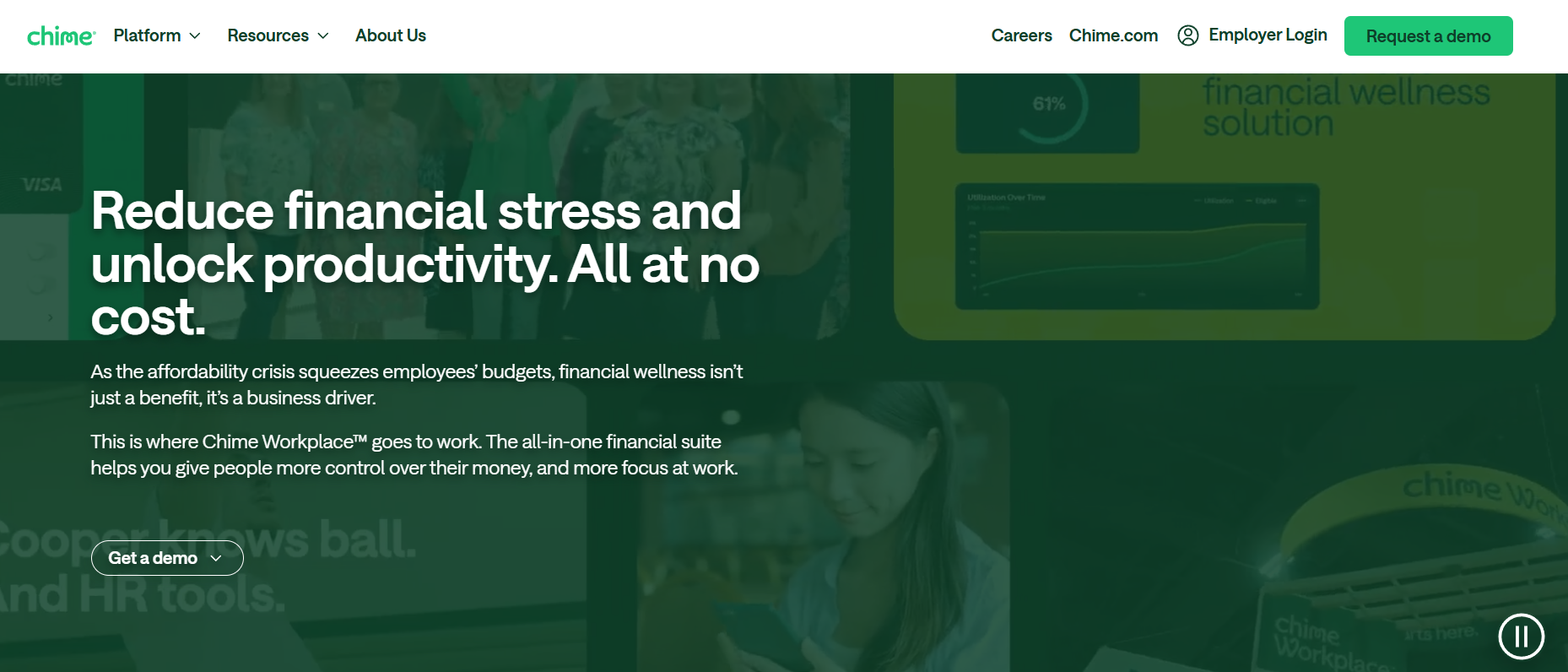
Chime Workplace needs a bit more context than most of the products on this list. It is primarily an employee financial wellness platform, not a conventional peer-to-peer recognition platform.
Its employee rewards component comes through Salt, which became part of Chime’s enterprise offering after Chime acquired Salt Labs. The model is built especially around hourly and frontline workers, with rewards connected to work itself and selected workforce behaviors.
So this isn’t the platform we’d compare with Bonusly or Nectar feature for feature. It belongs here because it tackles employee rewards from a different angle.
Best for: Employers that want frontline rewards tied closely to hourly work and financial wellness.
Key features
- Employees earn Salt based on hours worked, with each hour worked converting into Salt under the current program model.
- Challenges and badges can be used to encourage behaviors such as shift coverage and training completion.
- Employees can work toward their own reward goals, rather than relying only on manager-issued awards.
- Chime Workplace combines rewards with earned wage access, savings, credit-building and financial education tools.
- Employers receive centralized workforce financial-health reporting, covering areas such as savings, credit progress and platform engagement.
Frontline/remote/hybrid fit: Strong for hourly and frontline workforces. Chime explicitly positions Salt around frontline workers, and its broader Chime Workplace offering is being deployed with large frontline employers.
Pricing: Chime Workplace says its financial wellness suite is offered at no cost to employers and employees, although certain optional fees can apply to individual services.
Manager analytics: Partial, but not in the way the recognition query usually means. Chime Workplace provides employers with a centralized dashboard and reporting on financial-health outcomes and platform engagement.
Current official Chime materials do not document manager-facing recognition-pattern analytics that identify high-performing teams based on recognition frequency, peer-recognition patterns or recognition-driven engagement trends.
That’s an important distinction. If recognition analytics is the main buying requirement, Chime Workplace isn’t a like-for-like substitute for platforms such as HubEngage, Bonusly, Achievers or Workhuman.
3. Bonusly
Bonusly keeps the recognition experience fairly straightforward: employees recognize one another, attach rewards where appropriate and make appreciation visible to the wider team.
That model works naturally for remote and hybrid organizations because recognition can happen inside Slack, Microsoft Teams, the Bonusly web experience or its mobile apps. Bonusly has also added more explicit frontline support, so the old description of it as mostly a desk-worker tool is increasingly incomplete.
Best for: Companies that want straightforward peer-to-peer recognition across distributed, hybrid and mobile teams.
Key features
- Employees can give peer recognition and redeem rewards from iOS and Android, so using Bonusly doesn’t require returning to a desktop.
- Recognition integrates directly with Slack and Microsoft Teams, which works particularly well for remote and hybrid teams already spending their day in those tools.
- Automated milestone celebrations cover recurring events such as birthdays and work anniversaries.
- Manager and company analytics can surface recognition trends, top performers and engagement levels, with broader company-wide analytics and recognition quality reporting available in the Organization plan.
- Digital signage and QR-based use cases extend recognition into physical workplaces, including retail and other frontline environments.
Frontline/remote/hybrid fit: Strong. Bonusly’s current pricing materials explicitly position its mobile app for field teams, frontline staff and production employees. Its retail use cases also include mobile access, QR codes and digital signage.
Pricing: The Free plan supports up to 8 users. Team + Bizy is listed at $5/user/month, or $50/user/year on annual pricing. Bonusly also says Team without Bizy is available for $3/user/month or $30/user/year. Organization + Bizy uses custom pricing.
For smaller distributed teams, Bonusly is one of the easier products here to test before committing to a larger sales process. That’s a practical advantage when the team doesn’t yet know how much recognition software it’ll actually use.
4. Nectar
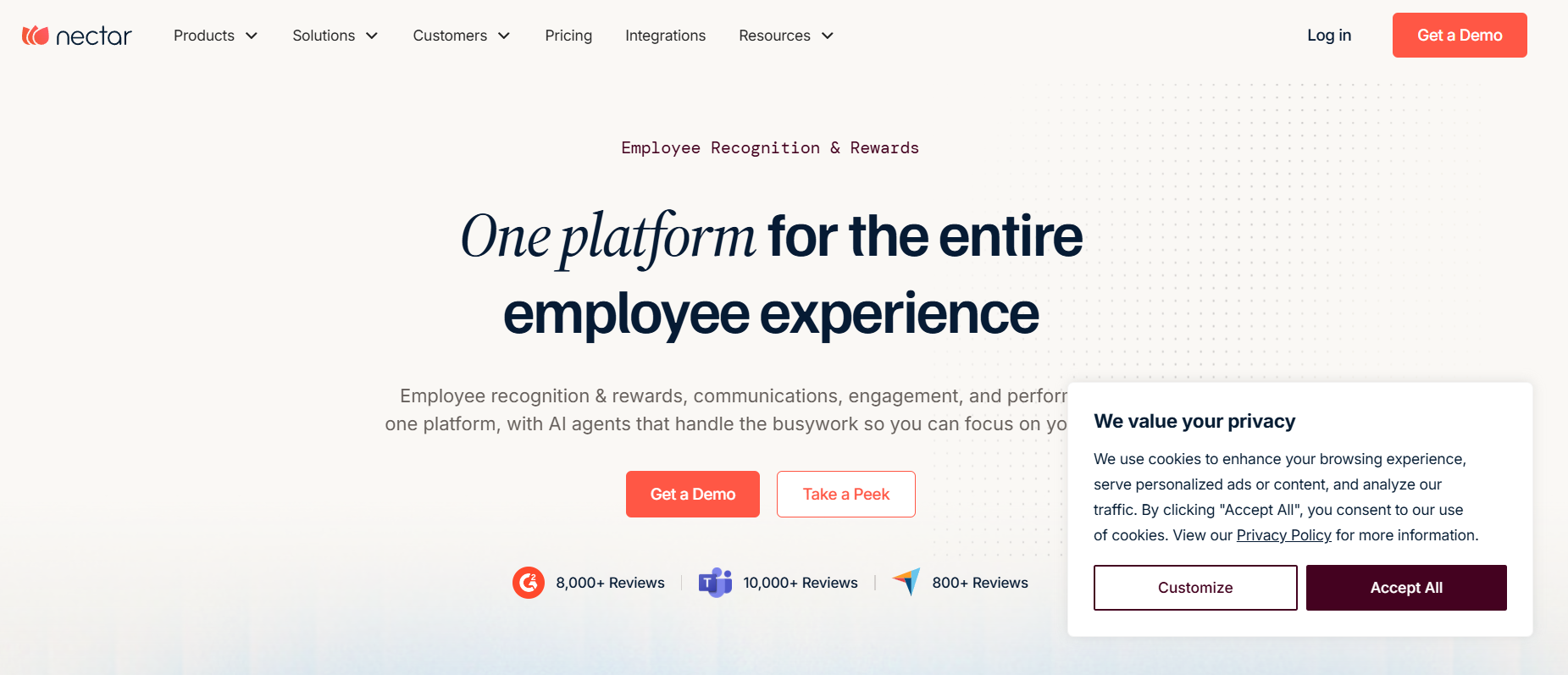
Nectar has expanded beyond basic recognition into a broader employee experience platform, but recognition and rewards still sit at the heart of the product.
The reason it stands out in this list is simple: current Nectar materials explicitly account for employees who don’t have a work email or a desk. That’s a small sentence with a fairly big implication for manufacturing, retail and other shift-based workplaces.
Best for: Companies that want one recognition program to work across frontline, remote and office employees.
Key features
- Peer-to-peer and manager recognition can be tied to company values, with points-based rewards and a public recognition feed.
- Automated milestones cover birthdays and work anniversaries, reducing the amount of manual recognition administration.
- Recognition analytics and engagement reporting help HR teams review program activity, rather than treating recognition as an unmeasured social feed.
- Kiosk Mode and mobile access extend the program to shared-device and deskless environments, including manufacturing and shift-based workplaces.
- Community Recognition can bring customer appreciation into the employee recognition program, allowing external praise to be surfaced internally.
Frontline/remote/hybrid fit: Very strong. Nectar states that employees do not need a work email or a desk. Recognition, announcements and surveys can reach employees through text, Slack, Microsoft Teams or the mobile app. Its frontline bundles also include SMS notifications, Kiosk Mode and mobile access.
Remote and hybrid teams are covered without needing a separate version of the recognition program. Slack, Microsoft Teams, mobile recognition, announcements and engagement surveys give those employees several ways to participate.
Pricing: Custom quote. Nectar’s current pricing pages say pricing depends on team size and the products selected. Companies can begin with recognition and add other Nectar products later.
Nectar is especially worth comparing when the workforce mix is messy. Some employees may be in Teams all day, while others have nothing more than a phone or shared kiosk. One system handling both groups is the real appeal.
5. Motivosity
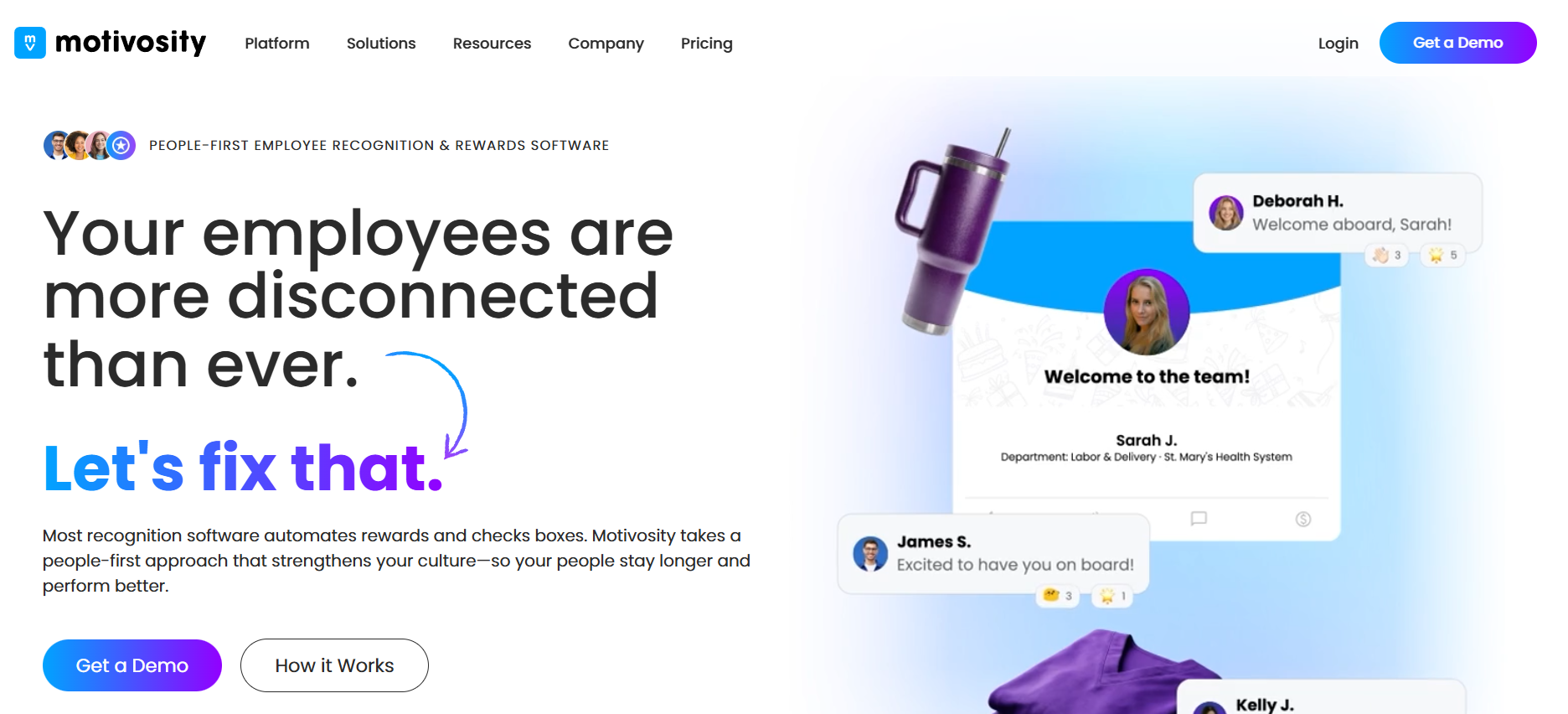
Motivosity sits somewhere between a recognition product and a broader workplace-culture platform. Recognition and rewards are central, but the product also puts a fair amount of weight on social connection and visible appreciation.
Its current frontline support is stronger than you might assume from a platform in this category. Employees can use mobile recognition, while physical ThanksCards provide another route for people who aren’t sitting at a company computer.
Best for: Companies that want recognition to help build connection across frontline, hybrid, remote and office employees.
Key features
- Peer-to-peer and manager-to-employee recognition programs can use points, dollars or non-funded appreciation, depending on how the organization wants to structure recognition.
- Spot bonuses give managers a dedicated way to reward strong performance in real time, with configurable budgets and approvals.
- ThanksCards provide physical recognition for deskless employees, with digital redemption available to the recipient.
- Achievements and Challenges can reward participation in business or culture goals, including safety and other workplace behaviors.
- Real-time reporting and Appreciation Intelligence features help organizations monitor recognition activity and program impact.
Frontline/remote/hybrid fit: Strong. Motivosity explicitly positions its native mobile app for frontline, hybrid, remote and in-office employees. The company also offers physical ThanksCards for deskless teams, while its broader frontline approach includes shared-display recognition through Motivosity TV.
Pricing: 100% custom pricing. Motivosity says it builds packages for organizations ranging from 75 to 10,000+ employees. Current bundles cover milestone programs, peer and manager recognition, spot bonuses, awards, challenges and global recognition requirements.
Motivosity makes the most sense when recognition isn’t just a rewards transaction. If the company also wants appreciation to be visible and social, there’s more here to work with than a basic points-and-rewards system.
6. Awardco
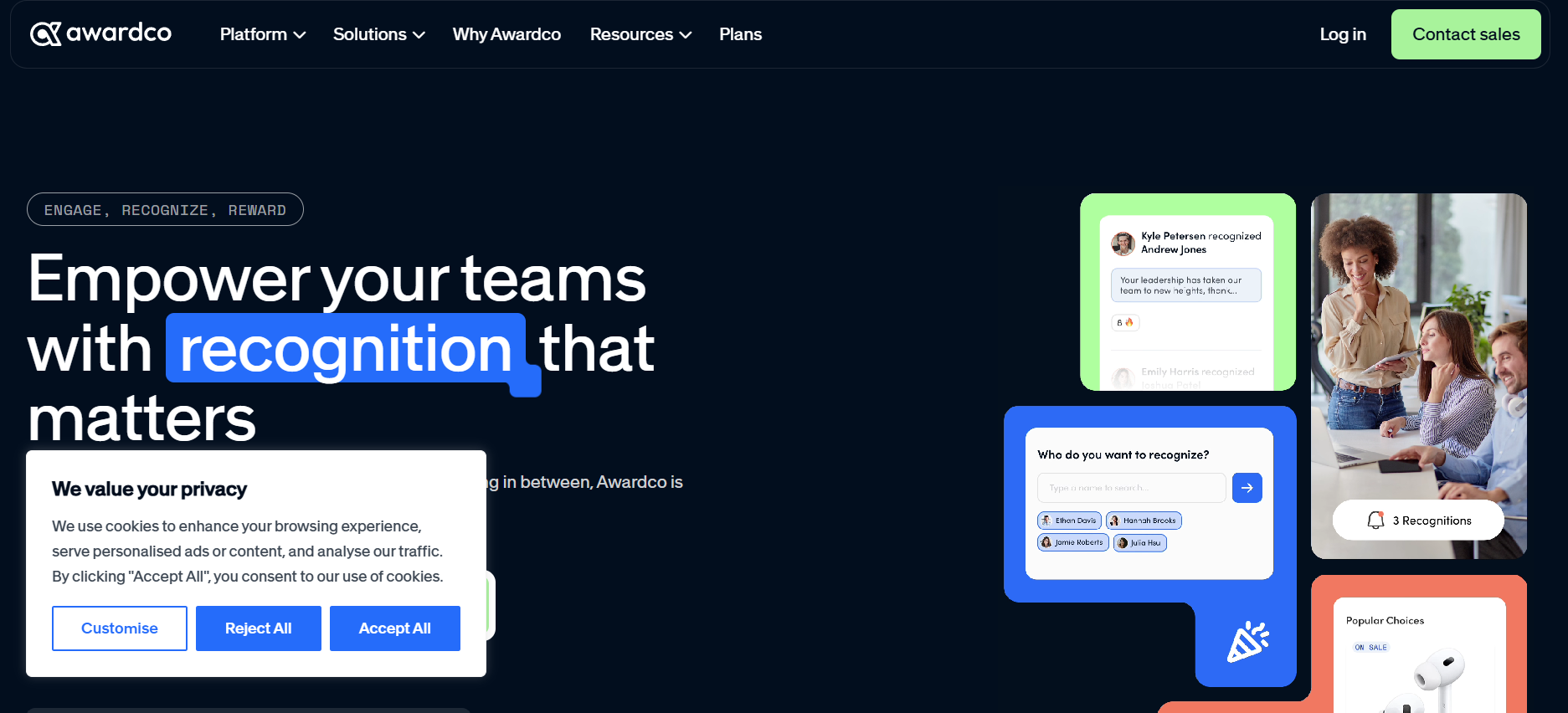
Awardco is built for a fairly broad range of recognition programs, from peer and manager recognition to service awards, incentives and frontline recognition.
What makes the frontline side worth looking at is that Awardco doesn’t stop at saying it has a mobile app. It offers several physical and digital routes for getting recognition to employees who may not have an email address, workstation or regular office access.
Best for: Larger organizations that need recognition across corporate, field, retail, manufacturing and other deskless workforces.
Key features
- AwardCodes provide physical recognition cards that can be handed to an employee in the moment and converted into reward points.
- Mobile-first recognition lets employees send and receive recognition, redeem points and manage rewards away from a desktop.
- Kiosks, SMS alerts and external recognition give organizations additional ways to involve workers and even capture recognition from customers or patients.
- Safety and Quality Programs can connect recognition with compliance, safety and quality behaviors.
- Reporting and recognition insights give HR and operational leaders visibility into activity across their programs.
Frontline/remote/hybrid fit: Very strong. Awardco’s frontline offering is designed for employees without a desk or email and specifically addresses manufacturing, retail, plant, field and other distributed workforces. Recognition can be delivered through mobile apps, browsers, kiosks, physical AwardCodes and SMS notifications.
There is one geographical limitation worth knowing before getting too attached to the AwardCodes use case.
One limitation to note: Awardco’s current documentation says AwardCodes are currently only available for employees in the United States. International organizations should confirm which other offline recognition methods are available for employees outside the U.S.
Its remote fit is more straightforward. Digital recognition and rewards aren’t tied to a fixed workplace, and mobile access gives employees another way in.
Pricing: Awardco uses quote-based plans. Its current plan structure includes Standard, Scale and Enterprise. For startups and small businesses with 100 employees or fewer, Awardco says flexible packages are available starting at $3,000.
Awardco is a better fit for organizations designing a larger recognition program than for a small team that only wants quick peer shoutouts.
7. Achievers
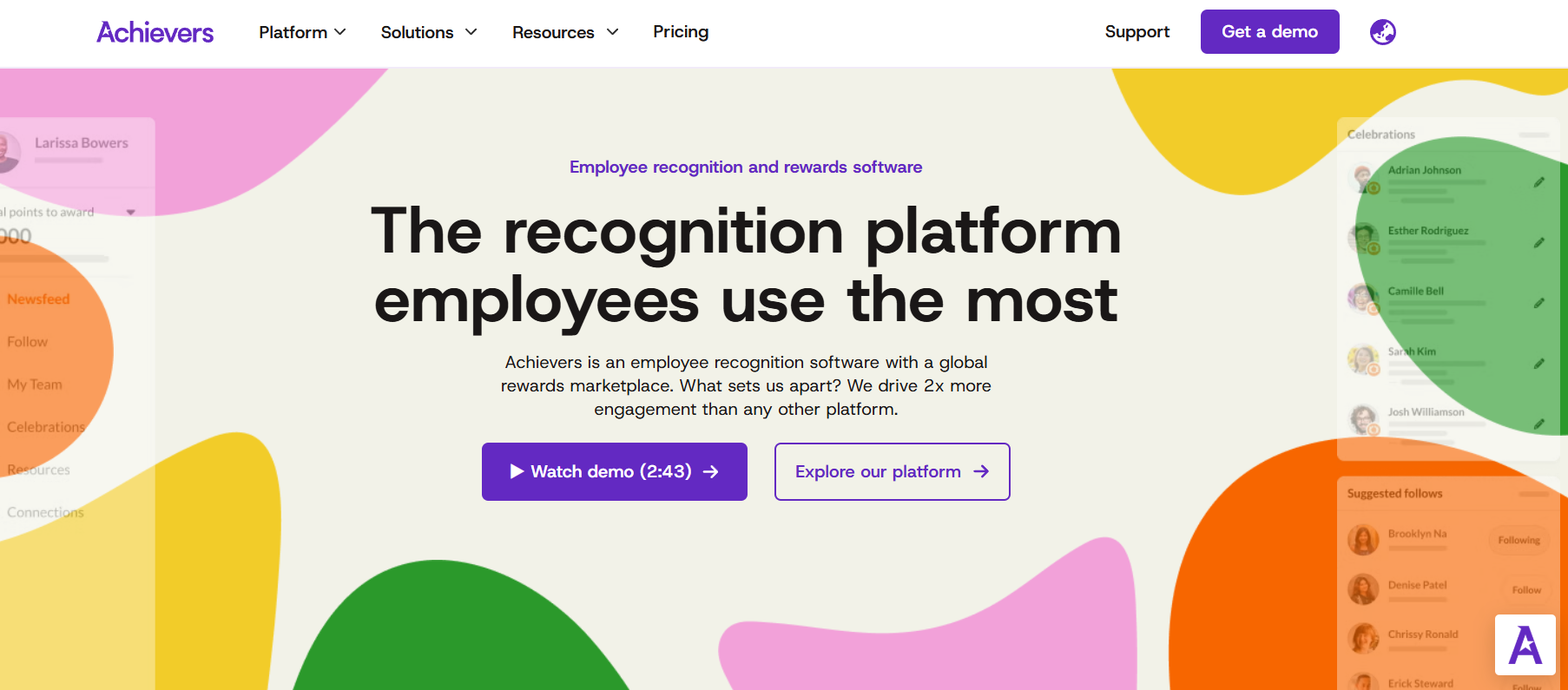
Achievers is built more like an enterprise recognition program than a lightweight team recognition app. It supports monetary and non-monetary recognition and is aimed largely at mid-sized and enterprise organizations.
The platform also takes workforce access seriously. Current Achievers materials explicitly describe Recognize as being designed for online, deskless and remote teams, rather than assuming everybody participates through the same desktop interface.
Best for: Global organizations that need a large-scale recognition program with enterprise integrations, rewards and analytics.
Key features
- Employees and managers can send monetary or non-monetary recognition, including individual, group and social recognition.
- Recognition can be delivered through mobile, desktop and tablet, with QR codes, physical cards and kiosks available for broader workforce access.
- Nomination workflows support structured awards, with managers able to track and approve nominations through a dashboard.
- Recognition analytics and dashboards help leaders track engagement, program activity and employee patterns.
- Achievers Intelligence uses recognition and engagement data to surface workforce signals and support manager decision-making.
Frontline/remote/hybrid fit: Very strong. Achievers describes Recognize as being designed for online, deskless and remote teams. Every subscription includes mobile and desktop access, recognition push notifications, analytics and dashboards.
Its recognition product also supports QR codes, physical cards and kiosks, helping close the access gap for employees who don’t sit at desks.
For remote and hybrid employees, Achievers integrates with workplace systems including Microsoft Teams, Slack, Zoom, Gmail, Outlook and SharePoint. That means recognition can show up closer to where those employees already work rather than requiring another daily destination.
Pricing: Custom quote. Achievers does not publish a fixed per-user recognition price and says it tailors pricing to the organization’s people, goals and requirements.
Achievers is particularly relevant when recognition needs to operate as a global HR program rather than a lightweight team perk.
8. Guusto
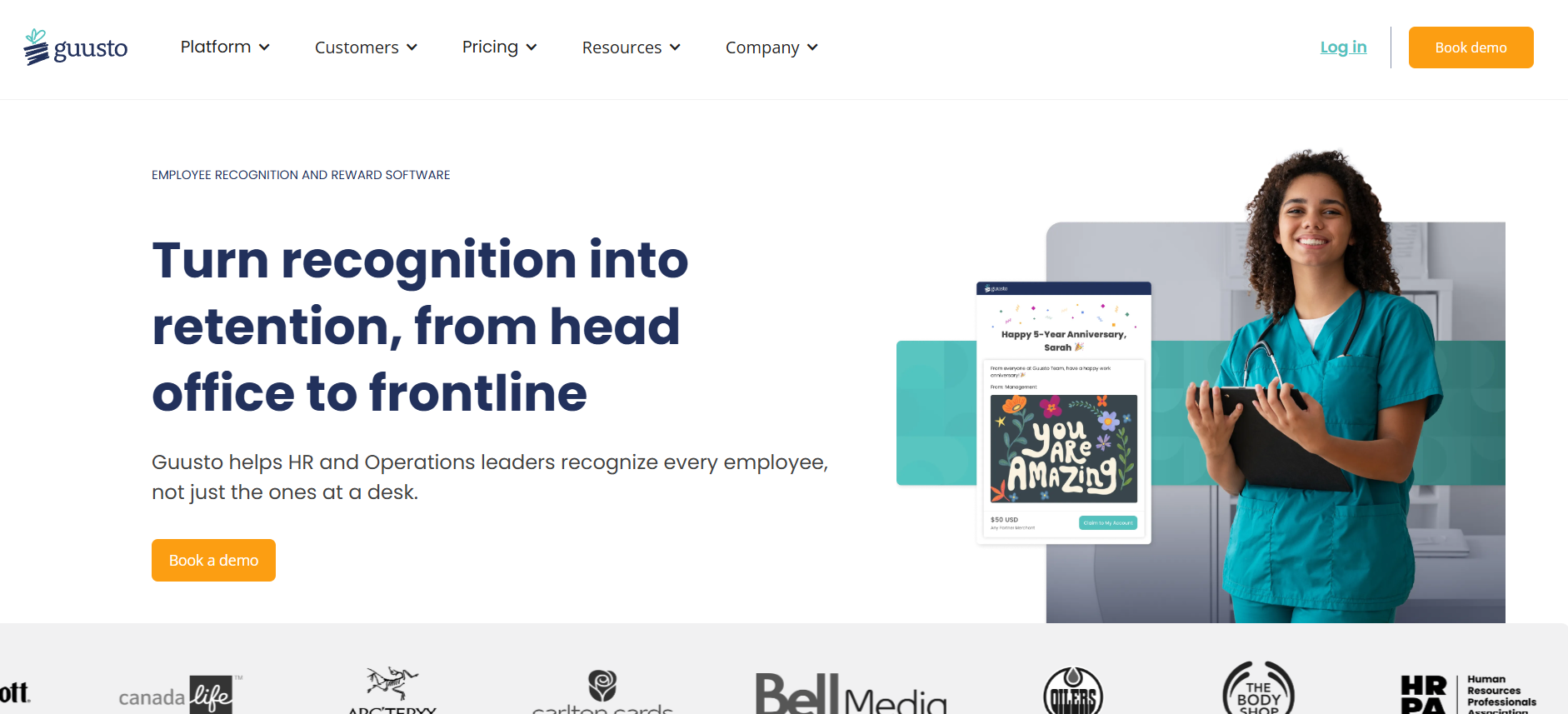
Guusto is probably the most visibly frontline-first platform in this comparison.
Its approach is refreshingly practical. If an employee doesn’t have email, a company device or even regular access to a phone at work, recognition can still be routed through SMS, QR codes, print or the employee’s manager. That’s the sort of detail that matters much more in the field than another polished recognition feed.
Best for: Healthcare, retail, hospitality, manufacturing, construction and other workforces with large deskless populations.
Key features
- Recognition can be delivered through email, SMS, mobile push, QR codes and print, instead of assuming every employee has a corporate inbox.
- Recognition can be routed to a manager for in-person delivery when the recipient has no email address or phone number in the system.
- TV and kiosk displays can make recognition visible in break rooms and physical workplaces.
- Manager Insights and recognition reporting help supervisors see activity and identify employees who may be missed.
- AI Recognition Scores and insights are available within the current platform’s higher-level feature set.
Frontline/remote/hybrid fit: Very strong. Guusto explicitly builds for frontline and offline employees. Rewards can even be redeemed without a login, and its current materials describe support for frontline, deskless, contingent and offline workers.
Remote and hybrid workers can still use the web and mobile app, while workplace integrations extend recognition into digital work. In other words, its frontline strength doesn’t prevent it from covering more conventional distributed teams.
Pricing: Guusto currently offers a Free plan. Its current USD pricing lists Lite at $150/month for 1 Sender Seat and 250 Recipient Seats.
On yearly pricing, Essential lists Sender Seats at $4.00/month and Recipient Seats at $0.70/month, with a $200/month minimum contract. Premium lists Sender Seats at $5.00/month and Recipient Seats at $1.00/month, with a $500/month minimum contract.
Few platforms make the frontline-access problem as central to the product as Guusto does, and that makes it one of the easier options here to understand from a buyer’s perspective.
9. Workhuman
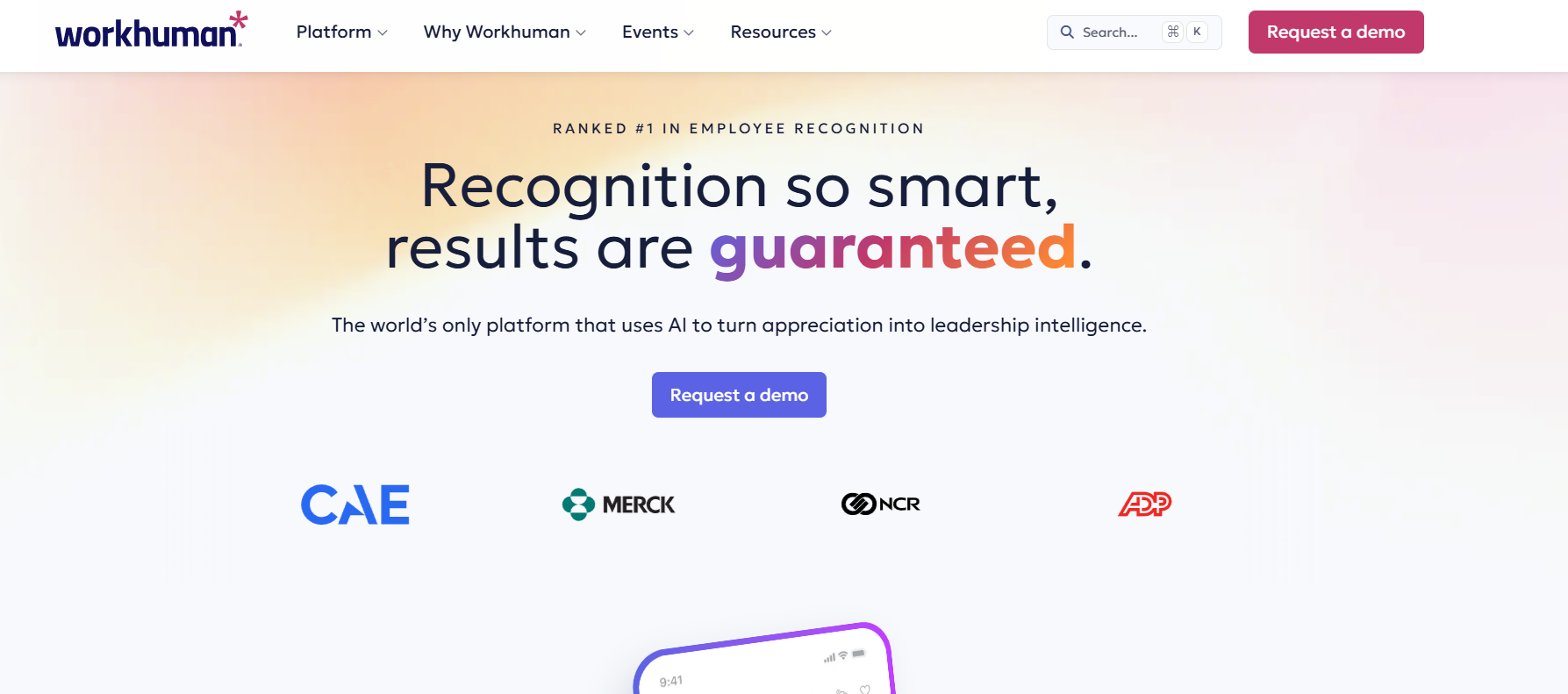
Workhuman is one of the longest-established enterprise recognition platforms in this comparison. Social Recognition remains central to the product, but Workhuman has increasingly focused on what organizations can learn from the recognition data being created.
That shows up in Workhuman iQ and its broader Human Intelligence approach. It also shows up in the company’s frontline direction. In April 2026, Workhuman introduced a new Frontline Recognition Experience, making its deskless positioning more explicit.
Best for: Large global employers that want enterprise recognition plus deeper analysis of the behavioral data created by recognition.
Key features
- Social Recognition supports employee and manager appreciation at enterprise scale, alongside service milestones, team awards, life events and broader community celebrations.
- Workhuman iQ analyzes recognition data to surface skills, collaboration patterns, performance signals and cultural information.
- Recognition data can help managers see what employees are repeatedly recognized for, providing an additional signal around skills and contribution.
- The 2026 Frontline Recognition Experience brings physical and digital recognition together for workers who don’t operate in a standard desktop environment.
- The mobile experience lets employees participate in recognition away from a traditional workstation.
Frontline/remote/hybrid fit: Strong. Workhuman explicitly lists Frontline Recognition as a current capability, and its April 2026 Frontline Recognition Experience was introduced specifically to extend recognition across deskless workforces. Its Social Recognition and mobile access also support remote and hybrid employees.
Pricing: Workhuman does not publish numeric pricing for Social Recognition on its current public product pages. Contact Workhuman for commercial pricing.
Workhuman’s clearest differentiator is what happens after recognition is collected. Workhuman iQ is designed to turn recognition interactions into information about skills, culture, collaboration and workforce patterns, not just count how many awards were sent.
For organizations already running recognition at serious scale, that’s a more interesting question than whether the platform can simply send another award.
Which Employee Recognition Software Should You Choose?
The best choice depends less on who has the longest feature list and more on how your employees actually work.
- Choose HubEngage if you need frontline recognition alongside communications, tasks, surveys, social engagement and broader frontline engagement software.
- Choose Bonusly or Nectar if peer recognition across remote and hybrid teams is the main requirement and you want an approachable recognition experience.
- Choose Motivosity if recognition should sit inside a wider social and culture program with mobile and physical options for deskless staff.
- Choose Awardco, Achievers or Workhuman if you’re building a larger enterprise recognition program with global rewards, reporting and more formal recognition structures.
- Choose Guusto if reaching frontline workers without email, devices or regular desktop access is one of your biggest practical challenges.
- Choose Chime Workplace if your priority is hourly-worker rewards tied to financial wellness rather than a traditional peer-to-peer recognition program.
For a budget-conscious smaller team, Bonusly has a free tier and published Team pricing. Guusto also offers a Free plan and publishes its core pricing structure, while most enterprise vendors on this list require a sales conversation.
Recognition also shouldn’t operate in isolation from the rest of the engagement program. Our review of employee engagement trends in 2026 looks at how peer recognition now sits alongside continuous listening, manager enablement and frontline-first engagement design.
Frequently Asked Questions
What is the best employee recognition software for frontline workers?
HubEngage, Nectar, Awardco, Achievers, Guusto, Motivosity and Workhuman all have verified frontline capabilities, but they solve the problem differently.
HubEngage combines employee recognition with mobile communication, tasks and wider engagement. Guusto goes especially far on offline access through SMS, QR codes, printed rewards and manager delivery. Awardco offers mobile, kiosk and SMS recognition, with AwardCodes currently limited to employees in the United States. Nectar supports employees without a work email through mobile, SMS and Kiosk Mode.
The best option depends on whether your frontline employees have personal phones, shared devices, email addresses or no regular digital access at all. That’s the question I’d settle before comparing reward catalogs or AI features.
How often should frontline employees be recognized?
Recognition should be frequent enough that employees don’t have to wait for annual awards or performance reviews to hear that good work was noticed.
There isn’t one required frequency for every organization. The more useful rule is to recognize meaningful work close to when it happens and make the recognition specific. Manager recognition, peer recognition, milestones, customer praise, safety achievements and team accomplishments can all create different opportunities for appreciation.
Organizations trying to build that consistency across the year can use a 12-month employee engagement calendar to coordinate recognition with listening, manager check-ins, communication and other engagement activities instead of treating each as a separate campaign.
Does recognition software work for employees without email or desk access?
Yes, but only some platforms provide real alternatives to email and desktop logins.
Nectar supports workers without company email and offers mobile, SMS and Kiosk Mode. Awardco supports mobile, kiosks and SMS, with AwardCodes available for employees in the United States. Guusto can use SMS, QR codes, print and manager-routed delivery. Achievers supports QR codes, physical cards and kiosks alongside mobile access.
For a heavily deskless workforce, this should be tested during the buying process rather than assumed from a generic “mobile-friendly” claim. A mobile app doesn’t help much if employees can’t realistically authenticate, receive notifications or access the device during work.
Does Chime Workplace provide analytics on recognition patterns to help managers identify high-performing teams and engagement trends?
Not based on the current official documentation reviewed.
Chime Workplace does provide employer reporting through a centralized dashboard. Its current materials describe visibility into financial wellness outcomes, including savings, credit-health improvement and overall engagement with Chime Workplace.
However, Chime does not currently document manager-facing analytics that analyze recognition patterns by team, identify high-performing teams from recognition data or show recognition-based engagement trends in the same way dedicated recognition analytics platforms do.
So the answer isn’t that Chime Workplace lacks reporting. It has reporting, but the documented reporting isn’t the recognition-pattern analytics described in this question.
What is the difference between employee engagement software and employee recognition software?
Employee recognition software is primarily designed to help employees and managers acknowledge good work, celebrate milestones and sometimes distribute rewards.
Employee engagement software covers a wider set of activities. It may include employee communications, surveys, feedback, social interaction, recognition, learning or frontline workforce tools.
That is why an employee engagement platform for frontline workers such as HubEngage has a broader scope than a dedicated recognition product such as Bonusly.
If recognition is being evaluated as part of a wider engagement program, our guide to measuring employee engagement explains how recognition can sit alongside surveys, manager conversations, communication access, task clarity and other workforce signals.
What features should frontline employee recognition software include?
For frontline employees, look beyond peer-to-peer recognition and reward catalogs.
Useful features include:
- Mobile access
- Recognition without corporate email
- SMS or push notifications
- QR codes or physical recognition options
- Shared-device or kiosk access
- Digital signage
- Manager-issued recognition
- Peer-to-peer recognition
- Automated milestones
- Recognition analytics by team or location
- Integrations with HRIS, payroll or workforce-management systems
The exact mix depends on whether employees work in stores, hospitals, factories, warehouses, field locations or other shift-based environments.
The practical test is simple: could the employee receive, understand and act on the recognition during an ordinary workday? If the answer is no, the feature list doesn’t matter much.
Final Take
The best employee recognition software is the one employees can actually access and managers can realistically keep using.
For frontline, remote and hybrid teams, HubEngage, Chime Workplace, Bonusly, Nectar, Motivosity, Awardco, Achievers, Guusto and Workhuman each take a different approach. HubEngage is the strongest fit in this comparison when recognition also needs to connect with frontline communication, task management and wider employee engagement.
Start with how your employees work, then compare recognition features, access methods, analytics and real pricing against that reality.