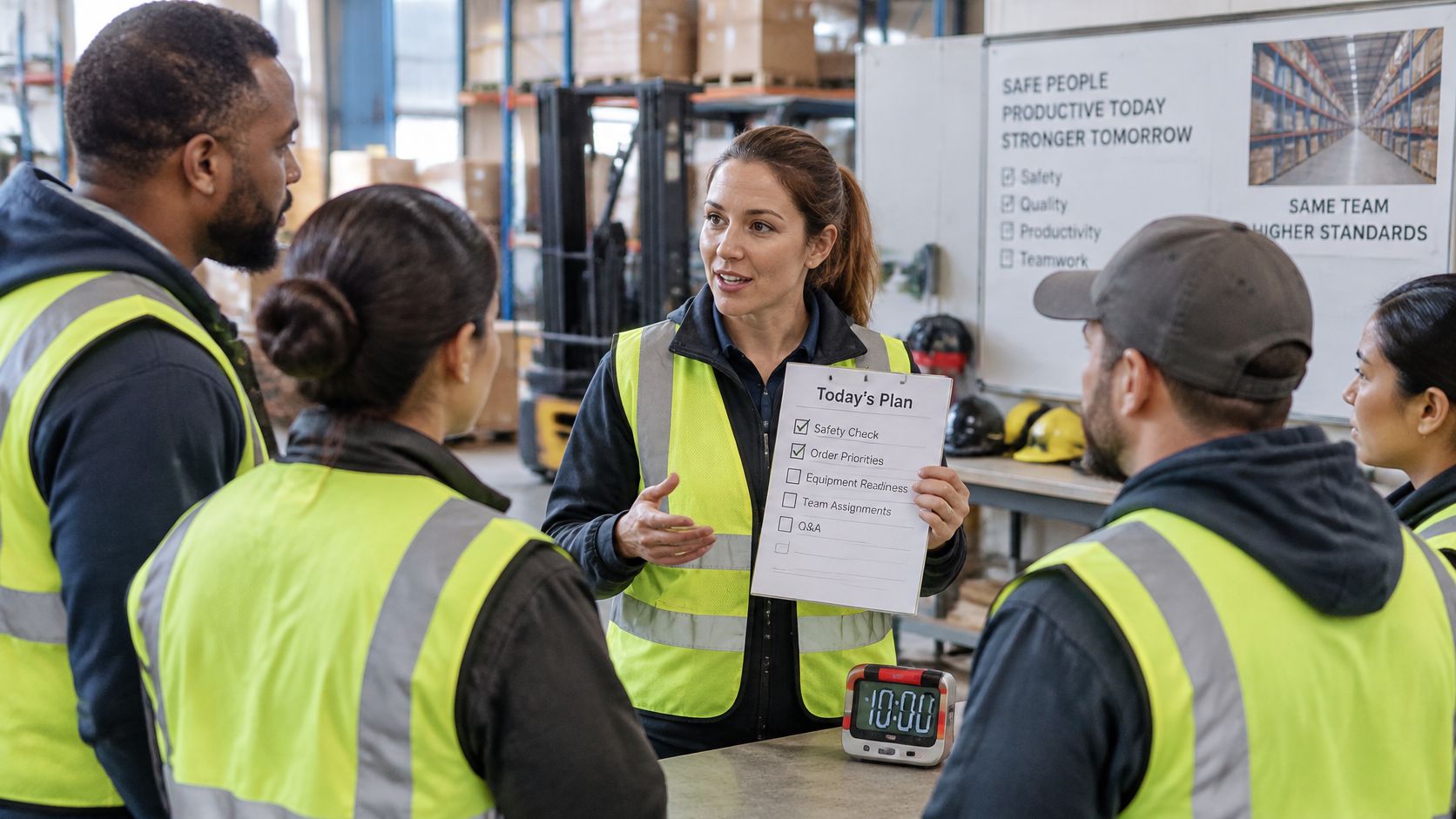
Roughly 80% of the global workforce is deskless, according to the 2022 State of Internal Communications report, and a large share of those employees have no work inbox. The standard fix, a recognition platform that emails a login link, reaches the people who needed it least.
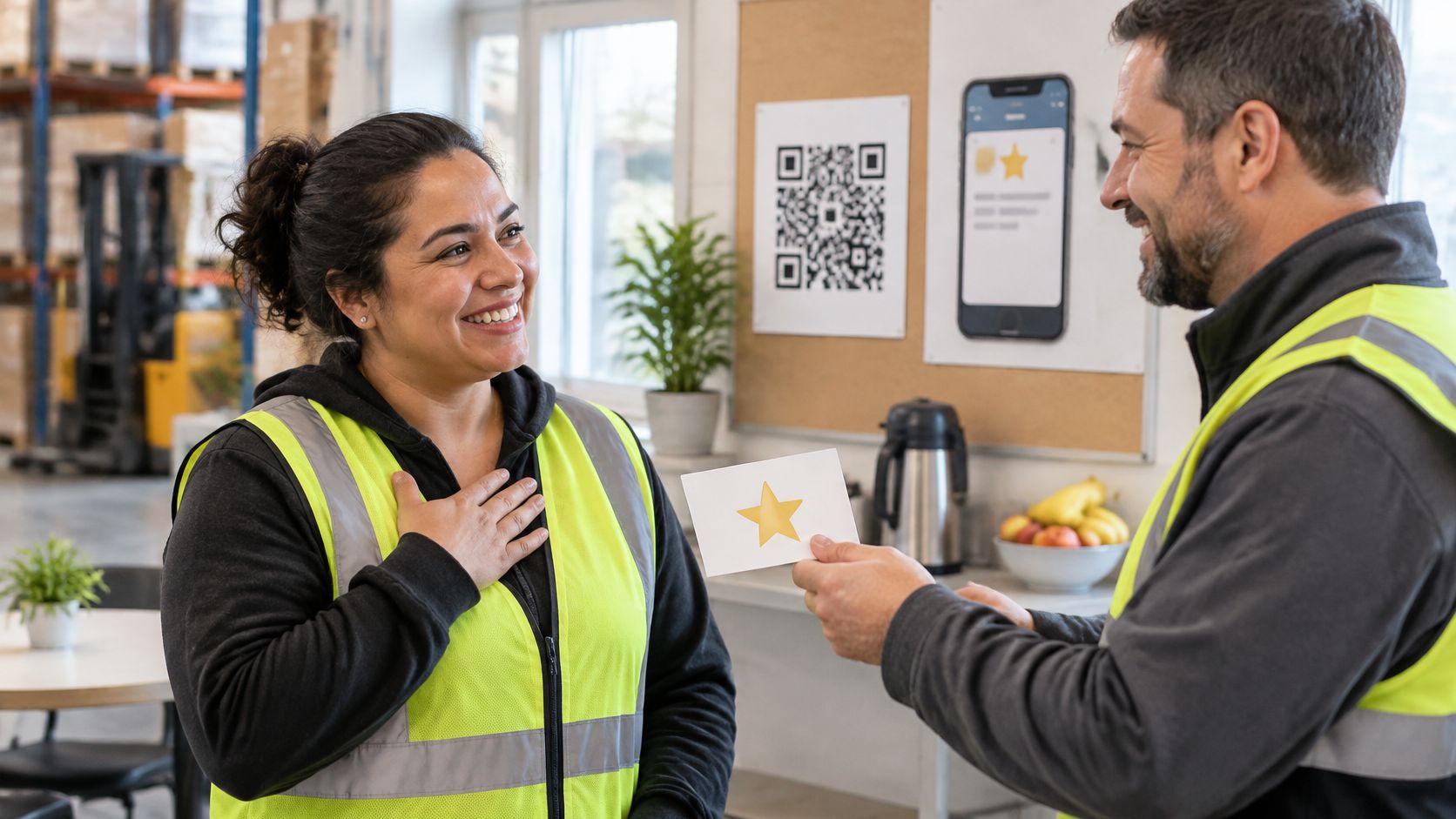
Recognition for deskless workers runs on a different stack: a phone number plus an opt-in, a short mobile link, a QR code taped beside a time clock, or a printed card at the shift huddle. Turn On Work’s Reach Check, an editorial model rather than an industry standard, audits whether every shift and device group can both give and receive recognition before any rewards catalogue is chosen. Pick two channels that together cover the whole roster, pilot them at one site, then fix the gaps the audit surfaces.
Key Takeaways
- Channels come before rewards. The first decision isn’t the gift card value, it’s how a worker on a production line or a night shift gives and receives praise at all.
- The gap is admitted, not just felt. HR leaders now concede that desk-based staff are recognized more often than frontline staff, even where they believed access was equal.
- Two channels beat one. Choose routes that together cover the whole roster, then write down the group each one leaves out.
- App-only delivery can backfire. Staff with limited technology access are far less likely to see recognition as equally available and more likely to read it as an empty gesture.
- Segment every metric. Cut reach, access and acknowledgment time by shift and site before anyone reads an average.
Channels That Reach Employees Without Email
For staff who have no company email, SMS, a mobile web link, a QR code at a fixed station, or a printed card can each carry recognition today. The right choice depends on two things: what the worker owns, and where they stand during a shift.
Email-first programs miss this group by design. The 2022 State of Internal Communications report describes deskless workers as roughly 80% of the global workforce, notes that many lack access to email and intranets, and finds that managers, printed materials and digital signage are their main channels. The same report ranks employee recognition among the most requested frontline communication topics at 45.8% of respondents, behind benefits at 60.5% and ahead of safety at 41.5%. People are asking for recognition through channels they already hold in their hands.
| Channel | What the employee needs | Works without company email | Works on shared or offline devices | Best fit |
|---|---|---|---|---|
| SMS | A mobile number and opt-in | Yes | Partly, needs cellular signal | Staff without smartphones or data plans |
| Mobile web link | A phone and a browser, no app install | Yes | Partly, submission needs a connection | Staff with smartphones who avoid app downloads |
| Dedicated app | A smartphone, an app install and an account | Often, if login uses a phone number | Partly, depends on offline sync | Sites with a stable, managed device fleet |
| QR code at a fixed station | Any camera-equipped phone or a shared device | Yes | Yes, if the form loads once and can be printed | Break rooms, lockers, production floors and time clocks |
| Printed card or huddle sheet | Nothing beyond a pen | Yes | Yes | Teams with no personal or shared device |
A dedicated app can work well when the login is a phone number. It stalls on sites running a mixed device fleet, because adoption splits between the people who installed it and everyone else. The printed card looks low-tech beside it, yet it is the only route in the table that asks nothing of the worker beyond a pen.
Rule of thumb: pick two channels that together cover every shift, then name the group each one leaves out. A single channel usually reaches most of the roster and quietly excludes the people who work nights, share a terminal, or carry a basic handset.
Before choosing between these routes, I would run the TurnOnWork Reach Check, an editorial model rather than an industry standard. It audits whether every shift and device group can both give and receive recognition before anyone selects a rewards catalogue. A channel that lets the day shift send praise but leaves the night shift no way to see it fails that check.
Recognition gaps also show up in survey data, measured differently. In Workvivo’s 2025 survey of 7,500 frontline workers, 20% said they had never received any form of recognition, and only one-third said they were frequently recognized. That figure tracks how rarely recognition happens at all, not how far a channel reaches, though the two problems overlap: the shifts a channel misses tend to be the same shifts nobody thanks. Our frontline communication channel guide works through the wider trade-offs between these routes.
Choosing Recognition Software That Works Without Email
Recognition software works without company email when three conditions hold: a worker can log in with a phone number, employee ID or shared code, submit through SMS, a link or a QR code, and read praise without a work account. Feature lists rarely mention any of that, so test for it directly.
Platforms such as HubEngage’s employee recognition software support employee appreciation through mobile apps, web access, text notifications, and digital displays. These multiple channels can help organizations reach frontline and deskless employees who rarely use corporate email. However, businesses should still verify login requirements and whether employees can submit recognition without a work email.
A seven-point buying checklist
Run these against every vendor. It’s a TurnOnWork editorial checklist, not an industry standard.
- Login. Confirm a work email is optional for both giving and receiving recognition.
- Channels. Ask which of SMS, mobile web link, QR code and printed card the product supports, and whether an app install is mandatory.
- Offline capture. Check that submissions queue on a shared or patchy-signal device and sync later, rather than failing at the moment someone tries to thank a colleague.
- Language and accessibility. Confirm the languages available and whether the interface reads cleanly with a screen reader.
- Consent and data. Confirm opt-in records, deletion on request, and that sensitive HR details stay out of recognition messages. Medical or personal reasons don’t belong in a message a whole shift can read.
- Reporting. Confirm reach, access rate and acknowledgment time can be cut by shift, site and device type. If everything reports as one company average, the tool can’t answer the only question that matters.
- Cost. Request pricing in writing and compare per-site against per-user terms. This article quotes no prices, and a verbal figure isn’t a term.
Red flag: a platform that only works after an app install and a work login has failed the access test, whatever else it does.
Ask each vendor to demonstrate one deskless employee’s full path on a shared device: QR scan or text reply, submission, notification, acknowledgment. If the demo needs your laptop and a corporate account, you have your answer. Our guide to how to choose an employee recognition platform covers the contract and integration questions that follow the demo.
How to Launch Recognition Without Company Email in Four Weeks
A launch without company email starts with one decision, the channel, then four weeks of mapping, consent, a single-site pilot and a reach review. None of it requires a platform contract, and none of it works if the channel decision is left to whoever answers the procurement email.
Choose the first channel by device. If most of the roster carries a personal phone and has no work email, start with SMS or a mobile link. If staff share terminals or carry no device, start with QR codes on fixed stations plus printed cards. Mixed rosters get both, with one clear owner who can explain which route covers which shift.
The reason to bother is operational, not sentimental. Research summarized by the International Association of Business Communicators found that 54% of frontline workers feel voiceless in their organizations and 63% say leadership messages do not reach them, and it notes that many frontline employees have no corporate email address or personal computer. Phone-number or username-based mobile access is what replaces the missing inbox.
Treat the launch as an access audit before it becomes a rewards decision. Turn On Work’s Reach Check is an editorial model rather than an industry standard: before any catalogue is chosen, confirm that every shift and device group can both give and receive recognition. A segment that can receive praise but cannot send it will look included in the policy and absent in the numbers.
Seven steps from roster map to live recognition
- Map the roster by device. List every site, shift and employment type, and count who has a work email, a personal phone, a shared terminal or nothing. The usual slip is a group that never appears on the map, most often night shift or part-time staff.
- Assign one or two channels to each group from the comparison table, so every employee can both give and receive recognition. No group should depend on a single route for something as basic as being thanked.
- Collect phone numbers with opt-in, store them for recognition only, and keep a record of consent. Reusing a number collected for rota messages breaks consent and trust in one move, so capture permission for this specific purpose even if the number is already on file.
- Publish a QR code or short link at every station, break room and time clock, paired with a printed card for anyone without a device. Codes placed only where desk staff walk past will reproduce the participation pattern you already had.
- Name a channel owner for each site and a backup for the days that person is off shift. Recognition dies when one person is on leave, so the backup needs the same access, the same posting rights and the same acknowledgment target.
- Set the first triggers and cadence. Weekly manager acknowledgment and monthly peer nominations work when both are tied to observable work, such as a covered handover or a safety catch, rather than personality.
- Pilot on one site and review before rolling out. One site tells you more in a fortnight than a company-wide launch tells you in a quarter, because gaps show up shift by shift instead of hiding inside an average.
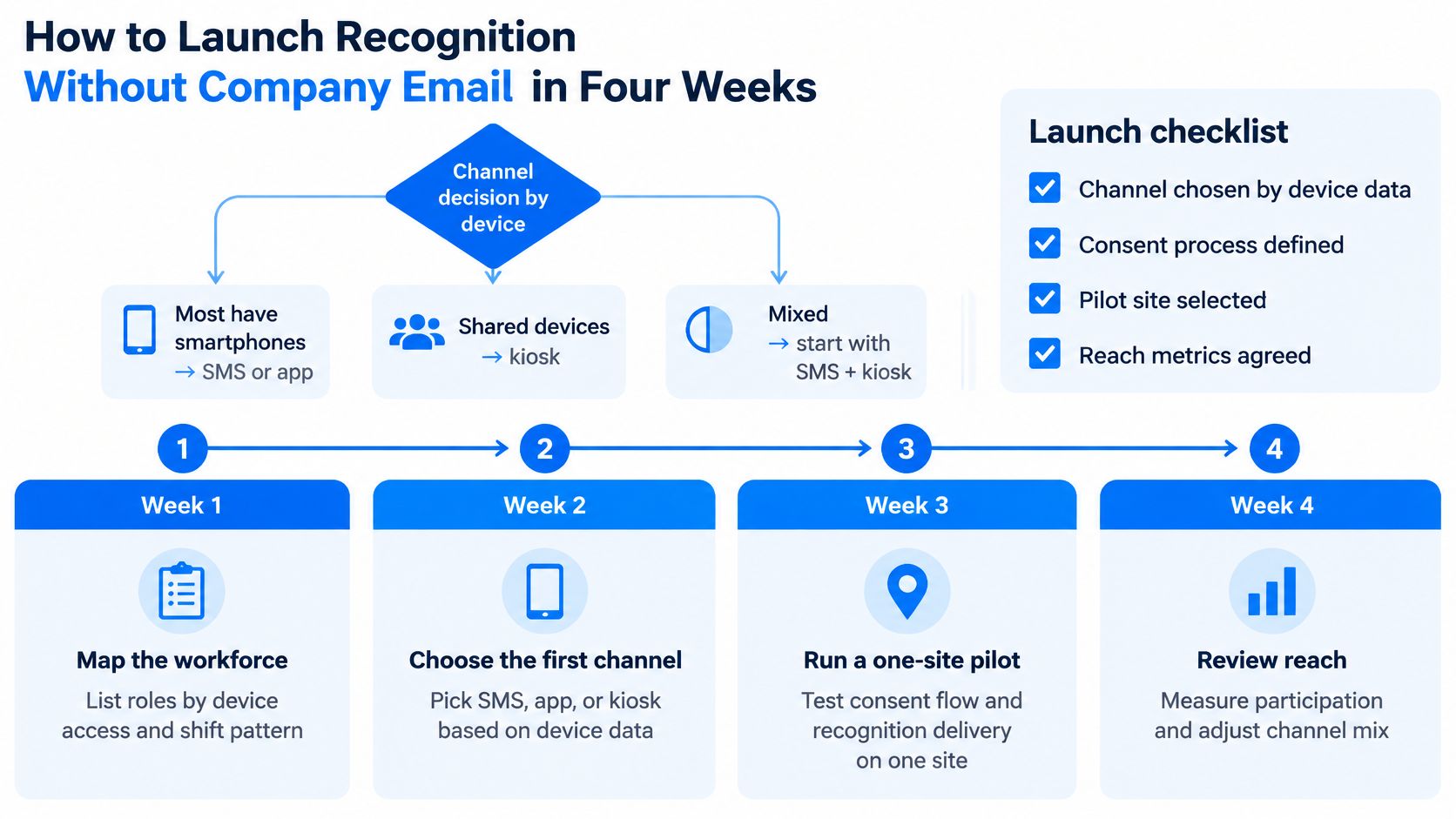
The four-week sequence and its pass signals
Week one covers steps one to three. Week two launches steps four to six on the pilot site only. Week three reviews reach, access rate and median acknowledgment time by shift. Week four decides whether to roll out, extend the pilot or change channel.
Pass signals are concrete. Every active shift has at least one submission and one acknowledgment during the pilot week, acknowledgment time is recorded per shift, and no group is excluded by device or language. The fail signal is equally clear: a channel used by only one shift has not solved the access problem, it has moved it.
Check the SMS consent rules that apply in your country before the first message goes out, and keep the opt-in record where an auditor could find it. Keep sensitive personal or medical detail out of recognition posts entirely; that information belongs in restricted HR or leave-management systems, not in a message a whole shift can read.
Behind the launch sit the mechanics Turn On Work’s internal communication strategy for distributed workforces sets out: audience mapping, channel ownership, and a defined path for information moving between central and local teams. Put the week-three review on a recurring employee engagement calendar so it repeats instead of becoming a one-off.
Three actions close the planning: name one channel owner, fix the pilot start date, and book the week-three review before week one begins.
Metrics That Show Whether Every Shift Is Recognized
62% of HR decision-makers say their organizations recognize and reward desk-based employees more frequently than deskless or frontline employees, even though many leaders believe recognition opportunities are equally available, according to a 2026 UK survey of more than 2,000 employees reported by HR Review. That finding is why a single enterprise recognition rate is close to useless: it averages a well-served group with an underserved one and calls the result a score.
The TurnOnWork Reach Check
The Reach Check is an editorial model from TurnOn Work, not a validated instrument or an industry benchmark. It asks three questions of every segment of the roster.
Can employees in this segment submit recognition? Can they receive it? And how long does acknowledgment take from the moment the contribution happened? A segment that fails any of the three is out of the program in practice, whatever the eligibility rules say.
Run it before you choose a rewards catalog. A catalog chosen first tends to shape the program around the people who can already reach it.
| Metric | How to calculate | Report by |
|---|---|---|
| Reach | Employees recognized in the period divided by active headcount | Site, shift, employment type |
| Access rate | Employees who can both submit and receive recognition divided by total headcount | Device type, language, site |
| Median time to acknowledgment | Middle value of hours from contribution to recognition | Shift, manager, site |
| Participation | Share of active staff who give at least one recognition in a month | Shift, site, tenure |
| Retention or absence trend | Change in turnover or absence for recognized and not-yet-recognized groups | Site, tenure, shift |
The benchmark set worth building around is recognition reach, median time from contribution to acknowledgment, participation by shift and site, and retention or absence trends, rather than redemption volume alone. The 2024 global UKG/Walr study of 10,915 frontline employees and 1,800 frontline leaders shows how often the baseline fails: 19% of frontline employees said their manager never recognized them, rising to 25% among healthcare frontline workers. Staff preferences diverge from employer habits too. Cash bonuses were selected by 66% of employees, paid time off by 55% and gift cards by 42%, while organizations most commonly reported using positive performance-review ratings at 39% and verbal praise in manager one-to-ones at 37%.
Picture a plant running three shifts. The headline reads 71% of staff recognized this quarter, which sounds healthy. Cut it by shift and the night crew sits at 12%, because the manager who nominates works days and the praise is delivered in a meeting the night crew never attends. That is an illustrative scenario, not a case study, and it’s the pattern segmented reporting exists to surface.
Treat retention and absence trends as correlations. A group that gets recognized may stay longer for a dozen other reasons, so the honest reading is that the measures move together, not that recognition caused the movement. Track reward choice as a separate signal, because cash, time off and gift cards tell you what staff pick when the option is real.
If one number gets reviewed each month, make it median time from contribution to acknowledgment, cut by shift. For the office-side view of these measures, Vendmoore’s collection of employee engagement metrics for offices is a useful comparison point, though the definitions need a work-location split before they mean anything on a frontline. Our guide to measuring employee engagement for frontline and deskless teams covers the listening side.
Mistakes That Leave Frontline Staff Out
The most common mistake is treating a mobile app as the fix. Evidence summarized in the 2025 Building a Culture of Recognition appendices found that employees with limited technology access were 57% less likely to believe recognition was equally available to everyone and 46% more likely to view it as an empty gesture. Digitizing a program without auditing access deepens the gap it was meant to close.
This is the reasoning behind the TurnOnWork Reach Check, an editorial model (not an industry standard) that audits whether every shift and device group can both give and receive recognition before any rewards catalog is chosen. Frontline-worker surveys point the same direction: many deskless employees feel they make a greater impact than office colleagues and go unacknowledged for it, and that their organization cares more about office staff.
- App-first launch with no device audit. Fix: run the channel comparison before the platform demo, and keep a second route open for everyone the app misses.
- Manager-only nominations. Praise then depends on proximity, so the one supervisor who shares a shift becomes the only source. Fix: let anyone nominate from any device.
- Announcements in meetings the night shift never attends. Fix: rotate meeting slots and repeat the message on a printed huddle sheet.
- Naming people publicly without asking. Fix: capture opt-in at enrollment, and treat private acknowledgment as a real outcome in its own right.
- Medical or personal detail in group messages. Sensitive information belongs in restricted HR or leave-management systems, not in a channel a whole shift reads.
- A work login before anyone can read praise. Fix: allow receipt by phone number, or post the acknowledgment where the team physically gathers.
- Measuring redemption volume only. Redemption counts the people who already had access. Fix: report reach and access by shift and site, and stop reading the average.
The design test is whether a night-shift worker on a shared handset has the same chance to give and receive recognition as the person who sits near HR.
Supervisor huddles with a logged record and printed acknowledgments are legitimate delivery methods. They avoid the surveillance problem of location-tracking tools and the unpaid administrative work of asking hourly staff to manage a system off the clock. Any channel that reaches people through a personal phone outside working hours should be opt-in only.
Recognition Examples by Sector and Work Pattern
The sector changes the channel and the trigger. The target stays constant: frequent, specific acknowledgment tied to the work completed on that shift.
| Sector | Typical non-desk work | Channel that fits | Recognition trigger |
|---|---|---|---|
| Retail | Sales floor and stockroom shifts | QR code in the staff room, SMS | Helping a customer resolve a problem at the counter |
| Manufacturing | Production lines with shared terminals | QR code on the line board, printed huddle card | A safety observation or a quality fix |
| Healthcare | 12-hour rotations in clinical areas | SMS or mobile link with opt-in | A handover that prevents a missed safety check |
| Hospitality | Split shifts across kitchen and floor | SMS, QR code at the pass | Service recovery or covering a late shift |
| Logistics | Warehouse teams and drivers on routes | Mobile link, SMS, printed card at the depot | An incident-free week or an on-time dispatch run |
Start with the TurnOnWork Reach Check, an editorial model rather than an industry standard: before any rewards catalogue is chosen, audit whether every shift and device group can both give and receive recognition. A ward team on 12-hour rotations shows the test. A handover catches a missed allergy check before the medication round, and the nurse manager sends a two-line SMS the next morning naming the check and the outcome. At a depot, a driver finishes an incident-free week and covers two late dispatch runs; the supervisor logs it on the QR-linked form at the dispatch desk and the driver reads it at the next stop.
Cadence matters as much as channel. In a 2025 deskless-workforce summary, Rippl reports that 56% of frontline teams said they would like recognition from a manager weekly or monthly, while only 45% of frontline employees feel connected to headquarters and leadership teams. The TurnOnWork minimum operating model, drawn from that finding rather than any industry standard, is weekly manager acknowledgment, monthly peer or team recognition, and recognition tied to safe work, completed shifts, training progress, customer outcomes or steady execution during peak demand. Keep appearance separate from acknowledgment: this guide to branding uniforms for small business teams can standardize the look for customer-facing teams, while the triggers above still define what earns praise.
Hybrid teams need one trigger and two routes. A remote coordinator with a laptop and a field technician with a phone should hear about the same completed project on the same day. More patterns sit in our guide to frontline team recognition examples.
Adapt every example to local labor rules, union agreements and the site’s own safety procedure, and confirm consent before any channel goes live.
Running Peer Recognition Across Shifts and Sites
Peer recognition works across shifts when anyone can nominate through any channel and the recipient sees it on their next shift, not three weeks later at an awards evening.
- Open nominations to everyone, on every shift, using the same QR code or SMS keyword that already exists for the site.
- Require a one-line reason tied to observable work, such as covering a late delivery or resolving a customer complaint. Vague praise trains people to nominate their friends.
- Route each nomination to a shift lead with a fixed acknowledgment window, so nothing sits unseen in a queue over a weekend.
- Post a monthly digest on a printed board at each site, not only on a screen in the break room that half the team never passes.
- Review the nomination map by shift and site each month. Popular people get nominated repeatedly while quiet, night-shift and part-time workers rarely appear, so track nominations per person as well as per team.
For teams spread over several sites, name a counterpart at each location who checks that nominations flow both ways. A one-way flow looks like a healthy program from head office and feels like a closed club from the far end of the estate.
Fairness rule: a peer nomination only counts if its recipient can actually see it.
FAQs on Recognition for Deskless Workers
Can deskless workers receive recognition without any device?
Yes. Printed cards, supervisor huddles with a logged record, and QR codes at shared terminals all work without a personal phone. The channel table earlier in this guide shows which option fits each device group.
Is an app better than SMS for recognition without email?
It depends on the device fleet, not on the feature list. SMS and mobile links need no install, while an app needs a download, an account and reliable offline sync to work well on shifts. Where sites run managed devices, an app earns its place; where they don’t, it splits the roster.
Do we need a work email or paid software to start?
No. Recognition can begin with opted-in phone numbers, a QR code and a printed card. Software becomes worth paying for once you need reporting by shift and site, which is the point where spreadsheets stop answering the question.
Are there set prices for these tools?
None are quoted in this article. Request written pricing from vendors and test it against the seven-point checklist in the software section, particularly the login and offline requirements.
How do we know recognition is fair across shifts and sites?
Report reach, access rate and median acknowledgment time by shift and site, then check that no group is excluded by device or language. The Reach Check in the metrics section is the quickest way to run that audit before a rollout.
Recognition for deskless workers doesn’t stall because leaders lack goodwill. It stalls because the delivery route was chosen for the people who already had one. This week, map a single site by device, pick two channels that together cover every shift, and name the owner who’ll make sure the night crew gets thanked. Then subscribe to the Turn On Engagement newsletter for the frameworks, reviews and operational guides that keep the rest of the rollout moving.