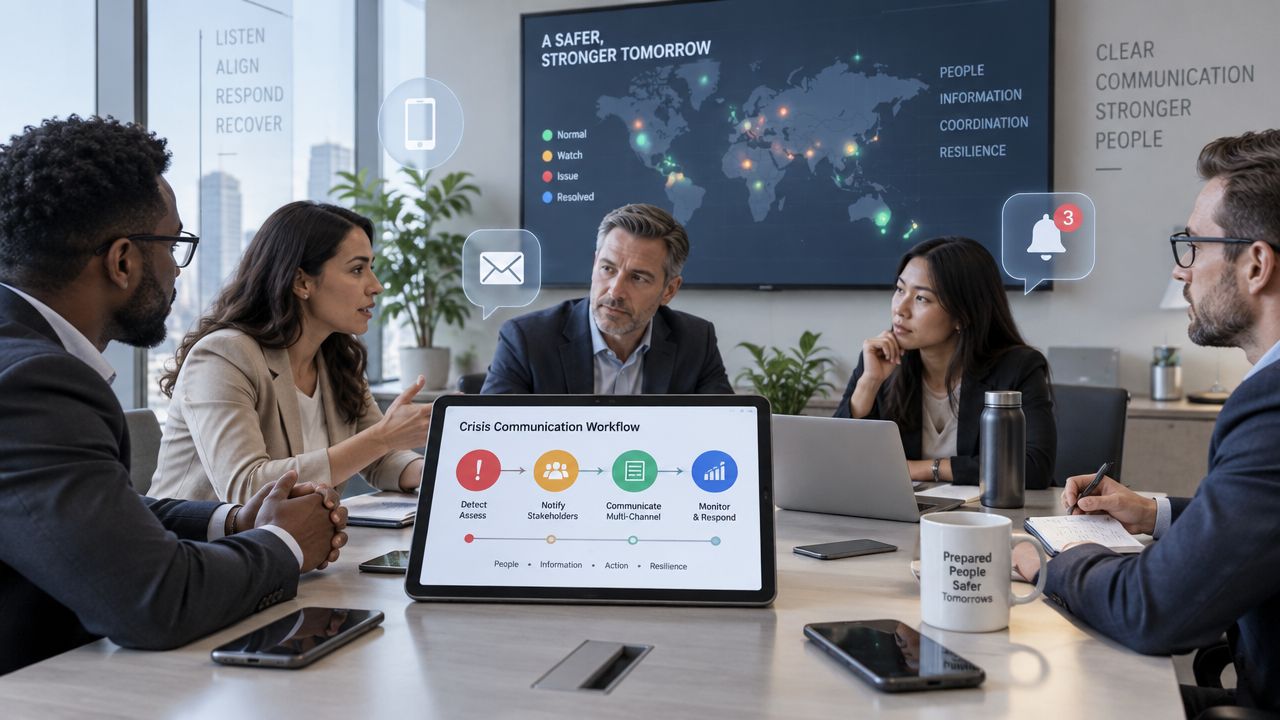
Your crisis communication plan should do one job fast, move verified information to every employee before confusion spreads. For distributed teams, that means SMS, app push, email, signage, voice, and manager escalation working as one system, not a folder of templates. The plan matters most when normal channels fail, people are on different shifts, or leadership needs to confirm who saw what and when. If it can’t be activated quickly and tracked clearly, it’s not operational enough.
Key Takeaways
- A crisis communication plan is an operating system, not a document. It needs roles, triggers, templates, channels, and acknowledgment loops.
- Execution fails when plans rely on a single channel or stale contact data. Most breakdowns happen at handoff points, not in the message itself.
- SMS and app push serve different jobs. SMS is broader and more universal, while app push can be richer and easier to segment.
- Frontline and deskless teams need backup paths. Email alone won’t reach people on the floor, in the field, or at a register.
- Testing and measurement are essential. If you don’t measure delivery, acknowledgment, and fallback activation, you won’t know whether the plan works.
| Channel | Fastest Strength | Weakest Point | Best Fit |
|---|---|---|---|
| SMS | Reaches phones quickly | Limited formatting | Urgent employee alerts |
| App push | Fast and targeted | Requires app access | Richer internal updates |
| Good for detail | Too slow for urgent alerts | Follow-up and documentation | |
| Voice | Good for critical escalation | Hard to scale | High-risk incidents |
| Digital signage | Visible on-site | Only helps onsite workers | Plant, warehouse, retail floor |
What a Crisis Communication Plan for Employees Actually Does
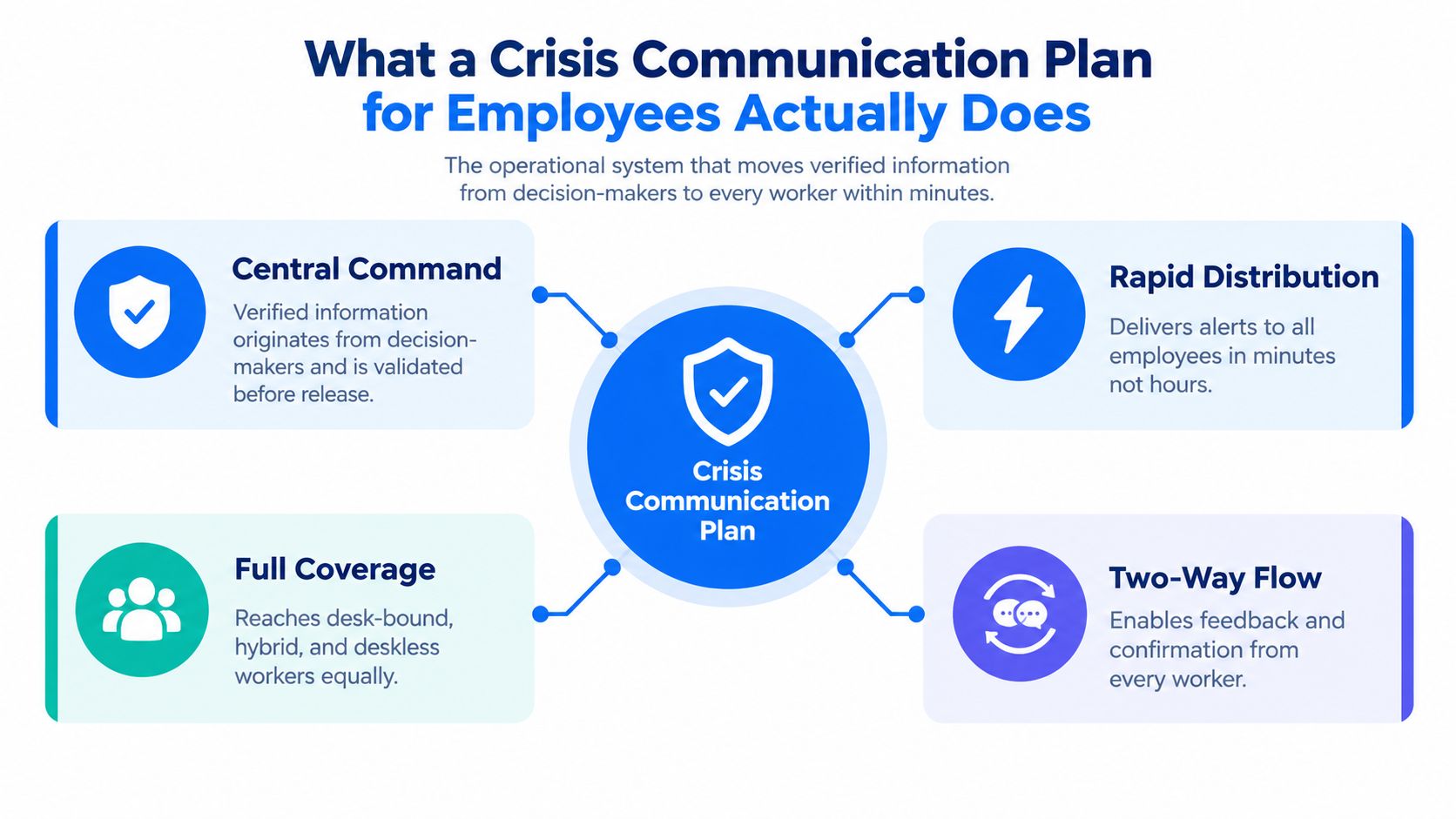
A crisis communication plan for employees is the operational system that gets verified information from decision-makers to every worker, including desk-bound, hybrid, and deskless staff, within minutes. It defines who can declare an incident, who drafts the alert, which channels fire first, and how acknowledgment gets tracked. It is not a binder on a shelf, it’s a rehearsed workflow for speed, clarity, and accountability.
The practical scope
The plan usually covers severe weather, active threats, IT outages, medical emergencies, and reputational crises. Each scenario needs a different trigger, channel stack, and approval path. A weather alert might go out through emergency SMS for employees and signage, while a reputational issue may require a tighter internal message first, then a public holding statement.
Practical rule: if the message can’t be verified, localized, and sent through more than one path, it isn’t ready for crisis use.
The useful distinction is between an employee crisis communication plan and a broader business continuity plan. Business continuity protects operations, facilities, and recovery. Crisis communication protects understanding, trust, and action. Both matter, but they solve different problems.
The 2023 survey benchmark shows why documentation alone isn’t enough. Only 49% of surveyed companies said they had a formal, documented crisis communication plan, while 28% had only an informal undocumented plan and 23% had none or were unsure, according to the Forbes-cited survey summary. Yet 98% of leaders who activated their plan said it was effective, and 77% called it very effective. That gap is the whole story, the plan works when it’s real, owned, and practiced.
Why Most Employee Crisis Plans Fail at Execution
Most plans fail because they’re written for approval, not for pressure. The readiness gap is visible in the survey data above, and the operational pattern is even clearer in the Business Continuity Institute’s emergency communications reporting. In 2020, 61.7% of organizations said they regularly exercised emergency communication plans, up from 49.0% two years earlier, and that exercise habit is what separates a usable plan from a policy artifact. In 2021, 41% of organizations could activate within 5 minutes, with specialist tools driving faster activation, and by 2022 the gap between tool-enabled and tool-light teams was still obvious in the BCI reporting linked in the Emergency Communications Report.
Where execution breaks down
The same weak spots show up again and again. Teams discover stale phone numbers, missing shift-worker contacts, and alerts sent only to email, which is fine for a corporate desk but useless for a warehouse, factory floor, or store team. If nobody owns the escalation decision, the message sits in draft while the incident keeps moving.
| Execution Gap | Operational Consequence | Team Most Affected |
|---|---|---|
| Outdated contact data | Alerts miss the right people | HR and workplace ops |
| Single-channel reliance | Entire segments stay uninformed | Internal comms |
| No acknowledgment loop | Leaders can’t tell who received the alert | Safety and security |
| Unclear authority | Decision time gets lost in approvals | Executive team |
| Unpracticed escalation | Backup channels don’t launch on time | All response teams |
The human cost is not abstract. Delayed evacuation, panic amplification on social media, and trust erosion all get worse when employees hear about an incident from someone else first. That’s why I treat the plan as a live coordination problem, not a communications document.
The internal mechanics matter too. If a shift manager, HRBP, and security lead are all waiting on the same approval chain, no one is leading. A good crisis communication plan makes that failure hard to repeat. It defines the fallback path before the first call comes in. For a deeper operating model on message ownership and audience tiers, see the guidance in Turn On Work’s internal communications strategy article.
Core Building Blocks of an Employee Crisis Communication Plan
A usable employee crisis communication plan has six essential parts. If any one is missing, the response becomes slower, less consistent, or harder to measure. The plan should be owned jointly by Internal Communications, Workplace Operations, and EHS, because no single silo sees the whole employee experience.
The six parts that actually matter
- Authority chain. Name a single Incident Commander and backups. That avoids the classic problem where three people think they own the first message.
- Scenario catalog. Map each scenario to severity, likely audience, and channel stack.
- Pre-approved templates. Build short holding statements with localization slots for site, language, and action step.
- Verified contact directory. Segment by role, location, and shift, not just by department.
- Channel orchestration rules. Define which channel fires first and which ones reinforce or confirm.
- Acknowledgment and escalation protocol. Set time thresholds for follow-up, manager escalation, and backup channel launch.
A practical self-audit helps expose weak points fast.
- Contact freshness: Are numbers, shift patterns, and location data current?
- Template status: Are holding statements approved, or still waiting in legal review?
- Channel permissions: Can the right people send through the right system without a bottleneck?
- Last exercise date: Did the team test the workflow recently enough to trust it?
- Backup readiness: If one channel fails, do the alternatives already exist?
- Ownership clarity: Does everyone know who can declare, draft, send, and close?
If the plan depends on one person remembering how to send the message, it’s already too fragile.
There’s also a knowledge-management issue. Plans stored in a shared drive tend to age badly because people don’t know which version is live. For workflow references, templates, and repository discipline, the internal knowledge base guidance is the kind of support function that keeps the plan current instead of ceremonial. The point is to make the plan easy to use under stress, not impressive in a review meeting.
Comparing Crisis Communication Channels for Employees
The best channel is the one that reaches the right workers fast enough to matter. In practice, that means you match the channel to workforce type, incident severity, and whether you need simple reach or two-way confirmation. SMS vs push notification for emergency communication is not an either-or debate, because the answer changes by audience and urgency.
Channel trade-offs that matter in real incidents
| Channel | Speed to Reach Employee | Frontline Reach | Acknowledgment Tracking | Best Use |
|---|---|---|---|---|
| SMS | Very fast | Strong if employees carry phones | Basic if linked to response workflow | Urgent alerts, evacuation, weather |
| App push | Very fast | Strong where app adoption is high | Better inside a crisis communication app | Follow-up instructions, segmented updates |
| Slower | Weak for deskless groups | Easy to log, slower to act on | Detailed updates, documentation, follow-up | |
| Voice | Fast for escalation, slower at scale | Good for critical contacts | Harder to track consistently | High-risk, high-urgency escalation |
| Digital signage | Immediate on-site visibility | Excellent for onsite workers | No direct acknowledgment | Plant floors, breakrooms, retail sites |
SMS works when you need broad reach and low friction. App push works when you need richer content, location targeting, or message history inside a crisis communication app. Email is useful, but it’s usually a secondary channel in urgent situations, not the first one. Digital signage emergency alerts are valuable because they catch people who may not be watching a phone, especially on a noisy floor or in a shared workspace.
The BCI reporting in the earlier section shows why this stack matters. By 2023, mobile phones were used by 95.9% of organizations for crisis management, email by 70.6%, and SMS by 56.1%, according to the BCI emergency communications report. The point isn’t that one channel wins forever. The point is that multi-channel emergency communication has become the operating norm.
A situational recommendation matrix
- Active assailer: SMS first, voice escalation next, signage for onsite staff.
- Severe weather: SMS and app push together, with signage for location-specific instructions.
- IT outage: App push and voice, then email once systems stabilize.
- Medical emergency: Voice to site responders, SMS to the affected location, signage if evacuation or shelter-in-place follows.
- Site evacuation: SMS, app push, and digital signage in parallel.
For product category comparisons and selection criteria, the employee communication tools overview is a useful companion. The core trade-off stays the same, though, speed and reach beat message elegance when people need to act now.
Crisis Response Timeline and Acknowledgment Benchmarks
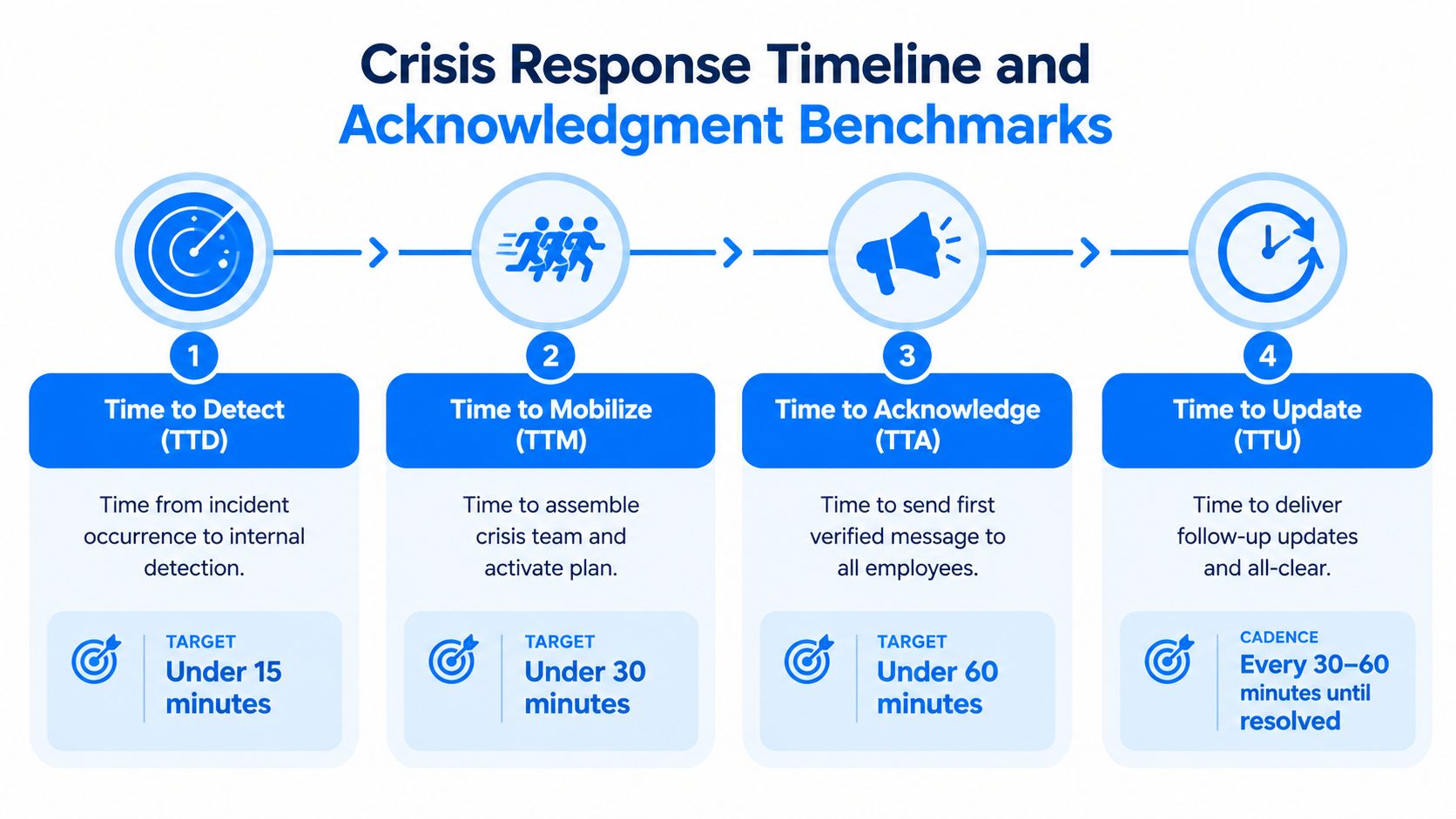
A good crisis response timeline gives safety, HR, and operations one clock to work from. The plan should measure Time to Detect (TTD), Time to Mobilize (TTM), Time to Acknowledge Publicly (TTA), and Time to Status Normalized (TSN), so the team can see where minutes are lost. Industry guidance from the benchmark linked below frames this as an SLA-backed workflow, with social acknowledgement targets in the 15 to 30 minute range and holding statements in 30 to 90 minutes depending on sensitivity, as noted in crisis response time guidance.
What happens in the first 90 minutes
- First 15 minutes, TTD. Security, facilities, or the manager on duty confirms the incident and notifies the Incident Commander.
- By 30 minutes, TTM. HRBP, comms, and safety align on the first message, the channel stack, and who approves the next update.
- By 60 minutes, TTA. The first verified message goes out to the affected employee group and acknowledgment tracking starts.
- By 90 minutes, TSN. The team has either stabilized the situation or moved into the next update cycle with a clear cadence.
That same benchmark source notes that material employee notifications can land in the 1 to 4 hour range depending on sensitivity, but for most workplace emergencies that’s too slow for the first alert. If you’re still waiting on perfect detail at minute 60, the team probably has an approval problem, not a messaging problem.
Operational rule: if acknowledgment is lagging badly by the half-hour mark, activate the fallback channel immediately.
A practical threshold is simple. If you’re below 70% confirmation by minute 30, assume the first path is failing and push through the next channel. That’s especially important for shift-based work, where one missed alert can turn into a site-wide coordination issue.
Adapting the Plan for Frontline, Deskless, and Hybrid Teams
A plan that only works for office workers isn’t a plan. It’s a partial solution that leaves the highest-friction groups behind. The right crisis communication channels change by workforce type, and deskless workforce realities should shape the design from the start.
Four workforce setups, four channel stacks
A frontline manufacturing team usually needs SMS plus breakroom or production-floor signage, because some workers won’t be at a desktop at all. A deskless retail or hospitality team often needs mobile app push, SMS, and manager cascade, especially when shifts are staggered and staff rotate quickly. A hybrid corporate group can lean more on email, collaboration tools, and app push because many people are already online. A multi-site operation needs geo-targeted alerts that respect location boundaries so one site’s incident doesn’t confuse another.
There are a few headaches generic templates ignore. Shift coverage means the person who gets the alert may not be the person who is physically present to act on it. BYOD gaps mean not every worker has the same device behavior, and language coverage matters when the team spans multiple regions or job families. Manager-on-duty escalation also matters because some teams won’t trust a message until their supervisor repeats it in person.
The strongest plans assume that some employees won’t see the first alert, and they build the next step around that reality.
A severe-weather event shows how the same incident unfolds differently. In a plant, the alert hits SMS and signage, then supervisors do floor checks. In retail, app push reaches shift leads, who then cascade through the store. In hybrid offices, email and collaboration tools provide details while SMS handles the urgent notice. In remote field teams, the plan may rely on SMS and voice because connectivity isn’t guaranteed.
The underlying policy is the same, but the execution must fit the work. Teams choosing the technology layer should also compare frontline employee communication apps based on mobile access, SMS, push notifications, targeting, and acknowledgment capabilities.
A 2026-Ready Framework for Channels, Roles, and AI Risks
The Turn On Work Channel-Fit Selection Model is simple, and it’s useful because it forces decisions instead of assumptions. Match three variables, workforce type, threat category, and time sensitivity, to a primary and secondary channel. That keeps the team from choosing channels by habit or vendor preference.
How to assign ownership without ambiguity
The key roles are Comms Lead, Incident Commander, HR, IT, Security, and Floor or Shift Leads. Each role needs a named backup with decision rights, not just a courtesy CC on the message draft. The Incident Commander owns the call to activate, Comms owns wording and sequencing, HR owns employee impact and manager guidance, IT supports system health, Security owns threat validation, and floor or shift leads convert the alert into action on site.
A few 2026 risks deserve attention because many plans still ignore them. Deepfake voice messages can impersonate executives, AI-generated phishing can target employees during the incident, and synthetic media can spread in personal channels before official comms land. A 2026 global study of 102 senior crisis and risk communication professionals across 32 countries found that 61.8% of organizations lacked a formal protocol for deepfakes or AI-generated misinformation, and teams rated IT integration at 3.2/5 and Legal or Compliance at 3.5/5, according to the 2026 crisis communication outlook. That’s a real readiness gap.
Countermeasures that fit the risk
- Executive verification: Use pre-registered voice or identity verification for high-sensitivity approvals.
- Watermarked internal comms: Mark official files and statements so staff can recognize authentic updates.
- Public vs private split: Keep employee guidance separate from public holding language when the audience needs differ.
- Escalation maps: Define who checks identity, who can override, and who can stop a false message from spreading.
A one-page governance checklist should link RACI assignments to channel authorization, escalation thresholds, and post-incident review triggers. That’s the level where AI risk becomes manageable, because the team has a verification step before the message leaves the system. I’ve found that the fastest teams are not the ones with the most tools, they’re the ones that decide in advance which tool is allowed to speak first.
Testing the Plan, Measuring Reach, and Common Questions
A crisis communication plan gets better only when it’s exercised. The right cadence is monthly micro-drills, semiannual tabletop exercises, and one annual full-scale simulation across all sites. That rhythm keeps the team honest about what still works and what only looks good on paper.
What to measure
For internal communications KPIs and metrics, crisis work needs a narrower scorecard than normal campaign reporting. Track delivery rate, open rate, two-tap confirm rate, time-to-acknowledge median, and segment-level coverage by role and shift. If those numbers aren’t segmented, a good result for office staff can hide a bad result for the plant or field team.
| Exercise Type | Cadence | Primary KPIs | Owner |
|---|---|---|---|
| Micro-drill | Monthly | Delivery rate, confirm rate | Shift lead or site manager |
| Tabletop exercise | Semiannual | Time-to-acknowledge, escalation speed | Internal comms and EHS |
| Full-scale simulation | Annual | Coverage by role and shift, fallback activation | Incident Commander |
Scenarios worth rehearsing
Test severe weather, active threat, IT outage, and executive impersonation. Score each one against the same response benchmarks so the team can compare performance fairly. The goal isn’t to prove perfection, it’s to identify where the plan slows down, where a channel underperforms, and which manager still needs clearer responsibilities.
For organizations still building the stack, one option is a crisis communication app that combines alerts, acknowledgments, templates, and segmented targeting. Turn On Work also covers this category in its internal communications coverage, but whichever tool you use, the evaluation criteria should stay the same, speed, reach, acknowledgment, and fallback behavior.
FAQs on Crisis Communication Plan
Who owns a crisis communication plan for employees?
Ownership should sit across Internal Communications, Workplace Operations, and EHS, with a named Incident Commander for activation and backups for each critical role.
How often should employee contact data be updated?
Update it continuously where possible, and always before scheduled drills or high-risk seasons. If the data is stale, the plan is compromised.
What counts as acknowledgment in an emergency alert?
A real acknowledgment is a tracked response, not just a delivered message. The plan should define whether that means a button tap, reply text, or manager confirmation.
What should we do if employees don’t acknowledge an alert?
Use the fallback channel immediately, then escalate through managers or site leads. Don’t wait for the first path to recover on its own.
How do we handle employees without company devices?
Use direct SMS where available, manager cascades, signage, voice, or local huddles. The plan has to assume some employees won’t have app access or corporate email.
What is the difference between an employee crisis communication plan and a template?
A template is only the message format. The plan includes roles, triggers, channels, acknowledgments, escalation, and testing.
If your current plan lives in a document nobody has tested, it’s time to turn it into an operating workflow. Audit your roles, refresh your contact data, and run a real drill with SMS, app push, and fallback channels this month. If you want the plan to work for frontline and hybrid teams, not just office staff, make the first action a test, not another review meeting.