A new frontline supervisor often arrives to a crowded shift, a half-working tablet, an experienced team that knows the shortcuts, and no clear definition of success beyond “keep things running.” A frontline manager 30-60-90 day plan fixes that gap. It turns the first three months into a progression from observing the floor, to aligning people and processes, to owning standards, coaching, communication, and performance without relying on a desk.
Key takeaways
- Days 1-30: Observe the work, map the team and tools, and document hidden risks before changing anything.
- Days 31-60: Align priorities, test small reversible fixes, and build credibility through visible follow-through.
- Days 61-90: Own the standard, lead the operating cadence, coach consistently, and take responsibility for a defined KPI.
- Frontline onboarding must be observable: Station mastery matters more than completed slide decks.
- Communication is operational infrastructure: A manager should audit whether workers can receive, understand, and act on important updates.
What a Frontline Manager 30-60-90 Day Plan Does
A supervisor inherits a live operation, not a classroom exercise. The first 90 days should show a clear progression in station mastery, with observable thresholds for what the manager can perform, explain, coach, and own.
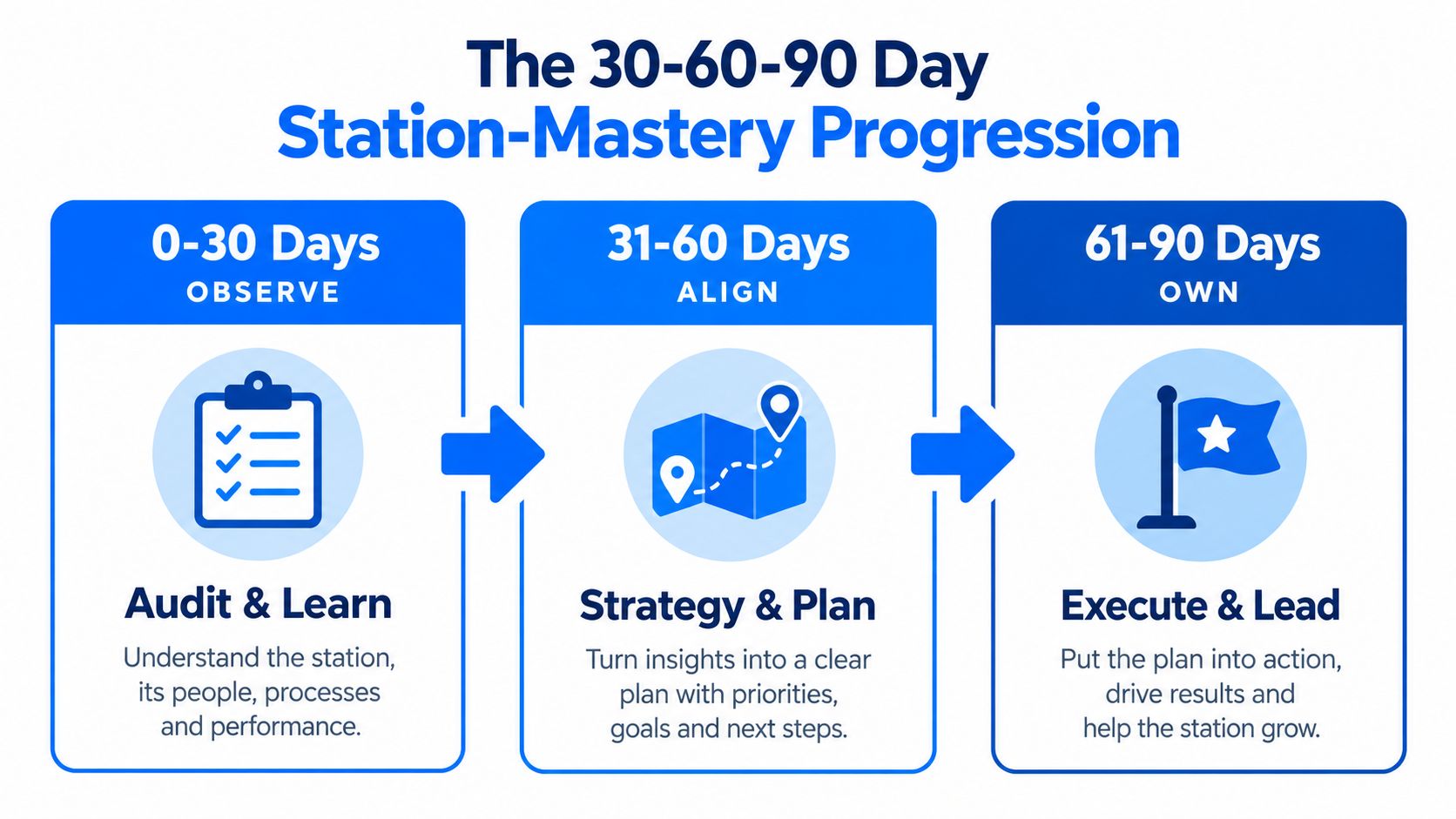
The sequence is observe, align, own:
- Observe: Shadow shifts, learn standard operating procedures, meet the crew, identify risks, and record how work is done in practice.
- Align: Choose priorities with the team, test contained improvements, and establish a dependable communication rhythm.
- Own: Run the shift, hold the standard, coach performance, handle first-line escalations, and report on a defined KPI.
A generic 30 60 90 day plan for managers may ask an office leader to review strategy documents, meet stakeholders, and present a roadmap. Those activities can support a frontline manager, but they do not demonstrate readiness. A warehouse supervisor, restaurant shift manager, production lead, or retail manager must prove competence while work is underway. The team must see that the manager can protect safety, make sound decisions under pressure, and support the operation at its real pace.
The three ownership thresholds
By day 30, the manager should complete core workflows with experienced support nearby. By day 60, they should execute those workflows independently at normal operating pace. By day 90, they should hold the standard without reminders and cover a second station or broader responsibility. This structure makes a new hire competency checklist useful because each requirement can be observed and signed off.
Practical rule: If a goal cannot be seen on shift, it is not a useful frontline goal.
Add one checkpoint that onboarding checklists often miss: a communication audit. Confirm that workers receive important updates, understand the instruction, know what action to take, and can explain where to raise an issue. A message posted in an app is not proof of communication. The proof is consistent action on the floor.
The framework gives HR and operations a defensible review process. Independent manager onboarding guidance recommends a process lasting at least 90 days, progressing from listening and documentation to alignment and improvement, then leadership and stabilization. A McKinsey finding cited in a structured onboarding research summary reports that leaders receiving structured onboarding are 2.5 times more likely to be high performers at the 12-month mark than leaders left to figure things out alone.
Write evidence into every milestone. Replace “learn the team” with “shadow three complete shifts, document five recurring workarounds, run the opening huddle with a senior lead present, and verify that each update was understood.” An onboarding and retention tool can organize milestones, but the manager must validate competence in person. Use Turn On Work’s workforce operations perspective to connect employee experience with daily execution.
Why Frontline Managers Need a Different 30-60-90 Plan
A new frontline manager makes decisions in public, often before they feel ready. The floor becomes the classroom, the team watches the response, and each choice can affect safety, quality, service, coverage, or trust. A corporate template fails when it treats learning as private preparation between meetings.
Frontline onboarding needs a station-mastery progression, not a generic learning timeline. The manager earns broader ownership only after demonstrating reliable judgment at each stage.
Four conditions shape the plan:
- The work is tacit: Experienced employees know shortcuts, sequence changes, exception paths, and informal escalation routes that policy documents rarely capture.
- Credibility is earned through behavior: Authority does not create trust. The new supervisor must understand the job, respect the team’s reality, and make sound decisions under pressure.
- Coverage leaves little slack: A shift worker cannot pause production or customer service for lengthy training. Learning must happen through shadowing, microlearning, huddles, and coached execution.
- The ramp window is compressed: A manager needs useful operating judgment quickly because early mistakes can affect retention and service quality.
Communication requires its own checkpoint. Speakap reports that 80% of deskless workers say they don’t receive adequate communication from employers (frontline communication research). SafetyCulture-reported research found that 40% of frontline workers said management messages made leaders seem out of touch, 42% said headquarters communications were often irrelevant, and more than 1 in 4 said there was no go-to channel for important updates (frontline communication findings). The manager must learn the workflow and test whether information reaches the people doing it.
| Dimension | Corporate 30-60-90 | Frontline 30-60-90 |
|---|---|---|
| Learning environment | Meetings, documents, and systems | Live shifts, stations, huddles, and handovers |
| Proof of readiness | Completed training and stakeholder meetings | Observed station mastery and supervisor sign-off |
| Credibility | Strategy quality and communication | Sound decisions, floor presence, and follow-through |
| Communication | Email, chat, and scheduled meetings | Mobile updates, visual boards, SMS, shared devices, and huddles |
| Main risk | Misalignment or slow delivery | Safety, quality, coverage, service, and trust failures |
| Manager transition | Learns before leading | Learns while leading with support |
| Plan design | Knowledge and output milestones | Ownership thresholds tied to real operating conditions |
The better model for a deskless workforce treats communication, tools, data, and operations as one system. A mobile-first huddle works only when workers can access the message, understand the instruction, know what action to take, and can explain where to raise an issue. A posted update is not proof of communication. Consistent action on the floor is.
That is why the plan should require shadow shifts, documented tacit knowledge, and a communication audit before the manager launches improvements. Each phase should end with observable ownership, not a completed slide deck.
Days 1 to 30 Listening Mapping and Documenting the Floor
The first 30 days should produce a reliable map of the operation, not a parade of premature changes. A strong first 30 days checklist for new employees starts with three complete shifts per function, a communication audit, a floor map, and a bottleneck inventory.
A four-week field plan
- Week 1, shadow: Follow the outgoing lead or strongest available operator through opening, peak activity, handover, close, and exception handling. Don’t take over just to appear decisive.
- Week 2, work side by side: Perform key tasks with employees from each relevant station. Ask what slows them down, what information arrives late, and which rule is hardest to apply.
- Week 3, take short leads: Run a huddle, coordinate a handover, and manage a contained period with a senior person nearby. Record where you hesitate.
- Week 4, operate with a check-in: Run the shift or assigned area independently while the senior lead observes at agreed points rather than hovering.
The floor map should fit on one page. Include the people and roles on each shift, station sequence, critical tools, safety and compliance points, bottlenecks, escalation paths, workarounds, and dependencies on other teams. Add one field called “what the procedure doesn’t explain.” That field usually reveals the knowledge a generic employee onboarding checklist misses.
Audit the information flow
Track how workers receive schedules, policy changes, safety updates, task assignments, and shift handovers. A structured frontline employee communication approach can help teams assess whether critical information actually reaches employees across shifts and locations. Check whether they use a phone, shared device, printed board, QR code, employee app, SMS, or manager relay. If the answer differs by shift, location, language, or employment status, record the difference instead of forcing one channel.
A mobile note-taking tool can capture observations, while voice-to-text can turn huddle notes into a searchable log. AI can cluster repeated themes or summarize handover entries, but the manager must verify the summary against the floor. Never allow an automated summary to decide whether a safety workaround is acceptable.
Run a Day-7 readiness pulse about access, role clarity, manager support, and friction. At Day 30, use a floor-knowledge quiz and count the undocumented workarounds surfaced. That count is a useful listening indicator, not a performance score. For a deeper approach to employee listening, use Turn On Work’s employee listening strategy for deskless teams.
Days 31 to 60: Aligning Priorities and Running Small Fixes
Days 31 to 60 are for influence, not wholesale redesign. The manager should turn the listening map into three priorities, then test one contained improvement in each priority area within two weeks.
Rank issues by customer impact, team impact, and operational risk. Choose pilots that are visible, reversible, and finishable within a shift cycle. A new supervisor earns credibility by completing a small fix and learning from the result, not by announcing a transformation program the team can’t absorb.
The small-fix sequence
- Define the gap: Describe the current behavior and the specific problem it creates.
- Write the new standard: Make the change short enough to teach at the station.
- Train the affected crew: Use demonstration, practice, and a knowledge check.
- Observe for three days: Watch whether the new method survives normal pressure and shift handover.
- Lock or revert: Keep the change if it works, revise it if it needs adjustment, or return to the prior method without blame.
Consider a retail back-of-house team that finds stock arriving without a consistent receiving handoff. The supervisor might pilot a single visual staging rule, a scan confirmation, and a short end-of-shift handover note. The manager should tell the adjacent shift, explain why the change matters, and check whether the new step creates a downstream delay before making it standard.
On a production line, the equivalent pilot might address a recurring pause during changeover. The manager can observe the sequence, identify one missing preparation step, create a station card, and test it with the crew. The point isn’t to claim a productivity gain without evidence. The point is to establish a controlled learning loop.
Use the daily huddle as the feedback mechanism. Ask what worked, what created friction, and what changed for the next shift. Share pilots with skip-level leaders and peer supervisors before they collide with staffing, quality, safety, or upstream processes. A practical change-management communication plan for frontline teams can help sequence the message, owner, channel, and follow-up.
Document the baseline, the intervention, who was trained, observations, worker feedback, and the decision to lock or revert. By Day 60, the manager should have a short list of improvements with clear ownership, not a folder full of untested ideas.
Days 61 to 90 Owning the Standard and Coaching the Team
Days 61 to 90 are the handoff from supported execution to accountable leadership. The manager should now run the daily huddle, sign off on standard work, handle first-line escalations, and become the named owner of one KPI.
The accountability trap appears when leaders assign results without transferring the operating mechanisms. Avoid it with a formal handoff:
| Ownership area | Supported phase | Day 90 expectation |
|---|---|---|
| Huddle | Senior lead models the rhythm | Manager sets the agenda and closes actions |
| Standard work | Manager follows documented steps | Manager validates and updates the standard |
| Escalations | Manager seeks frequent confirmation | Manager resolves first-line issues and escalates cleanly |
| Coaching | Manager observes with guidance | Manager delivers feedback and records follow-up |
| KPI | Manager learns the measure | Manager reports context, action, and next step |
Coach where the work happens
Use a weekly 15-minute one-to-one with each direct report where feasible, two ride-alongs or paired observations each week, and a written development note after every observation. Structure feedback around situation, behavior, impact, then ask the employee what would make the next attempt easier.
Corrective coaching with a tenured employee requires respect and precision. Describe the observed behavior, connect it to safety, quality, service, or team impact, and ask for the employee’s view before agreeing on the next standard. Where a union or works council applies, follow the relevant agreement and involve the representative appropriately. Don’t bypass peers to appear fast. Escalate through the established route with facts and a proposed next action.
Use visual management to make the baseline visible. A station card, updated board, translated instruction, or short mobile lesson can reinforce the same standard across shifts. The manager should still use judgment when a tool’s recommendation conflicts with worker knowledge, safety requirements, or a live operational constraint.
A Day 90 review with the manager’s boss should answer four questions:
- Which stations can you run and coach without support?
- Which standard did you stabilize, and what evidence supports that conclusion?
- Which KPI do you own, and what are its current risks?
- What is the next-quarter priority, including the people, tools, and decision rights required?
This is also where manager behavior affects engagement. Turn On Work’s guidance on manager behaviors and employee engagement offers useful context for connecting daily supervision with employee experience.
Building a Frontline Onboarding Checklist That Travels
A reusable frontline onboarding checklist needs five lanes, not one long task list: people, process, tools, metrics, and site-specific compliance. The checklist should travel across shifts and sites without erasing the ownership milestones that make the plan meaningful.
Assign work to the right owner
| Lane | Days 1-30 Owner | Days 31-60 Owner | Days 61-90 Owner |
|---|---|---|---|
| People | HR and buddy introduce the team, roles, and escalation paths | Manager builds feedback and coaching routines | Manager develops capability and handles recognition or correction |
| Process | Outgoing lead demonstrates workflows and exceptions | Manager tests small fixes and documents standards | Manager owns standard work and handovers |
| Tools | IT or operations verifies access to schedules, learning, and reporting | Manager confirms adoption and removes friction | Manager uses data to guide decisions without outsourcing judgment |
| Metrics | Senior lead explains measures and baseline context | Manager reviews trends and records pilot effects | Manager owns a KPI and reports action, risk, and result |
| Compliance | Site lead confirms safety, legal, and role-specific requirements | Manager observes adherence and closes gaps | Manager maintains readiness and escalates exceptions |
Mark every item as floor, virtual, or buddy sign-off. Safety demonstrations, station practice, and competency validation belong on the floor. Policy reading, system orientation, and some training modules can happen virtually. Informal questions, local norms, and social integration need a buddy who has credibility with the team.
Add a communication lane that includes peer check-ins, an open-door hour, and a skip-level pulse at Day 45. For distributed teams, create a shared onboarding channel, a mobile-friendly daily log, and asynchronous artifacts that preserve decisions across shifts. A manufacturing plant, retail store, and contact center can use the same structure while changing station names, compliance items, and KPI definitions.
Version the checklist by site and role. Keep the three ownership thresholds fixed, then maintain a local appendix for equipment, language, emergency procedures, and customer-specific requirements. Structured onboarding program tips can help teams sequence administrative and human activities without turning the process into a paperwork exercise.
Measuring Ramp-Up and Retention Risk at Day 7 30 and 90
Measure ramp-up at three checkpoints, each tied to a visible ownership threshold. Day 7 tests exposure and access. Day 30 tests station fluency and judgment. Day 90 tests whether the manager can sustain the standard, coach others, and protect the team’s experience.
| Checkpoint | Metric | Source | Target | Escalation trigger |
|---|---|---|---|---|
| Day 7 | Shifts walked, employees met, systems accessed | Manager log and readiness pulse | Broad exposure and working access | Access or relationship gaps remain unresolved |
| Day 30 | Workflow fluency, schedule accuracy, conflict handling | Observation, knowledge check, manager notes | Core workflows run with support nearby | Repeated errors or unclear escalation judgment |
| Day 90 | Standard adherence, KPI ownership, team retention risk | Audit, KPI report, stay interview | Manager sustains the operating cadence | Ownership still depends on reminders or senior intervention |
Use the scorecard with a frontline communication audit. Ask the manager to explain schedule logic, find the correct procedure, resolve a common conflict, and communicate a change across shifts. Then ask employees whether the manager is accessible, whether recognition is specific, and whether tools help or hinder the work. Record who received the message, which channel carried it, and where the handoff failed.
Retention risk often appears before a formal complaint. As noted earlier, early turnover can concentrate within a new hire’s first 90 days. Day 7, Day 30, and Day 90 conversations give HR and operations time to address confusion before it becomes a resignation or performance dispute.
Use stay-interview questions about schedule fairness, recognition, tool friction, and supervisor accessibility. Compare answers across shifts and repeat themes rather than treating one comment as a verdict. A missed check-in, unresolved access problem, or sudden drop in employee feedback should trigger structured coaching.
Escalate the cause, not just the symptom. If the issue is a missing tool, unclear authority, or weak listening habits, assign a specific correction, owner, and follow-up date. By Day 90, the manager should show evidence of independent station ownership and a communication routine the team can rely on.
FAQs on the Frontline Manager 30-60-90 Day Plan
How does a frontline plan differ from a corporate 30-60-90 template?
A frontline plan measures floor presence, station mastery, shift coverage, communication access, and judgment under operating pressure. It also accounts for labor agreements, works council involvement where applicable, safety, quality, and the informal knowledge held by experienced employees. A strategy deck can’t substitute for a manager who can run the workflow and coach the standard.
Should Day 1 start with direct reports or shadowing?
Use a split day. Let the new manager shadow the outgoing lead or experienced supervisor during the opening activity, then meet the team before lunch and explain how the first 30 days will work. The manager should listen before assigning changes, while still making expectations and availability clear.
What’s the biggest failure mode?
Premature authority without context. A new supervisor who changes schedules, rejects established workarounds, or corrects experienced employees before understanding the operation can create coverage errors and lose trust quickly. The remedy is visible observation followed by small, reversible decisions.
How should a hybrid manager split time across sites?
Use a 60/40 site allocation rule as a Turn On Work editorial model, not an industry benchmark. Spend the larger share of time at the site carrying the greatest onboarding risk, operational change, or team need, and keep the remaining share for the second site. Use a shared digital war room with handover notes, decisions, open risks, and named owners so remote support doesn’t become invisible support.
Which metric best predicts Day 90 success?
Voluntary turnover on the manager’s team is more consequential than an isolated engagement score. Pair it with standard adherence, access to manager support, and the quality of coaching records. A healthy score can hide a manager who is absent from the floor, while a retention signal prompts a more useful conversation about schedules, recognition, tools, and accessibility.
How tight should the first 90 days be?
Keep the milestones firm and the daily schedule flexible. Reserve one weekly half-hour of unscheduled floor time, because employees often raise the most useful operational information between planned activities. A strong 30 60 90 day onboarding plan creates structure without preventing the manager from noticing what the checklist can’t predict.
Start your next frontline manager’s plan before the first shift. Assign the buddy, confirm access, schedule the Day 7, Day 30, and Day 90 conversations, and define the station-level evidence required for ownership. Then give the manager protected time on the floor to observe, align, and earn the right to lead.